

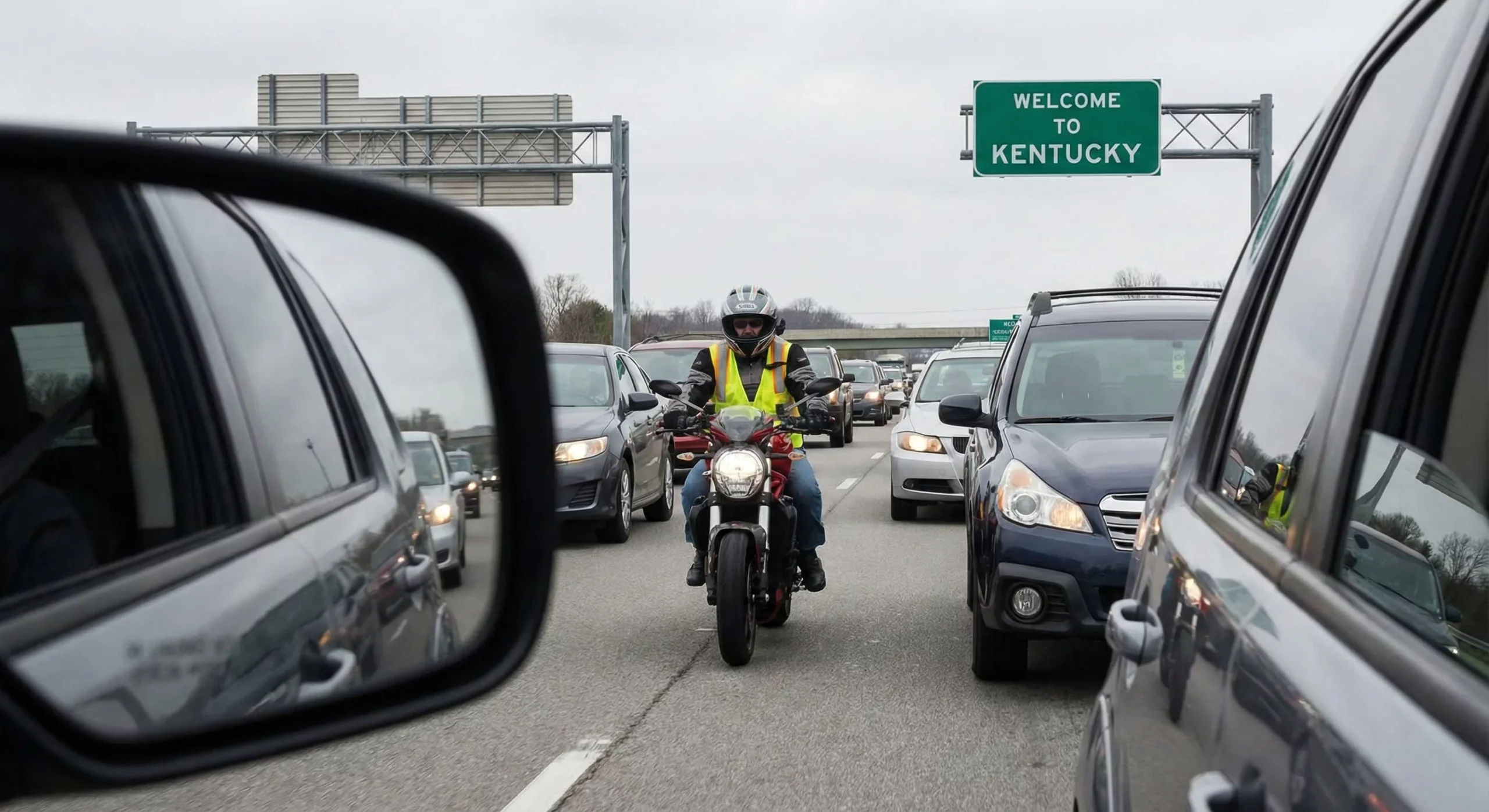
Is Lane Splitting Legal in Kentucky?
The short answer: lane splitting is not legally authorized in Kentucky. Motorcyclists who do it risk citations for unsafe operation — and if a crash follows, that citation can be used against you in your injury claim.
Lane splitting — riding a motorcycle between lanes of moving or stopped traffic — is not authorized under Kentucky law. While no single statute uses the words “lane splitting,” Kentucky’s traffic code requires motorcycles to be operated in a designated lane and prohibits unsafe lane changes. KRS 189.300 governs lane usage for all vehicles, and KRS 189.380 prohibits unsafe passing maneuvers. Kentucky State Police can and do cite motorcyclists for unsafe operation when lane splitting causes a hazard or crash.
What Kentucky Law Actually Says
Kentucky has no statute that explicitly says “lane splitting is illegal.” But that doesn’t make it a gray area in the practical sense. Here’s what the law does say:
- KRS 189.300 — Requires vehicles traveling in the same direction to use lanes consistently and prohibits unsafe lane changes without proper signaling and clearance.
- KRS 189.380 — Prohibits passing on the right in unsafe conditions or on surfaces not designed for traffic.
- KRS 189.515 — Governs motorcycle operation specifically, including lane usage and the prohibition on carrying passengers in a manner that leaves insufficient control of the vehicle.
When a motorcyclist rides between lanes of moving or stopped cars, any resulting crash or traffic violation will be evaluated under these statutes. Law enforcement officers have broad discretion to charge “unsafe operation” even where no specific lane-splitting statute exists.
The “Gray Area” Argument — Why It Doesn’t Protect You
Some riders argue that because Kentucky doesn’t explicitly ban lane splitting by name, it’s technically allowed. Here’s why that reasoning breaks down:
- Insurance companies and defense attorneys will use any citation — or the absence of a lawful basis for the maneuver — to argue you were at fault for a crash.
- Under KRS 411.182, Kentucky’s pure comparative fault rule, your compensation is reduced by your percentage of fault. Even partial fault for lane splitting could substantially reduce what you recover.
- “Not explicitly prohibited” is not the same as “authorized.” Without a statute that affirmatively permits the maneuver, riders have no legal protection if a crash results.
Lane Splitting vs. Lane Filtering vs. Lane Sharing
These three terms get used interchangeably but describe different maneuvers — and they have different risk profiles:
Lane Splitting
Riding a motorcycle between two lanes of moving traffic. The most dangerous form — cars are not expecting traffic to pass between them, and closing speeds at even moderate highway speeds are significant. Not authorized in Kentucky.
Lane Filtering
Moving between stopped or very slow traffic — typically at a red light or in gridlock. This is what some states have legalized in limited form. Still not authorized in Kentucky under current law.
Lane Sharing (Two Motorcycles, One Lane)
Kentucky law does allow two motorcycles to share a single lane — they are permitted to ride side-by-side. KRS 189.515(4) addresses motorcycle lane operation. This is different from lane splitting or filtering. The staggered formation is safer and is the common practice.
Shoulder Surfing
Riding on the road shoulder to bypass traffic. This is prohibited under Kentucky law regardless of traffic conditions.
How Neighboring States Handle Lane Splitting
| State | Lane Splitting Status | Notes |
|---|---|---|
| Kentucky | Not Authorized | No explicit statute; unsafe operation citations apply |
| California | Legal | Fully legalized; CHP guidelines limit speed differential |
| Ohio | Illegal | Explicitly prohibited by statute |
| Indiana | Illegal | Prohibited under traffic code |
| Tennessee | Illegal | Prohibited under traffic code |
| West Virginia | Illegal | Prohibited under traffic code |
| Missouri | Not Explicitly Prohibited | Similar gray-area status to Kentucky |
If You Were Hurt in a Kentucky Motorcycle Crash
Whether or not lane splitting was involved, motorcycle accident claims in Kentucky carry unique challenges. Riders are frequently blamed by insurance companies regardless of the actual facts — it’s one of the most consistent tactics used to undervalue motorcycle injury claims.
If a car driver cut across your lane, failed to yield, or turned in front of you, their fault doesn’t disappear because you were on a motorcycle. Under KRS 411.182, you can recover damages even if you are partially at fault — your compensation is simply reduced by your percentage of responsibility. The key is making sure that percentage is accurately assessed, not inflated by an insurer looking to minimize the payout.
After any motorcycle crash: Get medical attention immediately — even if you feel okay. Document the scene, get the other driver’s insurance information, and do not give a recorded statement to any insurance company before talking to an attorney. What you say in those first conversations can and will be used to reduce your claim.
The Comparative Fault Problem for Motorcycle Riders
Insurance adjusters in motorcycle cases almost always open with the assumption that the rider bears some fault. They’ll look for any basis — lane position, speed, conspicuity, protective gear — to assign a percentage. If lane splitting or an unauthorized maneuver is in the picture, that percentage goes up fast.
Our team has handled severe motorcycle accident cases where the initial fault attribution was dramatically inaccurate. Traffic camera footage, crash reconstruction, and witness accounts routinely show that riders were hit by inattentive or reckless drivers — not the other way around. Strong evidence keeps the fault percentages where they belong.
Frequently Asked Questions
Is lane splitting legal in Kentucky?
No. Lane splitting is not authorized under Kentucky law. While no single statute uses those exact words, Kentucky’s traffic code requires vehicles to stay within their designated lanes and prohibits unsafe passing maneuvers. Officers can cite motorcyclists for unsafe operation. There is no statute that affirmatively permits the practice.
What is the difference between lane splitting and lane filtering?
Lane splitting typically refers to passing between lanes of moving traffic at speed. Lane filtering refers to moving between stopped or very slow traffic, usually at a red light. Both are unauthorized in Kentucky. Lane sharing — two motorcycles side-by-side in a single lane — is permitted under KRS 189.515.
If I was lane splitting when I got hurt, can I still recover damages?
Potentially, yes — but the lane-splitting conduct will be used to assign a percentage of fault to you under Kentucky’s pure comparative fault rule (KRS 411.182). Your compensation is reduced by your fault percentage. If the other driver clearly caused the crash (running a red light, turning without looking, etc.), their majority of fault still stands. The degree of reduction depends on the specific facts.
What should I do right after a Kentucky motorcycle accident?
Call 911 and get medical care — adrenaline masks injury symptoms. Document the scene with photos before vehicles are moved. Get the other driver’s name, license, and insurance information. Identify any witnesses. Do not give a recorded statement to any insurer before speaking with an attorney. Your statement can be used to inflate your fault percentage.
How long do I have to file a motorcycle accident claim in Kentucky?
Under Kentucky’s statute of limitations, you generally have two years from the date of the crash to file a personal injury claim. Wrongful death claims must be filed within one year. Missing these deadlines permanently ends your ability to recover, regardless of the circumstances.
Tell Us What Happened
Fill out the form below and our team will reach out to discuss your motorcycle accident case.