

Federal Truck Safety Rules Used as Crash Evidence

The Federal Motor Carrier Safety Regulations, published at 49 CFR Parts 380 through 399 and enforced by the Federal Motor Carrier Safety Administration, control who can drive a commercial truck, how long a driver can stay behind the wheel, and how every truck must be inspected and maintained. According to NHTSA 2023 data, large-truck crashes caused thousands of deaths and well over a hundred thousand injuries that year nationwide. In Kentucky, a carrier’s violation of these rules can support a finding of negligence per se, meaning the violation itself becomes evidence of fault in an injury case.
Large Truck Crashes by the Numbers
Large trucks make up a small share of vehicles on the road and account for a disproportionate share of traffic fatalities, according to NHTSA 2023 data. That toll is one reason the federal government created the Federal Motor Carrier Safety Administration and the detailed rules carriers must follow. When an 80,000-pound tractor-trailer collides with a 4,000-pound passenger car, the passenger car’s occupants absorb almost all of the resulting force.
Hours of Service Rules Under 49 CFR Part 395
49 CFR Part 395 sets the maximum hours a commercial driver can work before resting. These rules exist because fatigue is a documented contributing factor in large-truck crashes, and the FMCSA notes that drowsy driving impairs reaction time and judgment in ways that parallel alcohol impairment.
Core Hours-of-Service Limits for Property-Carrying Drivers
- A driver may not drive more than 11 hours after 10 consecutive hours off duty.
- A driver may not drive beyond the 14th consecutive hour after coming on duty, even without having driven the full 11 hours.
- A driver cannot drive after being on duty 60 hours in 7 consecutive days, or 70 hours in 8 consecutive days.
- After 8 cumulative hours of driving, a driver must take a 30-minute break.
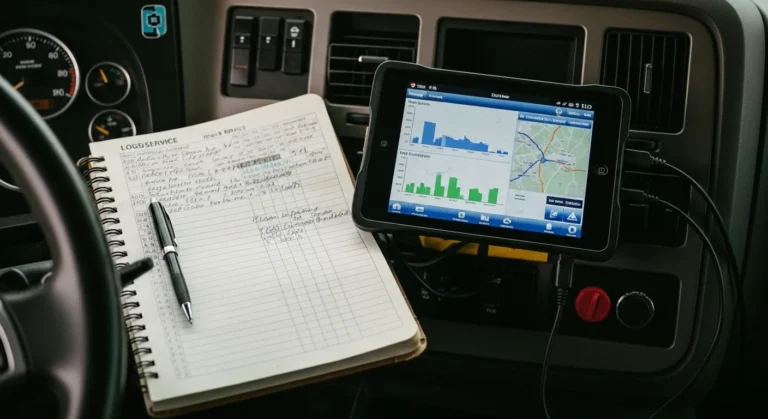
A violation of these limits creates direct evidence of driver fatigue. If a driver was behind the wheel well beyond a permitted window, the electronic logging record documents that violation, and the record can become a central piece of evidence in a case. Under 49 CFR Part 395, Subpart B, most commercial drivers are required to use an electronic logging device wired to the truck’s engine control module, which automatically records engine power, vehicle motion, and driver activity status in a way that is difficult to alter after the fact.
Driver Qualifications Under 49 CFR Part 391
49 CFR Part 391 sets minimum qualifications for commercial drivers. A carrier has a legal duty to verify these qualifications before putting a driver on the road and to keep records showing that it did.
Driver Road-Test and Equipment Qualification Explorer
Choose the equipment and the claimed basis to see the operations and the documents to review.

Operations and Routes
The grouped operations follow 49 CFR § 391.31(c). Coupling and uncoupling apply when combination equipment is included.
Pre-trip inspection
The referenced pre-trip inspection.
Coupling and uncoupling
Included only when combination equipment is part of the intended operation.
Placing the vehicle in operation
Starting the combination or straight vehicle the carrier intends to assign.
Controls and emergency equipment
Using the vehicle’s controls and emergency equipment.
Traffic and passing
Operating in traffic and passing.
Turning
Turning the vehicle.
Braking and slowing
Braking, and slowing by means other than the brakes.
Backing and parking
Both backing and parking.
A certificate older than three years does not satisfy the three-year certificate branch. Holding a tank endorsement does not invalidate the CDL. A missing road-test document is not a finding the driver was unable to operate the truck.
- A valid commercial driver’s license for the vehicle class being operated
- A minimum age requirement for interstate commerce
- Annual review of each driver’s motor vehicle record
- Pre-employment drug and alcohol testing under 49 CFR Part 382
- Current medical certification, including a periodic DOT physical exam
- Review of the driver’s employment history, including any prior crashes or violations
When a carrier skips these steps, or knowingly puts a driver with a troubling record back on the road, that conduct can support a case of negligent hiring or negligent retention, two of the more significant cases available in a truck crash case.
Vehicle Inspection and Maintenance Under 49 CFR Part 396
49 CFR Part 396 requires carriers to systematically inspect, repair, and maintain every commercial vehicle they operate. A tire failure at highway speed or a brake failure is often the end result of an unaddressed warning sign.
Daily DVIR vs. Annual Inspection Comparator
Pick a dimension to compare the two records, then walk the repair chain. The 12-month inspection interval and the 14-month report retention stay separate.

Comparison
Purpose
Purpose · Driver report: Identify applicable discovered or reported defects and document corrective action. 49 CFR § 396.11.
Purpose · Periodic inspection: Inspect the required components under the periodic inspection standard. 49 CFR § 396.17.
Purpose · Ongoing maintenance: Keep systematic inspection, repair, and maintenance in place for the carrier’s vehicles. 49 CFR § 396.3.
Timing
Timing · Driver report: Reporting relates to completion of the day’s work, with the cited no-defect exception and the rule’s other exceptions. 49 CFR § 396.11.
Timing · Periodic inspection: Covered components must have passed an inspection within the preceding 12 months, subject to the rule’s terms. 49 CFR § 396.17. This interval is separate from how long the report is retained.
Timing · Ongoing maintenance: Ongoing. It is not the daily report and it is not the periodic inspection interval.
Documents
Documents · Driver report: Driver report, the repair certification when a defect is in play, and the next-driver review when that review applies. 49 CFR § 396.11 and § 396.13.
Documents · Periodic inspection: Inspection report and the on-vehicle documentation. 49 CFR § 396.17 and § 396.21.
Documents · Ongoing maintenance: The carrier’s maintenance records for the systematic program. They are not the driver report and not the periodic inspection report.
Retention
Retention · Driver report: Three months from preparation for the motor-carrier report and certifications. 49 CFR § 396.11(a)(4).
Retention · Periodic inspection: Fourteen months from the inspection report date. 49 CFR § 396.21(b). This retention period is separate from the inspection interval.
Retention · Ongoing maintenance: Maintenance-record retention follows its own rule. It is not copied from the driver report or from the periodic inspection report.
Interpretation
Interpretation · Driver report: The report may document notice, correction, and review. Existence or absence still needs context. A property-carrier no-defect example is not a missing mandatory daily report.
Interpretation · Periodic inspection: The report documents a periodic inspection. It does not describe every later operating condition, and it is not a continuing safety guarantee.
Interpretation · Ongoing maintenance: Ongoing maintenance is a third obligation. A current periodic report does not stand in for it.
A defect report leads to repair or to a certification that repair is unnecessary, then to applicable next-driver review. Review is conditional. The chain does not say three different people must sign. A property-carrier no-defect example is not a missing mandatory daily report.
Under 49 CFR Section 396.11, drivers must complete an inspection report at the end of every duty period. If a driver notes a defect, the carrier generally cannot dispatch that truck again until the carrier certifies that the defect was repaired or that repair is unnecessary. When an inspection report shows a defect flagged before a crash, and the truck went back on the road without repair, that record can be significant evidence of negligence.
Part 396 also requires an annual inspection by a qualified inspector, along with a maintenance file documenting repairs, tire replacements, and brake work for every truck in the fleet. A pattern of recurring defects or missed scheduled maintenance can reflect a fleet-wide maintenance culture.
Safe Driving Rules Under 49 CFR Part 392
49 CFR Part 392 governs how drivers must operate their vehicles in real-world conditions. It provides that an ill or fatigued driver must not operate a commercial vehicle, that drivers must reduce speed or stop in hazardous conditions, and that texting or hand-held phone use while driving is prohibited. A driver shown to have been texting immediately before a crash has violated a federal rule written specifically to prevent that outcome, which can be significant evidence in a case.
Carrier Telematics and Safety Data
Modern trucking fleets record their own safety data. Telematics systems, GPS tracking, and in-cab cameras record speed, location, harsh braking, and driver behavior in real time, while engine control modules log fault codes for issues such as brake wear or tire pressure problems, sometimes weeks before a component fails. When this data shows a driver had repeated speeding alerts, or that a fault code was logged and ignored for an extended period before a crash, it can support a stronger negligence case, and in cases of flagrant indifference, a case for punitive damages under KRS 411.186.
Respondeat Superior and Direct Negligence
Truck crash cases involve two types of carrier liability.
- Under respondeat superior, the carrier is generally responsible for a driver’s negligent acts performed in the course of employment.
- Under direct negligence, the carrier can be independently liable for its own failures, including negligent hiring, training, supervision, or maintenance. Federal regulation violations often become central to this case.
Regulation Violations as Evidence
In a Kentucky truck injury case, a federal regulation violation establishes that the carrier breached a duty imposed by federal law to protect people on the road. Electronic logs, inspection reports, and telematics data follow automatic deletion cycles, so preservation requests need to reach the carrier promptly. The carrier’s public FMCSA safety record, including its safety rating and inspection history, shows how the company has operated, and each applicable regulation can be mapped to the specific facts of the crash to build the liability picture.
Truck crash injuries are often severe, including traumatic brain injuries, spinal cord damage, and crush injuries. Medical professionals and economic analysts document current medical bills, long-term care costs, and lost earning capacity.
Delivery Carriers Follow the Same Federal Rules
Federal safety rules reach well beyond long-haul tractor-trailers. Delivery vans and box trucks operating under a delivery service partner model are often subject to FMCSA regulations when they meet the applicable weight and commercial-purpose thresholds. Amazon delivery vehicle accidents raise their own liability questions, including whether the contracted carrier or the platform company bears responsibility, and the underlying safety-rule framework is the same.
Choosing a Team for a Truck Injury Case
Many personal injury firms rarely handle truck cases. The federal regulatory framework, the volume of evidence involved, and the size of the companies typically named as defendants call for a team that handles this work consistently. The dedicated truck accident team at Sam Aguiar Injury Lawyers handles these cases from investigation through resolution, and the firm’s page on finding the right truck accident representation outlines the questions worth asking any firm before hiring it.
Did a Safety Violation Cause Your Truck Crash?
Hours-of-service logs, driver qualification files, and inspection reports often show a trucking company cutting corners long before a crash happens. Sam Aguiar Injury Lawyers requests those records, compares them against the federal rules, and uses each violation as evidence of negligence. The fee never goes up if your case goes to trial, and the Bigger Share Guarantee® means you walk away with more than the firm after bills, liens and case costs. Set up a free case review to get those records requested.
Frequently Asked Questions
1What are the Federal Motor Carrier Safety Regulations?+
2What does negligence per se mean in a Kentucky truck crash case?+
3What do the hours-of-service rules require?+
4What is an electronic logging device, and what does it record?+
5What must a carrier verify before putting a driver on the road?+
6How do vehicle inspection records support an injury case?+
7What is the difference between respondeat superior and direct negligence in a truck case?+
8Do delivery vans and box trucks follow the same federal rules as large trucks?+
Latest Articles

Kentucky Diminished Value Claims
Kentucky drivers may pursue a repaired vehicle’s leftover market loss from the at-fault driver as part of a.
FMCSA Revoked ELDs: Fleet Compliance and Enforcement Deadlines
FMCSA removed five electronic logging devices from the registered list on August 6, 2026, and set an October.

FMCSA English Proficiency Rule and OOS Enforcement
FMCSA English Proficiency Rule Sam Aguiar Injury Lawyers August 11, 2026 7 minute read On This Page.