

Important Documents in a Car Accident Case

Under KRS 189.635, a driver in a Kentucky crash that causes injury, or damage that leaves a vehicle inoperable, must immediately notify a law enforcement officer, and the officer’s written report becomes the official record of the crash. An official report alone does not build a strong injury claim. The documents preserved at the scene, in the days after, and throughout treatment create the evidence that separates a well-documented case from one an insurance adjuster can minimize.
Scene and Crash Documentation
Scene records are gathered as soon as it is safe, ideally before the vehicles are moved:
- The police report number and the responding officer’s name. The report comes from the Kentucky State Police or the local law enforcement agency and records the basic facts, any citations, and the officer’s observations.
- Information for every driver and vehicle: full legal name, current address, driver’s license number, license plate, vehicle make, model, and year, VIN, insurance company, and policy number.
- Photos of all vehicle damage from every angle, taken before the vehicles are moved or towed, including undercarriage damage, airbag deployment, and interior impact damage.
- Photos of the crash scene: road conditions, skid marks, traffic signs, signal conditions, weather, the debris field, and where the vehicles came to rest.
- Photos of visible injuries such as bruising, cuts, swelling, and scrapes, taken right away and again over the following days as injuries develop.
- Names, phone numbers, and addresses of witnesses, who scatter quickly.
- The locations of traffic cameras, business cameras, and ATM cameras that may have captured the crash, since footage can be overwritten quickly.
Police Crash Reports
The notice duty in KRS 189.635(3) falls first on the driver, and when the driver cannot make the call, it shifts to the vehicle’s owner or an occupant. The officer with jurisdiction investigates and files a written report, and the law enforcement agency files its report with the Kentucky State Police within 10 days after the investigation. The firm’s article on police reports after an accident explains how to read one.
Medical Records and Bills
Medical records are the backbone of injury damages, so every provider, treatment, and prescription belongs in the file:
- Emergency room records and discharge paperwork, including all imaging such as X-rays, MRI, and CT scans, diagnoses, and discharge instructions.
- Follow-up treatment records from orthopedics, neurology, pain management, physical therapy, chiropractic care, and every other provider treating the crash injuries.
- Itemized bills from each provider, with the original billing statement and every explanation of benefits from the health insurer.
- Prescription receipts and pharmacy records for every medication taken for crash-related conditions, including over-the-counter pain and anti-inflammatory medication.
- Specialist referrals, surgical consultations, and recommendations for ongoing care that may become part of future damages.
Gaps in treatment are the most common argument insurance adjusters use to claim injuries were not serious or were not caused by the crash. Many serious crash injuries, including soft tissue damage, concussions, and spinal injuries, do not produce obvious symptoms right away, so prompt medical evaluation protects the record even when the person feels fine on the day of the crash.
Financial and Employment Records
Financial records document the economic losses beyond medical bills:
- Pay stubs and employer wage verification for time missed from work, or tax returns and client records for a self-employed person.
- Doctor’s notes placing the person on light duty, partial restrictions, or full leave.
- Employment records showing missed promotions or projects, which support a loss of earning capacity claim in serious injury cases.
- At least two independent vehicle repair estimates. An insurer that steers the owner to a specific shop does not remove the right to an independent estimate.
- A professional diminished value appraisal for a newer or higher-value vehicle, which captures the drop in resale value after repair, a separate damage element many people overlook.
- Rental car receipts and other transportation costs while the vehicle is repaired or replaced.
Insurance Communication Records
A paper trail of every insurance contact keeps an insurer from later changing what was said:
- The injured person’s own policy declarations page, showing personal injury protection limits, liability limits, uninsured and underinsured motorist limits, and medical payments coverage.
- All written communications with any insurer, including letters, emails, and claim correspondence, with written follow-up after every phone call.
- Claim numbers and adjuster names for every claim opened: the personal injury protection claim, the property damage claim, and the at-fault driver’s liability claim.
- A communications log recording the date, time, contact, and substance of each conversation.
Pain Journal for Non-Economic Damages
Pain and suffering, loss of enjoyment of life, and emotional distress are recoverable, and they are hard to establish without a record made at the time. A daily pain journal records pain levels, activities that were not possible, and how the injuries affected routine, sleep, relationships, and mood. Dated, consistent entries in the injured person’s own words are strong evidence of non-economic damages at mediation or trial.
Social Media and Medical Exam Precautions
Posts made after a crash can be used against the injured person. Insurance companies and defense attorneys monitor claimants’ social media, and a photo from a birthday party or a post about a hike, however innocent, can be used to challenge the severity of the injuries. The page on social media surveillance explains how that evidence is used, and the safest approach is to post nothing about the crash, the injuries, or physical activities while the claim is pending.
An insurer may also request an independent medical examination. The exam is conducted at the insurer’s direction, and the person examined has rights in that process.
Ready to Take Action on Your Injury Claim?
After a serious injury, medical bills pile up while the insurance company looks for ways to pay you less. Most law firms take their cut first and leave you with whatever is left. Sam Aguiar Injury Lawyers does things differently. With our exclusive Bigger Share Guarantee®, you always get more. Every client gets a dedicated three-person team: an attorney, a case manager, and a legal assistant. We never raise our fee rate if we have to go to court, and you pay $0 Out-Of-Pocket Forever.
Frequently Asked Questions
1What is the most important document after a car accident?+
2What if the other driver had no insurance information at the scene?+
3Are medical records needed when injuries seem minor?+
4Should a recorded statement be given to the insurance company?+
5How is a police report obtained after a crash in Kentucky?+
Latest Articles
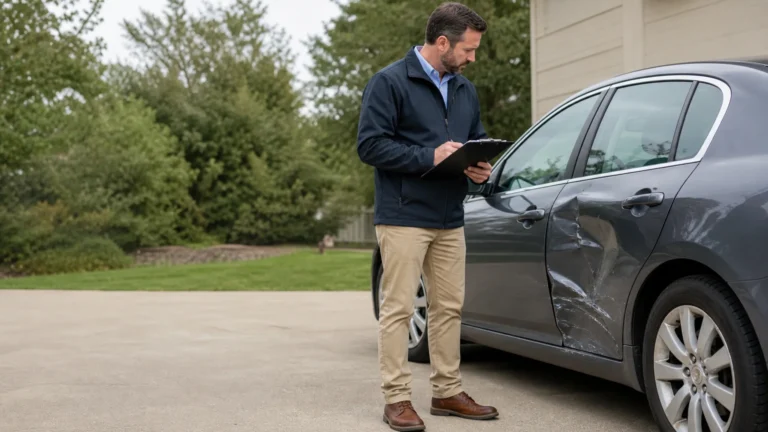
Kentucky Diminished Value Claims
Kentucky drivers may pursue a repaired vehicle’s leftover market loss from the at-fault driver as part of a.
FMCSA Revoked ELDs: Fleet Compliance and Enforcement Deadlines
FMCSA removed five electronic logging devices from the registered list on August 6, 2026, and set an October.

FMCSA English Proficiency Rule and OOS Enforcement
FMCSA English Proficiency Rule Sam Aguiar Injury Lawyers August 11, 2026 7 minute read On This Page.