

Amazon’s Delivery Network: Meteoric Growth, Rising Crashes
Amazon now delivers 6.3 billion packages a year and holds 28% of the U.S. parcel market, but the speed of that expansion has left a trail of crashes, unreported injuries, and crash victims.
Amazon has built the largest private delivery network in the United States in under a decade. It did it by creating thousands of small contractor businesses called Delivery Service Partners (DSPs), pressuring drivers to complete 250–400 stops per shift, and deploying an app that flags a driver if they fall even seconds behind schedule. The result: more vehicles on the road, more pressure on those drivers, and a measurable rise in Amazon-linked crashes. If you were hit by an Amazon delivery vehicle in Kentucky, marked or unmarked, Sam Aguiar Injury Lawyers handles these cases and knows how to identify every responsible party.
How Big Is Amazon’s Delivery Network?
The numbers are staggering. According to logistics data compiled by Capital One Shopping, Amazon processed 6.3 billion U.S. deliveries in 2024, a 6.78% increase year-over-year, and now holds 28.2% of the entire U.S. parcel market. That puts Amazon second only to the U.S. Postal Service. But unlike USPS, Amazon’s volume is accelerating: from 2019 to 2024, its package volumes grew at a compound annual rate of 25.8%.
On a given day in 2024, Amazon was processing over 17.2 million delivery orders, more than 199 packages every single second. The company has invested $4 billion to expand its rural delivery network, planning to triple its rural footprint to over 200 delivery stations by the end of 2026. In 2024, nine billion U.S. Amazon deliveries arrived in one day or less, up 28.6% year-over-year.
(Capital One Shopping / Pitney Bowes data)
(Capital One Shopping, 2024)
(Capital One Shopping, 2024)
(FMCSA Crash Causal Factors Program)
To keep pace with that growth, the FMCSA’s Crash Causal Factors Program noted that fatal crashes involving large trucks and buses increased 26.4% from 2016 to 2022, a period that directly tracks Amazon’s explosive network expansion. The agency has launched a new in-depth study specifically to understand what’s driving that trend. The timing is not a coincidence.
The DSP Model: Built for Volume, Not Safety
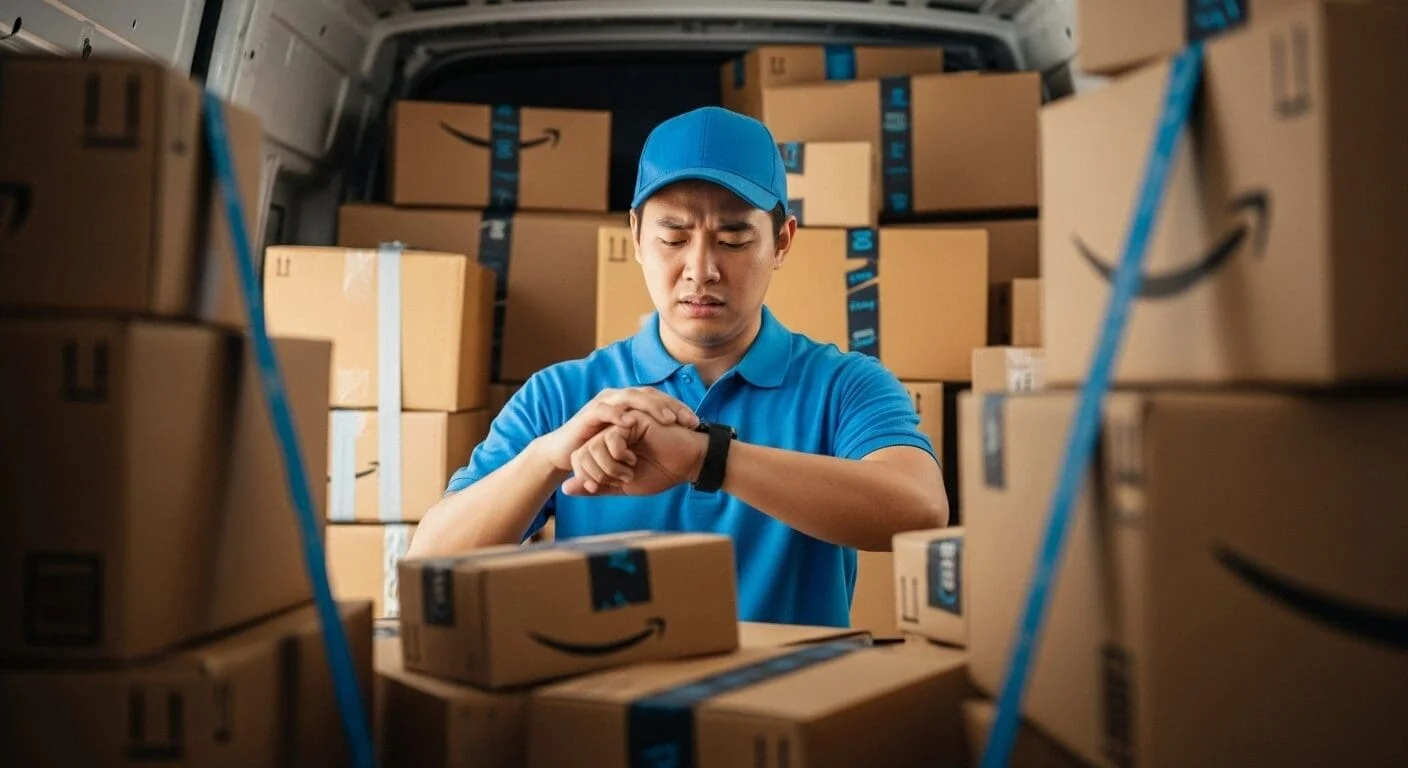
Amazon doesn’t employ most of its delivery drivers. Instead, it operates through a network of more than 4,400 Delivery Service Partners, small businesses that hire drivers, lease Amazon-branded vans, and handle all last-mile deliveries. According to Capital One Shopping’s logistics research, over 390,000 drivers work through these DSPs, making 180 stops and delivering 250–300 packages per shift. To stay on schedule, that works out to one stop every two minutes and 15 seconds.
That pace is not sustainable for safe driving. A typical DSP driver must park, exit the vehicle, locate the package, walk to the door, confirm delivery, return to the van, and move to the next stop, all in under 135 seconds, including drive time between addresses. During Prime Day and peak holiday periods, internal reports indicate drivers are expected to complete a delivery every 36 seconds.
The DSP Contractor Shell Game
When a crash happens, Amazon’s standard response is: “That driver doesn’t work for us.” Here’s how the structure actually works:
- Amazon contracts with DSPs through one-year renewable agreements
- DSPs hire the drivers, carry the insurance, and absorb liability
- But Amazon controls the routes, quotas, performance scores, and app-based monitoring
- DSPs that don’t meet Amazon’s metrics lose their contracts, so safety corners get cut
- Crash victims are often left chasing a small DSP with minimal assets
Courts have increasingly found that Amazon’s operational control over DSP drivers can make Amazon a liable party. Evidence of that control, routes, quotas, app data, disciplinary records, is what builds these cases.
Unmarked Vehicles and Unidentifiable Drivers
The DSP model isn’t Amazon’s only delivery channel. The company also runs Amazon Flex, a gig-economy program in which approximately 85,000 active drivers use their own personal, unmarked vehicles to make deliveries. These are ordinary cars and SUVs with no Amazon branding, no uniforms, and no way for the public to identify them as commercial delivery vehicles.
Attorney Jon Hollan, who handles commercial vehicle cases at Sam Aguiar Injury Lawyers, spoke to WKYT about the problem: “Have you ever been at your home, maybe at nighttime or early morning, and there is just an unmarked car with a person not in a uniform that parks and approaches your door quickly? That’s an example. It’s not just an Amazon tractor-trailer or someone in an Amazon uniform anymore.”
That anonymity creates real safety risks. When an unmarked Flex driver causes a crash, victims often don’t realize they were hit by an Amazon delivery vehicle. The claims process is more complicated. Insurance gaps exist when Flex drivers are traveling to pickup locations or on break, situations Amazon’s contingent commercial insurance doesn’t always cover. And because there’s no visible branding, witness accounts can’t confirm the vehicle’s purpose without a deeper investigation.
Amazon’s Three Delivery Models, All With Crash Exposure
- DSP Drivers, Amazon-branded vans operated by 390,000+ drivers working for 4,400+ contracted DSPs. These drivers follow Amazon routes and quotas but are employed by the DSP, not Amazon directly.
- Amazon Flex Drivers, Roughly 85,000 gig workers using personal, unmarked vehicles. Background checks are required but training is minimal, primarily app-based videos.
- Amazon Relay (Semi-Trucks), Long-haul contractors operating commercial vehicles over 10,000 pounds, subject to FMCSA oversight but often operating under the same quota pressures as last-mile drivers.
All three models create potential liability, and in all three, Amazon’s structural distance from the driver is the first line of defense when a crash occurs. Our Amazon delivery vehicle accident team knows how to pierce through that structure.
Driver Pressure: The Safety Crisis Behind the Quotas
The injury numbers tell a clear story. A study by the Strategic Organizing Center (SOC), based on data Amazon and its DSPs reported to OSHA, found that Amazon DSP drivers experience injury rates of 18.3 per 100 workers, compared to 7.3 per 100 across the broader delivery industry. That’s more than double the industry average.
Nearly 20% of Amazon delivery drivers sustained injuries in 2021, marking a 40% increase from 2020. One in seven Amazon drivers that year suffered injuries severe enough to require time off or restricted duties. Amazon’s own last-mile delivery stations, the final stop before packages reach customers, were identified as the most dangerous type of Amazon facility, with injury rates exceeding those of fulfillment warehouses by more than 40%.
(Strategic Organizing Center / OSHA data)
(Strategic Organizing Center)
(Federal carrier safety data, 2019–2024)
(FMCSA Large Truck and Bus Crash Facts 2022)
These injuries aren’t random. They’re the predictable result of a delivery model that prioritizes speed above all else. Amazon’s app-based monitoring system, called Mentor, tracks acceleration, braking, cornering, and phone use in real time. Drivers can be flagged for a score drop caused by another car cutting them off. Some DSP operators have reportedly instructed drivers to disable the monitoring app after initial hours so they can drive faster without triggering penalties, then race to hit Amazon’s quotas anyway.
The routing algorithm compounds the problem. Amazon’s dispatch system optimizes for speed, not safety. Drivers report being sent through active construction zones, routed to U-turns on roads where U-turns are prohibited, and directed through heavy traffic without accounting for real conditions. Drivers cannot alter their assigned route, Amazon prohibits deviation even when safety concerns arise. That level of operational control is exactly the evidence our commercial vehicle accident team uses to hold Amazon accountable.
Who Is Liable When an Amazon Driver Causes a Crash?
Amazon’s contractor structure is designed to keep Amazon at arm’s length from liability. When crashes happen, Amazon points to the DSP. The DSP points to its insurance. The insurance company delays. Meanwhile, crash victims are stuck in the middle, often unaware that Amazon’s operational control over the driver’s route, quota, and conduct may make Amazon itself a party to the claim.
In Kentucky, multiple legal theories can reach Amazon directly. These include:
-
Negligent hiring or supervision
Amazon has been cited in lawsuits for approving drivers with serious prior violations. In one documented case, a driver with 70 speeding violations while working a DSP route, each reported to Amazon, was never removed. Amazon’s decision to maintain that DSP’s contract despite known safety failures creates direct exposure.
-
Retained control / vicarious liability
Courts increasingly look past the independent contractor label when a company controls the details of the work. Amazon controls routes, pace, uniforms, vehicle monitoring, delivery confirmation requirements, and performance scoring. That degree of control can establish an employer-employee relationship for liability purposes.
-
DSP direct liability
The DSP employs the driver, maintains the vehicle, and makes training decisions. If the DSP pressured the driver to speed, overlooked a driver’s bad record, or failed to maintain the van, the DSP carries direct liability for the crash.
-
Negligent entrustment
If the DSP or Amazon allowed a driver to operate a vehicle knowing, or with reason to know, the driver was unqualified, impaired, or had a dangerous history, that creates a separate ground for liability beyond the crash itself.
Evidence disappears fast in Amazon crash cases. GPS route data, Netradyne dashcam footage, driver performance scores, DSP contract records, and Amazon’s internal routing data all need to be preserved immediately. Once a DSP’s contract with Amazon lapses or the company folds, which happens, that evidence can be gone. The sooner you act, the stronger the case.
What to Do After a Crash With an Amazon Delivery Vehicle
The steps after an Amazon crash are the same as any serious collision, but the evidence you need is different, and the clock runs faster. Here’s what matters most:
- Photograph everything at the scene, the vehicle, any Amazon branding or lack of it, license plates, driver’s appearance, and any packages visible in the vehicle
- Get the driver’s full name and ask directly whether they are making deliveries for Amazon or a DSP
- Call 911 and get a police report, even in crashes that seem minor. Amazon crashes are often underreported
- Seek medical attention immediately, soft tissue injuries, concussions, and internal injuries often don’t show symptoms for hours
- Do not talk to Amazon’s insurance or sign any release before getting legal advice, Amazon’s adjusters are trained to close these claims quickly and cheaply
- Contact our team, we send preservation letters immediately to Amazon, the DSP, and their insurers to lock down GPS, camera, and quota data before it disappears
Learn more about the broader pattern in our related pages: the rise in Amazon delivery accidents and how Amazon’s growth drove the crash increase. For general car accident claims in Kentucky, our team handles every step of the process.
Frequently Asked Questions
Can I sue Amazon directly if one of their delivery drivers hit me?
Yes, it’s possible, even if the driver worked for a DSP contractor rather than Amazon directly. Amazon’s defense is that DSP drivers are independent contractors, not Amazon employees. But courts look past labels to actual control. Amazon controls routes, delivery quotas, app-based monitoring, uniforms, and performance standards for DSP drivers. That level of operational control can establish liability through retained control or vicarious liability theories. Our team builds these cases by gathering DSP contracts, routing data, quota records, and Amazon’s own communications to document exactly how much control Amazon exercised over the driver who caused your crash.
What if the Amazon driver was in an unmarked personal vehicle?
Amazon Flex drivers use their own vehicles and wear no uniforms, making them nearly impossible to identify as Amazon workers at a crash scene. But the fact that the driver was logged into the Amazon Flex app and actively completing a delivery block at the time of the crash is enough to tie Amazon and its insurance into the claim. Amazon provides contingent commercial auto insurance for Flex drivers during active delivery blocks, but there are gaps, such as when drivers are traveling to pickup locations or on break. Our team investigates app records, delivery logs, and insurance documentation to identify all coverage available for your injuries.
How is an Amazon delivery crash different from a regular car accident case?
The biggest differences are the number of potentially liable parties and the type of evidence involved. A typical car accident involves one driver and one insurer. An Amazon crash can involve the driver, the DSP, Amazon itself, Amazon’s logistics insurance, the DSP’s commercial auto policy, and Amazon’s contingent coverage, all with different adjusters, attorneys, and interests. The evidence that matters most is also unique: GPS route data, the Netradyne dashcam inside the Amazon van, the driver’s Mentor app performance scores, DSP contract terms, and Amazon’s internal quota and routing records. Most of that evidence is held by Amazon and disappears quickly without a formal preservation demand.
Does Kentucky law cover crashes with Amazon delivery vehicles the same as truck accidents?
It depends on the vehicle. Amazon Relay semi-trucks are large commercial vehicles subject to FMCSA regulations and Kentucky commercial trucking law. DSP vans are typically not large trucks under FMCSA definitions, but they are commercial vehicles, and the driver’s employer status, training records, vehicle maintenance logs, and insurance coverage are all relevant to your claim. Flex driver crashes in personal vehicles are treated more like standard auto accidents, but with the added layer of Amazon’s commercial insurance. Kentucky’s comparative fault rules under KRS 411.182 apply to all of these crashes, your recovery is reduced by your percentage of fault, but you can recover even if you were partially at fault.
How long do I have to file a claim after an Amazon delivery crash in Kentucky?
For personal injury claims in Kentucky, you generally have two years from the date of the crash to file suit, or from the date of your last PIP payment, whichever is later. Wrongful death claims must be filed within one year. Property damage claims have a two-year deadline. But in Amazon cases, acting quickly matters well beyond the statute of limitations: GPS data, dashcam footage, and DSP records are routinely overwritten or lost. Many DSPs are small operations that close or lose their Amazon contracts, and when they do, their records may become impossible to recover. Don’t wait on these cases.
Start Your Case Review
Fill out the form below and our team will reach out to discuss your situation, usually within minutes during business hours.