

Spine Injuries and Car Accidents
Key Takeaways
- Car crashes are among the most damaging mechanical events the human spine can endure.
- Research comparing national crash and hospital databases estimates approximately 869,000 traffic crash-related cervical spine injuries are seen in U.S. hospitals annually.
- The spine is divided into three main regions, each with distinct vulnerability to crash forces and distinct injury patterns.
Crash Injury Frequency
Car crashes are among the most damaging mechanical events the human spine can endure. The forces involved, sudden deceleration, compression, rotation, and extension, routinely exceed what spinal discs, ligaments, and vertebral structures can absorb without injury.
Research comparing national crash and hospital databases estimates approximately 869,000 traffic crash-related cervical spine injuries are seen in U.S. hospitals annually, including around 841,000 sprain/strain injuries, 2,800 spinal disc injuries, 23,500 fractures, and 2,800 spinal cord injuries. Critically, researchers note that the actual number of disc injuries is likely dramatically higher because many are diagnosed outside emergency department settings, days or weeks after the crash when symptoms fully develop.
CDC data on motor vehicle ED visits identifies sprains and strains of the neck and back (23.6%) as the single most common primary diagnosis, with spinal disorders representing 8.0% of all diagnoses, higher than open wounds and fractures combined.
Spinal Regions
The spine is divided into three main regions, each with distinct vulnerability to crash forces and distinct injury patterns. The affected region shapes both medical treatment and the legal claim.
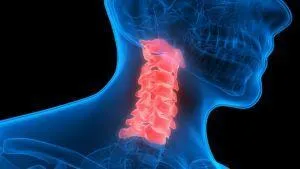
Cervical Spine (C1-C7)
The neck region. Highly vulnerable to whiplash forces, rear-end, and frontal crashes. Injuries here can cause neck pain, arm pain, numbness, and weakness. The C5-C7 levels are most commonly affected in vehicle crashes.
Thoracic Spine (T1-T12)
The mid-back region. Stabilized by the rib cage, making fractures more common than disc injuries at this level. Seat belt injuries and high-impact crashes are frequent causes of thoracic compression fractures.
Lumbar Spine (L1-L5)
The lower back region. Bears most of the body’s weight and load. The L4-L5 and L5-S1 levels are the most common sites for herniated discs from vehicle crashes, producing lower back pain and sciatica.
Crash-Related Injury Types
Herniated Discs
A herniated disc, also called a ruptured or slipped disc, occurs when the gel-like nucleus of a spinal disc pushes through the tough outer ring (annulus fibrosus), pressing on nearby nerves. Car crashes generate sudden compressive and flexion-extension forces that are a direct mechanical cause of disc herniation. Published medical literature indicates that up to 20% of car accident victims suffer herniated discs.
The Mayo Clinic lists radiating pain (sciatica when in the lumbar region), numbness or tingling in the arms or legs, muscle weakness, and in severe cases, loss of bladder or bowel control. Symptoms may not appear immediately after the crash, disc herniations can become symptomatic days or weeks later as inflammation develops around the compressed nerve root.
Bulging Discs
In a bulging disc, the disc extends beyond its normal perimeter without fully rupturing. The distinction carries medical and legal weight: insurance companies often argue that a bulging disc is “less serious” than a herniation. The Mayo Clinic describes bulging discs compressing nerve roots and the spinal cord just as aggressively, causing the same range of painful, disabling symptoms.
Whiplash-Related Spine Damage
Whiplash is the rapid flexion-extension movement of the neck during a rear-end collision. While often dismissed as a “soft tissue” injury, published research makes clear that whiplash frequently causes disc disruption, facet joint injuries, and ligament damage. The CDC reports neck sprains and strains are the most common crash injury diagnosis, and research confirms those injuries are regularly underdiagnosed when only ER visits are captured.
Vertebral Fractures
High-energy crashes, rollovers, and rear-end collisions at speed can fracture vertebral bodies. Compression fractures in the thoracic and lumbar spine are common in seat-belted occupants of severe crashes. Burst fractures, where bone fragments project into the spinal canal, are among the most serious non-cord spine injuries and may require surgical stabilization.
Facet Joint and Nerve Root Injuries
The facet joints are the small articulating joints along the back of the spine. Crash forces frequently damage these joints, causing chronic neck and back pain that is difficult to treat and persistently limiting. Nerve root compression from disc herniation or bone displacement can cause radiculopathy, a specific pattern of radiating pain, numbness, and weakness along the path of the affected nerve.
Treatment Costs
The economic damage in a serious spine injury case is substantial. Spine surgery costs range widely depending on procedure type:
- Microdiscectomy: $20,000-$50,000
- Laminectomy: $50,000-$90,000
- Spinal fusion (ACDF or lumbar): $80,000-$150,000
- Physical therapy, often needed for months or years
These costs, combined with lost wages, diminished earning capacity, and ongoing pain and suffering, form the core of a serious spine injury claim. Every dollar of loss needs documentation in the claim.
Conservative Care and Surgery
Most herniated and bulging disc injuries are treated conservatively first, meaning without surgery. Conservative treatment includes physical therapy, chiropractic care, epidural steroid injections, and pain management. Insurers love conservative treatment because it lets them argue the injury wasn’t serious enough to warrant surgery.
The reality is that conservative care is the appropriate first step for many spine injuries and does not diminish the seriousness of a claim. If conservative care fails and surgery becomes necessary, that progression, documented in the medical records, becomes strong evidence of the severity and permanence of the injury.
Surgical indications for crash-related spine injuries include:
- Failure of conservative treatment after 6-12 weeks
- Progressive neurological symptoms, worsening weakness, numbness, or coordination problems
- Bladder or bowel dysfunction, which the Mayo Clinic identifies as a sign of significant cord or nerve root compression.
- Unstable fractures requiring fixation to prevent further injury
Why Clients Choose Sam Aguiar
Spinal Cord Injury Basics
A spinal cord injury can change the body permanently. The Mayo Clinic explains that a spinal cord injury involves damage to any part of the spinal cord and often causes permanent changes in strength, sensation, and other body functions below the site of the injury, potentially causing paralysis.
Crashes are the leading cause for most people. The same Mayo Clinic guidance states that motor vehicle crashes are the leading cause of spinal cord injuries for people younger than 65.
Symptoms and Classification
The symptoms reflect where and how badly the cord is damaged. The Mayo Clinic lists loss of strength or paralysis, loss or change of sensation, and loss of bowel or bladder control among the possible effects of a spinal cord injury.
Doctors classify these injuries by how much function remains. The same Mayo Clinic guidance explains that injuries are classified as complete, meaning all feeling and movement are lost below the injury, or incomplete, meaning some function remains, a distinction that shapes both treatment and prognosis.
Injury Level
Where the cord is injured determines what the body can still do. Because the Mayo Clinic describes permanent changes below the site of the injury, an injury higher on the spine generally affects more of the body than one lower down, which is why the injury level is central to understanding a person’s long-term needs.
The medical evidence is built through examination and imaging. A StatPearls trauma care review describes a head-to-toe secondary survey and the use of imaging such as X-ray and CT to confirm the clinician’s examination, the process that documents a spine injury and its extent after a crash.
Regional Effects
The region of the spine that is injured determines which functions are affected. The Mayo Clinic explains that an injury at the chest level or in the lower back can affect the trunk, legs, bowel, bladder, and sexual function, while a neck injury affects those same areas plus movement of the arms and possibly the ability to breathe.
The terms for paralysis follow that pattern. The same Mayo Clinic guidance notes that paralysis of the lower half of the body is called paraplegia, while paralysis below the neck that includes both arms and legs is called quadriplegia, distinctions that describe how far-reaching a spinal injury’s effects can be.
Secondary Damage
A spinal injury is not always fixed at the moment of impact. The Mayo Clinic explains that in the days and weeks after a spinal cord injury, more damage can happen due to bleeding, swelling, and fluid buildup in and around the spinal cord.
The timing of care therefore carries great weight. The same Mayo Clinic guidance states that the time between injury and treatment can be critical, that numbness or paralysis can come on quickly or slowly, and that it is safest to assume a person has a spinal injury until proven otherwise, because a serious spinal injury is not always easy to see right away.
Long-Term Complications
The consequences of a spinal cord injury reach across the whole body. The Mayo Clinic lists complications including trouble breathing and coughing, orthostatic hypotension and a raised risk of blood clots such as deep vein thrombosis, loss of bladder and bowel control with a higher risk of urinary tract and kidney infections, and a loss of skin sensation that raises the risk of pressure sores.
The effects continue over the long term. The same Mayo Clinic guidance notes a raised risk of osteoporosis and broken bones below the level of injury, muscle atrophy and weight change, nerve pain, and a link to depression, a picture that shows why a spinal cord injury reshapes daily life well beyond the initial hospitalization.
Early Evaluation of a Suspected Spine Injury
A structured trauma evaluation is designed to catch these injuries. The StatPearls trauma care review explains that trauma care follows a primary survey in the sequence of airway, breathing, circulation, disability, and exposure, with the most vital areas taking precedence, followed by a head-to-toe secondary survey that includes the patient’s posterior surfaces to ensure nothing has been overlooked.
That thoroughness exists because spinal injuries can be missed if a person is not fully assessed. The same review notes that imaging is used to confirm the clinician’s examination, which is how a suspected spine injury is verified and recorded rather than assumed.
Damages and Pre-Existing Conditions
The most common defense in any spine injury case is that the damage pre-existed the crash. It is true that degenerative disc disease is common in adults over 35. But degeneration and traumatic injury are not the same thing, and Kentucky law does not let insurers off the hook for the aggravation or acceleration of pre-existing conditions.
Kentucky’s eggshell plaintiff rule holds that a defendant takes the victim as they find them. If a person had a mildly degenerated disc that was asymptomatic before the crash, and the crash caused it to herniate and compress a nerve, the defendant is responsible for that outcome, more than the marginal difference between the pre-existing condition and the final injury.
Building a strong spine injury claim requires:
- Immediate medical documentation. Every gap between the crash and the first medical visit becomes ammunition for the defense. Prompt treatment is important even when pain is manageable at first. Spine injuries frequently worsen in the days following a crash as inflammation increases.
- MRI imaging, before and after. An MRI is the gold standard for visualizing disc herniation, nerve compression, and soft tissue damage. If pre-crash imaging exists, it establishes the baseline. If not, the medical record timeline, no prior complaints, no prior treatment, serves the same function.
- Documenting radiculopathy through electrodiagnostic testing. Electromyography (EMG) and nerve conduction studies (NCS) provide objective, measurable evidence of nerve damage that correlates with crash mechanism and MRI findings. These tests make subjective pain complaints legible to insurance adjusters and juries.
- Demonstrating functional limitation. Medical records documenting restrictions on the ability to sit, stand, lift, drive, or work connect the clinical diagnosis to daily life. Functional capacity evaluations from occupational therapists translate injury into quantified limitation.
- Physician testimony on causation. An orthopedic surgeon or neurosurgeon who can testify that the specific disc injury is consistent with the crash mechanism, and inconsistent with what pre-existing degeneration alone would produce, is often decisive in contested spine cases.
Recoverable Damages
Under Kentucky law, crash victims with spine injuries can pursue:
- Past and future medical expenses: all treatment from emergency care through any future surgery and rehabilitation
- Lost wages and lost earning capacity: when the injury prevents or limits the ability to work at the pre-crash level
- Pain and suffering: physical pain, mental anguish, and the chronic burden of living with a spine injury
- Loss of enjoyment of life: activities the injured person can no longer perform
- Loss of consortium: the impact on marital and family relationships
Kentucky’s KRS § 304.39-060 no-fault system provides up to $10,000 through the injured person’s own PIP coverage for initial medical expenses. Spine injuries frequently exceed this amount within weeks of the crash, which opens a claim against the at-fault driver’s liability policy for the full extent of the damages.
If a car accident caused a spine injury, Sam Aguiar Injury Lawyers can review the accident records, treatment history, and available insurance coverage. Call (502) 888-8888 or request a free case review.