

Construction Zone Truck Accidents
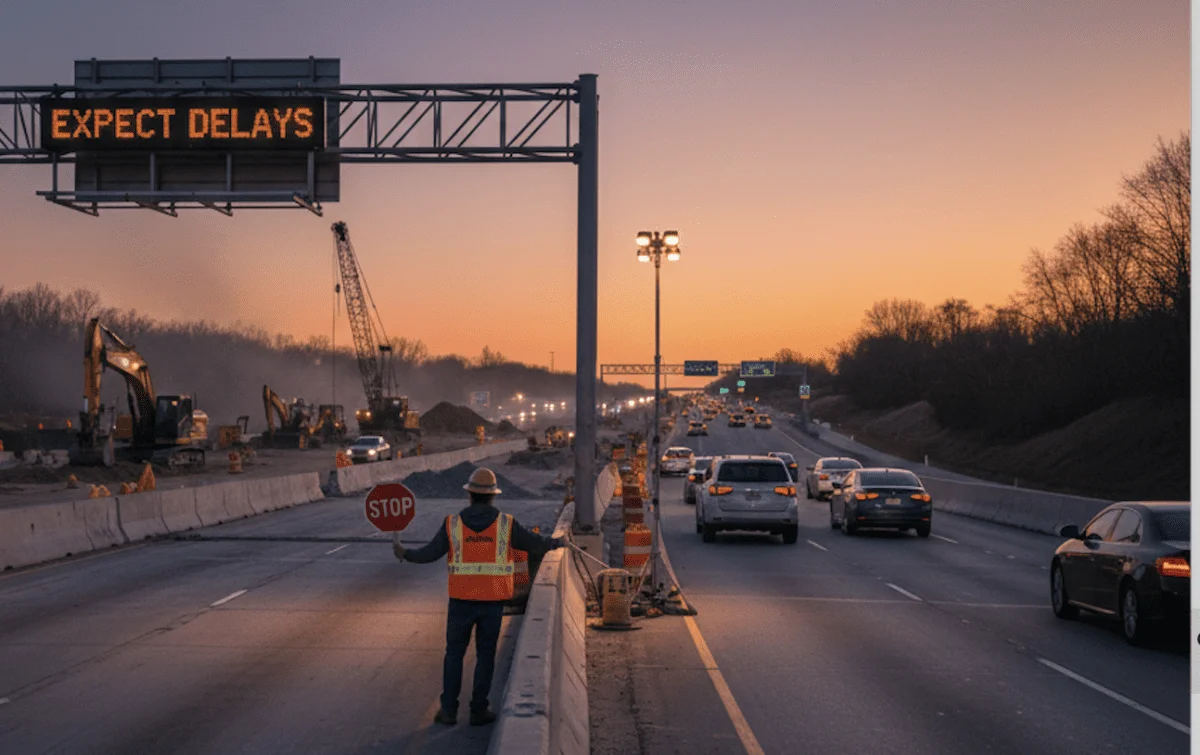
A fully loaded semi-truck weighing 80,000 pounds cannot stop quickly at highway speed, even under ideal conditions. At 65 mph, a commercial truck needs roughly 525 feet to stop. In a construction zone with sudden lane shifts, reduced speeds, and stopped traffic, that stopping distance turns a driver’s mistake into a deadly crash.
Truck Hazards in Construction Zones
Work zones create a specific set of hazards that are disproportionately dangerous for large trucks:
- Compressed lane widths: work zone lanes are often reduced to 11 feet or less, and a tractor-trailer is 8.5 feet wide, which leaves little room for driver error.
- Abrupt speed transitions: highway work zones drop speeds from 65 to 45 mph or less, and a distracted or fatigued truck driver who reacts late closes the gap to stopped traffic at lethal speed.
- Limited escape routes: concrete barriers, jersey walls, and equipment narrow a truck driver’s options for avoiding a collision ahead.
- Queue end crashes: vehicles stopped at the back of a traffic queue sit exactly where a truck’s extended stopping distance does the most harm, and large trucks are most overrepresented in these upstream rear-end collisions.
130+
Fatal crashes involving commercial vehicles in work zones each year
25%
Share of fatal work zone crashes that involve commercial vehicles
50%+
Share involving large trucks in daytime rural interstate work zones
Source: Rutgers Center for Advanced Infrastructure and Transportation, citing Fatality Analysis Reporting System data.
Outside work zones, large trucks are involved in 9 to 12% of fatal crashes, according to the same Rutgers CAIT review of federal fatal crash data.
Kentucky Work Zone Fines
Kentucky raises the fine for traffic violations committed in a highway work zone. Under KRS 189.2327, a violation in a work zone carries a $500 fine when no one is hurt, and a fine of $500 to $10,000 when the violation results in physical injury to or death of any person. The increased fine applies only when signs tell drivers they are entering a work zone with increased fines and at least one bona fide worker is present.
Kentucky law also requires every driver to stay in the designated traffic lane through a highway work zone and to yield to workers engaged in work there, under KRS 189.960. For trucks, the exposure goes further:
- Trucking companies whose drivers have prior speeding violations face regulatory scrutiny from FMCSA.
- Commercial drivers are subject to hours of service rules that can establish driver fatigue as a factor in a work zone crash.
When a truck driver enters a Kentucky work zone at excessive speed, ignores posted limits, or fails to account for stopped traffic ahead, the driver and the employer are potentially liable for every injury that results.
FMCSA Regulations in Work Zones
Commercial truck drivers operate under a separate layer of federal rules, the Federal Motor Carrier Safety Regulations (FMCSRs). Four of them bear directly on construction zone crashes:
- Part 395
Hours of Service
Driving-time limits and rest requirements for covered truck drivers.
- 392.6
Schedules and Speed Limits
Carriers may not schedule runs that require drivers to exceed speed limits.
- Part 391
Driver Qualifications
Driver eligibility, licensing, and records relevant to negligent hiring.
- 395.8
Driving Records
Records of duty status document driving time and other duty periods.
Evidence Preservation Steps
ELD data, dashcam footage, driver logs, pre-trip inspection reports, and company communications can be overwritten or destroyed within days of a work zone truck crash. A spoliation letter is a legal demand that the trucking company preserve all of those records, and an attorney can send it as soon as the crash is reported. Those records are the core of the trucking evidence in a work zone case.
Multiple Defendants in Work Zone Truck Cases
A work zone truck crash can involve several defendants, which makes these cases legally complex and potentially high in value. The truck driver answers for the driver’s own negligence. The trucking company is vicariously liable under respondeat superior for crashes its employees cause while driving within the scope of employment, and it carries direct liability when its schedules or hiring practices broke federal rules.
Construction companies can share responsibility too. They must follow the Manual on Uniform Traffic Control Devices (MUTCD) for work zone design, including proper advance warning, lane tapers, and channelization. When signage or layout fell short of that standard, the company that set up the work zone becomes one of the liable parties in a truck crash case.
Ready to Take Action on Your Injury Claim?
After a serious injury, medical bills pile up while the insurance company looks for ways to pay you less. Most law firms take their cut first and leave you with whatever is left. Sam Aguiar Injury Lawyers does things differently. With our exclusive Bigger Share Guarantee®, you always get more. Every client gets a dedicated three-person team: an attorney, a case manager, and a legal assistant. We never raise our fee rate if we have to go to court, and you pay $0 Out-Of-Pocket Forever.
Frequently Asked Questions
1Can I sue the trucking company and the driver for a work zone crash?+
2How can an hours of service violation be shown after a work zone truck crash?+
3What if the construction zone’s signage or layout contributed to the crash?+
4What are the fines for traffic violations in a Kentucky work zone?+
Latest Articles
Kentucky Diminished Value Claims
Kentucky drivers may pursue a repaired vehicle’s leftover market loss from the at-fault driver as part of a.
FMCSA Revoked ELDs: Fleet Compliance and Enforcement Deadlines
FMCSA removed five electronic logging devices from the registered list on August 6, 2026, and set an October.
FMCSA English Proficiency Rule and OOS Enforcement
FMCSA English Proficiency Rule Sam Aguiar Injury Lawyers August 11, 2026 7 minute read On This Page.