

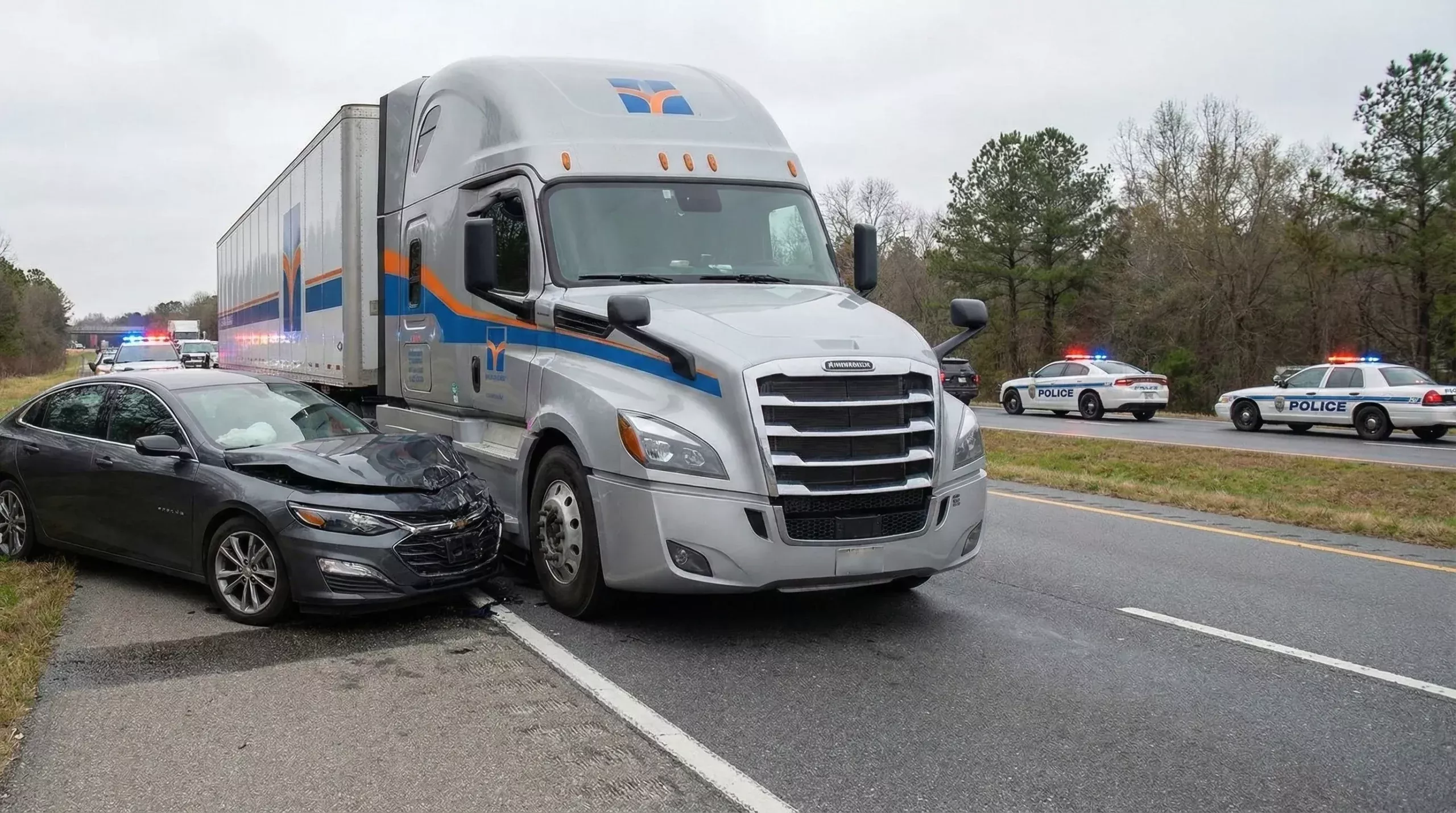
Semi-Truck Accident Lawyer Kentucky
Semi-truck accident cases in Kentucky involve multiple potentially liable parties: the driver, the motor carrier, the shipper, and the maintenance provider can each bear independent legal responsibility. Sam Aguiar Injury Lawyers has a dedicated trucking team that pursues all liable parties, preserves FMCSA records and black box data, and has secured 40+ seven- and eight-figure results in serious injury and commercial trucking cases across the state.
Multiple Liable Parties in a Tractor-Trailer Crash
Unlike a standard two-vehicle crash, a semi-truck collision often involves a chain of commercial relationships, each carrying its own potential liability. The driver may be employed by the motor carrier or may be an owner-operator under a lease agreement. The motor carrier owns or controls the truck under a DOT operating authority. The shipper arranged the load. A third-party maintenance provider may have serviced the brakes. Under federal trucking regulations, each of these parties has independent compliance duties, and a failure by any one of them can be a proximate cause of the crash.
The FMCSA lease and interchange regulations under 49 CFR Part 376 govern the relationship between motor carriers and owner-operators. Under these rules, the motor carrier that holds the operating authority bears primary liability for the actions of drivers operating under that authority, even if the driver is technically an independent contractor. This regulatory structure prevents carriers from structuring owner-operator agreements to avoid liability for driver negligence.
According to NHTSA Fatality Analysis Reporting System data, large trucks were involved in 5,936 fatal crashes nationally in 2022, with occupants of other vehicles accounting for 72 percent of those deaths. The mass disparity between a fully loaded semi-truck at 80,000 pounds and a passenger vehicle at 3,000 to 4,000 pounds means that catastrophic injuries are the expected outcome, not the exception, in serious tractor-trailer collisions.
FMCSA Regulations and How They Establish Liability
Federal Motor Carrier Safety Administration regulations establish minimum standards for every aspect of commercial trucking operations. When a driver, carrier, or other party violates those standards and a crash results, the violation is evidence of negligence per se under Kentucky law. The most commonly violated FMCSA regulations in crash cases include hours-of-service rules under 49 CFR Part 395, driver qualification standards under Part 391, vehicle inspection and maintenance requirements under Part 396, and cargo securement under Part 393.
Beyond federal regulations, Kentucky has its own commercial vehicle enforcement infrastructure. The Kentucky Transportation Cabinet Motor Carrier division enforces state registration and permit requirements, and Kentucky State Police conduct commercial vehicle inspections at weigh stations and through mobile enforcement units. Out-of-service orders and inspection violations generated by Kentucky enforcement are part of the carrier’s compliance record and are relevant to negligence claims in crash cases.
Catastrophic Injuries and What They Mean for Your Case
Semi-truck crashes produce injuries that are categorically more severe than standard vehicle collisions. Traumatic brain injury, spinal cord damage, crush injuries, amputations, and multi-organ trauma are documented consequences of tractor-trailer impacts at highway speeds. These injuries require extended medical care, rehabilitation, and often permanent lifestyle modifications. The full economic value of a semi-truck crash case includes not just current medical bills but future care costs, lost earning capacity, and non-economic damages for pain, suffering, and diminished quality of life.
Calculating these future damages accurately requires input from life care planners, vocational rehabilitation attorney, and economic experts. Sam Aguiar Injury Lawyers builds these cases with the expert infrastructure that catastrophic injury claims require. The firm’s 40+ seven-figure results reflect cases where the full scope of the victim’s damages was established and presented, not where early low settlement offers were accepted before the medical picture was complete.
Frequently Asked Questions: Semi-Truck Accident Cases in Kentucky
Who can be sued after a semi-truck accident in Kentucky?
Liable parties can include the truck driver, the motor carrier holding the DOT operating authority, the truck owner if different from the carrier, the cargo shipper or loader, and any third-party maintenance provider. Under 49 CFR Part 376, the motor carrier generally bears primary liability for drivers operating under its authority regardless of contractor status.
How much insurance does a semi-truck driver carry in Kentucky?
Under 49 CFR Part 387, interstate motor carriers transporting general freight must carry a minimum of $750,000 in liability insurance. Carriers transporting hazardous materials must carry between $1 million and $5 million depending on the commodity. Many large carriers carry $1 million to $5 million or more in coverage, making policy limits a critical early issue in case evaluation.
What evidence is most important in a Kentucky semi-truck accident case?
Critical evidence includes the truck’s electronic logging device records, black box (EDR) data, driver qualification file, maintenance and inspection records, dispatch logs, cargo documentation, and traffic camera footage. The Aguiar trucking team issues preservation letters immediately on taking a case, citing the carrier’s duty to retain all records. The FMCSA Safety Measurement System also provides the carrier’s compliance history.
Is a semi-truck accident case handled differently from a car accident case?
Yes, significantly. Semi-truck cases involve federal FMCSA regulations, multiple potentially liable parties, larger insurance policies, and more complex evidence. The carrier’s rapid response team may arrive at the scene within hours to begin building their defense. Having a dedicated trucking litigation team rather than a general personal injury practice respond with equal urgency is critical to preserving the plaintiff’s evidentiary position from day one.