

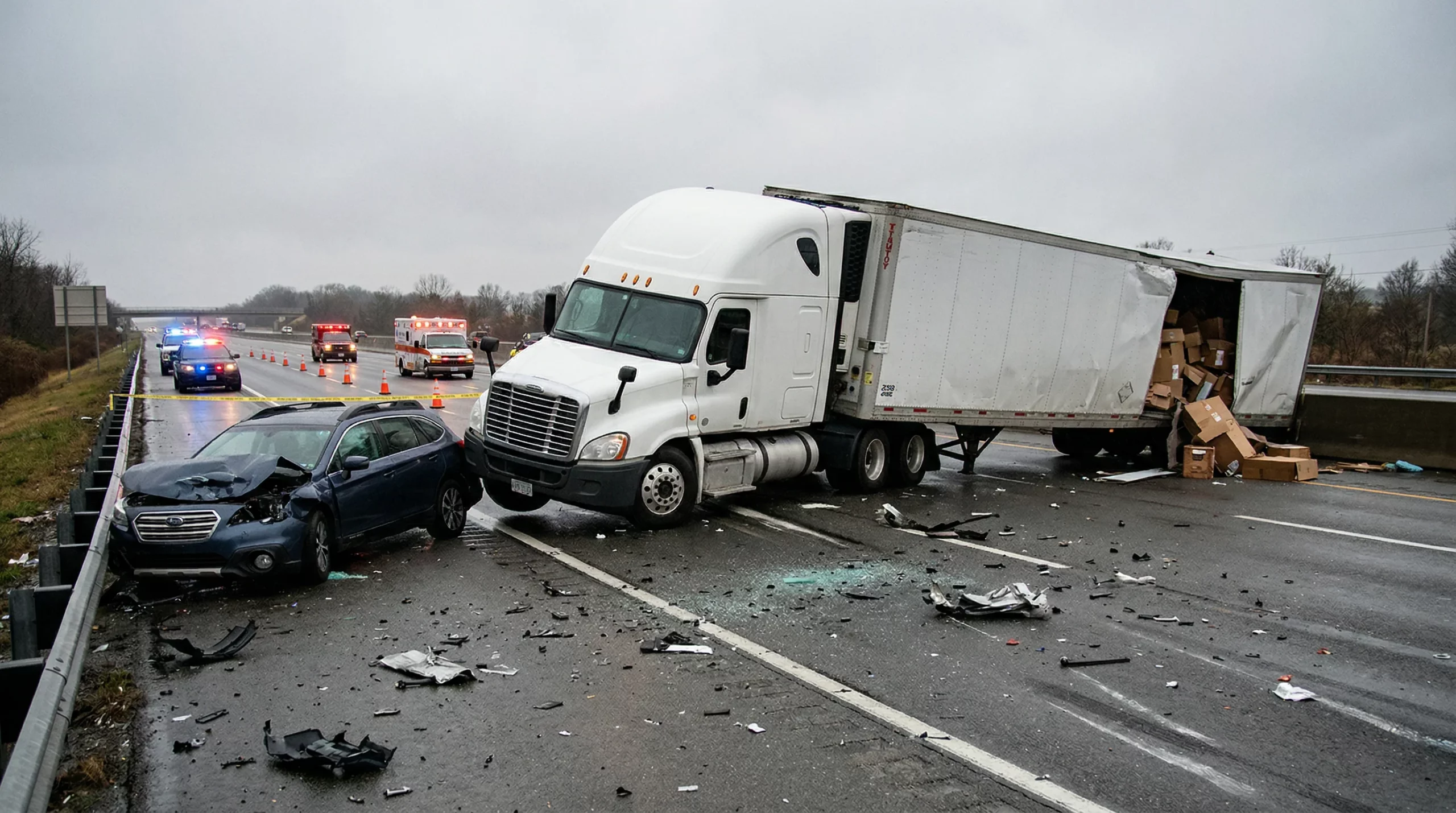
Trucking Company Tactics After a Crash
- The Rapid Response Team: Why Trucking Companies Move Within Hours
- The Trucking Company Playbook: Tactics Used Against Kentucky Crash Victims
- How Critical Evidence Disappears After a Truck Crash
- The Insurance Layer: Why Trucking Insurance Claims Are Different
- What the First 72 Hours Look Like After a Kentucky Truck Crash
- How Our Trucking Team Counters These Tactics
Trucking Company Tactics After a Crash cases are strongest when the page answers the real search intent: what happened, what proof matters, and who may be responsible. Sam Aguiar Injury Lawyers uses crash reports, medical records, insurance data, and source material like the Kentucky Transportation Cabinet crash data to frame Kentucky crash claims clearly.
The Rapid Response Team: Why Trucking Companies Move Within Hours
Most people do not realize that major trucking carriers and their insurance companies have crash response protocols ready before any accident ever happens. These protocols activate immediately after a serious collision.
Within two to four hours of a crash, many trucking companies send a rapid response team to the scene. This team typically includes a defense attorney, a private crash investigator, a company safety manager, and sometimes an insurance adjuster. Their job is not to check on your well-being. Their job is to protect the company.
According to the American Trucking Associations, large carriers maintain pre-arranged contracts with defense law firms and investigation companies in every state where they operate. When a crash happens, one phone call activates the entire team.
While you are in the emergency room or waiting for police to finish their report, the trucking company’s team is already at the scene. They photograph skid marks, tire positions, road conditions, and vehicle damage. They interview witnesses before you even know who those witnesses are. They inspect the truck and remove the electronic data recorder before it can be overwritten.
This is not illegal. But it creates a massive information gap between what the trucking company knows and what you know. By the time most crash victims hire an attorney weeks later, the trucking company has already built the foundation of its defense.
Why Speed Matters in Truck Crash Cases
In a typical car accident case, evidence stays available for weeks or months. In a truck crash case, critical evidence can disappear within 72 hours. Electronic control module (ECM) data, dashcam footage, and post-accident drug test windows are all time-sensitive. Every hour counts.
The Trucking Company Playbook: Tactics Used Against Kentucky Crash Victims
Trucking companies and their insurers use a set of well-rehearsed tactics after a crash. These tactics are designed to limit what they pay you. Knowing what they do takes away their advantage.
Immediate Scene Investigation
The rapid response team arrives at the scene while police are still working. They create their own documentation: photos, measurements, video, and witness lists. This private investigation is not shared with you or your attorney unless a court orders it during litigation.
Witness Contact Before You Can Reach Them
Defense investigators contact witnesses within the first 24 to 48 hours. They take recorded statements while memories are fresh. These statements are protected by attorney-client privilege because the defense attorney directs the investigation. If a witness later changes their account, the trucking company has the early statement locked in.
Driver Isolation
The trucking company instructs the driver not to speak with anyone about the crash. No public statements, no social media posts, no conversations with the other driver’s family or attorney. The driver is often taken to a company facility or hotel, removed from the scene, and connected with the company’s defense attorney before anyone else can speak to them.
Electronic Data Management
Modern trucks carry electronic logging devices (ELDs) and electronic control modules (ECMs) that record speed, braking, engine RPM, and other critical data in the seconds before a crash. Under 49 CFR Part 395, ELD data must be retained for at least six months. But ECM “snapshot” data from the crash event can be overwritten if the truck is driven again or the module is reset.
The trucking company knows exactly how this data works. They know what it shows. And they control access to it until a court order or preservation demand forces them to share it.
Quick Settlement Offers
Some trucking companies or their insurers contact crash victims within days with a settlement offer. These early offers almost always undervalue the claim. They are timed to reach you before you understand the full extent of your injuries, before you hire an attorney, and before you realize how much evidence the company has already collected.
Accepting an early settlement means signing a release that ends your claim permanently. You cannot go back and ask for more money if your injuries turn out to be worse than you thought.
Surveillance of Crash Victims
In serious truck crash cases, the defense may hire private investigators to follow you. They look for evidence that your injuries are not as severe as your medical records suggest. A video of you carrying groceries, mowing the lawn, or attending a social event can be used to undercut your claim, even if those activities caused you significant pain.
Key point: These tactics are not theoretical. They happen in Kentucky truck crash cases regularly. The FMCSA reported that Kentucky had over 5,700 large truck crashes in a single recent year, with more than 120 resulting in fatalities. Trucking companies operating on I-65, I-64, I-71, and I-75 through Kentucky deal with crash litigation constantly. Their defense infrastructure is well-funded and experienced.
How Critical Evidence Disappears After a Truck Crash
Evidence in a truck crash case is more fragile than most people realize. Several types of critical evidence have built-in expiration dates that the trucking company understands and you probably do not.
Electronic Control Module (ECM) Data
The truck’s ECM, sometimes called the “black box,” records data from the seconds before and after a crash. This includes speed, throttle position, brake application, cruise control status, and whether the driver wore a seatbelt. The National Transportation Safety Board (NTSB) has repeatedly recommended that this data be preserved in all serious truck crashes.
But ECM data can be overwritten. If the truck is driven again after the crash, some ECM systems record a new “last stop” event that replaces the crash data. If the module is reset during repairs, the crash data may be lost entirely. There is no federal law requiring trucking companies to preserve this data automatically. Without a formal preservation demand, it can disappear.
Electronic Logging Device (ELD) Records
Under 49 CFR § 395.8, motor carriers must retain ELD records for at least six months. These records show the driver’s hours of service: when they drove, when they rested, and whether they exceeded the legal limits. If the driver was over their hours, the ELD data proves it.
Six months sounds like a long time. But if you do not send a preservation demand early, the carrier may argue that routine data purges destroyed the records before anyone asked for them.
Post-Accident Drug and Alcohol Testing
Federal regulations under 49 CFR § 382.303 require post-accident drug and alcohol testing for truck drivers involved in qualifying crashes. But there are time limits. Alcohol testing must occur within 8 hours of the crash. Drug testing must occur within 32 hours. If the carrier misses these windows, the test cannot be performed, and the evidence is gone.
Some carriers have been accused of deliberately delaying testing until the window closes. Without timely testing, there is no way to prove whether the driver was impaired at the time of the crash.
Dashcam and Fleet Camera Footage
Many commercial trucks have forward-facing and cab-facing cameras. Some fleet systems also record rear and side views. This footage is stored on cloud servers or onboard storage that may be overwritten on a loop, sometimes within 7 to 14 days. Without a preservation demand, the footage may be recorded over before anyone outside the company sees it.
Cell Phone Records and GPS Data
Driver cell phone records can show whether the driver was texting, calling, or using apps at the time of the crash. GPS data from the truck’s fleet management system shows the exact route, speed, and stop patterns. Both data types require formal preservation requests to prevent deletion.
What Is a Spoliation Letter?
A spoliation letter is a formal legal demand sent to the trucking company, the driver, and the insurer. It requires them to preserve all evidence related to the crash: ECM data, ELD logs, dashcam footage, driver files, drug test results, inspection records, and maintenance logs. Failure to preserve evidence after receiving a spoliation letter can result in court sanctions, including instructions to the jury that the destroyed evidence would have been unfavorable to the company.
Our trucking team sends spoliation letters within 24 hours of taking a case. This is one of the most important steps in any truck crash claim.
The Insurance Layer: Why Trucking Insurance Claims Are Different
Truck crash claims are fundamentally different from car accident claims because of the insurance involved. The FMCSA requires minimum insurance coverage for commercial motor carriers based on the type of cargo they haul:
- General freight carriers (over 10,001 lbs): $750,000 minimum
- Oil transport: $1,000,000 minimum
- Hazardous materials: $5,000,000 minimum
Compare that to Kentucky’s minimum auto insurance requirement of just $25,000 per person and $50,000 per accident for passenger vehicles. The insurance policies behind truck crash claims are 15 to 200 times larger than a typical car accident policy.
Those larger policies mean the insurance companies behind them have more resources to invest in defending the claim. Trucking insurers employ in-house claims teams staffed by experienced adjusters who handle nothing but commercial motor vehicle crashes. They hire defense firms that have defended thousands of truck crash cases. They retain accident reconstruction experts, biomechanical engineers, and medical consultants.
The trucking company’s insurer is not going to handle your claim the way a personal auto insurer would. They will treat it like a high-stakes business decision, because that is exactly what it is.
In Kentucky, major trucking corridors like I-65, I-64, I-71, and I-75 carry heavy commercial traffic year-round. Carriers operating on these routes have experienced defense teams and established relationships with local law firms in Louisville, Lexington, and across the state. When a crash happens on a Kentucky interstate, the trucking company’s response is coordinated and rehearsed.
The bottom line: When a trucking company’s insurer has a $750,000 to $5,000,000 policy on the line, they will spend whatever it takes to reduce or deny your claim. Having an attorney who understands commercial motor carrier litigation is the only way to level the playing field.
What the First 72 Hours Look Like After a Kentucky Truck Crash
If you or someone in your family has been hit by a commercial truck in Kentucky, the steps you take in the first three days matter enormously. Here is what you should know.
- Get Medical Attention Immediately
Even if you feel okay at the scene, get evaluated at a hospital. Truck crashes generate tremendous force. Internal injuries, spinal injuries, and traumatic brain injuries may not produce obvious symptoms right away. Your medical records from the day of the crash become a critical piece of evidence.
- Document Everything You Can
If you are physically able, photograph the scene: the vehicles, the road, traffic signals, skid marks, debris, and any visible injuries. Get the names and phone numbers of witnesses. Write down what you remember as soon as possible. Details fade quickly.
- Do Not Give a Recorded Statement
The trucking company’s insurer may contact you within hours asking for a recorded statement. You are under no obligation to provide one. Anything you say can and will be used to reduce your claim. Politely decline until you have spoken with an attorney.
- Do Not Sign Anything From the Trucking Company
You may receive documents from the trucking company or their insurer: medical authorization forms, release forms, or settlement offers. Do not sign any of them. These documents are designed to give the company access to your full medical history or to close your claim before you understand its true value.
- Contact a Trucking Crash Attorney Within 72 Hours
The trucking company’s defense team activates within hours. Your response should be equally fast. An experienced trucking crash attorney can send spoliation letters, dispatch an independent investigator, and begin preserving the evidence you need before it disappears.
How Our Trucking Team Counters These Tactics
At Sam Aguiar Injury Lawyers, we have a dedicated trucking team that handles commercial vehicle crash cases exclusively. We understand the defense playbook because we have been on the other side of it for years. Here is how we work.
Spoliation Letters Within 24 Hours
The moment we take your case, we send formal evidence preservation demands to the trucking company, the driver, the motor carrier’s insurer, and any third-party logistics providers involved. These letters cover ECM data, ELD records, dashcam footage, driver qualification files, maintenance logs, cargo records, and cell phone data. If the company destroys evidence after receiving our letter, we pursue sanctions in court.
Exclusive Access to DOT Cameras
Sam Aguiar Injury Lawyers has exclusive access to Kentucky Department of Transportation camera footage. These cameras are positioned at key intersections and highway segments across the state. When a truck crash occurs within range of a DOT camera, we can obtain footage that shows exactly what happened, independent of anything the trucking company provides.
FMCSA Compliance Review
Every commercial motor carrier has a safety record with the FMCSA. We pull the carrier’s full compliance history: out-of-service rates, crash involvement rates, HOS violations, vehicle maintenance violations, and driver fitness scores. If the carrier has a pattern of safety violations, that pattern becomes evidence in your case.
ECM and ELD Data Extraction
We work with certified crash data analysts who can extract and interpret ECM and ELD data. This data tells us the truck’s exact speed at the time of impact, whether the driver applied the brakes, how long the truck traveled before stopping, and whether the driver was within legal hours of service. These are facts, not opinions, and they are extremely powerful in settlement negotiations and at trial.
Independent Crash Investigation
We deploy our own investigators and crash reconstruction engineers to the scene. They create an independent record of the physical evidence: road surface conditions, sight lines, traffic control devices, vehicle damage patterns, and final resting positions. This independent investigation ensures that the trucking company’s version of events does not go unchallenged.
Bigger Share Guarantee®
Unlike most injury firms, our fee never increases if your case goes to litigation or trial. Under our Bigger Share Guarantee, you always take home more than we do after all expenses, liens, and medical bills are paid. That guarantee applies to every case we take, including truck crash claims where litigation is common.
Related Kentucky Crash Resources
Related Kentucky Crash Resources
Frequently Asked Questions
What is a trucking company rapid response team?
A rapid response team is a group of defense professionals, typically including a defense attorney, a crash investigator, and a company safety representative, that the trucking company sends to the crash scene within hours. Their purpose is to document the scene, interview witnesses, inspect the truck, and secure evidence in a way that protects the company’s interests. Major carriers have pre-arranged contracts with these teams in every state where they operate. The Kentucky Transportation Cabinet tracks crash data that can shape how roadway claims are evaluated. The Kentucky Transportation Cabinet tracks crash data that can shape how roadway claims are evaluated. The Kentucky Transportation Cabinet tracks crash data that can shape how roadway claims are evaluated. The Kentucky Transportation Cabinet tracks crash data that can shape how roadway claims are evaluated. The Kentucky Transportation Cabinet tracks crash data that can shape how roadway claims are evaluated.
How quickly can truck accident evidence be destroyed?
Some evidence can be lost within hours. Post-accident alcohol tests must occur within 8 hours, and drug tests within 32 hours under 49 CFR § 382.303. ECM “black box” data can be overwritten if the truck is driven again. Dashcam footage may loop every 7 to 14 days. ELD records have a 6-month retention requirement, but without a formal preservation demand, carriers have argued that routine data purges destroyed the records. The Kentucky Transportation Cabinet tracks crash data that can shape how roadway claims are evaluated. The Kentucky Transportation Cabinet tracks crash data that can shape how roadway claims are evaluated. The Kentucky Transportation Cabinet tracks crash data that can shape how roadway claims are evaluated. The Kentucky Transportation Cabinet tracks crash data that can shape how roadway claims are evaluated. The Kentucky Transportation Cabinet tracks crash data that can shape how roadway claims are evaluated.
Why are truck crash claims different from car accident claims?
Truck crash claims involve significantly larger insurance policies ($750,000 to $5,000,000 under FMCSA requirements ), more sophisticated defense teams, complex federal regulations (FMCSA, NTSB), multiple potentially liable parties (driver, carrier, broker, loader), and time-sensitive evidence that requires immediate preservation. The defense infrastructure behind a trucking company is dramatically more organized and better-funded than a personal auto insurer’s. The Kentucky Transportation Cabinet tracks crash data that can shape how roadway claims are evaluated. The Kentucky Transportation Cabinet tracks crash data that can shape how roadway claims are evaluated. The Kentucky Transportation Cabinet tracks crash data that can shape how roadway claims are evaluated. The Kentucky Transportation Cabinet tracks crash data that can shape how roadway claims are evaluated. The Kentucky Transportation Cabinet tracks crash data that can shape how roadway claims are evaluated.
What is a spoliation letter and why does it matter?
A spoliation letter is a formal legal demand sent to the trucking company, the driver, and the insurer requiring them to preserve all evidence related to the crash. This includes ECM data, ELD logs, dashcam footage, driver qualification files, maintenance records, drug test results, and dispatch records. Once the company receives this letter, destroying or failing to preserve evidence can result in court sanctions. We send these within 24 hours of taking a case. The Kentucky Transportation Cabinet tracks crash data that can shape how roadway claims are evaluated. The Kentucky Transportation Cabinet tracks crash data that can shape how roadway claims are evaluated. The Kentucky Transportation Cabinet tracks crash data that can shape how roadway claims are evaluated. The Kentucky Transportation Cabinet tracks crash data that can shape how roadway claims are evaluated. The Kentucky Transportation Cabinet tracks crash data that can shape how roadway claims are evaluated.
How much insurance do trucking companies carry?
The FMCSA sets minimum insurance requirements based on cargo type: $750,000 for general freight carriers over 10,001 lbs, $1,000,000 for oil transport, and $5,000,000 for hazardous materials. Many large carriers carry policies well above these minimums. By comparison, Kentucky requires only $25,000/$50,000 in auto liability coverage for passenger vehicles. The Kentucky Transportation Cabinet tracks crash data that can shape how roadway claims are evaluated. The Kentucky Transportation Cabinet tracks crash data that can shape how roadway claims are evaluated. The Kentucky Transportation Cabinet tracks crash data that can shape how roadway claims are evaluated. The Kentucky Transportation Cabinet tracks crash data that can shape how roadway claims are evaluated. The Kentucky Transportation Cabinet tracks crash data that can shape how roadway claims are evaluated.
What should I do in the first 72 hours after a truck accident?
Get medical attention immediately, even if you feel fine. Document the scene with photos and witness information if you can. Do not give a recorded statement to the trucking company’s insurer. Do not sign any documents from the trucking company. Contact a trucking crash attorney as soon as possible so they can send spoliation letters and begin preserving evidence before it disappears. The trucking company’s defense team is already moving. Your response needs to match their speed. The Kentucky Transportation Cabinet tracks crash data that can shape how roadway claims are evaluated. The Kentucky Transportation Cabinet tracks crash data that can shape how roadway claims are evaluated. The Kentucky Transportation Cabinet tracks crash data that can shape how roadway claims are evaluated. The Kentucky Transportation Cabinet tracks crash data that can shape how roadway claims are evaluated. The Kentucky Transportation Cabinet tracks crash data that can shape how roadway claims are evaluated.