

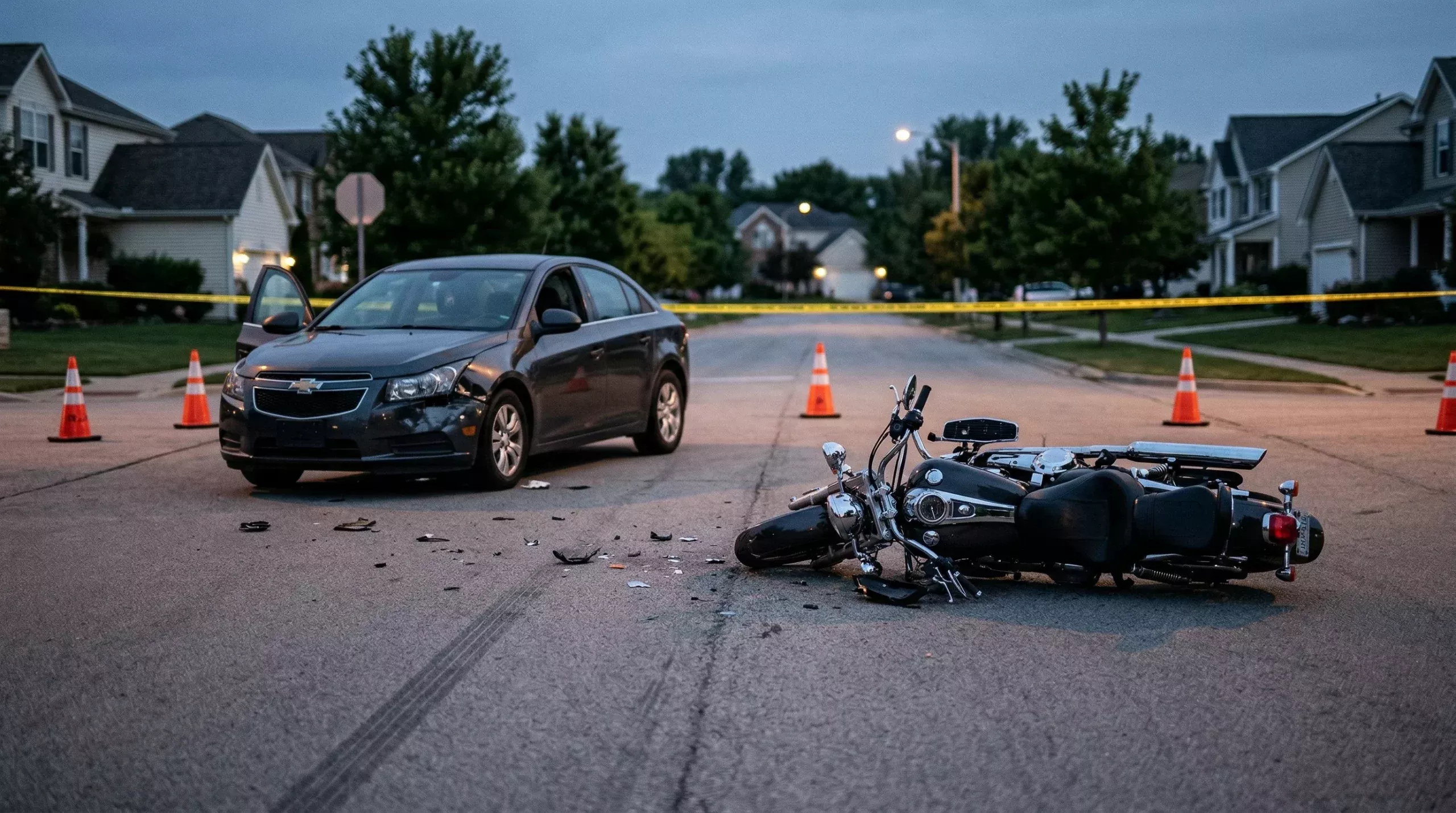
Bicycle Accident Lawyer Louisville, Kentucky
Bicyclists struck by motor vehicles in Kentucky face serious injuries and a recovery process with a critical insurance gap: Kentucky’s Personal Injury Protection (PIP) coverage does not apply to bicyclists because they are not operating a motor vehicle. Recovery runs through the at-fault driver’s liability insurance, the bicyclist’s own health coverage, and any applicable uninsured/underinsured motorist policy. Sam Aguiar Injury Lawyers handles bicycle accident cases across Louisville and Kentucky with no upfront costs.
Common Bicycle Crash Scenarios: Dooring, Right-Hook, and Distracted Drivers
The most frequent vehicle-bicycle crashes in Louisville involve three scenarios. The first is the dooring crash, where a driver or passenger opens a car door into the path of a cyclist traveling alongside parked vehicles. The second is the right-hook crash, where a vehicle turns right across a cyclist’s path at an intersection or driveway without yielding. The third is the overtaking crash, where a driver approaching a cyclist from behind misjudges clearance or is distracted and strikes the cyclist from the rear.
According to the NHTSA Bicycle Safety program, 1,105 bicyclists were killed in motor vehicle crashes in the United States in 2022, and hundreds of thousands more suffered injuries. The majority of fatal crashes involved a vehicle failure to yield or a failure to maintain lane position. Urban intersections and corridors with high bicycle traffic, like Louisville’s Bardstown Road, Frankfort Avenue, and NuLu corridors, produce the highest concentration of vehicle-bicycle conflicts in Jefferson County.
Kentucky law requires motorists to give cyclists at least three feet of clearance when overtaking under KRS 189.340. Violations of this statute are direct evidence of negligence. Cyclists have the same rights to use roadways as motor vehicles in Kentucky, and the failure of a motorist to recognize and accommodate that right is not a defense to liability when a crash results.
The PIP Gap: Why Bicycle Accident Claims Are Different
Kentucky’s no-fault PIP coverage applies to people injured while occupying a registered motor vehicle. A bicyclist is not occupying a motor vehicle, meaning PIP does not attach to the claim based on the bicyclist’s status alone. This is one of the most important and most misunderstood coverage issues in Kentucky bicycle crash cases. A bicyclist injured by a negligent driver must pursue compensation through the driver’s liability policy, the bicyclist’s own health insurance, and any UM/UIM coverage on a household auto policy.
The at-fault driver’s liability policy is the primary compensation source. Kentucky’s minimum liability limits are $25,000 per person, $50,000 per occurrence under KRS 304.39-110. When a bicyclist sustains traumatic brain injury, spinal cord damage, or significant orthopedic injuries, minimum policy limits are often far below the full value of the claim. Identifying additional coverage sources, pursuing all available defendants, and establishing the full extent of damages from the beginning of the case are all critical steps that affect the final outcome.
Building a Strong Bicycle Accident Case in Louisville
Evidence in a bicycle crash case includes the crash report, traffic camera footage, dashcam footage from other vehicles, physical evidence at the scene (skid marks, bicycle damage, vehicle damage), cell phone records from the at-fault driver, and witness statements. The Aguiar firm maintains exclusive statewide access to DOT and TriMarc camera footage archived up to six months, which covers many of Louisville’s high-traffic bicycle corridors. Cell phone records obtained through the discovery process can establish whether the driver was texting or using an app at the moment of the crash.
Medical documentation in bicycle crash cases must be thorough and continuous. Traumatic brain injury from a cyclist’s head striking the pavement, even with a helmet, is one of the most commonly underdiagnosed injuries in bicycle crashes. Symptoms of mild TBI can be delayed. Gap in medical treatment, even brief ones, give insurers an argument that the injury was not as serious as claimed or that the gap period represents recovered function. Early and continuous medical documentation ties the injury timeline directly to the crash and closes the gap that insurers otherwise exploit.
Frequently Asked Questions: Bicycle Accident Cases in Louisville, Kentucky
Does Kentucky PIP cover a bicyclist hit by a car?
Kentucky PIP does not automatically cover a bicyclist because PIP applies to persons occupying a registered motor vehicle. A bicyclist’s primary recovery paths are the at-fault driver’s liability coverage, the bicyclist’s own health insurance, and any UM/UIM coverage on a household auto policy. This coverage gap is one reason bicycle crash cases require dedicated handling from the start of the claim.
What is the three-foot passing law in Kentucky and how does it affect my case?
Under KRS 189.340, motorists must give cyclists at least three feet of clearance when overtaking. A violation of this statute establishes negligence per se, meaning the driver’s failure to maintain required clearance is direct evidence of legal fault without requiring additional proof of unreasonable conduct. Physical evidence and traffic camera footage are used to document clearance distance in rear-strike and sideswipe cases.
What are the most serious injuries in Louisville bicycle accident cases?
Traumatic brain injury, spinal cord damage, pelvic fractures, road rash requiring skin grafting, and internal organ injuries are the most severe outcomes. According to NHTSA bicycle safety data, TBI is the leading cause of bicycle crash fatalities. Injuries may require extended rehabilitation and permanent medical management, and the full future damages must be calculated early in the case.
Can I recover damages if I was not wearing a helmet during a bicycle crash?
Kentucky does not have a universal bicycle helmet law for adults. Helmet use may be raised by the at-fault driver’s insurer under Kentucky’s pure comparative fault rule (KRS 411.182) as a factor that aggravated head injuries. Recovery is not barred, but the assigned fault percentage may be higher. This argument must be challenged with medical and biomechanical evidence establishing the actual contribution of helmet absence to the injury outcome.
Related Kentucky injury case pages
Explore other pages that connect to this topic.