

Spine Injuries From Car Accidents

Key Takeaways
- The cervical spine contains C1 through C7, the thoracic spine T1 through T12, and the lumbar spine L1 through L5.
- CT, MRI, and X-ray answer different questions, so imaging choices should follow the symptoms and examination.
- New weakness, numbness, difficulty walking, breathing trouble, or loss of bladder or bowel control needs emergency evaluation.
Vertebral Column Basics
The spine supports the body, protects the spinal cord and nerve roots, and allows movement through a linked system of vertebrae, discs, joints, muscles, and ligaments. A collision can load that system through bending, rotation, compression, distraction, or direct impact. The result may be a soft-tissue strain, disc injury, fracture, nerve-root injury, or damage to the spinal cord.
The National Library of Medicine anatomy review divides the vertebral column into cervical, thoracic, lumbar, sacral, and coccygeal regions. Location changes the injury because each region has different mobility, load, surrounding structures, and neurological consequences. A diagnosis should come from a clinician who connects the history, examination, and appropriate imaging rather than from the crash direction alone.
Collision Force Patterns
A rear impact may rapidly move the head and neck relative to the torso. A side impact may add rotation and lateral bending. A frontal impact can load the restrained body through the seat belt and seat while the head and limbs continue moving. Vehicle intrusion, rollover, and ejection can add direct blows and high-energy compression.
Those descriptions explain possible mechanisms, not a diagnosis. Two people in the same crash may have different injuries because of seating position, head position, age, bone health, prior degeneration, restraint use, and the exact movement of the vehicle. Exterior damage is also an incomplete measure of the force transmitted to one occupant.
Medical evaluation begins with what the person felt, where symptoms travel, whether weakness or sensory changes are present, and what the examination shows. The treating clinician then decides whether imaging or specialist care is needed.
Cervical Spine Injuries (C1-C7)
The cervical spine is the neck portion of the vertebral column. It contains seven vertebrae and supports a wide range of head movement. A rapid bend, extension, or rotation can injure cervical muscles and ligaments, irritate joints, or affect discs and nerve roots.
The American Academy of Orthopaedic Surgeons describes whiplash as rapid back-and-forth neck movement commonly seen after rear-end collisions. Symptoms can include neck pain, stiffness, reduced range of motion, headache, shoulder-area pain, arm numbness, tingling, or weakness. Pain may begin hours after the event rather than at the scene.
Cervical complaints should not be reduced to the word whiplash when the findings suggest something more. A fracture, dislocation, herniated disc, nerve-root compression, or spinal cord injury requires a different workup. Arm weakness, loss of hand control, gait changes, or widespread sensory symptoms can signal neurological involvement.
Mid-Back Trauma (T1-T12)
The thoracic spine runs through the upper and middle back and contains 12 vertebrae. The ribs attach in this region, making it less mobile than the cervical and lumbar spine. That stability does not make it immune from injury. High-energy loading can produce compression, burst, flexion-distraction, or fracture-dislocation patterns.
AAOS guidance on thoracic and lumbar fractures states that traumatic fractures in these regions need emergency evaluation. Moderate or severe back pain that worsens with movement can occur, and injury to the cord or nerves may add numbness, tingling, weakness, or bladder and bowel dysfunction.
Thoracic pain can also overlap with chest-wall, rib, shoulder-blade, and internal injuries. A clinician has to distinguish spinal pain from other trauma. Because the thoracic spinal canal surrounds the cord, a significant fracture or compression in this region can have neurological effects below the injury level.
Why Clients Choose Sam Aguiar
Lumbar Spine Injuries (L1-L5)
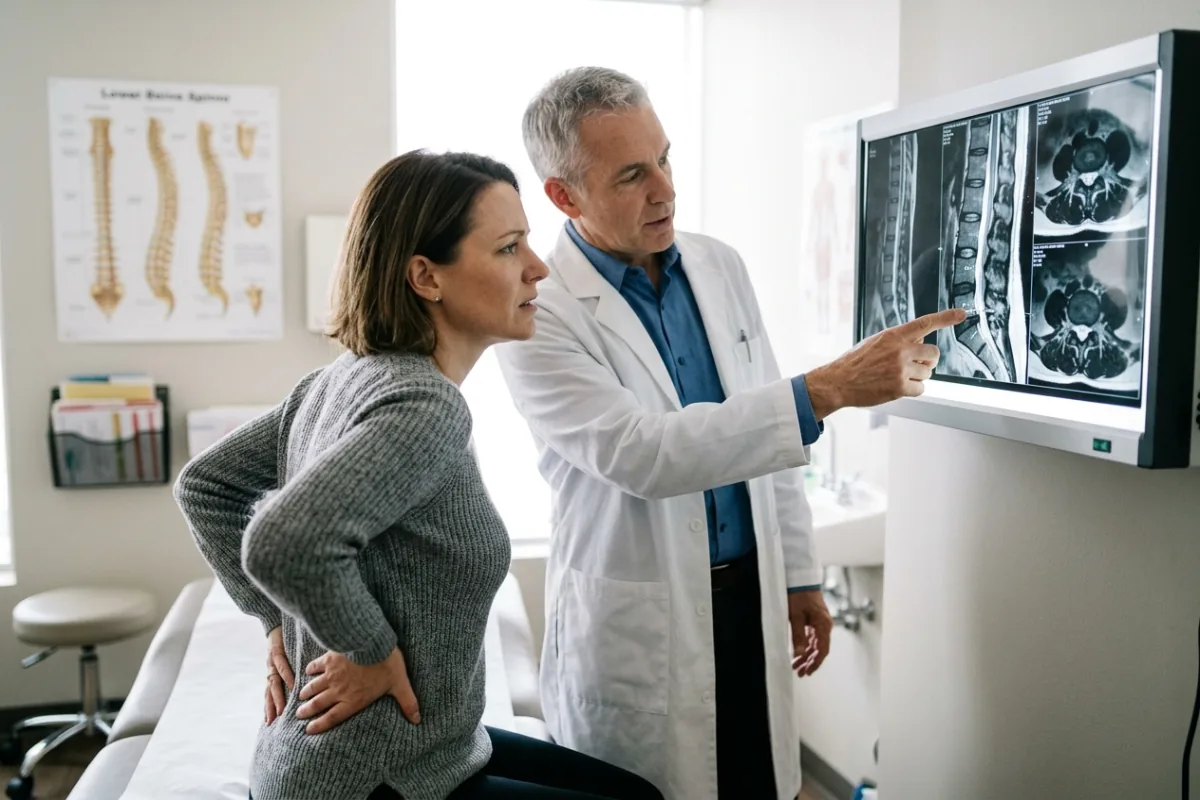
The lumbar spine contains five large vertebrae in the lower back. It bears substantial body weight and transfers load toward the pelvis. A collision may strain lumbar muscles and ligaments, irritate facet joints, fracture a vertebra, or injure a disc and nearby nerve root.
A lumbar disc can bulge or herniate, but imaging language alone does not establish how much pain or disability a person has. AAOS guidance on lumbar disc herniation explains that a herniated disc can cause lower-back pain, radiating leg pain, numbness, tingling, or weakness when a nerve root is affected. Pain traveling below the knee is one clinical clue.
Low-back pain after a crash may improve with time and nonsurgical care, while some injuries produce lasting radicular symptoms or functional limits. The important questions are whether symptoms are anatomically consistent, whether they began or changed after the collision, and how the findings respond to treatment.
Regional Differences in Symptoms
The region changes both the symptom pattern and the stakes. Cervical injuries may produce neck pain, headaches, shoulder pain, arm symptoms, or problems with hand control. Thoracic injuries may create mid-back pain, pain around the ribs or trunk, and neurological changes below the injured level. Lumbar injuries may cause low-back pain, buttock pain, sciatica, leg weakness, or foot symptoms.
The structures also move and bear load differently. The cervical spine prioritizes mobility, the thoracic spine is constrained by the rib cage, and the lumbar spine bears greater weight. A disc, joint, ligament, fracture, or nerve injury therefore presents differently depending on its level.
A patient can injure more than one region in the same collision. Clinicians should follow the reported symptoms and examination instead of assuming that a rear impact affects only the cervical spine or that a side impact affects only the thoracic spine.
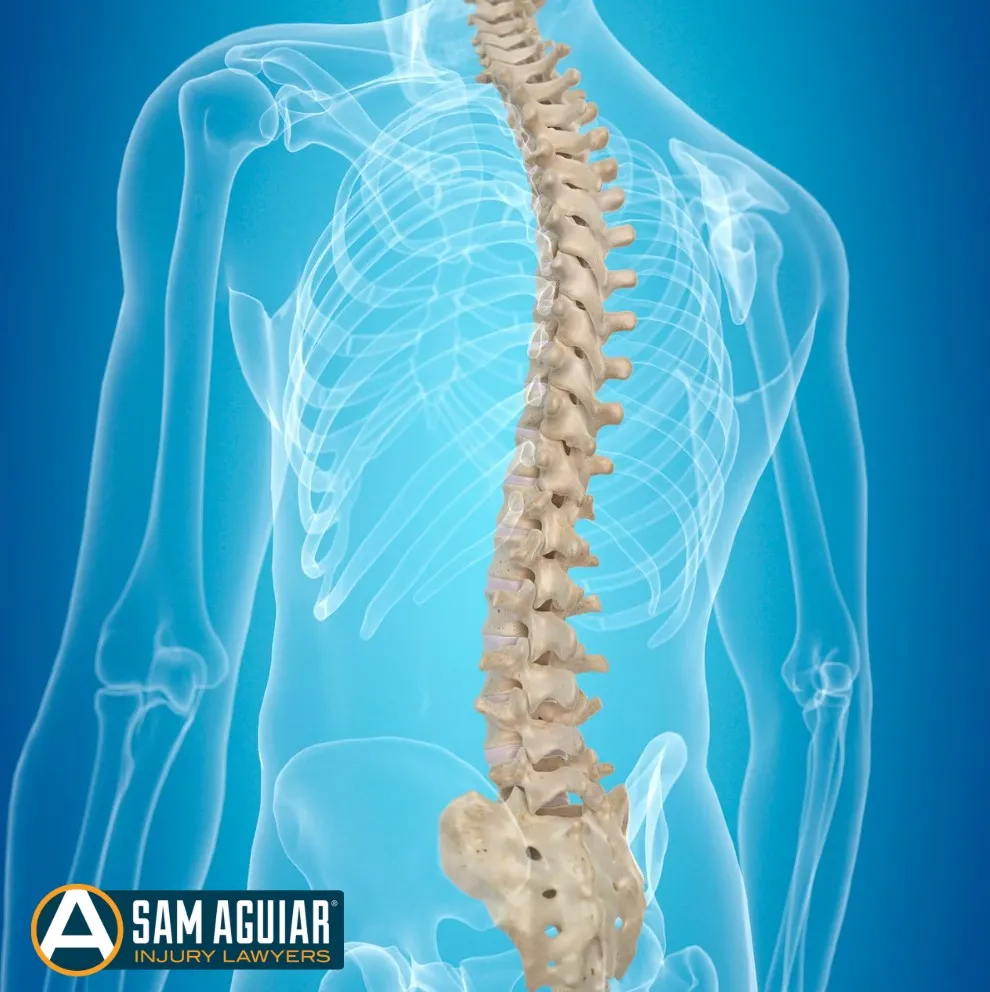
One Spine, Three Different Regions
The cervical spine moves the neck, the thoracic spine anchors the ribs, and the lumbar spine carries substantial body weight.
The injured level explains where pain, weakness, numbness, or movement limits appear.
Common Diagnoses After a Collision
Spine injury is a category, not one diagnosis. Common findings include muscle strain, ligament sprain, facet-joint injury, disc bulge, disc herniation, annular fissure, vertebral fracture, radiculopathy, and spinal cord injury. Some findings are traumatic, some are degenerative, and some require comparison with earlier records to understand.
- Sprain and strain involve ligaments, muscles, or tendons and may cause pain, spasm, stiffness, and reduced movement.
- Disc injury can affect the disc’s outer ring or allow disc material to displace toward the spinal canal or a nerve root.
- Radiculopathy describes symptoms from an irritated or compressed nerve root, often producing pain, numbness, tingling, or weakness along a nerve distribution.
- Fractures range from stable compression injuries to unstable patterns that threaten the spinal cord or nerve roots.
- Spinal cord injury can change strength, sensation, walking, breathing, bladder, bowel, and other functions below the damaged level.
MedlinePlus guidance on spinal cord trauma explains that the effects of spinal cord injury depend on the level and extent of the damage, with different consequences for cervical, thoracic, and lower injuries.
Symptoms That Need Prompt or Emergency Care
New or worsening neurological symptoms after a crash should not wait for a routine appointment. MedlinePlus lists weakness, numbness or altered sensation, difficulty walking, pain or pressure in the head, neck, or back, breathing difficulty, and loss of bladder or bowel control among possible spinal cord injury symptoms.
Loss of bladder or bowel control, saddle-area numbness, rapidly progressing leg weakness, or severe difficulty walking can indicate compression of critical nerve structures and requires emergency evaluation. Severe neck or back pain after a high-energy collision, visible deformity, or symptoms in multiple limbs also call for urgent attention.
Not every delayed symptom is an emergency, but delay can occur with cervical strains and other soft-tissue injuries. AAOS notes that neck-sprain pain may begin hours later or the next day. A timely examination documents the neurological baseline and determines whether the person needs imaging, medication, activity restrictions, or specialist referral.
Clinical Examination and Imaging
Diagnosis begins with the crash history, symptom timing, prior medical history, and physical examination. Clinicians may test strength, sensation, reflexes, gait, tenderness, and range of motion. They also look for patterns that point to a particular nerve root or spinal level.
Imaging is selected to answer a clinical question. The American College of Radiology’s acute spinal trauma criteria describes multidetector CT as the usual first-line modality for many blunt-trauma scenarios, with MRI considered in specific situations. CT is strong for fractures and alignment. MRI can show the spinal cord, discs, ligaments, bleeding, inflammation, and nerve compression. X-rays can show some fractures or misalignment but do not display a neck sprain itself.
An abnormal MRI is not a complete diagnosis by itself. The clinician must compare the image with the symptoms, examination, trauma mechanism, and any earlier studies. The same is true when imaging is normal but the patient has pain and functional limits that require continued clinical evaluation.
Treatment Options
Treatment varies with stability, neurological findings, pain, function, age, health, and the injured structure. Many strains and uncomplicated disc symptoms are initially managed without surgery. A plan may include short-term activity modification, medication, supervised exercise, physical therapy, and follow-up examination.
AAOS guidance describes nonsurgical care for many lumbar disc herniations and notes that only a small percentage of patients require surgery. Surgery may be considered when painful symptoms do not improve with appropriate nonsurgical treatment or when muscle weakness, walking difficulty, or bladder and bowel loss is present. Fractures and spinal cord injuries follow different pathways and may require stabilization or urgent surgery.
Chiropractic care, injections, or other procedures are not automatically right or wrong for every crash injury. The diagnosis, red flags, imaging, medications, and medical history all change the plan. Treatment decisions belong with licensed clinicians who can explain the expected benefit, alternatives, and risks.
Functional Recovery
Pain scores are only one part of recovery. A useful record describes whether the person can sleep, drive, sit, stand, lift, work, exercise, care for children, and complete ordinary household tasks. It also records whether symptoms radiate, whether weakness or numbness changes, and what happens after activity.
Improvement is rarely perfectly linear. A person may tolerate an activity one day and have increased symptoms afterward. That does not automatically prove recovery or permanent injury. Repeated examinations, treatment response, work restrictions, and functional testing provide a more dependable picture than one photograph or isolated office note.
Keeping appointments and following the treatment plan creates continuity. When there is a gap, the reason should be documented, whether it involved access, cost, transportation, improvement, another illness, or a change in the treatment plan.
Pre-Existing Spine Changes and Crash Aggravation
Degenerative disc changes, arthritis, earlier pain, or a prior injury do not answer what a later crash caused. The medical question is whether the collision produced a new condition, worsened an existing condition, or caused new symptoms and functional limits from a previously stable finding.
The most useful comparison includes earlier medical records and imaging, the person’s function before the crash, the onset and location of new symptoms, objective examination changes, and the treating clinician’s reasoning. Hiding a prior condition damages credibility. Addressing it directly allows the new and old evidence to be compared.
The firm’s pre-existing condition page explains this issue in more detail. The legal result is fact-specific, so no one should assume that an old MRI defeats the case or that every post-crash symptom was caused by the collision.
Building the Medical and Legal Record
A spine injury claim is stronger when the record stays specific. Preserve the crash report, scene and vehicle photographs, witness information, ambulance and emergency records, imaging, specialist notes, therapy records, work restrictions, bills, and prior records for the same region. Describe symptoms accurately without exaggerating or minimizing them.
When a commercial vehicle or defective component may be involved, additional evidence can disappear quickly. Electronic vehicle data, video, inspection records, and maintenance records may require early preservation. A legal team can also identify applicable insurance and evaluate whether another person or company may share responsibility.
A daily symptom and activity log is useful when it stays factual. Record the affected region, radiating symptoms, medication effects, sleep, missed work, and specific tasks that became harder. Avoid turning the log into a legal argument. The medical record and the person’s consistent description should remain the primary evidence.
Our car accident practice page explains the broader claim process, while the spinal cord injury page addresses catastrophic neurological injuries. The form on this page can be used to request a case review. Medical emergencies should go to emergency services first.
If a car accident caused a spine injury, Sam Aguiar Injury Lawyers can review the accident records, treatment history, and available insurance coverage. Call (502) 888-8888 or request a free case review.