

Car Accident Lumbar Spine Injuries
Key Takeaways
- In a 2017 study in BMC Musculoskeletal Disorders of 903 crash patients, lumbar disc derangement was more frequent after head-on collisions than after rear-end or T-bone crashes.
- The American Academy of Orthopaedic Surgeons describes a Chance fracture that can occur in a head-on crash when a lap belt holds the pelvis while the upper body is thrown forward.
- A systematic review in the American Journal of Neuroradiology found disc degeneration on imaging in 37% of 20-year-olds and 96% of 80-year-olds with no back pain.
Lumbar Spine Anatomy
The lumbar spine is the lower back. The American Academy of Orthopaedic Surgeons (AAOS) describes it as five vertebrae, with a soft, round cushion called an intervertebral disc between each pair. Each disc has a tough outer ring, the annulus fibrosus, and a jelly-like center, the nucleus pulposus, and the discs work as shock absorbers when a person walks, runs, or jumps.
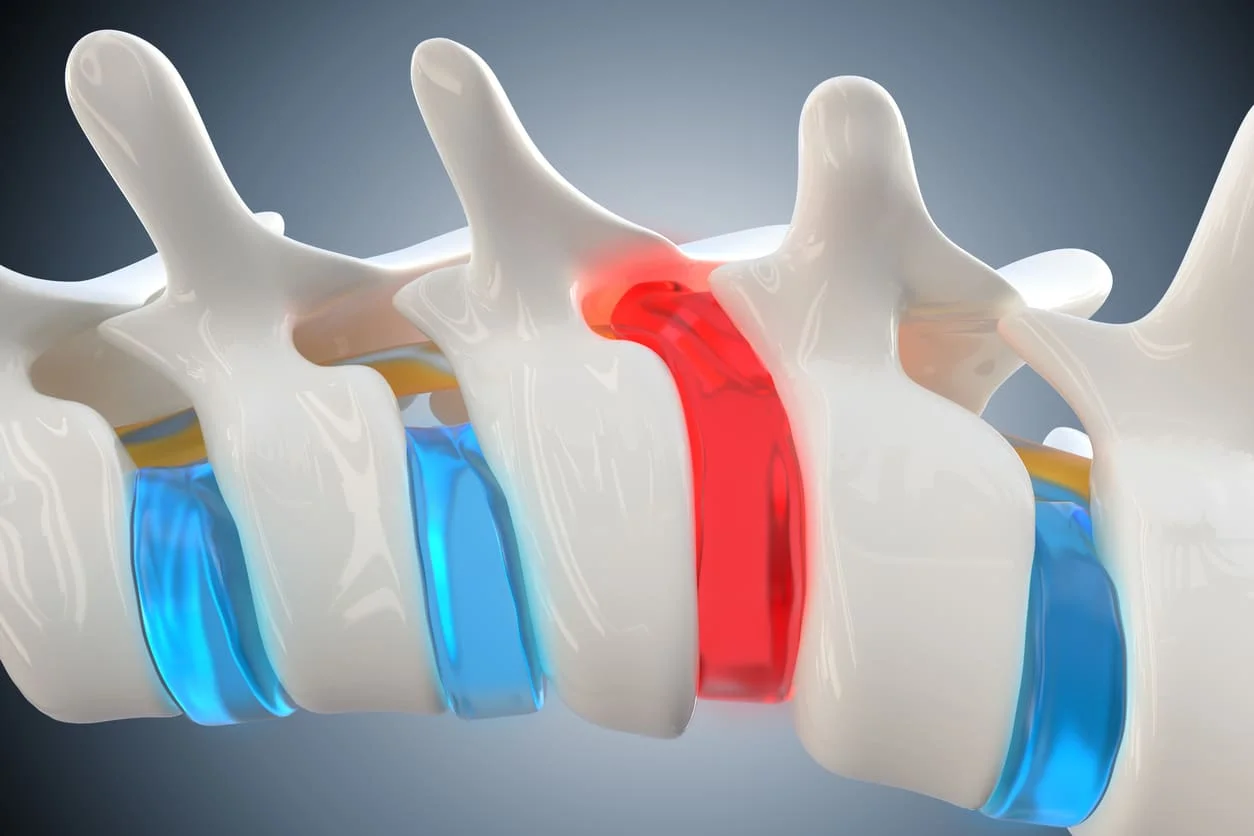
This part of the spine carries a heavy load. MedlinePlus notes that the lower back is the most common place for back pain because it supports most of the body’s weight.
The AAOS describes the cauda equina, Latin for “horse’s tail,” as the bundle of nerve roots at the lower end of the spinal cord. It explains that these roots send and receive signals to the pelvic organs and the legs, and that the roots controlling bladder and bowel function are especially vulnerable to damage.
Crash Forces on the Lower Back
Direction of impact shapes what happens to the lower back. A 2017 study in BMC Musculoskeletal Disorders reviewed 903 crash patients evaluated within 10 days of symptom onset. Lumbar disc derangement, defined as a protrusion or herniation larger than 2 mm on MRI, was more frequent after head-on collisions than after rear-end or T-bone crashes.
The authors linked that pattern to how a belted body moves. In a head-on crash, they wrote, the lower back first bends forward sharply and is compressed, and the fast loading can raise pressure inside the disc and strain its outer fibers. They also noted the study’s limits: it came from a single pain clinic, and crash speed and other impact details were not known.
Seat belts add a specific fracture pattern. The AAOS describes a flexion/distraction fracture, also called a Chance fracture, that can happen in a head-on collision when the upper body is thrown forward while a lap belt holds the pelvis in place. The page on seatbelt injuries covers belt-related injuries elsewhere in the body.
Soft Tissue Strains and Sprains
Most acute low back pain is a muscle or ligament problem. MedlinePlus says it is most often caused by a sudden injury to the muscles and ligaments that support the back, through muscle spasm or a strain or tear in those tissues, and that the pain often starts right after a sudden movement or an accident.
The same source lists the usual complaints: stiffness, less movement in the lower back, and trouble standing up straight. The pain can be a dull ache, a burning or tingling feeling, or a sharp pain severe enough that the person cannot move.
Strains usually settle. MedlinePlus says most people with back pain improve or recover within 4 to 6 weeks, often sooner. MedlinePlus lists low back pain that does not get better after treatment among the most common reasons for a lumbar MRI.
Herniated Discs and Nerve Roots
A herniated disc happens when the soft center of a disc pushes through its outer ring. The AAOS says this can develop slowly from wear and tear or suddenly after an injury, that a traumatic event such as a fall can cause it, and that it happens most often in the lumbar spine.
The damage is both mechanical and chemical. According to the AAOS, the bulging disc squeezes nearby nerve roots, and the disc material also releases chemical irritants that inflame the nerve. That combination can cause pain, numbness, or weakness in one or both legs.
Nerve pain does not always come with a visible herniation. The BMC Musculoskeletal Disorders study defined lumbar radiculitis as nerve-root symptoms without disc derangement on MRI, and found it more common after head-on and side-swipe collisions. The page on car accident herniated discs goes deeper into disc injuries at every level of the spine.
Symptoms That Travel Down the Leg
Low back pain is usually the first sign of a herniated disc, according to the AAOS. It may last a few days and then improve. Other symptoms can follow: a sharp, shooting pain from the buttock down the back of one leg, numbness or tingling in the leg or foot, or weakness in the leg or foot.
That leg pain is called sciatica. MedlinePlus describes the sciatic nerve as starting in the lower back and running down the back of each leg, and says sciatica most often affects one side. Some people feel sharp pain in one part of the leg and numbness in another, and a weak foot can catch on the ground while walking.
Fractures feel different. The AAOS says a fracture of the lumbar spine causes moderate to severe back pain that gets worse with movement. After a high-energy crash, other injuries may hurt more than the fractured spine, and the AAOS says a spine fracture has to be assumed in that setting.
Some symptoms need prompt attention. MedlinePlus lists signs that call for contacting a provider right away, and the AAOS calls cauda equina syndrome a surgical emergency.
Lower Back Red Flags
- Back pain after a severe blow or fall
- Loss of control over urine or stool, or being unable to urinate
- Numbness between the legs, over the buttocks, or in the inner thighs
- Weakness or numbness in the buttocks, thigh, leg, or pelvis
- Pain traveling down the legs below the knee
- Pain that is worse lying down or that wakes a person at night
- Difficulty walking or keeping balance
- Unexplained fever with back pain
Why Kentucky Hires
Sam Aguiar Injury Lawyers
Vertebral Fractures From High-Energy Crashes
The AAOS lists car and motorcycle collisions among the high-energy events that can fracture the thoracic and lumbar spine and says most spinal fractures happen in the thoracic and lumbar spine or where the two meet. Surgeons classify them by the fracture pattern, often grouped as flexion, extension, or rotation injuries, and by whether the spinal cord is injured.
A compression fracture crushes the front of a vertebra and leaves the back intact. The AAOS says it is usually stable and rarely causes nerve problems. A burst fracture breaks both the front and back of the vertebra, can press on nerves, and may or may not be stable. A Chance fracture pulls the vertebra apart and is typically unstable.
Rotation and sideways bending can break a transverse process, a fracture the AAOS says does not usually affect stability. A fracture-dislocation, where one vertebra shifts off the next, is unstable, frequently compresses the spinal cord, and requires surgery.
Three Injuries Side by Side
The table below lines up three lumbar injuries seen after crashes, using the MedlinePlus and AAOS descriptions cited above. They are not mutually exclusive: the AAOS notes that people in high-energy crashes often have more than one injury.
| Feature | Muscle or Ligament Strain | Herniated Disc | Vertebral Fracture |
|---|---|---|---|
| What is injured | Muscles and ligaments that support the back | Disc center pushed through its outer ring | Bone of one or more vertebrae |
| Typical symptoms | Stiffness, spasm, trouble standing straight | Back pain, then leg pain, numbness, or weakness | Moderate to severe back pain that worsens with movement |
| Usual course | Most improve within 4 to 6 weeks | Most symptom free by 3 to 4 months | Back pain for several months is not uncommon |
| Surgery | Not a listed treatment | Needed in a small share of patients | Depends on stability and nerve injury |
Imaging the Lumbar Spine
Imaging depends on how the injury happened. For ordinary back pain, MedlinePlus says providers usually do not order spine tests during the first visit or for 4 to 6 weeks unless certain symptoms are present. After trauma, the AAOS says a radiologic evaluation is required once the physical exam is done, and it may include x-rays, CT scans, and MRI scans of several areas.
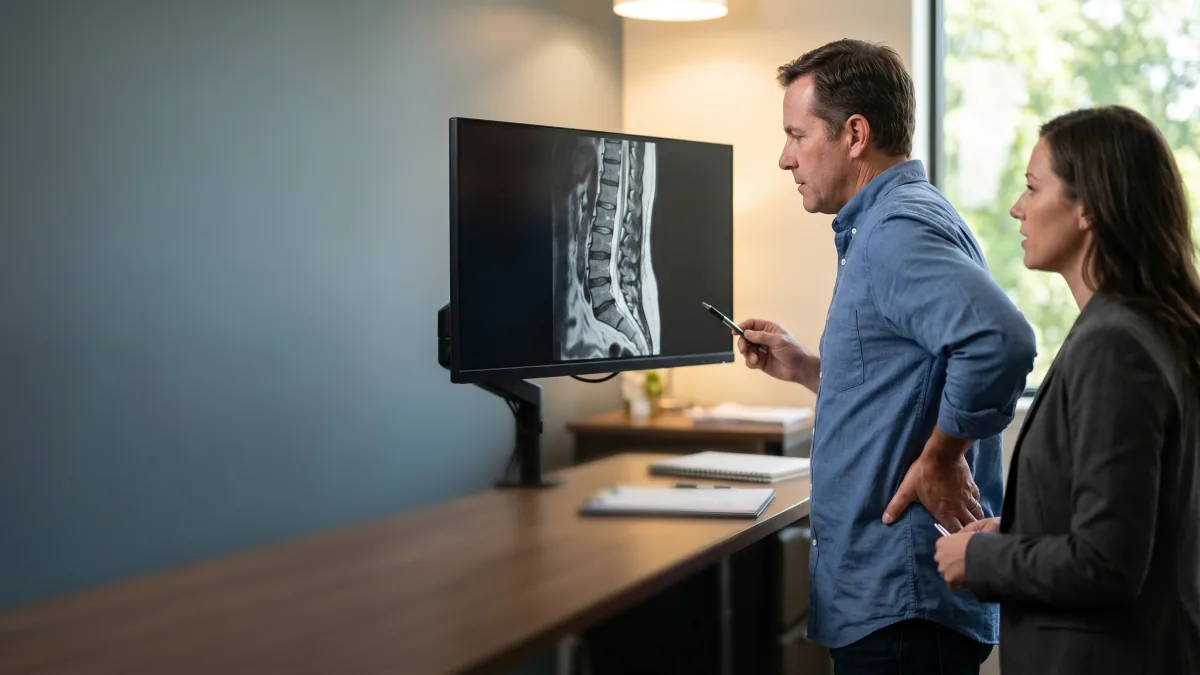
MRI shows the discs and nerves. MedlinePlus says a lumbar MRI uses strong magnets instead of x-ray radiation, most often lasts 30 to 60 minutes, and is ordered for injury or trauma to the lower spine and for leg weakness or numbness that does not improve. The AAOS adds that MRI can confirm a herniated disc and show which nerves are affected, and that a CT scan or CT myelogram is an option for people who cannot tolerate MRI.
The page on reading an MRI report explains the terms that show up most often in lumbar reports.
Age-Related Disc Changes on MRI
Lumbar MRIs often show wear that was there before a crash. A systematic review in the American Journal of Neuroradiology pooled imaging from 3,110 people with no back pain. Disc degeneration appeared in 37% of 20-year-olds and 96% of 80-year-olds, and disc bulges rose from 30% to 84% across the same ages. The authors concluded that many of these findings are likely part of normal aging and unrelated to pain.
Old changes and new symptoms can sit together. The BMC Musculoskeletal Disorders study noted that some patients may have had disc derangement before the collision and that the crash may have started their symptoms. It cited a three-part causation analysis: biologic plausibility, a link in time between the collision and symptom onset, and no more probable explanation for the symptoms.
Conservative Care and Epidural Injections
Treatment for a herniated disc usually starts without surgery. The AAOS lists a day or two of rest, anti-inflammatory medication, physical therapy to strengthen the lower back and abdominal muscles, and epidural steroid injections, which place a cortisone-like medicine around the irritated nerve.
The AAOS says there is good evidence that epidural injections relieve pain in many patients who have not improved after 6 weeks or more of other nonsurgical care. It also points out that these treatments ease symptoms without healing the disc itself, and that in many cases the herniated material dissolves over time.
Long bed rest is not part of the plan. MedlinePlus says bed rest is not recommended and that people with no sign of a serious cause are encouraged to stay as active as possible. It adds that pain lasting longer than a month may lead to a referral to a rehabilitation physician or an orthopedist.
Surgery for Disc Herniation and Fractures
Only a small share of lumbar disc herniations need surgery, according to the AAOS. Surgery is usually considered when nonsurgical care has not relieved the pain, or when there is muscle weakness, difficulty walking, or loss of bladder or bowel control. The most common procedure for a single herniated disc is a microdiscectomy, which removes the herniated portion through a small incision.
Timing matters. The AAOS says studies suggest results are less beneficial when surgery comes at around 9 to 12 months instead of before 9 months.
Unstable fractures follow a different path. The AAOS describes a laminectomy to take pressure off the spinal cord, followed by screws, rods, or cages to stabilize the fracture. MedlinePlus defines spinal fusion as surgery that permanently joins two or more vertebrae so there is no movement between them, and lists injury or fractures to the spine among its uses.
Recovery Timelines and Chronic Pain
Recovery runs in ranges. MedlinePlus says many people with acute low back pain feel better within a week. For a herniated disc, the AAOS says most patients are free of symptoms by 3 to 4 months, though some have flare-ups along the way. After a microdiscectomy, leg pain tends to improve more than back pain, with pain improving first, then leg strength, then sensation.
Fractures take longer. The AAOS says continued back pain for several months is not uncommon after a thoracic or lumbar fracture, and that rehabilitation follows healing whether or not surgery was needed.
Some pain outlasts healing. The National Institute of Neurological Disorders and Stroke defines chronic pain as pain lasting longer than three months or past the expected healing time, and says an acute pain condition can persist and become chronic.
Long-Term Complications and Repeat Herniation
A treated disc can fail again. The AAOS puts the lifetime chance of the same disc herniating again at up to 20 to 25%, with or without surgery. Surgical risks it names include nerve injury, infection, a tear in the sac covering the nerves, and the need for more surgery.
Fusion changes how the rest of the spine moves. MedlinePlus says the vertebrae above and below a fusion are more likely to be stressed and to wear, which may cause problems later.
Fractures bring their own risks. The AAOS lists blood clots in the pelvis and legs, pulmonary embolism, pneumonia, and pressure sores, plus spinal fluid leaks, hardware failure, and bones that do not heal after surgery. For cauda equina syndrome, the AAOS says some patients do not recover full function even with immediate treatment.
Medical Records That Track Each Stage
A lumbar injury is documented in layers. The emergency or urgent care note records the first complaint. The physical exam, which the AAOS describes as testing leg strength, sensation, and reflexes, records the nerve findings. Each imaging report records what the radiologist saw at that point in time.
Later records carry as much weight as the first ones. Physical therapy notes, injection records, and surgical reports show how the injury responded to treatment, and a prior spine MRI, if one exists, gives a point of comparison for new findings.
Back pain that starts in the days after a crash is easier to trace when the first complaint, each imaging report, and every referral are kept together. A dated log of symptoms, including any leg pain, numbness, or weakness, gives each new provider a record to compare against.
Lower Back Injury Keeping You Off Work?
A herniated disc or a fractured vertebra can keep you from lifting, sitting, or driving for months, and an insurer may point to age-related changes on the MRI to say the crash changed nothing. Sam Aguiar Injury Lawyers lines up the emergency records, the imaging, and the treating doctors’ notes so the timeline of your symptoms is on paper. Under our Bigger Share Guarantee®, you always walk away with more than the firm after bills, liens, and case costs. Start with a free case review.