

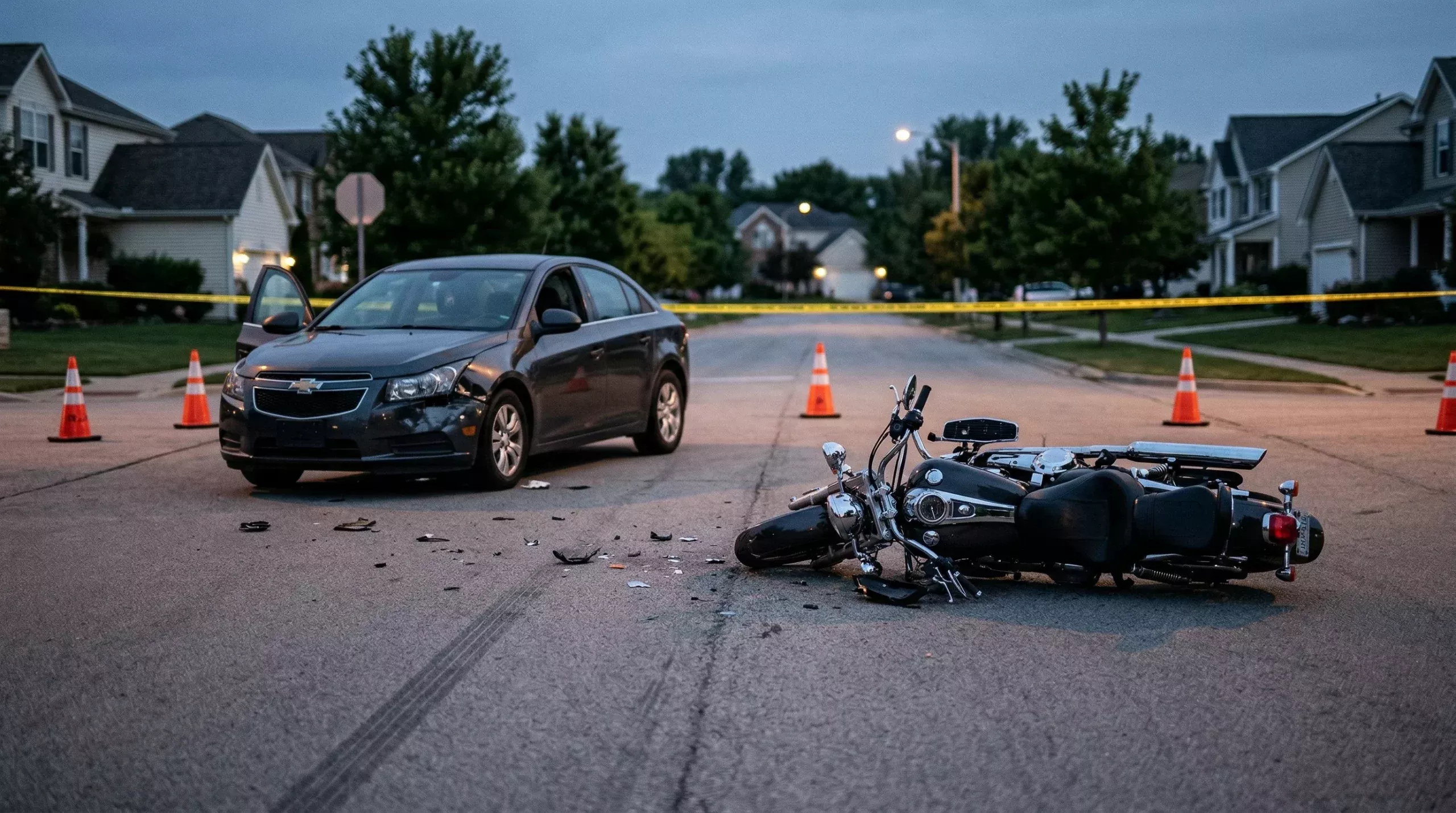
Nighttime Motorcycle Accidents in Kentucky
When darkness makes every mile more dangerous — and proves why evidence collected fast matters most.
The Numbers Behind Kentucky’s Nighttime Motorcycle Risk
Dark conditions kill at a rate far out of proportion to the hours driven in them. Nationwide, NHTSA’s 2023 motorcycle crash data shows that 39% of motorcycle fatalities occurred in the dark — despite the fact that far fewer vehicle miles are traveled at night than during the day. The fatality rate per mile traveled at night is dramatically higher than during daylight.
Kentucky’s own numbers are striking. The 2023 Kentucky Traffic Collision Facts Report documented that 43.3% of all fatal collisions in the state — 332 out of 767 fatal crashes — happened in dark conditions. That’s nearly half of all deadly crashes concentrated in the hours of reduced visibility. For motorcyclists, whose visibility challenge is greater than it is for car occupants, the nighttime environment demands a level of caution from other drivers that is not always present.
The Insurance Institute for Highway Safety (IIHS) confirms that 47% of motorcyclist deaths in 2023 occurred on weekends, and those deaths were more likely to occur after 6 p.m. compared to weekday crashes. This aligns with a pattern of increased nighttime exposure combined with higher rates of impaired driving by other motorists on weekend evenings.
Why Nighttime Makes Motorcycle Crashes More Likely and More Deadly
Motorcycle crashes at night are not simply daytime crashes that happen after sunset. The darkness introduces specific physical and perceptual challenges that compound each other:
Reduced Rider Conspicuity
A motorcycle’s visual footprint is already small compared to a car or truck. In daylight, a moving headlight and a rider’s silhouette provide some conspicuity. At night, the motorcycle is reduced essentially to a single moving light. Drivers at intersections, making left turns, or changing lanes have less visual information to process, and less time to process it, before they act. The inattentional blindness research that applies to daytime left-turn crashes intensifies at night — drivers scanning an intersection are even less likely to register a single headlight as an oncoming vehicle.
Road Lighting Deficiencies
Not all Kentucky roads are equally lit. Rural state routes, older county roads, and even some urban arterial corridors have inadequate or non-functioning lighting. The Federal Highway Administration’s roadway lighting guidance recognizes that proper road lighting reduces nighttime crash rates significantly. When a rider is injured on a stretch of road with absent or inadequate public lighting, the governmental entity responsible for that road’s maintenance may bear partial liability for failing to provide safe conditions.
Reduced Reaction Distance
Even with headlights operating properly, the distance at which a driver can detect and react to a motorcycle at night is shorter than in daylight. Under KRS 189.040, motorcycle headlights in Kentucky must have sufficient intensity to reveal persons and vehicles at a distance of at least 200 feet on low beam. That’s the legal minimum — but at highway speeds, 200 feet of reaction distance is only about 1.5 seconds. The margin for error is narrow, and it evaporates when other drivers aren’t looking for motorcycle-sized hazards.
Kentucky Lighting Laws: What Motorcyclists and Other Drivers Are Required to Do
Kentucky law is clear about lighting obligations on the road at night:
- KRS 189.030 — All vehicles must have headlamps illuminated during the period from one-half hour after sunset to one-half hour before sunrise, and any other time when atmospheric conditions reduce visibility. This is the standard headlight law applicable to both motorcycles and cars. A driver who hits a motorcycle without proper headlights may have violated this statute.
- KRS 189.040 — Every motorcycle in Kentucky must be equipped with at least one and no more than two headlamps that meet U.S. Department of Transportation standards. These headlamps must be capable of revealing persons and vehicles at least 200 feet ahead on low beam and 350 feet ahead on high beam. Headlamps must emit only white light — no colored covers or films that alter the beam.
- Duty to use low beams within 500 feet of oncoming vehicles — Under KRS 189.040, drivers must switch to low beams when approaching an oncoming vehicle within 500 feet and when following another vehicle within 300 feet. Failure to do this creates a blinding situation that can directly cause or contribute to a collision.
When Other Drivers Violate Lighting Laws
A driver who hits a motorcyclist at night while running without headlights, or who blinded the rider by failing to dim their high beams within the required distance, may have committed negligence per se — meaning the violation of the statute itself establishes the breach of duty. If you were hit at night by a driver whose lighting conduct violated KRS 189.030 or KRS 189.040, that violation is central evidence in your claim. We document and preserve this evidence from the first consultation.
Government Liability for Inadequate Road Lighting
When a crash occurs on a poorly lit section of public roadway, the question of government liability deserves serious attention. Kentucky municipalities and the Kentucky Transportation Cabinet have a duty to maintain roadways in a reasonably safe condition. Where inadequate or non-functioning street lighting is a contributing factor in a crash, a governmental entity may be liable under Kentucky’s limited waiver of sovereign immunity.
These claims require specific procedural steps. Kentucky law imposes strict notice requirements before you can sue a governmental body — deadlines that can be as short as 90 days from the date of injury. Missing these deadlines can permanently bar a valid claim. If you believe road lighting played a role in your nighttime crash, the clock on your notice obligation may already be running.
The Federal Highway Administration’s guidance on roadway lighting establishes technical standards for illumination levels at intersections and high-crash locations. Evidence that a road fell below FHWA standards — obtained through public records requests or engineering testimony — can establish the governmental negligence claim.
Building Evidence After a Nighttime Motorcycle Crash
Nighttime crashes present unique evidence challenges. Physical evidence may be harder to photograph. Witnesses may have had reduced visibility themselves. Crash scenes are cleared quickly. Here’s the evidence we prioritize:
Critical Evidence in Nighttime Motorcycle Cases
- Surveillance and traffic camera footage — Intersections, business parking lots, ATMs, and residential doorbell cameras often capture nighttime crashes on video. This footage is typically overwritten within 24–72 hours. We move immediately to preserve it.
- Street lighting maintenance records — Public records requests to city or county transportation departments can reveal whether nearby streetlights were reported outaged, scheduled for repair, or had a documented maintenance history. A non-functioning light the government knew about is powerful evidence.
- Vehicle headlight and electrical systems — Physical inspection of the at-fault driver’s vehicle can confirm whether their headlights were functioning and whether they were using them. Post-crash inspection by an independent engineer can document this before evidence is lost.
- First responder lighting notes — Police reports and fire department records sometimes note lighting conditions and visibility at the scene. These are official records that can substantiate your account.
- Dashcam and event data — The at-fault driver’s dashcam, if any, captures exactly what was visible at the time of the crash. The vehicle’s EDR data records speed and braking inputs, establishing what the driver did in the moments before impact.
- Weather and luminance data — National Weather Service data establishes whether conditions beyond darkness — fog, overcast skies, rain — further reduced visibility on the date and time of the crash.
After a Nighttime Crash: What the Insurance Company Will Try
Nighttime motorcycle crashes give insurance adjusters specific arguments to use against riders. Understanding them in advance protects you:
- Claiming the rider wasn’t visible Adjusters may argue the rider was wearing dark gear, had a malfunctioning taillight, or was otherwise not conspicuous enough. This argument attempts to place fault on the rider for not compensating for the other driver’s failure to look. A properly functioning motorcycle with legal lighting has the right to be on the road at night. A driver’s failure to see it is a failure to observe, not the rider’s fault.
- Alleging excessive speed The argument goes: “If you were going slower, you would have had time to react or avoid the crash.” This is often unsupported speculation. We counter it with physical evidence — stopping distances, damage patterns, and EDR data — that establishes actual vehicle speeds.
- Suggesting impairment Because nighttime crashes have higher alcohol-involvement rates overall, adjusters sometimes raise impairment as a factor even when there is no evidence of it. If you were not impaired, toxicology results from the accident scene are your documentation. We obtain and preserve them.
- Minimizing lighting deficiency claims When government lighting failure is involved, the at-fault driver’s insurer has a financial interest in deflecting blame away from their policyholder. Identifying and documenting the road lighting defect separately from the collision claim protects your ability to pursue the full value of your injuries.
Frequently Asked Questions
What percentage of Kentucky motorcycle crashes happen at night?
Can I sue the city or county if poor road lighting contributed to my crash?
What are Kentucky’s motorcycle headlight requirements?
How important is dashcam or surveillance footage in a nighttime crash case?
Does wearing dark gear affect my ability to recover damages after a nighttime crash?
Start Your Free Case Review
Fill out the form below and our team will reach out to discuss your options.