

Amazon Crash Lawsuits
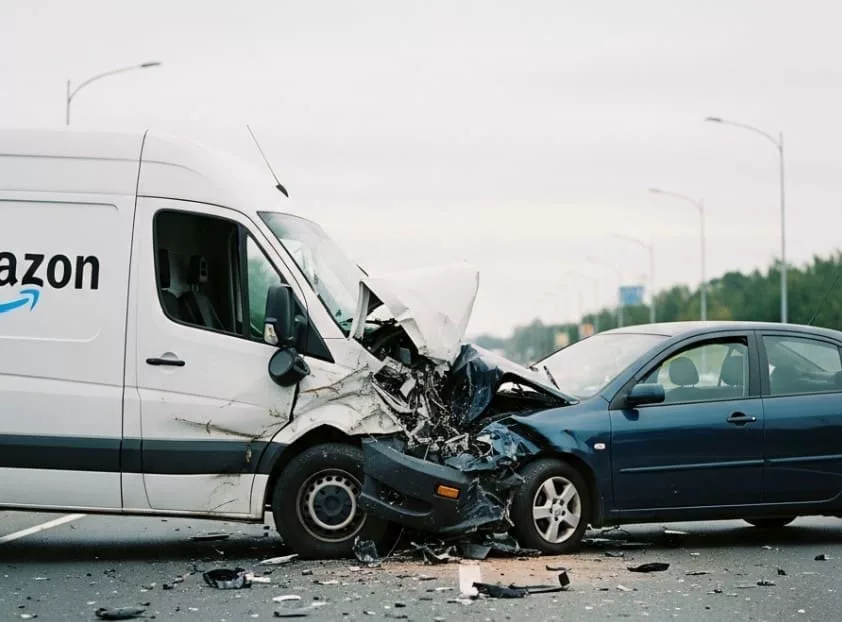
Amazon does not directly employ most of the drivers who deliver its packages in Kentucky. It operates through a three-tier structure of Delivery Service Partners (DSPs), Amazon Flex gig workers, and a small number of direct seasonal employees, and that structure shapes who can be sued after a crash and which insurer pays.
Multiple Defendants
A DSP is a small business that contracts with Amazon, hires drivers, and operates Amazon-branded vans under Amazon’s operational rules. Amazon describes DSP owners as independent contractors who manage day-to-day delivery operations, profit and loss, and the hiring and management of employees and delivery shifts. Amazon, sitting above the DSP in the chain, maintains that it has no liability because the driver works for the DSP.
Amazon’s contractor agreements do not resolve every liability question. In Shaw v. Amazon.com Inc., a South Carolina case, the presiding judge reported that the plaintiffs established Amazon’s actual control and right to control the work of the DSP and its driver, and the jury returned a $44.6 million verdict that included $30 million in punitive damages against Amazon. The judge’s report to the South Carolina General Assembly also states that the parties settled all issues before the appeal was heard. A Kentucky claim requires its own analysis of the working relationship, the applicable law, and the evidence.
Three Potential Amazon Defendants
The driver is personally liable for negligent operation. The DSP is liable as the driver’s employer under respondeat superior and for its own negligent hiring, training, and supervision. Amazon itself can be liable if discovery shows it controlled the driver’s route, performance metrics, equipment, and schedule to the degree that the DSP was operating as Amazon’s agent. All three can be named defendants in a single Kentucky civil action.
Delivery Evidence to Preserve
Delivery operations generate electronic records about routes, vehicle movements, and driver activity that can reconstruct a crash. Availability varies, so the systems involved should be identified and preservation of relevant material requested promptly. The primary categories of evidence in an Amazon crash lawsuit are:
- Camera footage. Amazon describes in-vehicle camera technology used in its delivery operations. Whether a particular vehicle had cameras, what was recorded, and how long it is retained must be confirmed from the actual system and custodian.
- Mentor app safety scores. The Mentor app scores DSP drivers on speeding, phone use, hard braking, and seatbelt use. A poor score for a driver who later causes a crash can show that the DSP and Amazon knew about the safety risk.
- Telematics data. Onboard systems can record speed, braking, acceleration, cornering, and GPS position, which can reconstruct the driver’s movements in the minutes before impact.
- Delivery station routing records. The station assigns the route, sets the time window, and records how many packages the driver was carrying and what the delivery timeline required.
- Flex app and Relay app logs. For Flex gig drivers and Relay middle-mile carriers, the app logs show the instructions Amazon sent, the route the driver was directed to follow, and navigation commands issued before the crash. In November 2025, a Clark County, Nevada judge denied Amazon Logistics’ summary judgment motion in a case where the driver testified the Relay app directed the U-turn that caused the crash.
- Driver qualification and training records. The DSP’s hiring file, Amazon’s required training protocols, and prior incident reports document what Amazon and the DSP knew about the driver.
- Delivery quota and performance metrics. When quota pressure can be tied to a crash through driver communications or Amazon’s performance data, that evidence supports direct liability arguments against Amazon.
A preservation letter provides notice and identifies the evidence sought. It is not a court order and does not automatically establish sanctions if information is lost. Retention periods for camera footage, app logs, and GPS records depend on the system, settings, operator, and applicable requirements, and follow-up or court relief may be needed. Preservation duties and remedies depend on the facts and governing rules, including Rule 37(e) for certain electronic information in federal litigation.
Court Filing and Jurisdiction
An Amazon crash claim may be filed in Kentucky state court when jurisdiction and venue are proper. Federal diversity jurisdiction generally requires complete diversity of citizenship and an amount in controversy exceeding $75,000, excluding interest and costs, under 28 U.S.C. 1332. A crash on an interstate highway does not by itself create federal jurisdiction.
The complaint names each potentially liable party: the driver individually, the DSP as the driver’s employer, and Amazon.com, Inc. and Amazon Logistics, Inc. as the entities that controlled the DSP’s operations. Amazon is incorporated in Delaware with its principal place of business in Washington, while a local DSP and driver are often Kentucky citizens, so the parties’ citizenship must be evaluated before filing.
Kentucky generally provides basic Personal Injury Protection benefits of up to $10,000. For people subject to the no-fault tort limitations, KRS 304.39-060(2)(b) permits recovery for pain, suffering, mental anguish, and inconvenience when medical expenses exceed $1,000 or a listed injury threshold applies, such as a fracture, permanent injury, or death. The statute includes exceptions. The Kentucky Department of Insurance’s no-fault page explains basic benefits and rejection of the no-fault limitations.
Discovery Requests to Amazon
Discovery can clarify which company controlled the delivery work and what safety information it held. The records and testimony sought should address route planning, driver monitoring, and reported safety problems in the particular delivery relationship.
Interrogatories and Requests for Production
Written discovery to Amazon and Amazon Logistics targets the contractual relationship between Amazon and the DSP, including operations manuals, the service partner agreement, and the performance standards the DSP was required to follow. These documents can show whether Amazon controls driver uniforms, vehicle specifications, delivery windows, customer contact protocols, and the criteria for ending DSP contracts, all of which bear on operational control.
Depositions of Amazon Logistics Managers
Depositions can examine who controlled the delivery work. Depending on the records and the claims, witnesses may include the driver, DSP managers, and Amazon personnel involved in the delivery relationship. The testimony must establish what the particular companies and individuals did, because job titles alone do not establish liability.
Subpoenas to Third-Party Data Providers
Amazon’s in-vehicle camera and telematics systems are run through providers like Netradyne and similar platforms. When Amazon resists producing this data, a subpoena to the provider can seek production directly from the source, with requests narrowed to the crash at issue.
FMCSA Records and Safety Data
For middle-mile carriers and DSPs that operate vehicles requiring commercial driver’s licenses, FMCSA inspection records, violation histories, and out-of-service orders are public and discoverable. A CBS News analysis of six years of FMCSA data found that average unsafe driving violation rates for carriers hauling for Amazon were at least 89 percent higher than other carriers in every month studied.
Kentucky Rules for Delivery Crashes
Kentucky’s no-fault system gives a person injured in a motor vehicle crash a right to basic reparation benefits regardless of who caused the crash, under KRS 304.39-030.
A 2024 change in Kentucky law complicates that starting point for delivery drivers. Under KRS 304.39-048, a motor vehicle liability insurer may exclude coverage, and the duty to defend or indemnify, for injury or loss during a delivery available period or a delivery service period. The statute applies to policies issued or renewed on or after January 1, 2025.
The delivery model identifies the insurer and the defendants. The independent-contractor DSP arrangement differs from the Amazon Flex model, which Amazon describes as delivering part-time with a personal vehicle. Amazon also says it gives DSPs hands-on training, business coaching, logistics technology, and on-road support, and pays them fixed monthly amounts based on package volume. For a personal vehicle, the driver’s on-app status at the time of the crash decides which coverage responds.
Injury Documentation
Contemporaneous medical records anchor any crash claim. A StatPearls trauma care review describes how trauma evaluation records the events leading to injury using the S.A.M.P.L.E. history, which covers signs and symptoms, allergies, medications, past history, last meal, and the events of the crash.
The same review explains that imaging such as X-ray, CT, and FAST ultrasound confirms the clinician’s examination, producing objective records of injury. A delivery crash claim relies on two kinds of evidence at once: the records that show who was driving and in what capacity, and the medical records that show what the crash did to the people involved.
Amazon’s Independent-Contractor Defense
Amazon’s litigation position in crash cases follows a consistent pattern: the driver works for the DSP, the DSP is an independent contractor, and Amazon has no liability. Amazon presses this argument through early dispositive motions, including summary judgment.
The argument is most vulnerable when discovery reveals the degree of control Amazon exercises over DSP operations, such as uniform and van specifications, GPS compliance, delivery window adherence, background check protocols, and performance scores that can cost a DSP its Amazon contract.
Amazon also points to its investment in safety technology. The CBS News analysis of carriers hauling for Amazon is one data point against that position in middle-mile truck cases.
Punitive Damages in Amazon Crash Cases
The South Carolina Shaw verdict included $30 million in punitive damages and settled before appeal. That result does not establish entitlement to punitive damages in a Kentucky case. KRS 411.184 governs punitive damages and restricts when they may be assessed against an employer for another person’s conduct. A poor driver score or prior crash does not automatically satisfy that standard.
Claims That Become Lawsuits
An Amazon crash claim may begin like a normal insurance case and become a commercial liability case once responsibility is split across the driver, the DSP, Amazon Logistics, vehicle ownership, and layered insurance policies. An Amazon delivery accident lawsuit asks who assigned the route, who controlled the work, what telematics or camera systems were running, and which entities need to be named before the evidence is lost. The firm’s Amazon DSP contractor model page covers the contractor structure behind these cases.
Ready to Take Action on Your Injury Claim?
After a serious injury, medical bills pile up while the insurance company looks for ways to pay you less. Most law firms take their cut first and leave you with whatever is left. Sam Aguiar Injury Lawyers does things differently. With our exclusive Bigger Share Guarantee®, you always get more. Every client gets a dedicated three-person team: an attorney, a case manager, and a legal assistant. We never raise our fee rate if we have to go to court, and you pay $0 Out-Of-Pocket Forever.
Frequently Asked Questions
1Why is suing Amazon more complicated than suing a regular driver?+
2What evidence does Amazon control that a lawsuit can demand?+
3Has a court ever let a case against Amazon’s delivery program go to trial?+
4Can punitive damages be part of an Amazon lawsuit?+
5What does Amazon’s routing system have to do with liability?+
6Does Amazon settle these cases before trial?+
Latest Articles
Kentucky Diminished Value Claims
Kentucky drivers may pursue a repaired vehicle’s leftover market loss from the at-fault driver as part of a.
FMCSA Revoked ELDs: Fleet Compliance and Enforcement Deadlines
FMCSA removed five electronic logging devices from the registered list on August 6, 2026, and set an October.
FMCSA English Proficiency Rule and OOS Enforcement
FMCSA English Proficiency Rule Sam Aguiar Injury Lawyers August 11, 2026 7 minute read On This Page.