

Amazon Delivery Accident Lawyers
Hit by an Amazon Vehicle?
 ★★★★★
Over 1,000 Five-Star Reviews
•
Available 24/7. $0 Out-Of-Pocket Forever.
★★★★★
Over 1,000 Five-Star Reviews
•
Available 24/7. $0 Out-Of-Pocket Forever.
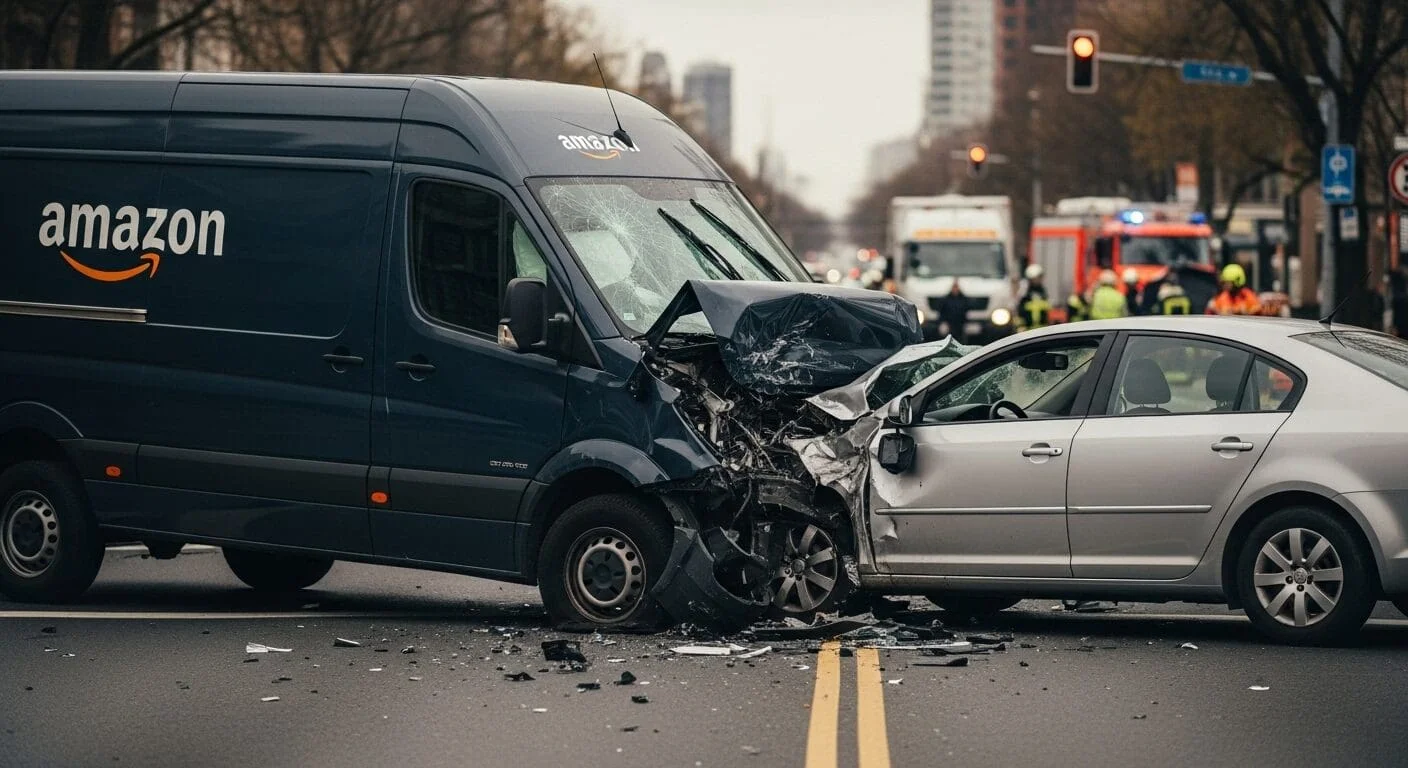
Amazon moves packages through three setups: branded vans run by Delivery Service Partners (DSPs), Flex drivers using their own cars, and Amazon-operated trucks. The setup decides which company is responsible and which insurance applies, so an accident with an Amazon vehicle is rarely a simple two-car case. While you focus on medical care, the delivery company’s insurer may already be reviewing what happened.
Amazon’s Three Delivery Models
Each delivery model puts a different employer and a different first layer of insurance behind the driver.
| Delivery Model | Who Employs the Driver | Insurance That Usually Applies |
|---|---|---|
| DSP (Delivery Service Partner) | A contracting company that delivers exclusively for Amazon | The DSP’s commercial auto policy. Amazon’s responsibility depends on how much control it kept over the work. |
| Amazon Flex | Gig drivers using their own vehicles through the Flex app | The driver’s personal policy, plus Amazon’s commercial auto policy while the driver is actively delivering during a delivery block (not in New York). |
| Amazon Logistics (direct) | Drivers Amazon hires directly for its own vans and trucks | Amazon’s commercial fleet policy |
Contractor Label and Amazon’s Control
Amazon sets the work in its Delivery Service Partner program while holding the contractor at arm’s length. Amazon designs the routes, sets the delivery windows, supplies the branded vans and the technology, and grades performance against its own metrics. When a driver causes an accident, Amazon’s position is that the DSP is the employer. The Georgia state court complaint in Rana v. Amazon Logistics alleges that Amazon decides each driver’s route, chooses the packages on it, and tracks drivers through its apps.
The gap between that control and the contractor label is the center of these cases. An investigation reported by CBS News found that Amazon often avoids liability for delivery-driver accidents through its contractor model, while Amazon tells drivers the route and the order of deliveries. Amazon’s own routing data, performance standards, and contracts show where the control sits.
Injury and Crash Rates in Amazon’s Network
Nearly one in five drivers making deliveries for Amazon were injured in 2021, a 40% increase from the prior year’s injury rate, according to a Strategic Organizing Center report covered by CNBC. The report found contracted Amazon delivery drivers were injured at nearly two and a half times the rate of the non-Amazon delivery industry, and one in seven suffered injuries severe enough to keep them from their regular job or out of work.
The Rana v. Amazon Logistics complaint alleges that Amazon relied on routing algorithms that pushed drivers to complete unsafe package volumes, and that Amazon employees text DSP operators when a driver falls behind Amazon’s pace. The CBS News report cites a ProPublica and BuzzFeed News finding that Amazon delivery drivers were involved in more than 60 crashes causing injuries or death since June 2015.
An Insurance Journal report on a study by the New York City Comptroller’s office found that after last-mile delivery facilities opened, 78% of nearby areas saw more injury-causing crashes, and injuries within a half-mile radius rose by an average of 16%.
Direct Liability for Amazon
Cases have reached Amazon itself when the record shows Amazon controlling the route, the pace, and the vehicle. In Bradfield v. Amazon Logistics, an August 2024 case in the State Court of Gwinnett County, Georgia, an Amazon delivery driver struck and severely injured a young boy. The jury returned a $16.2 million verdict and found Amazon 85% responsible for failing to adequately train the driver, and the court found Amazon exercised enough control over its delivery service providers and their drivers to be treated as a secondary employer. The Rana complaint and the CBS News investigation describe the same control.
Insurance Layers in an Amazon Case
What the driver was doing in the app, on the route, at the minute of the accident decides which coverage was active. The policies that can apply include DSP coverage, commercial auto coverage, Amazon-related coverage, the driver’s personal auto policy, UM/UIM coverage, and household policies.
A personal auto insurer can dispute or deny coverage when the driver was using the vehicle for delivery work, and other policies may still apply. The faster every policy is identified, the easier it is to stop insurers from passing the case back and forth. Your own automobile policy can also pay: many drivers carry underinsured motorist coverage that applies when a delivery driver’s coverage is not enough.
Evidence in Amazon Delivery Cases
Amazon delivery cases often start with the driver relationship, because a DSP driver, a Flex driver, and a subcontracted driver each point to different records and insurance arguments. The app and route data has to be secured immediately. Records that show the driver’s work status and the route include:
- Route assignments and package scans
- Delivery and app timestamps
- Dispatch messages
- GPS history
- Vehicle ownership records
- Contracts between Amazon and the delivery company
Federal Commercial Vehicle Rules
Amazon’s larger vehicles, including its middle-mile tractor-trailers and box trucks, fall under FMCSA regulations when they are commercial motor vehicles as defined in 49 CFR 390.5, such as vehicles with a gross vehicle weight rating of 10,001 pounds or more used in interstate commerce. The Federal Motor Carrier Safety Administration sets standards for driver qualification, hours of service, vehicle inspection, and record-keeping, and those records become evidence when one of these vehicles is in an accident. NHTSA’s event data recorder rule, 49 CFR Part 563, covers light vehicles of 8,500 pounds or less, so heavy truck engine and telematics data comes from the carrier’s own systems.
Injuries in Amazon Delivery Accidents
Injuries from delivery van accidents range from whiplash and disc injuries to fractures, traumatic brain injuries, and spinal cord damage, because delivery vans are heavier than passenger cars and operate in tight residential spaces. The defense will scrutinize the injury record, so it needs complete treatment records, the right medical specialists, and a damages presentation that covers medical costs, lost income, and the long-term effects your doctors expect.
Other Delivery Company Cases
- 1
Parcel Carriers
UPS, FedEx, and USPS vehicle accidents, including the federal case rules that apply when a USPS vehicle is involved.
- 2
Gig Delivery
DoorDash, Uber Eats, and Instacart accidents, where app status decides which commercial coverage was active.
- 3
Commercial Trucks
Box trucks, semis, and freight carriers. The truck accident page covers carrier cases in depth.
How Sam Aguiar Injury Lawyers Handles Amazon Delivery Cases
Sam Aguiar Injury Lawyers builds the record that decides these cases: route assignments, app data, delivery timestamps, dispatch messages, and the contracts that show how much control Amazon kept over the driver. The firm handles the case details, organizes the records, communicates with the insurance companies, and builds the case around your injuries, lost income, medical costs, and the changes the accident caused in your life. When a loved one died in a delivery vehicle accident, the firm’s wrongful death team handles the case for the family.
The case review is free, and every Amazon delivery case carries the same terms, including the Bigger Share Guarantee®:
- Dedicated three-person team: a top-rated attorney, an experienced case manager, and a skilled legal assistant.
- Bigger Share Guarantee®: Clients always walk away with more money than the firm after medical bills, liens, and case expenses are paid. If the client’s share would ever be less than the legal fee, the firm cuts its fee.
- Flat contingency fee that never increases if your case goes to trial.
- $0 Out-Of-Pocket Forever.
An Amazon van, a Flex driver’s car, or a middle-mile truck points to a different insurer, and the app and route records that prove which one applies sit with Amazon and the delivery company. Tell us who was driving and what they were delivering, and start a free case review.
Key Takeaways
Can Amazon Be Responsible for a Contractor’s Crash?
The van that hit you may carry a contractor’s name on the paperwork while Amazon controlled the route, the schedule and the app the driver followed. Sam Aguiar Injury Lawyers looks past that label to find every company and policy connected to your crash. A dedicated three-person case team handles your file, and you pay $0 Out-Of-Pocket Forever. Call today for a free case review.
Frequently Asked Questions
1Who is responsible after an accident with an Amazon delivery vehicle?+
Responsibility depends on whether the driver is a DSP employee, an Amazon Flex contractor, or an Amazon employee. The driver, the vehicle owner, the delivery service partner, Amazon-related coverage, and other insurers may all need review depending on the delivery setup. Amazon’s contractor label carries less weight when evidence shows Amazon controlling routes and pace, and an investigation reported by CBS News found Amazon often avoids liability through its contractor model.
2Can Amazon itself be held responsible for a DSP driver’s accident?+
It can. Amazon’s defense is that DSP drivers are not its employees, but in Bradfield v. Amazon Logistics a Georgia jury found Amazon 85% responsible for failing to train the driver in a $16.2 million verdict, after the court found Amazon controlled enough of the work to be a secondary employer.
3What insurance coverage applies after an Amazon Flex accident?+
According to Amazon Flex, Amazon’s commercial auto policy, which includes liability, uninsured and underinsured motorist, and contingent comprehensive and collision coverage, applies only while the Flex driver is actively delivering during a delivery block, and it does not apply in New York. Flex drivers must also carry their own required insurance, so app records showing the driver’s status at the moment of impact decide which policy responds.
4What records show an Amazon driver was working?+
Route assignments, package scans, delivery timestamps, app records, dispatch messages, GPS data, and vehicle records can show the driver’s work status at the time of the accident.
5Can a personal auto insurer deny an Amazon delivery case?+
A personal auto insurer can dispute coverage when the driver was using the vehicle for delivery work. Other policies may still apply, including DSP coverage, commercial auto coverage, UM/UIM coverage, and household policies.
6Do injury crashes increase near last-mile delivery hubs?+
Yes. An Insurance Journal report on a New York City Comptroller study found that 78% of areas near new last-mile delivery hubs saw more injury-causing crashes, with injuries rising by an average of 16% within a half mile of a hub.
7Does this cover DoorDash, Uber Eats, and Instacart accidents too?+
Yes. App status and stacked coverage decide gig delivery cases across platforms the same way they decide Amazon Flex cases, and federal commercial vehicle rules apply to the larger delivery vehicles on every platform.