

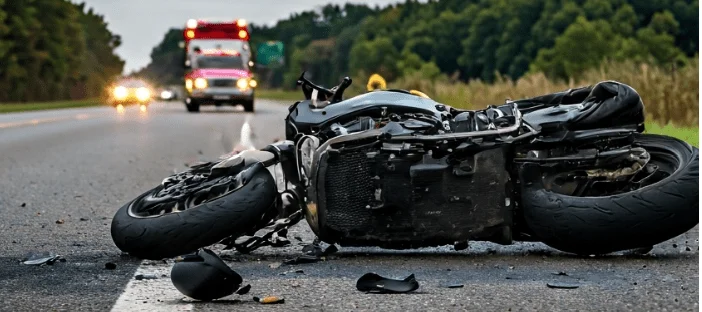
Nighttime Motorcycle Accidents in Kentucky
On This Page
Nighttime motorcycle accidents in Kentucky are disproportionately fatal. The Kentucky Transportation Cabinet Traffic Collision Facts report shows that 43.3% of fatal motorcycle crashes occur in dark conditions, despite fewer riders being on the road after sunset. Under KRS 411.182, Kentucky follows a pure comparative fault system, meaning a motorcyclist injured at night can recover damages even if partially at fault. Our motorcycle accident attorneys handle nighttime crash cases across Kentucky.
Why Nighttime Motorcycle Crashes Are Deadlier
A motorcycle is already the smallest vehicle on the road during daylight hours. After dark, it becomes nearly invisible. The single headlight on most motorcycles produces a narrow beam that blends into the surrounding headlights, streetlights, and signage. Drivers scanning for oncoming traffic at night are looking for the dual headlight pattern of a car or truck. A single light does not register as an approaching vehicle until it is dangerously close.
The National Highway Traffic Safety Administration reports that motorcyclists are about 24 times more likely to die per vehicle mile traveled than passenger car occupants. At night, the fatality rate climbs even higher because darkness eliminates the visual cues that both riders and drivers depend on to judge speed, distance, and road conditions.
Reduced Visibility and Perception Gaps
The human eye loses approximately 70% of its peripheral vision at night. Contrast sensitivity drops by over 50%. A motorcycle rider wearing dark gear on a dark road is visible to an oncoming driver for roughly two to three seconds at highway speeds. That is not enough time for the driver to process what they see, make a decision, and physically apply the brakes.
The problem runs both directions. Riders at night face their own visibility challenges: road debris, potholes, oil slicks, and gravel patches that are visible during the day become invisible after dark. A hazard that a car can roll over without consequence can throw a motorcycle rider from the bike at 55 mph.
Where Nighttime Motorcycle Crashes Happen in Kentucky
Nighttime motorcycle crashes in Kentucky concentrate in two environments: urban entertainment corridors and rural two-lane highways. Kentucky Transportation Cabinet crash data shows the highest nighttime motorcycle fatality rates in the following areas:
- Bardstown Road and Baxter Avenue in Louisville, where bar and restaurant traffic peaks after 9 p.m.
- US 60 (Shelbyville Road) through eastern Jefferson County, with long stretches of inadequate street lighting
- I-65 through Hardin and Hart counties, where semi-truck traffic and motorcycle touring mix on unlit interstate segments
- US 25E through southeastern Kentucky, a winding mountain road with no center-line lighting and sharp elevation changes
- US 68 through central Kentucky, popular with sport touring riders but poorly lit outside city limits
Rural roads without painted edge lines, reflective markers, or overhead lighting account for a disproportionate share of fatal nighttime motorcycle crashes statewide.
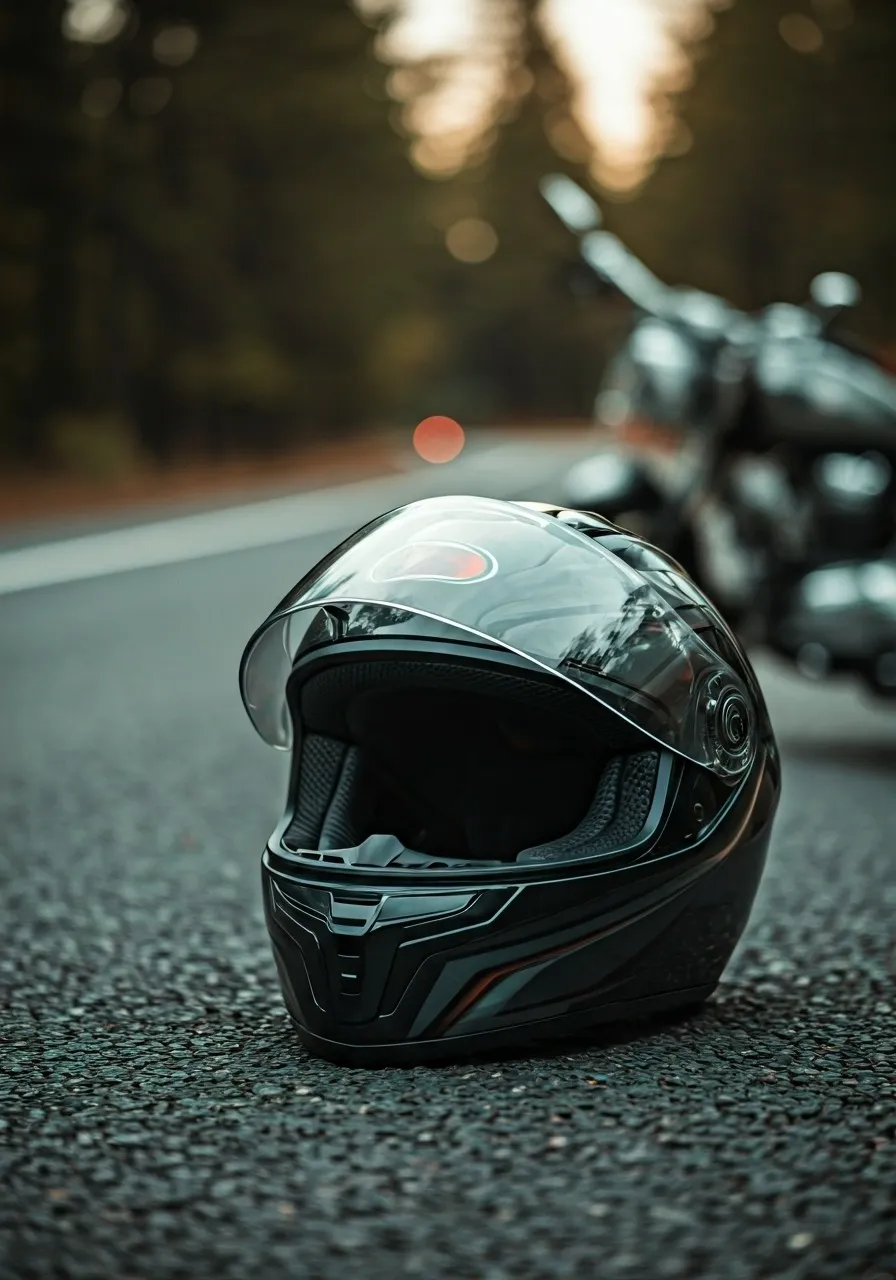
Nighttime Motorcycle Crash Facts
According to the Kentucky Transportation Cabinet, 43.3% of fatal motorcycle crashes occur in dark conditions (unlighted or poorly lighted roads). The IIHS reports 6,084 motorcyclist deaths nationwide in 2022. The NHTSA found that 33% of all fatal motorcycle crashes nationwide involve alcohol, and the rate rises sharply between 9 p.m. and 3 a.m. Kentucky recorded 90 motorcycle fatalities in 2023, with the Office of Highway Safety identifying dark-condition crashes as a leading factor.
How Nighttime Conditions Cause Motorcycle Crashes
Nighttime motorcycle crashes have distinct causes that separate them from daytime collisions. Unlike a typical car accident where both drivers have comparable visibility, darkness changes the physics of the encounter between motorcycles and other vehicles in ways that create specific liability arguments.
Oncoming Headlight Glare and Temporary Blindness
High-beam headlights from oncoming vehicles temporarily blind motorcycle riders. The Federal Highway Administration research on nighttime driving shows that headlight glare from an oncoming vehicle can impair a driver’s vision for three to five seconds after the vehicle passes. For a motorcycle rider traveling at 55 mph, three seconds of impaired vision means covering 242 feet with degraded depth perception and contrast sensitivity.
Riders cannot simply look away. They need to track the road surface, lane markings, and any vehicles ahead. When a car or truck with improperly aimed or aftermarket high-intensity headlights passes an oncoming motorcycle rider, the glare can cause the rider to miss a curve, road defect, or stopped vehicle ahead.
Poor Road Lighting and Unmarked Hazards
Kentucky has over 80,000 miles of public roads. The majority of rural roads have no street lighting, no reflective edge-line markings, and no retroreflective road signs at curves. The Federal Highway Administration’s Nighttime Visibility Guidelines recommend retroreflective pavement markings and roadside delineators for two-lane rural roads, but many Kentucky roads predate these standards.
For motorcycle riders, the absence of road markings is more dangerous than for car drivers. A car has four tires and a wide contact patch that can absorb minor road irregularities. A motorcycle has two narrow tires that can lose traction instantly on loose gravel, standing water, or uneven pavement. When the rider cannot see these hazards coming, the result is often a single-vehicle crash that would not have occurred in daylight.
Impaired Drivers on Kentucky Roads After Dark
Alcohol-impaired drivers are a lethal threat to nighttime motorcycle riders. The NHTSA reports that 33% of all fatal motorcycle crashes involve alcohol, but after 9 p.m. that figure rises above 50% in multi-vehicle crashes. Impaired drivers have slower reaction times, impaired judgment of closing distance, and reduced ability to detect the single headlight of an approaching motorcycle.
Kentucky law (KRS 189A.010) sets the DUI threshold at .08 BAC, but impairment begins well below that level. A driver at .05 BAC has measurably reduced coordination and ability to track moving objects. For a motorcycle rider, that reduced ability to track moving objects is the difference between a driver who sees the motorcycle in time and one who does not.
Animal Crossings on Rural Routes
Kentucky’s white-tailed deer population creates a hazard that peaks between October and December and intensifies after dusk. The Kentucky Department of Fish and Wildlife Resources tracks deer-vehicle collisions, and the data consistently shows that the highest-risk window is between 5 p.m. and midnight during fall. A deer on the roadway is a minor fender-bender for a car. For a motorcycle rider, it is a catastrophic collision.
Riders hitting a deer at highway speed are thrown from the motorcycle. The impact itself can cause fatal chest and head injuries. Even swerving to avoid a deer on a dark road can cause a single-vehicle crash when the rider leaves the pavement or overcorrects.

“If you need a personal injury lawyer who will truly have your back, this is the team you want.”
B. Shumake
Proving Fault in a Nighttime Motorcycle Crash
Nighttime motorcycle crash claims require evidence that addresses the darkness itself. The insurance company will argue that the rider should have been more cautious after dark, that they were hard to see, or that they were riding too fast for conditions. Defeating these arguments requires specific evidence gathered quickly after the crash.
Lighting Surveys and Road Condition Documentation
Our team returns to the crash scene at the same time of night the crash occurred to document the actual lighting conditions. We photograph and measure:
- Street light placement, bulb type (sodium vapor, LED, or burned out), and light throw distance
- Retroreflective pavement marking condition (faded, missing, or never installed)
- Road sign reflectivity (does the speed limit sign or curve warning reflect headlights at the approach distance?)
- Sight-line obstructions (vegetation, utility poles, parked vehicles) that block a driver’s view of the motorcycle
- Ambient light levels measured with a lux meter at the point of impact
This evidence builds the case that the rider was not visible because the road environment failed, not because the rider did anything wrong.
Vehicle Headlight and EDR Evidence
Most vehicles manufactured after 2014 have event data recorders (EDRs) that capture pre-crash data including speed, braking, throttle position, and headlight status. The NHTSA requires EDR data to be retrievable using standard tools. In a nighttime crash, EDR data can prove whether the at-fault driver had their headlights on, whether they were using high beams, and whether they applied brakes before impact.
We also examine the motorcycle’s headlight and taillight. A damaged headlight assembly can reveal whether the headlight was on at impact based on filament stretch patterns. If the insurance company claims the motorcycle was riding without lights, physical evidence from the bulb can disprove that.
Toxicology and BAC Evidence
When a nighttime crash involves a driver who was leaving a bar, restaurant, or party, blood alcohol concentration (BAC) evidence is critical. Kentucky law requires a blood or breath test when a driver is suspected of impairment. Under KRS 189A.010, a BAC of .08 or higher establishes DUI per se.
But even below .08, BAC evidence supports a negligence claim. A driver at .06 BAC has measurably impaired visual tracking and divided attention, both critical to detecting a motorcycle at night. We subpoena bar tabs, credit card receipts, and witness statements from the driver’s evening to establish a timeline of alcohol consumption.
DOT Camera and Dashcam Footage
Louisville Metro and the TriMarc Traffic Management System operate traffic cameras across the Louisville freeway and arterial network, many of which record in low-light and infrared. Our team has exclusive statewide access to DOT and TriMarc camera footage with archives dating back six months. Nighttime footage can show the motorcycle’s headlight visibility, the at-fault vehicle’s approach speed, and the signal phase at the intersection.
We also request dashcam and rear-camera footage from other vehicles near the crash scene. Modern dashcams with night-vision capability can capture the entire collision sequence.
When Poor Lighting Makes the Government Liable
Not every nighttime motorcycle crash is the fault of another driver. Sometimes the crash happens because a road was too dark, a street light was burned out for months, or a curve had no warning signs or reflective markers. In those cases, the government entity responsible for road maintenance may share liability.
Municipal Liability for Inadequate Street Lighting
Kentucky municipalities have a duty to maintain roads in a reasonably safe condition, including adequate lighting on roads they control. Under KRS 65.2003, municipal governments retain sovereign immunity for some functions, but the maintenance of public roads and infrastructure is generally considered a ministerial duty. When a city knows a street light is burned out on a high-crash corridor and fails to replace it, that failure can form the basis of a negligence claim.
These claims require notice. The municipality must have known or should have known about the lighting deficiency. We obtain maintenance records, work order logs, and citizen complaint records to establish that the government was on notice and failed to act.
State Liability for Road Design Defects
When a state-maintained road lacks retroreflective markings, curve delineators, or adequate signage, claims against the Commonwealth go through the Kentucky Board of Claims. The Board of Claims has exclusive jurisdiction over negligence claims against the state. We present evidence that the road failed to meet Federal Highway Administration design standards and that the deficiency contributed to the crash.
These cases are complex because they involve governmental immunity defenses, damage caps, and specific procedural requirements. But when a road design deficiency caused or contributed to a nighttime motorcycle crash, the state can be held accountable for its share of fault under Kentucky’s comparative fault system.
Kentucky’s pure comparative fault system (KRS 411.182) allows a nighttime motorcycle crash victim to recover damages even if the insurance company or jury assigns partial fault to the rider for riding after dark, wearing dark clothing, or traveling without auxiliary lighting. If a jury finds the other driver 75% at fault and the rider 25% at fault, the rider still recovers 75% of the total damages. There is no threshold that bars recovery entirely.
Injuries from Nighttime Motorcycle Collisions
Nighttime motorcycle crashes tend to produce more severe injuries than daytime crashes for two reasons: speeds are often higher on less-congested nighttime roads, and the absence of visual warning means riders cannot brace for impact or take evasive action.
High-Speed Impact Injuries
When a motorcycle strikes a vehicle or fixed object at nighttime highway speeds (55 to 70 mph), the kinetic energy transfer is devastating. Common injuries include:
- Traumatic brain injuries, including severe concussions, intracranial hemorrhage, and diffuse axonal injuries, even with helmet use at high speeds
- Cervical and thoracic spinal cord injuries from sudden deceleration
- Bilateral femur fractures and pelvic ring disruptions from the motorcycle frame collapsing into the rider’s lower body
- Flail chest and pulmonary contusions from blunt thoracic trauma
- Aortic dissection and other major vascular injuries from rapid deceleration forces
The Centers for Disease Control and Prevention identifies motorcycle crashes as one of the leading causes of traumatic brain injury among adults age 15 to 44.
Road Surface Contact Injuries
When a rider is ejected or slides across pavement after a nighttime crash, the injuries from road contact are severe. Road rash at highway speeds strips skin through the epidermis and dermis down to muscle and bone. Degloving injuries, where skin is peeled away from underlying tissue, require skin grafts and leave permanent scarring.
At night, riders who are thrown from the bike and land in unlit areas face an additional risk: secondary vehicle strikes. A rider lying on a dark roadway wearing dark gear is nearly invisible to approaching traffic. Secondary strikes are often fatal.
Delayed Discovery of Injuries
Nighttime crashes present a unique medical concern: delayed discovery. When a rider goes down on a rural road after dark, it may take longer for other motorists to notice the crash scene. Extended time on the ground without medical attention allows internal bleeding to progress, swelling in the brain to increase, and spinal injuries to worsen from movement.
Every minute of delay matters. We document response times from 911 call to EMS arrival to emergency room treatment, because delays caused by the nighttime conditions are part of the damages picture.
What to Do After a Nighttime Motorcycle Crash
-
Get off the roadway if possible
You are in extreme danger lying on a dark road. If you can move safely, get to the shoulder or behind a guardrail. Do not remove your helmet.
-
Call 911 and describe the lighting conditions
Tell the operator the road is dark and you are on a motorcycle. Request both police and EMS. Mention if there are no street lights so responding units approach with caution.
-
Make yourself visible
Turn on your phone flashlight and set it on the ground near you. If your motorcycle is still running and the tail light works, leave it on. Use any reflective gear you have.
-
Document the darkness
If you are physically able, photograph the crash scene showing the lighting conditions. Capture burned-out street lights, missing road markings, and the visibility of your motorcycle from the at-fault driver’s perspective.
-
Get the at-fault driver’s information
Name, license number, insurance information, and license plate. Note whether they have headlights on, high beams, or aftermarket lights. Note any odor of alcohol or signs of impairment.
-
Go to the emergency room
Adrenaline masks pain. Internal injuries, concussions, and fractures may not produce symptoms for hours. A medical record created the night of the crash is critical evidence.
-
Call Sam Aguiar Injury Lawyers
We dispatch investigators to the scene, secure DOT camera footage before it is overwritten, and send preservation notices for vehicle data recorders. The earlier we get involved, the more evidence we preserve.
Frequently Asked Questions
Is it legal to ride a motorcycle at night in Kentucky?
Yes. There is no law prohibiting nighttime motorcycle riding in Kentucky. Motorcycles must have a functioning headlight, taillight, and at least one rear reflector under KRS 189.040. Riding at night is legal, and the insurance company cannot penalize you simply for choosing to ride after dark.
Can the insurance company blame me for riding at night?
They will try. Insurance adjusters may argue the rider assumed a greater risk by riding after dark. Under Kentucky’s pure comparative fault statute (KRS 411.182), riding at night is not negligence. Negligence requires a violation of a duty of care, and riding at night is a lawful activity. Any fault assessment must be based on actual conduct, not the time of day.
What if the other driver was drunk?
A DUI conviction (KRS 189A.010) is strong evidence of negligence in a civil claim. Even without a conviction, BAC evidence above .05 supports an argument of impaired driving. We subpoena toxicology results, bar receipts, and witness statements to establish the driver’s level of impairment at the time of the crash.
Can I sue the city if a street light was out?
Potentially. Kentucky municipalities have a duty to maintain roads in a reasonably safe condition. If the city knew or should have known that a street light was out on a high-crash corridor and failed to repair it, a negligence claim may be possible. These claims involve governmental immunity defenses and require specific evidence of prior notice. Contact our team to evaluate the facts of your case.
How long do I have to file a nighttime motorcycle crash claim?
For motor vehicle claims with PIP coverage, KRS 304.39-230 sets the deadline at two years from the date of the last PIP payment. Claims against government entities have shorter notice periods. Contact an attorney promptly to make sure no deadlines are missed.
Does wearing reflective gear affect my claim?
Kentucky does not require motorcycle riders to wear reflective or high-visibility gear. The absence of reflective gear is not negligence per se. However, the insurance company may use it in a comparative fault argument. We counter by showing that reflective gear does not change the at-fault driver’s duty to maintain their lane, yield at intersections, or drive sober.
What evidence is most important in a nighttime motorcycle crash?
Lighting conditions at the scene are the most critical evidence. This includes photographs of the road at the same time of night, lux meter readings, street light status, and road marking condition. Vehicle EDR data showing headlight status and pre-crash speed is also essential. DOT camera footage and dashcam recordings from other vehicles round out the evidence package.
How much does it cost to hire Sam Aguiar for a nighttime motorcycle crash?
$0 out of pocket. We are not paid unless you are. Your fee never increases, even if the case goes to litigation or trial. With our Bigger Share Guarantee, your share of the recovery is always bigger than the firm’s share after all bills, liens, and expenses are paid.