

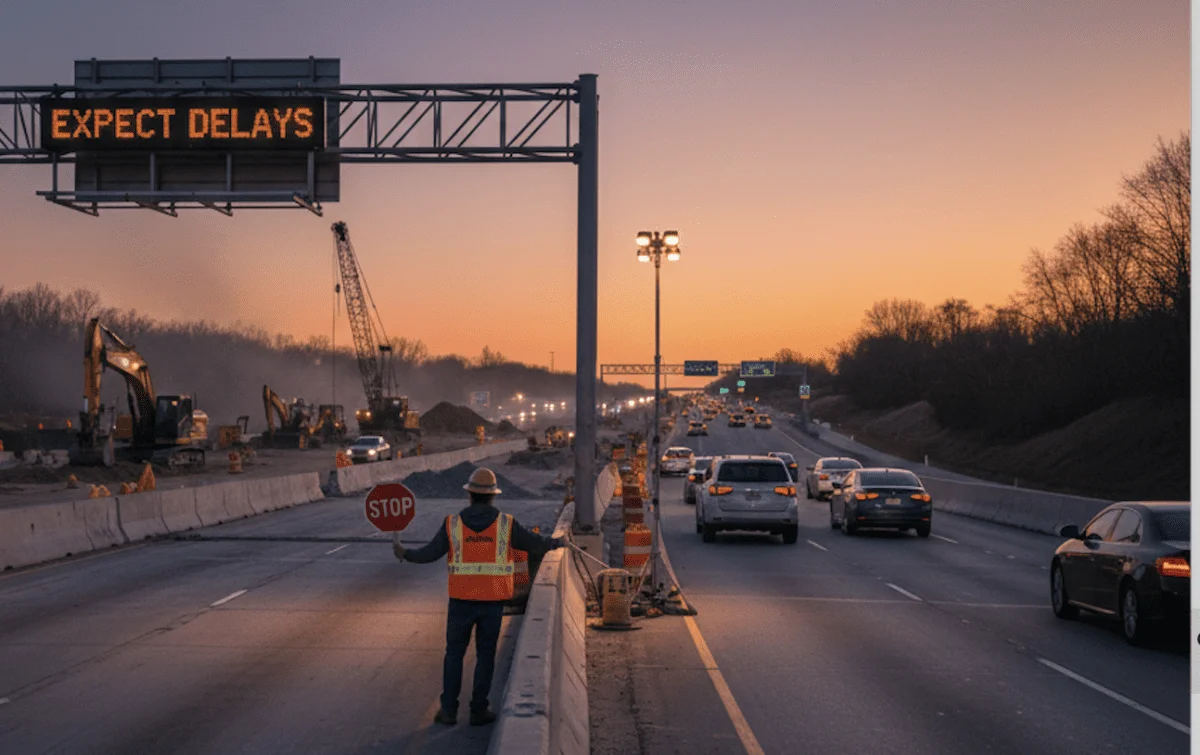
Truck Accidents in Kentucky Construction Zones
Large trucks account for 33% of work zone fatal crashes. When a truck hits you in a Kentucky construction zone, multiple parties may be liable.
Why Trucks Are Uniquely Dangerous in Construction Zones
A fully loaded semi-truck weighing 80,000 pounds traveling at highway speed cannot stop quickly — even under ideal conditions. At 65 mph, a commercial truck needs roughly 525 feet to stop. In a work zone with sudden lane shifts, reduced speeds, and stopped traffic, that physics problem becomes a deadly one.
Work zones create a specific set of hazards that are disproportionately dangerous for large trucks:
- Compressed lane widths: Standard work zone lanes are often reduced to 11 feet or less. A tractor-trailer combination is 8.5 feet wide, leaving little room for driver error.
- Abrupt speed transitions: Highway work zones drop speeds from 65 to 45 mph or less. A distracted or fatigued truck driver who doesn’t react in time closes the gap to stopped traffic at lethal speed.
- Limited escape routes: Concrete barriers, jersey walls, and equipment narrow a truck driver’s options for avoiding a collision when something goes wrong ahead.
- Queue end crashes: The most deadly work zone crash type involves vehicles stopped at the back of a traffic queue — precisely where a truck’s extended stopping distance becomes critical. Rear-end collisions of this type account for roughly 25% of fatal work zone crashes.
According to Rutgers CAIT research using FMCSA Fatal Accident Reporting data, when a work zone is on a rural interstate, large trucks are involved in over 50% of fatal crashes at those locations — compared to 9-12% of fatal crashes outside work zones generally.
Kentucky Work Zone Speed Laws and Truck Compliance
Kentucky law gives the Transportation Cabinet authority to reduce speed limits in work zones without a formal engineering study. Under KRS 189.390(4)(b), the Cabinet may temporarily post reduced limits — and 603 KAR 5:320 establishes that double fines apply when workers are present and unprotected.
For trucks, the stakes are even higher:
- Speeding in a work zone that causes injury or death can result in fines from $500 to $10,000 under Kentucky law
- Trucking companies whose drivers have prior speeding violations face regulatory scrutiny from the FMCSA
- Commercial motor vehicles are subject to Hours of Service rules that can establish driver fatigue as a factor in work zone crashes
When a truck driver enters a Kentucky work zone at excessive speed, ignores posted limits, or fails to account for stopped traffic ahead, the driver and their employer are potentially liable for every injury that results.
FMCSA Regulations That Apply in Work Zones
Commercial truck drivers operate under a separate layer of federal regulations through the Federal Motor Carrier Safety Regulations (FMCSR). Several of these regulations are directly relevant to construction zone crashes:
- Hours of Service (49 CFR Part 395): Truck drivers are limited in how many consecutive hours they can drive. A driver who exceeded hours of service limits and was fatigued when entering the work zone is in federal violation.
- Speed limits (49 CFR 392.6): Carriers are prohibited from scheduling routes that require drivers to exceed posted speed limits to meet delivery times. If a carrier’s schedule pressured a driver to speed through a Kentucky work zone, the carrier shares liability.
- Driver qualification (49 CFR Part 391): Carriers must verify that drivers have valid commercial driver’s licenses and clean driving records. A carrier that hired a driver with prior construction zone violations may be liable for negligent hiring.
- Electronic Logging Devices (49 CFR Part 395.8): ELDs document every hour the truck was in operation. In a crash investigation, ELD data can establish whether the driver was fatigued at the time of the crash.
Trucking Company Records Must Be Preserved Immediately
After a truck crash in a work zone, a critical clock starts running. ELD data, dashcam footage, driver logs, pre-trip inspection reports, and company communications can be overwritten or destroyed within days. Sending a spoliation letter — a legal demand to preserve all records — must happen fast. An attorney can issue that demand letter immediately after a crash, protecting evidence the trucking company might otherwise “lose.”
Multi-Party Liability in Kentucky Work Zone Truck Cases
What makes these cases legally complex — and potentially high-value — is the number of parties that can share responsibility. Unlike a standard two-car accident, a truck crash in a work zone can involve four or more defendants:
| Potentially Liable Party | Basis for Liability | Evidence to Pursue |
|---|---|---|
| Truck Driver | Speeding, distraction, fatigue, failure to maintain safe following distance | ELD records, dashcam, cell phone records, toxicology |
| Trucking Company / Carrier | Negligent hiring, inadequate training, unrealistic schedules, failure to maintain vehicle | Driver qualification file, dispatch records, maintenance logs, prior violations |
| Construction Company / Contractor | Inadequate signage, improper lane taper, missing barriers, insufficient advance warning | Traffic control plan, contract with KYTC, inspection records, OSHA filings |
| Kentucky Transportation Cabinet / KYTC | Negligent work zone design, inadequate oversight of contractor, deficient plans | Contract documents, project specifications, inspection reports |
| Vehicle / Equipment Manufacturer | Brake failure, tire defect, or equipment malfunction contributing to the crash | Vehicle inspection, maintenance records, manufacturer recalls |
Kentucky follows pure comparative fault under KRS 411.182, meaning each party pays in proportion to their share of responsibility. Identifying every defendant — especially the trucking company, which typically carries $750,000 to $5 million in liability insurance — is essential to maximizing your recovery.
Frequently Asked Questions
Can I sue the trucking company, not just the driver, for a work zone crash?
How do I know if the truck driver was violating FMCSA hours of service rules?
What if the construction zone’s signage or layout contributed to the crash?
What is the statute of limitations for a truck accident in a Kentucky work zone?
Start Your Free Case Review
Fill out the form below and our team will reach out to discuss your options.