

TRUCK TALK
Truck Blind Spots

Jon Hollan explains commercial tractor-trailer No-Zones, mirror standards, and lane-change collisions.
Commercial tractor-trailers operate with four substantial blind zones where passenger automobiles are completely obscured from the driver’s direct vision. The commercial transportation industry terms these areas No-Zones, and collisions originating within them involve distinct regulatory duties rather than simple lane disputes. In this Truck Talk segment, partner Jon Hollan explains commercial blind zone locations, regulatory mirror mandates, and the electronic evidence used to resolve sideswipe collisions.
Commercial Vehicle No-Zone Dimensions
The Federal Motor Carrier Safety Administration defines four major commercial vehicle blind spots located to the front, rear, and both sides of a tractor-trailer. The most dangerous blind zone extends along the right side of the trailer across multiple traffic lanes, while the driver-side zone sits below the left window.
A front blind zone extends roughly twenty feet ahead of the cab hood, and the rear blind zone reaches up to two hundred feet behind the trailer. Commercial drivers receive professional training to account for these blind zones before initiating maneuvers. Asserting that a passenger vehicle was in a blind spot constitutes an admission of failure to confirm roadway clearance.
Truck Blind Spots and Turning Paths
Select a position around the truck to explore visibility and turning-path questions. Actual visibility depends on the vehicle, equipment, and conditions.
Visibility Around A Large Truck
- Front: a driver high in the cab may not see a vehicle or person immediately ahead. Cab design, mirrors, cameras, and relative position all matter.
- Left side: mirrors cover part of the left side, but mirrors do not establish continuous visibility, and two moving vehicles change position constantly.
- Right side: generally the hardest area for a driver to monitor. There is no universal lane count for how far the limited-visibility region extends.
- Rear: a driver cannot see directly behind the trailer. That limit is separate from each driver’s duty to operate safely; following distance is the following driver’s choice.
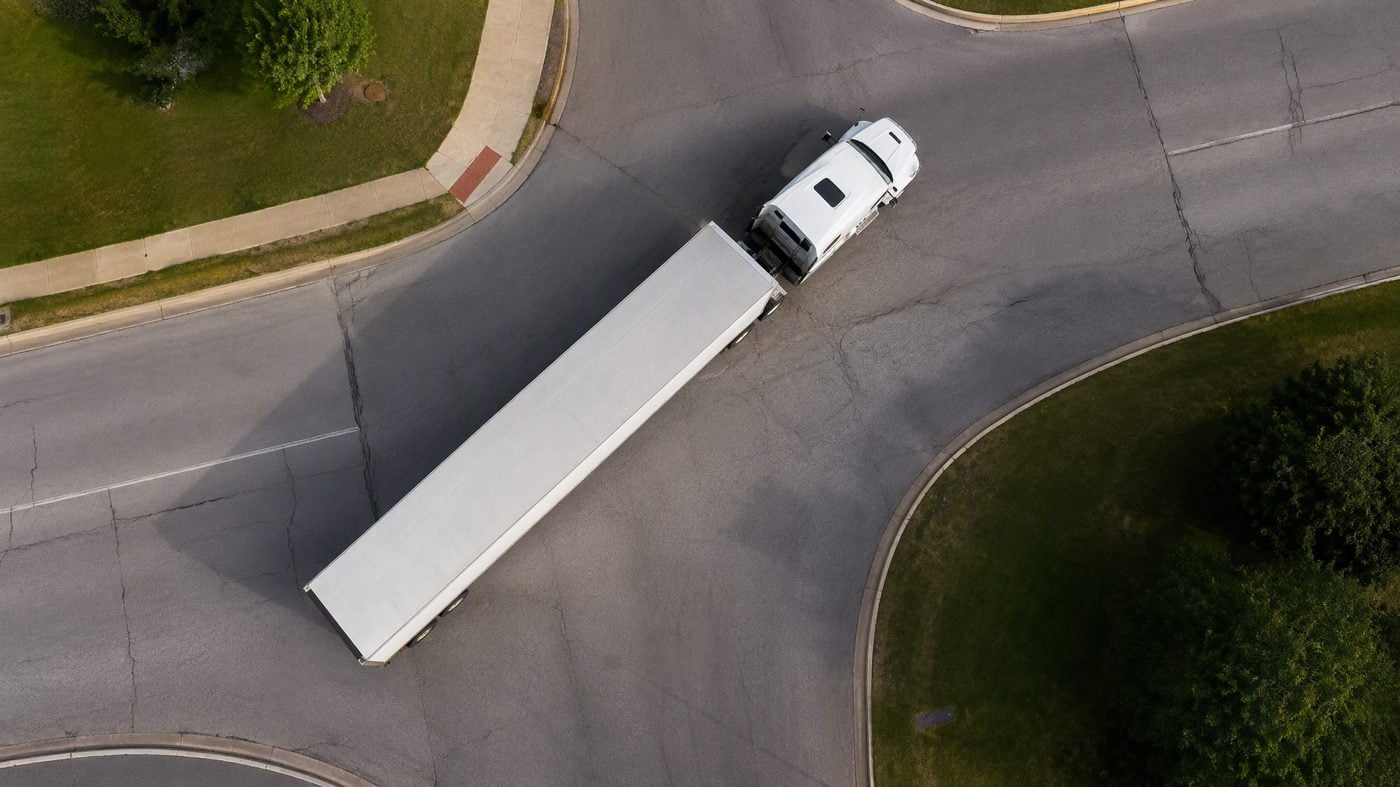
- Turning path: in a turn, the trailer’s wheels follow a path inside the tractor’s path. That off-tracking is geometry, not a blind spot.
The interactive diagram requires JavaScript; this summary carries the same educational content.
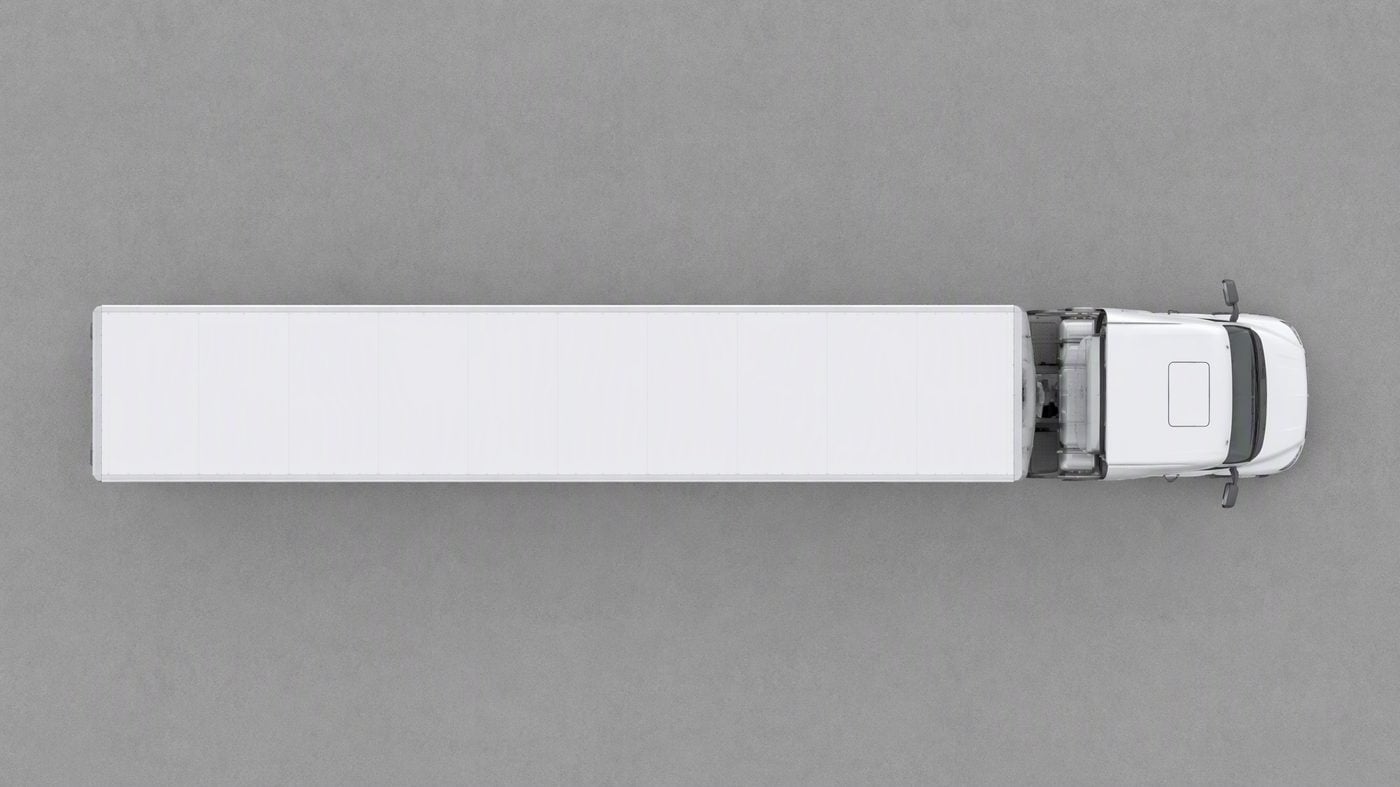
Explore A Position Or Layer
Federal Rear-Vision Mirror Standards
Federal regulation 49 CFR 393.80 mandates that every commercial truck must possess two rear-vision mirrors positioned to provide views along both sides of the vehicle. Commercial carriers frequently augment primary mirrors with convex spot mirrors and digital camera sensors to reduce blind spots.
Daily vehicle inspection regulations in 49 CFR Part 396 require drivers to inspect mirror assemblies and log physical defects. A motor carrier that dispatches a vehicle with cracked, damaged, or misaligned mirrors violates federal equipment standards.
Highway Lane Change Maneuvers
Right-side commercial blind zones cause numerous sideswipe collisions when commercial drivers execute unsafe merges on multi-lane highways. Federal entry-level training rules in 49 CFR Part 380 mandate structured visual search protocols and turn signal usage before changing lanes.
Commercial tractor modules record steering angle inputs, turn signal activations, and lane positioning metrics. Downloading this telemetry confirms whether a commercial driver executed a gradual merge with proper signaling or abruptly crossed lane boundaries into an occupied lane.
Right-Turn Squeeze Collision Dynamics
Commercial long-combination vehicles must swing wide to the left to execute sharp right-hand turns without tracking trailer wheels over curbs. This wide maneuver invites passenger vehicles into the opening right lane before the trailer cuts back across the roadway in a right-turn squeeze.
Initiating a wide swing requires the commercial driver to verify that the opening right lane remains clear.
Off-tracking trailer axles follow a sharper turning radius than the steering cab, crushing vehicles trapped along curbs.
Commercial operators carry an ongoing duty to monitor the right-side convex mirror throughout the entire turn.
Municipal traffic camera recordings and intersection sensors provide objective visual footage of the vehicle turning paths.
The driver initiating the turning maneuver maintains the primary duty to ensure adjacent lanes remain clear. Mapping the turn radius against final vehicle rest positions confirms whether the commercial driver monitored available sightlines.
Spatial Separation Requirements
Following distances behind commercial vehicles must account for the substantial blind zone extending directly behind the commercial trailer. Federal Hours of Service rules in 49 CFR Part 395 guard against driver fatigue that delays braking responses in heavy traffic.
Commercial tractors require extended stopping distances compared to passenger vehicles. When a commercial driver follows too closely, forward collision warning sensors and automatic emergency braking systems record driver overrides. Evaluating throttle and brake timing confirms whether the operator maintained safe following intervals.
External Video Sensor Technology
Commercial transportation fleets increasingly utilize multi-angle camera systems positioned along trailer perimeters to capture blind zone activity. These video files provide definitive evidence of vehicle positioning in disputed sideswipe cases.
Driver-facing cameras record whether an operator executed required mirror sweeps or looked down at an unauthorized mobile device. Federal safety regulations in 49 CFR 392.82 prohibit commercial handheld device usage. Immediate preservation demands prevent the automated overwrite of camera footage.
Carrier Safety Audit Records
Investigating a commercial blind-spot collision requires analyzing the motor carrier’s complete safety management structure. Federal regulation 49 CFR 391.51 mandates that carriers maintain driver qualification records, documenting training in space management.
Public safety snapshots from the FMCSA SAFER System provide objective records of carrier safety ratings and out-of-service violations. Federal financial responsibility rules under 49 CFR Part 387 mandate substantial commercial liability insurance coverage for interstate operations.
Geometric Collision Reconstruction
Reconstructing blind-spot collisions requires mapping physical vehicle geometry against highway markings rather than accepting subjective driver assertions. Commercial reconstruction specialists download engine control module telemetry and correlate it with physical damage profiles.
Reconstruction specialists model mirror viewing angles, cab sightlines, and vehicle positions in the seconds preceding contact. Pairing geometric sightline models with recorded steering inputs establishes that the passenger vehicle was visible had the commercial driver executed mandatory mirror checks.
Legal Representation
Jon Hollan leads commercial vehicle litigation from the Lexington office of Sam Aguiar Injury Lawyers, handling complex tractor-trailer collision cases. Proving liability in blind-spot collisions requires rapid preservation of onboard cameras, engine control telemetry, and carrier safety files.
Our legal representation operates under the Bigger Share Guarantee®, ensuring that clients receive greater net financial recovery than the firm after medical costs and case expenses are paid. Our contingency fee terms never increase if a case proceeds to trial, and clients experience $0 Out-Of-Pocket Forever. Call our Lexington office at (859) 888-8000 or our Louisville office at (502) 888-8888 for a free case review. Get more. Get it faster. Get it with Sam Aguiar.
Why Kentucky Chooses Sam Aguiar