

TRUCK TALK
Winter Driving Conditions
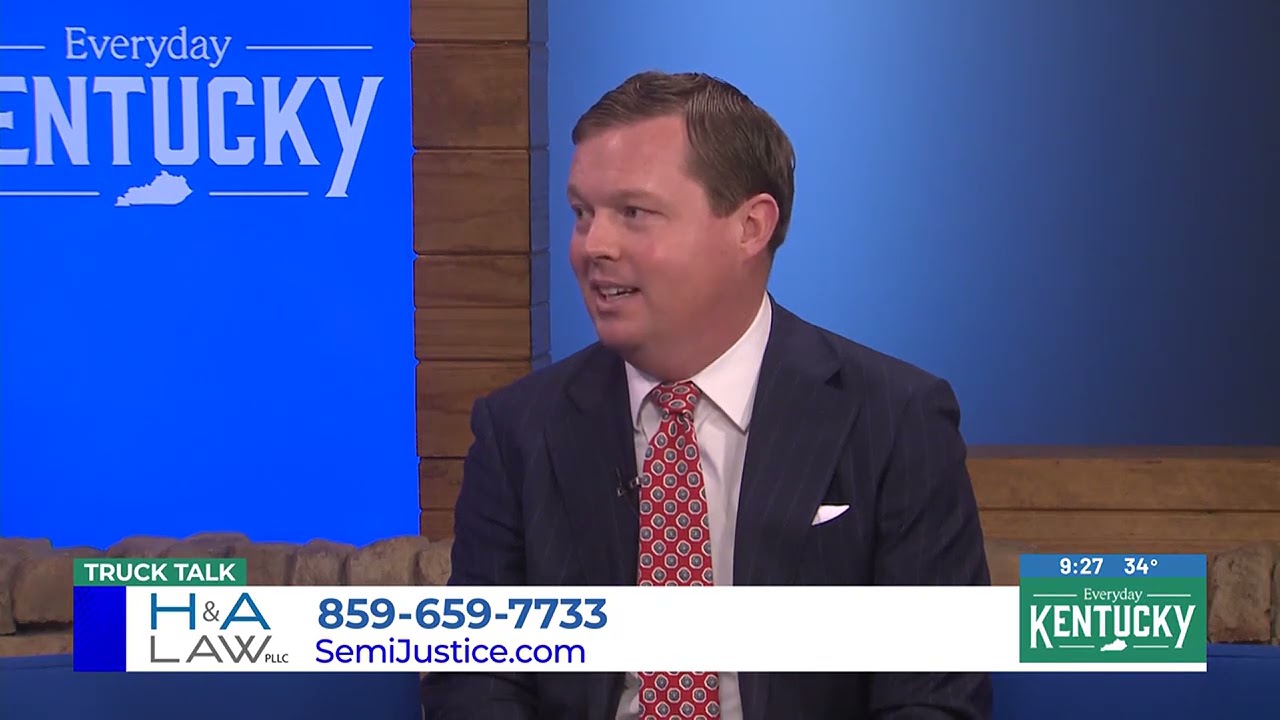
Winter does not arrive. as a single sheet of ice. It arrives as falling snow, blowing sleet, a wall of fog over the river bottoms, a windshield that glares low into a four o’clock sunset, and a bridge deck that freezes while the road on either side stays wet. In this Truck Talk segment, Jon Hollan walks through what a commercial driver and the carrier behind that driver are supposed to do when the weather turns, and how the choices they make in that hour become the evidence that decides a winter truck crash case.
Carrier Duty
A loaded tractor-trailer is the heaviest thing on the interstate, and winter does not lower the standard that vehicle is held to. The federal rules treat bad weather as a known and foreseeable part of running freight, not as a surprise that excuses a crash. This Truck Talk segment is one in a series Jon Hollan records on how trucking rules play out in real Kentucky crashes. A carrier that dispatches a truck into a snow event already knows the forecast, the route, and the limits of the equipment, and that knowledge is exactly what we examine after a winter collision.
The starting point is the hazardous-conditions rule. Under 49 CFR 392.14, extreme caution is required when snow, sleet, fog, or other conditions reduce visibility or traction, the driver must slow down, and when conditions become sufficiently dangerous the truck must be taken off the road until it is safe to continue. That single regulation frames almost every winter case our office handles. The driver is not allowed to simply maintain speed and hope. The rule puts the decision in the driver’s hands and the responsibility on the carrier that set the schedule.
When a winter crash lands in our office, the first question is rarely how slick the road was. It is what the driver and the carrier did once the weather made the road dangerous, because that is where the duty lives and where the case is usually won.
A motorist hit by a tractor-trailer in a storm often assumes the weather was simply bad luck and that nothing can be done about it. That assumption is what the carrier’s insurer counts on. The regulations say something different. They place the burden of judging the conditions on the professional driving the heaviest vehicle on the road, and they hold the company that dispatched that vehicle to the standard it agreed to meet when it accepted a federal operating authority. Winter is a condition the industry plans for every year, and a crash in the snow is judged against that planning, not against a passenger driver’s ordinary commute.
Reduced Visibility
Snow and sleet do more than coat the pavement. They cut how far a driver can see, and a driver who cannot see far enough to stop within the clear distance ahead is driving too fast no matter what the posted limit says. Fog along the Ohio and Kentucky river valleys can drop visibility to a few car lengths in minutes, and blowing snow off an open field can do the same on a clear-sky afternoon. The traction side of that same storm, where a tire simply cannot grip, is its own subject covered in our Truck Talk episode on icy road conditions.
A commercial driver carries a heightened duty here because the stopping distance of a loaded truck is already long. The Federal Motor Carrier Safety Administration driving-conditions guidance instructs drivers to reduce speed as visibility and traction drop, and to keep reducing as conditions worsen. A truck that holds highway speed into a fog bank or a snow squall has eliminated the one thing that protects the cars ahead of it, which is the room to react.
The truck records what the driver actually did. Engine control module data shows road speed second by second, and a driver who never came off the throttle while visibility collapsed leaves a clean timeline. We pull that data and lay it against weather records for the route, because a speed that looks ordinary on a dry day reads very differently when the air was full of snow.
Lighting compounds the visibility problem in winter. Kentucky days are short in December and January, and a low winter sun can sit directly in a driver’s sightline at the same hour that frost and salt film coat a windshield. A defroster that cannot keep the glass clear, or a driver who never cleared the snow off the cab and trailer before pulling out, turns a manageable afternoon into a blind one. Snow blowing off the top of a poorly cleared trailer can also blind the cars behind it, and a driver who leaves the yard with a loaded roof of snow has created a hazard before the truck reaches the highway.
Bridge Freezing
Bridges and overpasses freeze before the roadway does, because cold air moves under and over the deck at the same time while the ground insulates the pavement on either side. Kentucky carries a dense network of river crossings and interstate overpasses, and a driver who treats a bridge like the wet road behind it can lose a trailer in a single second.
A trained commercial driver knows the bridge-freezing pattern and is taught to back off speed and avoid sudden steering or braking before the deck, not on it. The Kentucky Transportation Cabinet posts and treats these structures during winter events, and its road condition reporting tells a driver which corridors are already being salted. A carrier that routed a truck across a string of overpasses during an active freeze, with that information available, made a decision we put in front of the insurance company.
Jackknife and trailer-swing crashes cluster on and near bridge decks for this reason. When that is the fact pattern, the reconstruction starts with where the freeze began and whether the driver adjusted before reaching it.
The physics behind a bridge crash also point to the trailer. An empty or lightly loaded trailer pushes far less weight onto its tires than a full one, so it breaks loose sooner on a frozen deck and swings around the cab. A driver crossing a known overpass in a freeze is supposed to account for the load, the wind, and the deck temperature together, and to set up speed and lane position well ahead of the structure. We map the truck’s recorded inputs against the location of the bridge to show whether the driver eased into the deck or carried highway momentum straight onto ice that the cab’s tires had already started to lose.
Pre-Trip Inspection
Winter punishes a truck that left the yard with the wrong equipment. Worn tires that pass on a dry day cannot hold a snow-covered grade. Frozen or out-of-adjustment brakes pull a trailer sideways under hard stopping. Defroster and wiper failures blind a driver in the exact conditions where seeing matters most. Each of those is supposed to be caught before the truck ever moves.
The inspection duty is not optional. 49 CFR 396.13 requires the driver to be satisfied that the vehicle is in safe operating condition before driving it, and Part 396 as a whole requires systematic inspection, repair, and maintenance with records to match. In winter, a real pre-trip means checking tire tread and pressure, brake adjustment, lights, defrosters, wipers, and the cold-weather gear the route demands.
Tires and tread
Cold drops tire pressure and stiffens rubber, and thin tread that grips a dry road slides on packed snow. The maintenance file shows the last time those tires were measured.
Brakes and adjustment
An out-of-adjustment brake on one axle can swing a trailer in conditions where a balanced system would have held the line.
Vision systems
Defrosters, heated mirrors, and wipers are safety equipment in winter, and a failure logged in a prior inspection is a failure the carrier knew about.
The inspection record
Driver vehicle inspection reports and maintenance logs show whether a known defect was repaired or written down and ignored.
The maintenance and inspection records are among the first documents we request. A truck that crashed in the snow on bald tires noted weeks earlier is a different case than a sudden, unforeseeable loss of traction, and only the paper trail tells us which one happened.
Schedule Pressure
Freight runs on a clock, and the clock does not care about the weather. A driver who is paid by the mile and dispatched against a tight delivery window has every financial reason to keep rolling through conditions where the rule says to slow down or pull off. That pressure is where many winter crashes are really born, and it points straight back at the carrier rather than the driver alone.
Federal hours-of-service limits in 49 CFR Part 395 cap how long a driver can be behind the wheel, and the adverse driving conditions provision in that rule actually allows extra time so a driver can slow down or wait out a storm without running out of legal hours. A carrier that leans on a driver to make up lost winter time, or that builds a schedule with no room to stop, is working against the very safety valve the regulation provides.
The electronic logging device and the dispatch messages tell that story. We match the driver’s hours, the load’s delivery deadline, and the timing of the storm to see whether the driver was pushed to beat weather that the rule said to respect. A carrier that chose the deadline over the conditions owns the result.
The way a carrier pays and praises its drivers is part of the same picture. A pay structure built entirely around miles and on-time arrivals tells a driver, in dollars, to keep moving. A safety culture that treats a weather delay as a failure does the same thing in a quieter way. When a winter crash comes from a driver who pressed on through conditions the rule told him to wait out, the question is whether the company built a system that rewarded that choice. The dispatch records, the pay agreement, and the company’s own weather and safety policies show whether stopping for a storm was a supported decision or a penalized one.
Speed Management
The single most common winter failure is too much speed for the conditions, and it does not require ice to be dangerous. Wet snow, slush, and a temperature hovering near freezing all cut the grip a loaded truck needs, and a posted limit is a ceiling for good conditions, never a target for bad ones. A driver who matches the dry-pavement flow of traffic in a snowstorm has misjudged the one variable that mattered.
The National Highway Traffic Safety Administration winter guidance is blunt about speed and following room in snow and reduced visibility, and a commercial driver is held to more than a passenger-car standard. Slowing down, lengthening the gap to the vehicle ahead, and avoiding abrupt inputs are the basic moves a professional is trained to make the moment the weather turns.
We reconstruct speed from the engine data, the road geometry, and the weather record for the hour of the crash. A truck traveling at a speed that was reasonable for dry pavement and reckless for snow is a truck whose driver and carrier made a choice, and that choice is what decides the case.
Following distance is the other half of the speed problem. A loaded tractor-trailer needs far more room to stop than the car ahead of it even on dry pavement, and snow or slush stretches that distance much further. A driver who keeps a dry-weather gap in winter has left himself no room to react when traffic slows. When a truck rear-ends a vehicle in the snow, the carrier often reaches for a sudden-stop defense, but the engine data shows throttle and brake timing in the seconds before impact. A driver who never lifted off the throttle until the moment of contact had a following-distance and speed problem that the weather did not create on its own.
Carrier Records
A winter crash is almost never just one slick moment. The carrier hired the driver, set the training, maintained the equipment, and built the schedule that put that truck on that road during that storm. The driver qualification file under 49 CFR 391.51 shows whether the driver was trained and screened, whether prior weather-related incidents were on record, and whether the carrier acted on them or looked away.
The investigation obtains the carrier’s public safety profile from the Federal Motor Carrier Safety Administration SAFER system early. A company already carrying a pattern of speeding, hours violations, or out-of-service equipment is a company whose winter crash fits a documented history rather than a one-time misfortune. That pattern reframes the conversation from a single bad night to a way of doing business.
The same investigation drives every commercial vehicle case our firm handles, including the tractor-trailer and semi cases our Lexington office handles against the national carriers running I-64, I-65, I-71, and I-75. A winter case becomes a carrier case the moment the qualification file and the maintenance records come out.
Key Evidence
Winter crashes reward firms that move fast, because the conditions that caused the crash do not last. Snow melts, the road dries, and the temperature climbs back over freezing by noon. The evidence that survives is electronic and documentary, and most of it sits inside the truck or the carrier’s servers on a timer.
A preservation letter has to leave before anything overwrites. That demand names the engine control module data, the electronic logging records, the dispatch and messaging logs, any forward-facing or driver-facing camera footage, and the maintenance and inspection files. Camera systems often overwrite within weeks, and the engine data can be lost when the truck is repaired or returned to service, so the letter has to leave promptly after retainment.
We pair that record with the independent weather and road data for the route, drawing on National Weather Service observations and the Kentucky Transportation Cabinet road condition history to fix exactly what the driver was facing. The combination of what the conditions were and what the driver did inside them is what turns a winter crash from an act of nature into a documented failure to follow the rule.
Commercial Truck Litigation Counsel
Handling catastrophic commercial truck collisions requires thorough knowledge of the Federal Motor Carrier Safety Regulations, digital evidence preservation requirements, and corporate motor carrier discovery practices. Jon Hollan and Sam Aguiar maintain selection in the Trucking Trial Lawyers Association Top 10, directing complex commercial vehicle investigations against national transportation carriers.
Under the Bigger Share Guarantee®, our clients always walk away with more money than the firm after medical bills, liens, and case expenses are paid. If a client’s share would ever be less than the legal fee, the firm cuts its fee. Every case receives a dedicated three-person team: a top-rated attorney, an experienced case manager, and a skilled legal assistant. We work under a flat contingency fee that never increases if your case goes to trial, with $0 out-of-pocket expenses forever.
Insurance companies push settlement releases quickly after a commercial wreck because an injury release is permanent. Once signed, the insurance claim is closed forever, leaving injured people to pay future medical expenses out of pocket. For a free case review, contact Sam Aguiar Injury Lawyers in Louisville at (502) 888-8888 or in Lexington at (859) 888-8000. Get more. Get it faster. Get it with Sam Aguiar.
Why Kentucky Chooses Sam Aguiar