

Kentucky ATV Accident Lawyers
INJURED IN AN ATV ACCIDENT?
 ★★★★★
Over 1,000 Five-Star Reviews
•
Available 24/7. $0 Out-Of-Pocket Forever.
★★★★★
Over 1,000 Five-Star Reviews
•
Available 24/7. $0 Out-Of-Pocket Forever.

Kentucky ATV Accident Cases
ATV accidents rarely fit the same pattern as an ordinary road accident. The vehicle may have rolled on a trail, crossed a public road, carried a passenger, been rented for a guided ride, or been used on someone else’s land. Those facts change which safety rules apply, who controlled the risk, and which insurance policies may respond.
An ATV case is built from the machine, the scene, and the people who controlled each. An inspection of the ATV answers mechanical questions, the terrain and sight lines show the setting, ownership and operator records show who made decisions, and medical records show the injury.
Four questions recur: whether the ATV was the right size for the rider, whether the manufacturer’s warning label remained in place, whether a passenger was permitted, and whether a public agency or local government had authorized use at that location. Golf carts and other low-speed vehicles follow separate street-legal rules in Kentucky.
Insurance Coverage Sources
Coverage is document-driven. A dedicated ATV policy may include liability, medical-payments, collision, comprehensive, uninsured-motorist, or underinsured-motorist benefits. The declarations page identifies the listed vehicle and coverages, but the full policy and endorsements determine when those coverages apply.
Homeowners, farm, commercial general liability, umbrella, rental-company, tour-operator, and vehicle policies may also apply. Homeowners policies can carry motor-vehicle exclusions that narrow coverage, and the policy wording, ownership, location, and use decide whether one does. The belief that a policy “never covers an ATV” stays an assumption until someone reads the policy.
When a street-legal special purpose vehicle was operating on an authorized road, registration and motorcycle-form insurance requirements under current Kentucky law may add another coverage path. The local ordinance and the vehicle’s compliance records belong in the same file as the policies.
Potentially Responsible Parties
Operator. Speed, steering, braking, passenger carriage, alcohol or drug use, supervision, and compliance with location-specific rules may bear on the operator’s conduct.
Owner. Ownership records and communications may show who selected the rider, maintained the ATV, approved its use, or knew about a mechanical problem.
Property controller. A landowner, tenant, public agency, trail operator, or event organizer may have controlled access, warnings, route design, maintenance, or a concealed hazard.
Commercial operator. Rental companies and guided-tour businesses may hold inspection, training, waiver, route, and incident records that show how the ride was organized.
Manufacturer or seller. A defect theory requires preservation and technical inspection of the ATV, its components, warnings, recalls, service history, and any aftermarket modifications.
Landowner Liability on Recreational Land
An ATV accident can happen on land that belongs to someone else, such as a relative’s farm, a hunting lease, or a trail on private property. Under Kentucky’s recreational use statute, an owner of land owes no duty of care to keep the premises safe for recreational entry or to warn of a dangerous condition.
The statute leaves two kinds of liability in place: a willful or malicious failure to guard or warn against a dangerous condition, and an injury suffered where the owner charges people to enter for recreational use. The statute defines a charge as the admission price or fee asked in return for permission to enter the land.
Kentucky courts read “willful or malicious” more broadly than intent to injure. In Huddleston v. Hughes, a school had set a basketball goal upright each time it fell, with no added security to prevent another fall. The Kentucky Court of Appeals held in 1992 that a jury could decide whether that conduct showed indifference to the natural consequences of its actions or an entire want of care for the child’s safety. A landowner who knew of a hidden culvert or an unmarked drop-off on a ridden trail and left it unmarked presents the same kind of question.
Common ATV Accident Patterns
Rollovers may involve speed, a sharp turn, a steep side slope, tire condition, a passenger shifting the center of gravity, or an ATV whose size did not match the rider. Ejections can cause a second impact with the ground, trees, rocks, fences, or another vehicle. Roadway accidents bring additional evidence such as police reports, vehicle damage, lighting, traffic controls, and nearby cameras.
Other cases begin with a stuck throttle, brake problem, steering failure, tire separation, or a part installed during repair. Some involve a child operating an adult-size machine or carrying a passenger. In rental and tour incidents, the questions are what the business inspected, what instructions it gave, the condition of the route, and whether the guide responded to a known hazard.
A passenger case may differ from an operator case because the passenger had no control over speed, route, or steering. A property case may depend on whether the rider had permission to enter and whether the person controlling the land knew of a dangerous condition.
Kentucky ATV Operation Rules
KRS 189.515 covers highway operation, consent for private-property use, approval for public-property use, headgear, young riders, crossings, lighting, licensing, and warning labels. Its text follows.
As used in this section, “federal all-terrain vehicle standards” means the all-terrain vehicle standards set forth by the American National Standards Institute/Specialty Vehicle Institute of America and incorporated by reference in 16 C.F.R. sec. 1420.3, to the extent those standards are applicable.
Except for vehicles authorized to operate on a public highway as of July 15, 1998, and except as provided in subsection (7) of this section, a person shall not operate an all-terrain vehicle upon any public highway or roadway or upon the right-of-way of any public highway or roadway.
A person shall not operate an all-terrain vehicle on private property without the consent of the landowner, tenant, or individual responsible for the property.
A person shall not operate an all-terrain vehicle on public property unless the governmental agency responsible for the property has approved the use of all-terrain vehicles.
Except for vehicles authorized to operate on a public highway, a person sixteen (16) years of age or older operating an all-terrain vehicle on public property shall wear approved protective headgear, in the manner prescribed by the secretary of the Transportation Cabinet, at all times that the vehicle is in motion. The approved headgear requirement shall not apply when the operator of any all-terrain vehicle is engaged in: (a) Farm or agriculture related activities; (b) Mining or mining exploration activities; (c) Logging activities; (d) Any other business, commercial, or industrial activity; (e) Use of that vehicle on private property; or (f) The crossing of a public roadway with a posted speed limit of fifty-five (55) miles per hour or less. The crossing of a public roadway outlined in this paragraph shall be in compliance with subsection (7)(a) of this section.
(a) A parent or legal guardian of a minor who is under the age of six (6) shall not knowingly allow that person to operate an all-terrain vehicle. (b) A person under the age of sixteen (16) years shall not operate an all-terrain vehicle except under direct parental supervision. (c) A person under the age of sixteen (16) years, when operating or riding as a passenger on an all-terrain vehicle, shall wear approved protective headgear, in the manner prescribed by the secretary of the Transportation Cabinet, at all times that the vehicle is in motion. (d) A parent or guardian of a minor who is under the age of sixteen (16), or who does not possess an instruction permit, an intermediate license, or an operator’s license, shall not knowingly allow that person to carry a passenger while operating an all-terrain vehicle. (e) A parent or guardian of a minor under the age of sixteen (16) shall not knowingly allow that person to operate an all-terrain vehicle in violation of the age restriction warning label affixed by the manufacturer as required by the federal all-terrain vehicle standards.
(a) Except for off-highway vehicles described in KRS 189.281, a person may operate an all-terrain vehicle on any two (2) lane public highway in order to cross the highway. In crossing the highway under this paragraph, the operator shall cross the highway at as close to a ninety (90) degree angle as is practical and safe, and shall not travel on the highway for more than two-tenths (2/10) of a mile. (b) A person may operate an all-terrain vehicle on any two (2) lane public highway, if the operator is engaged in farm or agricultural related activities, construction, road maintenance, or snow removal. (c) The Transportation Cabinet may designate, and a city or county government may designate, those public highways, segments of public highways, and adjoining rights-of-way of public highways under its jurisdiction where all-terrain vehicles that are prohibited may be operated. (d) A person operating an all-terrain vehicle on a public highway under this subsection shall possess a valid operator’s license. (e) A person operating an all-terrain vehicle on a public highway under this subsection shall comply with all applicable traffic regulations. (f) A person shall not operate an all-terrain vehicle under this subsection unless the all-terrain vehicle has at least one (1) headlight and two (2) taillights, which shall be illuminated at all times the vehicle is in operation. (g) A person operating an all-terrain vehicle under this subsection shall restrict the operation to daylight hours, except when engaged in snow removal or emergency road maintenance. (h) It shall be unlawful for a person to remove from an all-terrain vehicle the manufacturer age restriction warning label required by the federal all-terrain vehicle standards.
Street-legal special purpose vehicles are governed separately by current provisions in KRS Chapter 186 and 601 KAR 23:070. Registration does not create a statewide right to use every road. Local authorization, equipment, inspection, registration, insurance, and roadway restrictions must be checked together.
Evidence That Builds The Case
A qualified inspection of the ATV can answer questions that testimony cannot. It can document brakes, throttle, steering, tires, suspension, restraints, lights, warning labels, damage patterns, and aftermarket changes. Downloadable electronic information should be identified before power loss, repair, or disposal makes it unavailable.
Scene evidence provides the setting: grade, surface, ruts, loose gravel, vegetation, trail width, sight distance, signage, lighting, and the path from first loss of control to final rest. Measurements and photographs should be tied to a map and time. Weather records and public-agency maintenance records add context.
A helmet is physical evidence as well as protective equipment, and its condition can indicate the forces involved. Clothing, boots, gloves, photographs of bruising, and the location of damage on the ATV add context to the machine itself.
Ownership, permission, supervision, training, rental, inspection, and maintenance records show who made decisions before the ride. Insurance policies identify potential sources of recovery. Medical and employment records document the injury and its consequences. Each category supports a different part of the same factual account.
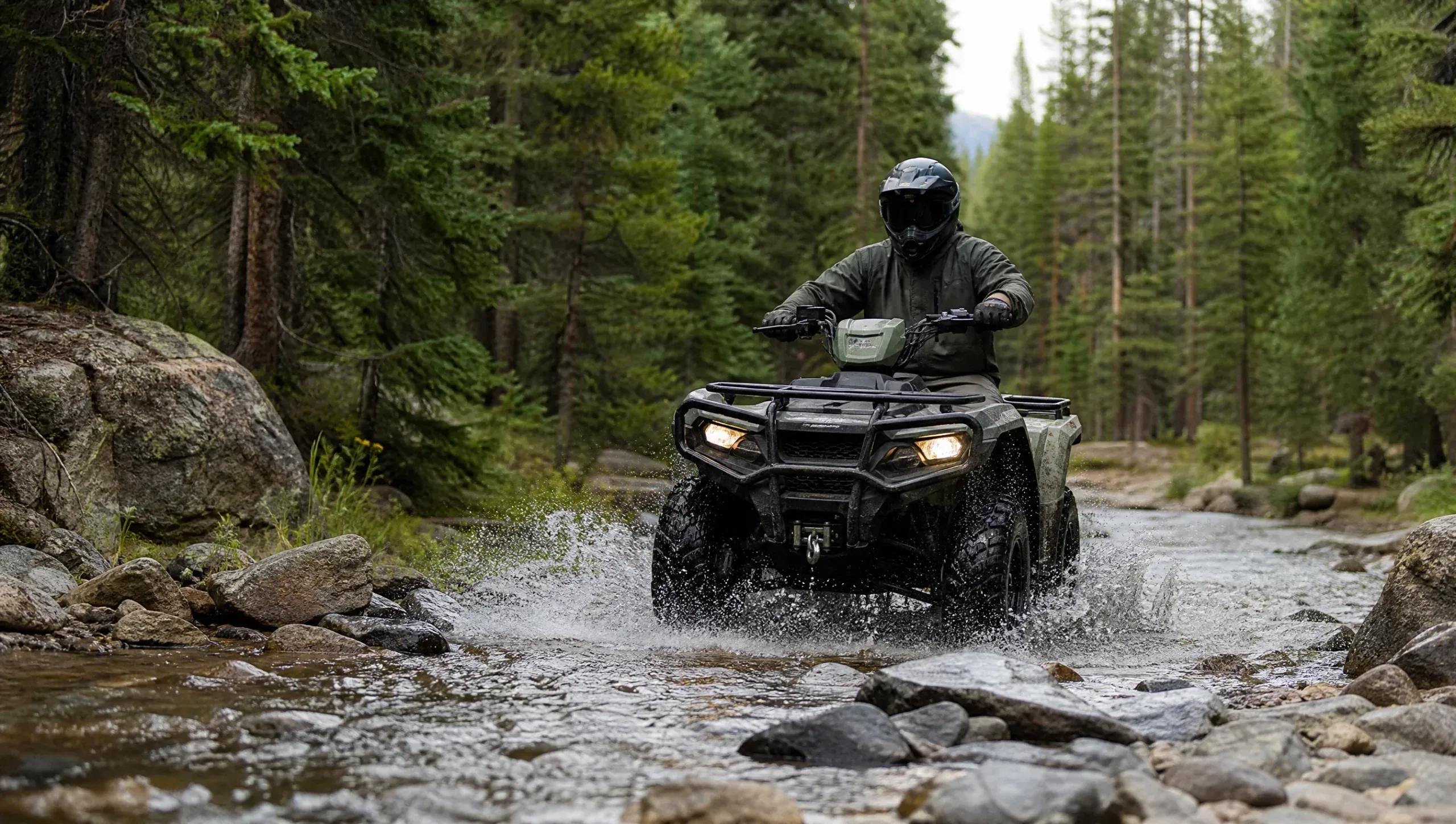
Losses Documented In An ATV Case
ATV accidents can cause traumatic brain injuries, spinal cord injuries, fractures, internal injuries, crush injuries, burns, severe cuts, and joint damage. Emergency records establish the first findings. Imaging, specialist notes, operative reports, therapy records, and work restrictions show how the diagnosis developed, and they distinguish symptoms reported immediately from those documented later.
An ATV injury case may seek payment for medical expenses, lost income, reduced earning capacity, pain, disability, scarring, and other losses recognized by Kentucky law. Property damage and loss of use may also apply. A fatal accident can lead to a wrongful death case. Under KRS 411.130, the personal representative of the deceased brings that action, and the recovery goes to the family members the statute lists.
The amount depends on the evidence in that individual case. Medical billing and treatment records support past expenses. Provider opinions and a documented care plan may address future treatment. Payroll, tax, attendance, and vocational records can show lost work and changes in earning ability. Family testimony and contemporaneous notes may describe limits on daily life without replacing the medical evidence.
Key Takeaways
Who Is Responsible for Your ATV Accident?
An ATV accident can point to a careless rider, a defective machine, a landowner or a rental outfit, and the insurance behind each one is different. Sam Aguiar Injury Lawyers works out who is responsible and which coverage applies, then documents your injuries and lost income with verified records. Most cases qualify in under 10 minutes, and the Bigger Share Guarantee® means you always walk away with more than the firm after bills, liens and case costs. Call today for a free case review.
Frequently Asked Questions
1Does Kentucky allow ATVs on public roads?+
Mostly no. KRS 189.515 bars ATV operation on a public highway or its right-of-way, with exceptions that include crossing a two-lane highway and farm, construction, road maintenance, and snow removal work. Separate Kentucky law lets a local government allow street-legal special purpose vehicles by ordinance, so the road, the vehicle, its equipment and registration, and any local ordinance each decide the answer.
2Does Kentucky require ATV riders to wear helmets?+
The answer depends on the rider’s age, the property, and the activity. Under KRS 189.515, a rider under sixteen, including a passenger, must wear approved protective headgear while the ATV is moving. An operator sixteen or older must wear it on public property, except during farm, mining, logging, or other business work, on private property, or when crossing a public road with a posted limit of 55 miles per hour or less.
3Can a child operate an ATV in Kentucky?+
KRS 189.515 bars a parent or guardian from knowingly allowing a child under six to operate an ATV. A rider under sixteen needs direct parental supervision, and a parent or guardian may not knowingly allow a child to operate an ATV in violation of the manufacturer’s age-restriction warning label.
4Does the recreational use statute protect a landowner after an ATV accident?+
Only in part. KRS 411.190 provides that an owner of land owes no duty of care to keep the premises safe for recreational entry or to warn of a dangerous condition. It does not limit liability for a willful or malicious failure to guard or warn against a dangerous condition, or for an injury where the owner charges people to enter for recreational use.
5Who may be responsible for an ATV accident?+
The answer follows the evidence. A case may involve an unsafe operator, an owner who entrusted the ATV to an inexperienced rider, a land possessor who created or concealed a dangerous condition, a rental or tour business, or a manufacturer or seller when a defect contributed to the accident. Each theory has its own evidence requirements.
6What evidence supports an ATV accident case?+
Photographs of the ATV and scene, helmet and safety gear, witness information, ownership and maintenance records, rental paperwork, applicable insurance policies, emergency records, follow-up treatment, and records of missed work each answer a different part of the case. An ATV that has been repaired, sold, or discarded can no longer be inspected.
7Does homeowners insurance cover an ATV accident?+
It depends on the policy language and where the accident happened. Homeowners policies can limit or exclude motor-vehicle coverage, while a dedicated ATV policy may provide liability, medical-payments, or physical-damage coverage. The declarations, endorsements, exclusions, and place of use are read together.