
Aviation Safety Oversight: Who Is Responsible for What
Airlines and cargo carriers hold operational control of their flights, manufacturers and repair stations carry defined duties, and the FAA certifies and oversees while the NTSB only investigates.
Who Holds Responsibility
No single organization is responsible for the safety of a commercial flight. Federal regulations divide the duties of aviation safety oversight and operation among the airline or cargo carrier that operates the flight, the manufacturers that designed the aircraft and its parts, the repair stations that maintain it, the pilot in command, the airport, and the Federal Aviation Administration (FAA), which prescribes minimum safety standards and certifies the others. The National Transportation Safety Board (NTSB) investigates accidents but does not regulate the industry.
The concept that sorts out who answers for what is operational control. 14 CFR 1.1 defines it as “the exercise of authority over initiating, conducting or terminating a flight.” Federal regulations assign that authority to the certificate holder that operates the flight.
The table summarizes each organization’s main duties, the federal laws and regulations that set them, and the records or documents each one generates.
| Organization | Main responsibility | Main federal rules | Records and documents |
|---|---|---|---|
| Air carrier or operator | Operational control; airworthiness of its aircraft; safety management system | 14 CFR Parts 119, 121, 135, and 5 | Maintenance records, airworthiness releases, dispatch releases |
| Pilot in command | Final authority over operation of the aircraft | 14 CFR 91.3 and 121.533 | Pilot logbook entries |
| Manufacturer (type certificate holder) | Approved design; Instructions for Continued Airworthiness; defect reports | 14 CFR Part 21; airworthiness standards such as Part 25 | Failure, malfunction, and defect reports |
| Component supplier (parts manufacturer approval or technical standard order holder) | Approved design and production of replacement parts and articles | 14 CFR Part 21, including 21.303 and 21.601 | Failure, malfunction, and defect reports |
| Repair station | Maintenance within its ratings; quality control; return to service | 14 CFR Parts 145 and 43 | Part 43 compliance records; maintenance releases; service difficulty reports |
| FAA | Sets minimum standards; issues certificates; oversees certificate holders | 49 U.S.C. 44701 and 44705; Title 14 | Certificates and operations specifications |
| Air traffic control (FAA) | Air navigation services in controlled airspace | 14 CFR Parts 71 and 91 | Air traffic clearances issued to pilots |
| Airport operator | Operating the airport under its certificate and manual | 14 CFR Part 139 | Training, self-inspection, and incident records |
| Owner or lessor | Airworthiness under Part 91; naming operational control in large-aircraft leases | 14 CFR 91.403, 91.23, and 119.53; 49 U.S.C. 44112 | Written lease with truth-in-leasing clause |
| NTSB | Investigates accidents; determines probable cause; issues recommendations | 49 U.S.C. 1131; 49 CFR Part 831 | Public investigation dockets |
Sources: 14 CFR Part 121; Part 135; Part 21; Part 145; Part 139; Part 91; Part 5; 49 U.S.C. 44701; 49 U.S.C. 44112; 49 U.S.C. 1131.
Air Carriers and Operational Control
A company that sells air transportation to the public needs an air carrier operating certificate, which the FAA issues only after finding the company properly equipped and able to operate safely. Under 14 CFR 119.5, a direct air carrier, meaning a company that controls the operational functions of the transportation it provides, receives an Air Carrier Certificate. The holder then flies under Part 121 or Part 135 depending on its aircraft and type of service, and sorts operators into those two parts by seats, payload, and schedule.
Both parts place operational control on the certificate holder. Under Part 121, each holder conducting domestic, flag, or supplemental operations is responsible for operational control (121.533, 121.535, 121.537), and under Part 135 each holder is responsible for operational control and must list in its manual the name and title of each person it authorizes to exercise it.
Inside a Part 121 airline conducting domestic or flag operations, the duties are shared. The pilot in command and the aircraft dispatcher are jointly responsible for preflight planning, delay, and the dispatch release. The dispatcher monitors each flight’s progress and may cancel or redispatch a flight if the dispatcher or the pilot concludes it cannot operate or continue safely as planned.
Cargo Carriers and Integrated Airlines
Cargo flights use the same certification structure as passenger flights. An all-cargo operation is any operation for compensation or hire that is other than a passenger-carrying operation, with limited exceptions. All-cargo operations with airplanes that have a payload capacity above 7,500 pounds are supplemental operations, which Part 121 governs, while all-cargo operations with airplanes at or below that payload are on-demand operations under Part 135 (14 CFR 119.21).
Integrated express carriers, which include FedEx, UPS, and DHL, operate scheduled aircraft, trucks, and couriers for door-to-door delivery. Because the airline within such a company is a certificate holder, the duties described in this article apply to it. A November 2025 UPS flight now under NTSB investigation, for example, was a cargo flight operating under Part 121.
Maintenance and Contracted Work
Airlines may hire others to maintain their aircraft, but the responsibility stays with the airline. Under 14 CFR 121.363, a certificate holder is primarily responsible for the airworthiness of its aircraft, which an FAA airworthiness approval describes as conformity to the approved design and a condition for safe operation, and for the performance of maintenance under its manual. It may arrange for another person to do the work, but that arrangement does not relieve it of the responsibility. 14 CFR 135.413 sets the same primary responsibility for Part 135 holders.
Much contracted work is done by repair stations certificated under 14 CFR Part 145. A repair station may perform maintenance and alterations only on articles it is rated for and within its operations specifications, and it may approve those articles for return to service. It must keep a quality control system, report serious failures, malfunctions, or defects to the FAA within 96 hours, and retain records for two years from the date an article returns to service, available for inspection by the FAA and the NTSB.
Before an airline operates an aircraft after maintenance, the airline or the person it arranged for the work must prepare an airworthiness release or log entry certifying that the work followed the airline’s manual and that no known condition makes the airplane unairworthy. Each airline must also keep maintenance records showing, among other items, the total time in service of the airframe, the status of life-limited parts, and the current status of applicable airworthiness directives.
Manufacturers and Component Suppliers
Manufacturers are regulated through design and production approvals under 14 CFR Part 21. The FAA issues a type certificate, its approval of a product’s design, when the applicant shows that the aircraft, engine, or propeller meets the applicable airworthiness and other requirements. For transport category airplanes, the design standards are in 14 CFR Part 25.
Suppliers of parts and equipment need approvals of their own. An applicant for a parts manufacturer approval must show that the article’s design meets the airworthiness requirements, and a technical standard order authorization is an FAA design and production approval for an article that meets a specific technical standard order, which is a minimum performance standard.
The duties continue after delivery. The holder of a design approval must furnish Instructions for Continued Airworthiness to the owner of each aircraft, engine, or propeller, and when an airworthiness directive calls for design changes the type certificate holder must, on the FAA’s request, submit design changes for approval and make the approved data available to all operators.
Holders of type certificates, parts manufacturer approvals, and technical standard order authorizations must also report certain failures, malfunctions, and defects, including engine failures, fires caused by system failures, and flight control malfunctions that interfere with normal control. The report is due within 24 hours after the holder determines that a reportable occurrence has happened. When the FAA finds an unsafe condition that is likely to exist in other products of the same type design, it can issue an airworthiness directive, which is a legally enforceable rule.
Pilots and Crew Authority
The pilot in command is the person with final authority and responsibility for the operation and safety of a flight. Under 14 CFR 91.3, which is part of the general operating rules, the pilot in command is directly responsible for, and is the final authority as to, the operation of the aircraft. In an in-flight emergency requiring immediate action, the pilot may deviate from any rule of Part 91 to the extent required and must send a written report of the deviation if the FAA asks for one.
Part 121 adds that the pilot in command is responsible for the safety of the passengers, crewmembers, cargo, and airplane, and has full control and authority over the other crewmembers during flight time. Pilots must also document their training and flight experience in a pilot logbook.
The FAA as Certifying Authority
By statute, the FAA Administrator must promote safe flight by prescribing minimum standards for aircraft design and construction, regulations and standards for inspection and overhaul, and regulations on the maximum hours of service of airmen and other air carrier employees. The FAA issues the certificates that let others operate, and it may delegate examination, testing, and inspection to qualified private persons under its supervision, a delegation it can rescind at any time.
A safety management system is a formal, top-down, organization-wide approach to managing safety risk and assuring that risk controls work. 14 CFR Part 5 applies to holders of Part 121 and Part 135 certificates, air tour operators with a Letter of Authorization under 14 CFR 91.147, and certain holders of type and production certificates. The FAA’s final rule, published April 26, 2024 and effective May 28, 2024, expanded safety management system requirements beyond Part 121 airlines.
The compliance dates differ by group. Part 121 holders with an existing safety management system had to revise it by May 28, 2025. Part 135 and air tour operators must implement a safety management system and submit a declaration of compliance by May 28, 2027. Type and production certificate holders had to submit an implementation plan by November 28, 2024 and must implement the system by May 28, 2027. A safety management system must be appropriate to the size, scope, and complexity of the organization, and it is not a substitute for compliance with other federal regulations.
Air Traffic Control and Airports
Air traffic control is an FAA function. The FAA’s Air Traffic Organization is the operational arm of the FAA, responsible for air navigation services across 29.4 million square miles of airspace. Federal regulations define air traffic control as a service operated by appropriate authority to promote the safe, orderly, and expeditious flow of air traffic, and an air traffic clearance as an authorization from air traffic control for an aircraft to proceed under specified traffic conditions in controlled airspace.
Airports are certificated separately. Under 14 CFR Part 139, an airport serving scheduled passenger operations of air carrier aircraft with more than 9 passenger seats, or unscheduled operations with at least 31 seats, must hold an Airport Operating Certificate and adopt and comply with an Airport Certification Manual. Certificate holders keep records such as personnel training, self-inspections, and accidents and incidents in movement areas for set periods.
Owners, Lessors, and Operational Control
Owning an aircraft and operating it are different things under federal regulations. The owner or operator of an aircraft is primarily responsible for maintaining it in an airworthy condition under Part 91. For a lease of a U.S.-registered large civil aircraft, the parties must include a truth-in-leasing clause that identifies the person responsible for operational control, and the requirement does not apply to every lease, for example not when the lessee is a Part 121 certificate holder.
When a certificate holder leases an aircraft to another person engaged in common carriage, the FAA determines which party has operational control and amends the operations specifications of each party as needed.
Federal law also limits when a lessor, owner, or secured party can be liable. Under 49 U.S.C. 44112(b), such a person is liable for personal injury, death, or property loss or damage only when the aircraft, engine, or propeller is in that person’s actual possession or operational control and the harm occurs because of the aircraft, engine, or propeller, or because of the flight of, or an object falling from, it. The statute defines a lessor as a person leasing for at least 30 days. The limit follows the line the regulations draw: responsibility attaches to whoever exercises operational control. Which defendants can be liable in a particular accident depends on facts beyond this structure, and the rules on who can be liable after an aviation accident are a separate subject.
The NTSB Investigates Without Regulating
The NTSB is an independent federal agency charged by Congress with investigating every civil aviation accident in the United States, determining probable cause, and issuing safety recommendations. The statute directs it to establish the facts, circumstances, and cause or probable cause of aircraft accidents. It has no authority to require implementation of its recommendations.
When the NTSB sends a recommendation to the Secretary of Transportation, federal law requires a formal written response within 90 days stating whether the Secretary intends to adopt all of it, part of it, or none of it. A response that adopts must include a timetable, and a refusal must include reasons. The duty is to answer, not to adopt.
The NTSB brings the other organizations into an investigation as parties, one step in the NTSB investigation process. Party status is limited to those whose employees, functions, activities, or products were involved in the accident and who can provide qualified technical personnel, and apart from the FAA no entity has a right to participate. In the investigation of the November 4, 2025 accident of UPS flight 2976, the NTSB invited the FAA, UPS, Boeing, GE Aerospace, Collins Aerospace, and two labor organizations. That investigation is still ongoing, and the NTSB describes its published information as preliminary and subject to change.
Party status is not a finding about the party. A probable cause determination is an investigative conclusion, and federal regulations bar use of a Board accident report in any suit or action for damages growing out of a matter it mentions. Whether an organization is legally responsible for an accident is decided separately, and the duties described above are only one input to that question.
Aviation Accident Case Review
Which organizations were responsible for an aviation accident depends on the facts of that accident, including who had operational control, who maintained the aircraft, and who designed the parts involved. Sam Aguiar Injury Lawyers reviews aviation accident cases for injured people and families. You pay $0 out-of-pocket forever. Start your free case review today.
Frequently Asked Questions
Can the NTSB fine or penalize an airline?
No. The NTSB investigates and recommends but has no authority to regulate the industry or require anyone to act on its recommendations. The NTSB’s role in enforcement is limited to deciding appeals of FAA enforcement actions.
Do charter operators follow the same safety rules as large airlines?
Not the same rules, but the same structure. Charter and other on-demand operators generally fly under Part 135 rather than Part 121, and a Part 135 certificate holder is also responsible for operational control. The rules differ in detail and timing: Part 121 airlines had to revise their safety management systems by May 28, 2025, while Part 135 operators have until May 28, 2027.
Is an airline responsible for work done by an outside maintenance shop?
Under federal regulations, yes. A certificate holder may arrange for another person to perform maintenance, but that does not relieve it of its primary responsibility for airworthiness. A repair station also has its own duties, including a quality control system and record retention.
Latest Articles
Federal Aviation Regulations: How Title 14 Is Organized
How Title 14 is organized and which aviation rules bind which operators.
Who Can Be Liable After an Aviation Accident
Which carriers, manufacturers, repair stations, and agencies can be responsible.
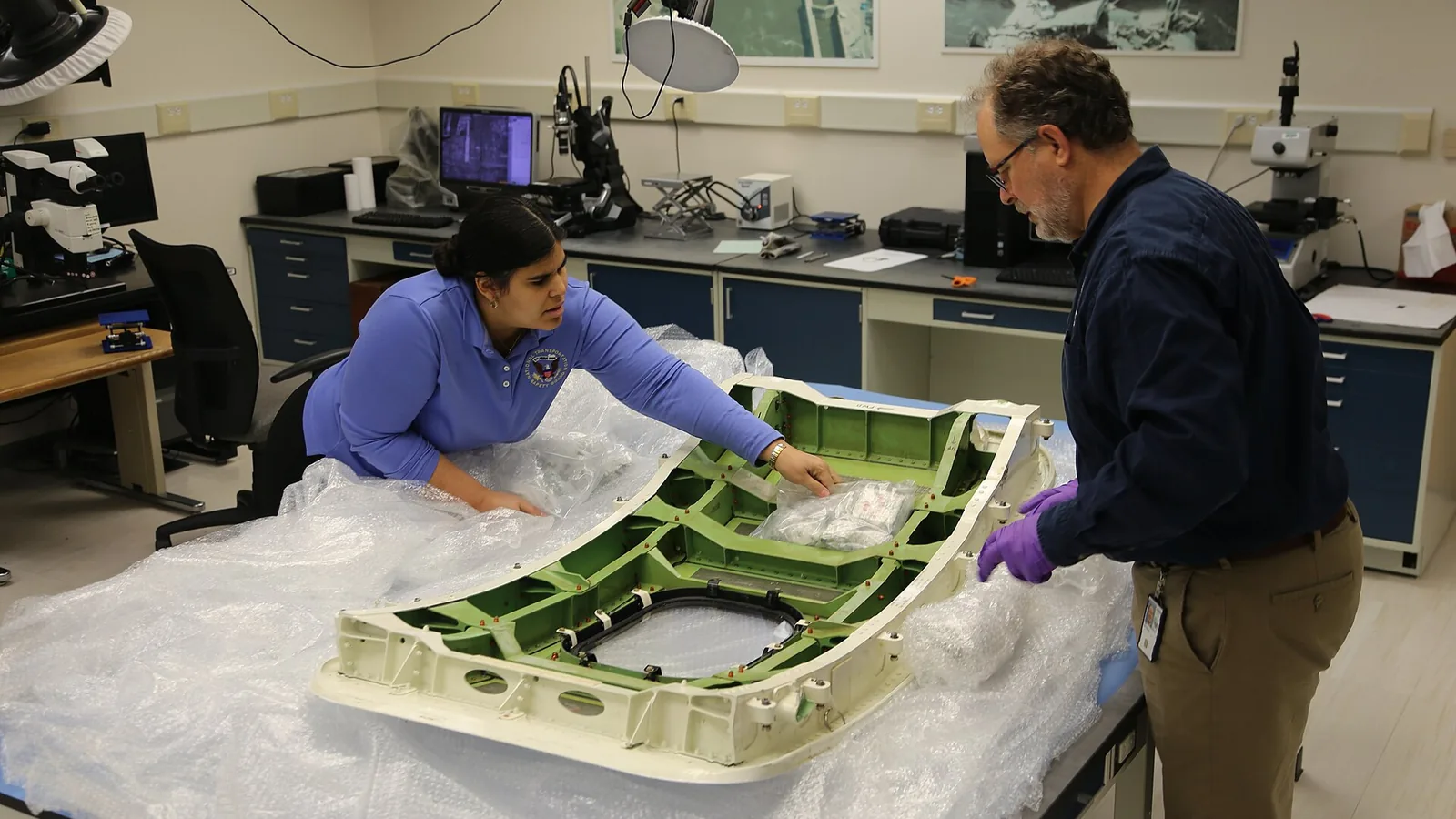
How an NTSB Investigation Works After an Aviation Accident
How the NTSB investigates, which reports it publishes, and what courts can use.