

I-264 Watterson Expressway Car Accidents
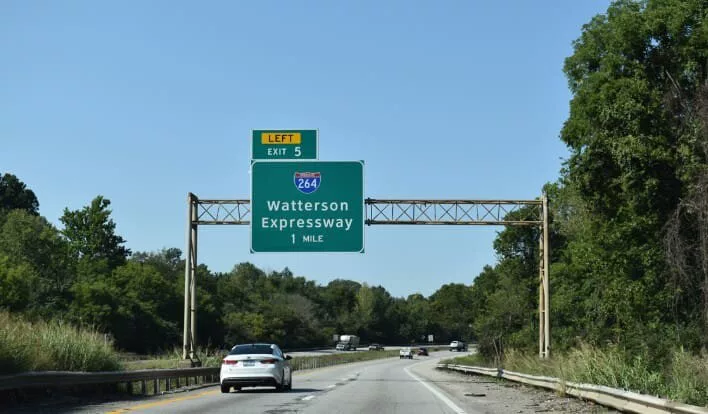
The Watterson Expressway, officially Interstate 264, runs along the southern side of Louisville in a partial loop connecting the Gene Snyder Freeway to I-264’s eastern terminus near the Watterson Trail interchange. Kentucky Transportation Cabinet data recorded 19,064 collisions on I-264 between 2013 and 2015, more than any other road in Louisville. That volume is why an I-264 car accident is rarely treated as a one-off event on an otherwise ordinary highway.
I-264 Accident Concentration
The Taylorsville Road and Breckenridge Lane corridor is among the most statistically dangerous segments, driven by high-speed merge conflicts and chronic congestion backups. Statewide collision volume is broken out in the firm’s Kentucky car accident statistics article. I-264’s local pattern still has to be read from the roadway itself: merge length, queue formation, and how closely the next interchange sits.
I-264 carries approximately 95,700 vehicles per day in its highest-volume segments, with projections exceeding 107,000 vehicles per day by 2030. Volume plus short acceleration lanes is what produces accident rates above a typical urban interstate baseline.
Expressway Design Factors
Traffic-engineering files document several structural factors that combine on this loop:
- Short merge distances at on-ramps. I-264 was built with shorter-than-standard acceleration lanes at several interchanges. Drivers merging from Taylorsville Road, Breckenridge Lane, and Browns Lane face high-speed differentials between entering traffic and highway-speed traffic. A misjudged gap produces a sideswipe or rear-end collision at expressway speeds.
- Congestion-induced queue backups. Peak-hour traffic regularly produces stop-and-go queues upstream of bottleneck interchanges. A driver approaching at 55 to 65 mph who meets a sudden queue faces an extreme rear-end accident risk, especially at the Breckenridge and Browns Lane interchange.
- Weaving zones. Multiple interchanges in close succession create sections where drivers are merging and exiting at the same time. Those zones produce lane-change conflicts at highway speeds.
- High traffic volume. Daily counts in the mid-90,000s, with projected growth past 107,000, keep the same geometric defects under constant load.
Breckenridge and Browns Lane Corridor
The stretch of I-264 between Breckenridge Lane and Browns Lane eastbound carries one of the highest documented accident-concentration factors of any point on the expressway. The geometry forces lane decisions in compressed space, with congestion reducing reaction time and stopping distance. Rear-end accidents in queued traffic and merge-zone sideswipes on this stretch produce serious and fatal injuries.
Fatal-accident counts statewide are tracked separately in the firm’s Kentucky fatal car accident statistics article. On this corridor the local file still has to show where the queue formed, which lane the impact occupied, and which cameras covered that segment.
Queue Traffic Rear-End Accidents
The most common serious-injury accident on I-264 is a rear-end collision in queued traffic. A driver traveling at highway speed meets a standing or slow-moving queue that formed behind a bottleneck and cannot stop in time. Those accidents routinely produce spinal, head, and neck injuries.
Liability in these accidents typically rests on the following driver’s speed and following distance, not on road design alone. Road design can still matter when the queue forms unusually fast because of a structural bottleneck. If several vehicles are involved, fault can be shared across more than one driver.
Evidence After an I-264 Accident
I-264 has KYTC traffic-monitoring cameras, Louisville Metro surveillance infrastructure, and commercial cameras along adjacent corridors. Vehicle event data recorders capture speed, braking, and steering input in the final seconds before impact. Witness accounts from stopped motorists, police collision reports, and reconstruction from skid marks and impact angles complete the file.
Digital footage is typically overwritten within 24 to 72 hours. Preservation letters and camera pulls have to go out on that clock, or the recording is gone even when the collision report remains.
Road Design Claims Against the State
A design claim against KYTC is possible and uncommon. Kentucky’s sovereign-immunity rules limit claims against state agencies. A road-design theory typically requires proof that a specific known hazard was not remediated after the state had actual notice of the danger. Those claims are complex and case-specific.
Liability more often falls entirely on the at-fault driver. Design facts can still explain why a queue formed so quickly, or why a merge left so little room, even when the state is not a defendant. Filing deadlines then follow ordinary personal-injury and Motor Vehicle Reparations Act rules under KRS Chapter 413 and KRS Chapter 304.39.
Ready to Take Action on Your Injury Claim?
After a serious injury, medical bills pile up while the insurance company looks for ways to pay you less. Most law firms take their cut first and leave you with whatever is left. Sam Aguiar Injury Lawyers does things differently. With our exclusive Bigger Share Guarantee®, you always get more. Every client gets a dedicated three-person team: an attorney, a case manager, and a legal assistant. We never raise our fee rate if we have to go to court, and you pay $0 Out-Of-Pocket Forever.
Frequently Asked Questions
1Why is the Watterson Expressway so dangerous?+
2Who is liable for a rear-end accident in highway queue traffic on I-264?+
3Can a driver sue the state of Kentucky if road design contributed to an I-264 accident?+
4What evidence exists after an accident on I-264?+
5What is the time limit to file an I-264 accident lawsuit in Kentucky?+
Latest Articles

Kentucky Diminished Value Claims
Kentucky drivers may pursue a repaired vehicle’s leftover market loss from the at-fault driver as part of a.
FMCSA Revoked ELDs: Fleet Compliance and Enforcement Deadlines
FMCSA removed five electronic logging devices from the registered list on August 6, 2026, and set an October.

FMCSA English Proficiency Rule and OOS Enforcement
FMCSA English Proficiency Rule Sam Aguiar Injury Lawyers August 11, 2026 7 minute read On This Page.