

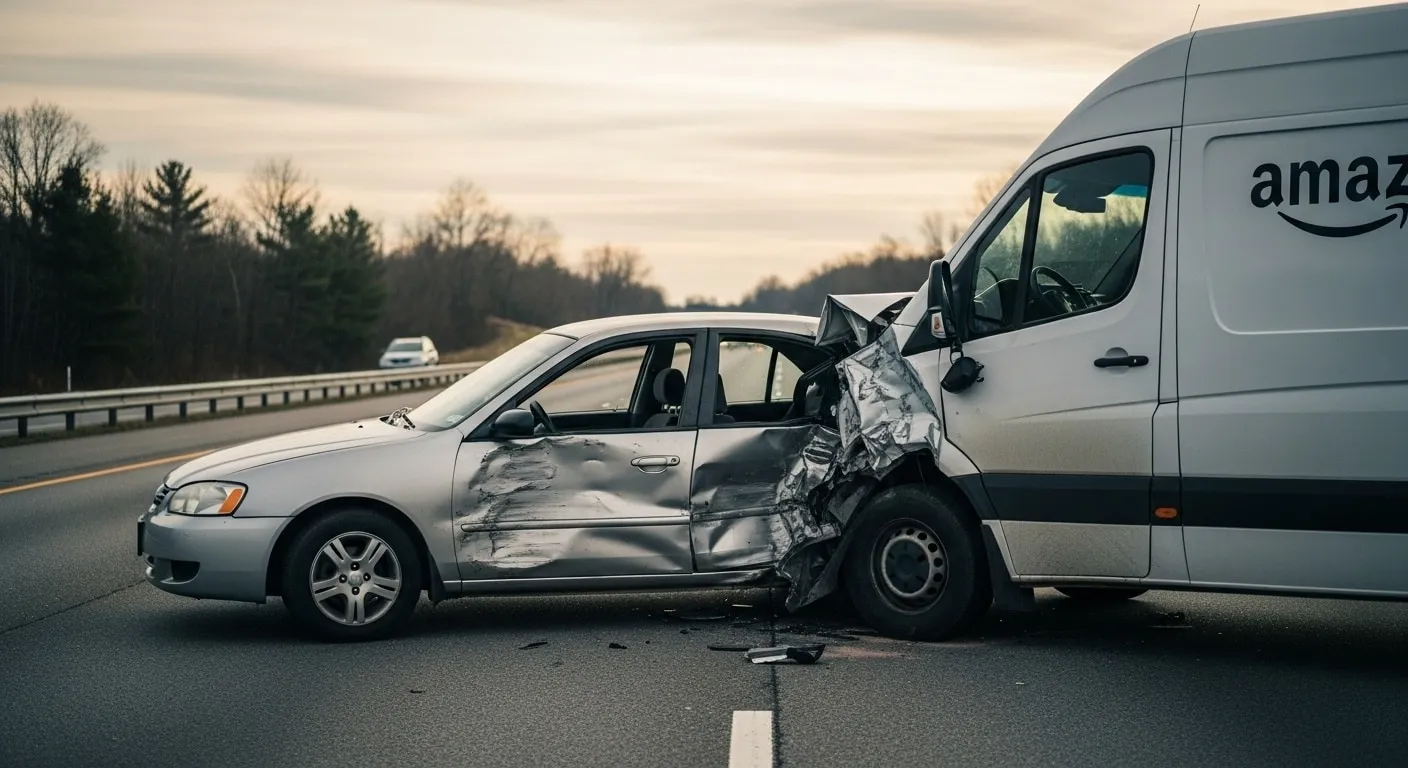
Amazon DSP Driver Negligence in Kentucky
When an Amazon delivery van hits you, the company behind the wheel may be harder to identify than the logo on the door.
On This Page
When an Amazon DSP driver crashes in Kentucky, the driver’s employer is typically a small independent company, not Amazon itself. A Strategic Organizing Center report found DSP drivers are injured at 2.5 times the industry average, driven by delivery quotas of 200 to 400 stops per shift. Despite the contractor label, courts have held Amazon directly liable in multiple crash cases, including a $16.2 million Georgia verdict where the jury assigned 85% of fault to Amazon and a $44.6 million South Carolina verdict that included $30 million in punitive damages against Amazon.
What Is an Amazon Delivery Service Partner?
The Amazon Delivery Service Partner (DSP) program launched in 2018 as a way for Amazon to rapidly scale its last-mile delivery network without taking on the legal obligations of a large employed workforce. Amazon describes DSPs as independent small business owners who manage a fleet of Amazon-branded vans and hire their own drivers. Each DSP operates as its own legal entity, typically a limited liability company.
On paper, the DSP is your employer if you deliver packages for Amazon through this program. In practice, the arrangement looks very different. Estimates from labor researchers put the total number of DSP drivers in the United States at 275,000 to 300,000, making this workforce at least twice the size of UPS’s package car driver force. Amazon may use five to ten separate DSPs to deliver packages out of a single delivery station, all operating under separate contracts on separate timelines.
The structure gives Amazon enormous reach into local markets without the overhead of a traditional employer. A DSP owner can start the business with as little as $10,000 in startup capital, according to program guidelines, which covers licensing, legal entity formation, office setup, and recruitment. Vehicle costs are separate. This low entry point means many DSPs are thinly capitalized from day one, with little financial cushion to absorb liability when a crash happens.
The DSP Model in Plain Terms
Amazon recruits entrepreneurs to set up small delivery companies that hire drivers, lease vans, and deliver Amazon packages exclusively. Amazon sets the routes, the volume, the performance standards, and the monitoring systems. The DSP owner manages the payroll and takes the legal risk. When a driver crashes, Amazon points to the DSP. The DSP often lacks the insurance or assets to cover serious injuries. Courts are increasingly piercing this structure to reach Amazon directly.
Amazon Controls the Work While Avoiding the Label
The central issue in Amazon DSP crash cases is not what Amazon calls the relationship. It is what Amazon actually does. Courts apply a “right to control” test: the more a company directs how a worker does their job, not just the final result, the more likely that company is treated as the true employer for liability purposes.
In practice, Amazon’s control over DSP drivers is extensive. Court filings in federal litigation describe how Amazon itself assigns routes to each driver, determines the number of packages per route, and reprimands DSP operators when they reassign drivers to different routes. Amazon employees use a messaging system to alert DSP operators when a specific driver is running behind schedule, down to the minute.
Amazon’s Flex app is the primary interface for DSP drivers throughout the workday. The driver uses the app to receive the route, scan packages, document deliveries, and move to the next stop. Investigations by Motherboard/VICE found that approximately 85,000 contracted delivery drivers rely on Amazon’s routing algorithm, and that algorithm sometimes routes drivers across active traffic lanes on foot to complete what the app counts as a single consolidated stop. Amazon contracted drivers must follow the app’s routing directions.
Amazon also controls onboarding and discipline. According to litigation documents, Amazon has the authority to remove a driver from a route permanently if it decides the driver committed a serious infraction, bypassing the DSP owner entirely. The DSP contract itself spans pages of mandatory policies, procedures, and performance guidelines that the DSP must follow to keep its Amazon contract.
Amazon’s own monitoring data has been used against it in court. In the South Carolina case that produced a $44.6 million verdict, evidence showed the DSP driver had logged more than 90 recorded distracted driving incidents in Amazon’s internal camera system before the crash. Amazon saw the data and did not remove the driver. The jury found a textbook agency relationship and awarded $30 million in punitive damages.
Delivery Quotas That Create Unsafe Conditions
The single most documented safety problem in Amazon’s DSP network is delivery volume pressure. A Strategic Organizing Center (SOC) study based on OSHA data filed by 201 DSPs found that Amazon DSP drivers are expected to complete between 350 and 400 package deliveries per shift, equating to one delivery every one to two minutes with no breaks.
That same SOC study found the DSP driver injury rate in 2021 was 18.3 per 100 full-time-equivalent workers, a 40% increase from the prior year. The Bureau of Labor Statistics reports an industry average of 7.5 injuries per 100 workers for couriers and express delivery services. Amazon DSP drivers were hurt at roughly 2.5 times that rate. One out of every seven DSP drivers suffered an injury serious enough to require time off work or restricted duty in 2021.
The Flex app’s route-planning algorithm compounds the pressure. Investigative reporting by VICE/Motherboard found that Amazon uses “stop consolidation” to bunch multiple addresses into a single counted stop to reduce apparent route length. Drivers described completing what the app shows as 200 stops when the actual delivery count is closer to 240 because of consolidated multi-unit stops. The app counts a seven-building cluster as one stop while requiring the driver to sprint between buildings to complete it.
DSPs are also paid a fixed rate per route, meaning faster delivery directly increases per-delivery revenue. Sources familiar with Amazon’s routing systems told investigators that Amazon also offers bonuses to DSPs for timely delivery and route completion rates, creating a financial incentive at the DSP level to push drivers harder. DSP operators have been documented texting drivers mid-route to tell them they are falling behind or need to move faster.
What “999 Out of 1,000 On Time” Means on the Road
A ProPublica and BuzzFeed News joint investigation found that Amazon work orders require 999 out of every 1,000 deliveries to arrive on time. Drivers consistently described the pressure to meet that standard as the dominant feature of the job. Speeding, skipping vehicle checks, and taking unsafe shortcuts in residential neighborhoods are the predictable result of building a delivery system around that kind of performance expectation.
★★★★★
“Easiest process I could have asked for!”
— M. Key
Short Training Windows and Thin Margins
Amazon provides DSP owners with a two-week hands-on training program before launch. Program documentation describes the training as covering virtual instruction and in-person logistics operations. The driver training that flows from the DSP to its newly hired delivery associates is compressed further, typically reduced to an online safety module and brief orientation before drivers begin running live routes.
This is a structurally thin training pipeline for a job that puts large vans in residential neighborhoods, school zones, and congested urban streets every day. In the Georgia “Bradfield” case, plaintiffs successfully argued that Amazon’s safety training was deficient specifically for residential environments where children are likely to be present. The jury agreed, holding Amazon 85% responsible for the crash.
Driver turnover at DSPs is high enough to make consistent training difficult even when a DSP tries to do it right. DSP operators and former drivers report turnover rates exceeding 150% at some stations. Drivers describe the core problem as a mismatch between the physical demands of the job and the compensation offered: Amazon’s monitoring systems track every minute of every route, and drivers who consistently finish routes early are assigned progressively longer routes until the workload becomes unmanageable.
The financial structure of DSPs creates a separate layer of risk. A DSP that enters the program with $10,000 in startup capital is operating with minimal reserves. When claims exceed insurance limits or when multiple incidents occur in a short period, an undercapitalized DSP may be judgment-proof. Plaintiff attorneys who have handled Amazon DSP cases describe this as a structural trap: the small DSP is the nominal employer, but it lacks the depth to satisfy a serious injury verdict. Reaching Amazon directly, through agency law and the control test, is often the only path to meaningful recovery.

“Sam Aguiar and his team made a difficult time manageable. They communicated clearly, kept me updated, and got me a settlement I was happy with. I never felt like just another case number.”
— Michael T.
How Courts Are Ruling on Amazon DSP Liability
For years, Amazon’s litigation posture in crash cases was straightforward: the driver works for the DSP, not Amazon, so Amazon is not liable. That posture has been challenged successfully in multiple jurisdictions, and the verdicts have been significant.
In Gwinnett County, Georgia, a jury awarded $16.2 million in the Bradfield case, assigning 85% of fault to Amazon after finding that Amazon exercised the right to control over the DSP driver’s time, manner, and method of work. The jury heard testimony about Amazon’s control over onboarding, route assignment, monitoring, and discipline of drivers employed by the DSP. Amazon’s own contract documents, which ran to pages of mandatory policies the DSP was required to follow, were central to establishing the agency relationship.
One year earlier, a South Carolina jury returned a $44.6 million verdict, including $30 million in punitive damages, after a DSP driver struck a motorcyclist. The DSP and driver admitted simple negligence. The trial focused on whether Amazon shared that liability. The jury found it did, pointing to Amazon’s own surveillance records showing the driver’s prior distracted driving incidents and Amazon’s failure to act on that data.
At the regulatory level, the National Labor Relations Board issued rulings in 2024 affirming that Amazon must bargain collectively with DSP drivers as a joint employer in California and Georgia. The NLRB applied the same logic courts use in tort cases: the entity with operational control over workers cannot fully disclaim employer status simply by inserting a contractor between itself and the workforce.
A CBS News analysis of six years of FMCSA data found that Amazon’s trucking contractors had unsafe driving violation rates at least 89% higher than non-Amazon carriers in every single month studied. A Michigan State University professor who reviewed the data described the gap as “stunning” and said violation differentials of that magnitude are not normal in carrier comparisons. In the same timeframe, at least 57 people died in crashes involving Amazon’s federally regulated carriers.
What This Means If You Were Hit in Kentucky
Kentucky uses two legal tests to determine whether a worker is an employee or an independent contractor: the “right to control” test and an economic realities test. Under the right to control test, a company is treated as the employer if it controls how work is performed, even if it does not exercise that control on a daily basis. Amazon’s documented control over DSP route assignment, monitoring, and discipline fits squarely within that test.
The legal theories that have succeeded in Georgia and South Carolina are available under Kentucky law. Agency by estoppel, joint employer doctrine, negligent hiring and supervision, and vicarious liability based on the right to control are all recognized in Kentucky courts. The key to making these theories work is building the factual record: subpoenaing Amazon’s DSP contract, route data, driver monitoring records, performance scorecards, and any communications between Amazon and the DSP about the driver or the route on the day of the crash.
Amazon’s DSP contracts are non-public. The DSP is unlikely to voluntarily produce its Amazon agreement. Discovery in this type of case requires targeted litigation strategy from the start, not something that can be assembled after a quick settlement demand. The same evidence that turned two cases into eight-figure verdicts is potentially available in a Kentucky crash case, but only if it is preserved and pursued before records are lost or overwritten.
Amazon DSP Liability Belongs Under the Main Amazon Truck Accident Page
This article exists to explain DSP negligence, contractor structure, and why Amazon tries to separate itself from the crash. The main landing page for Amazon truck accident lawyer and Amazon truck accident attorney searches is our Amazon delivery vehicle accident lawyers page. This page should support that hub with DSP-specific authority, not compete with it.
If the issue is the lawsuit path and corporate accountability, continue to Amazon crash litigation. If the issue is immediate post-crash handling, use our Amazon truck accident claims guide.
Frequently Asked Questions
What is an Amazon DSP driver?
A DSP driver is hired by a small company called a Delivery Service Partner, which contracts exclusively with Amazon to deliver packages. Amazon’s DSP program launched in 2018 and now has an estimated 275,000 to 300,000 drivers across the country. The driver wears Amazon gear, drives an Amazon-branded van, and follows Amazon’s routes, but the DSP company, not Amazon, issues the paycheck.
Can I sue Amazon if a DSP driver hit me in Kentucky?
Yes, though Amazon will argue it is not liable because the DSP is a separate employer. Courts in Georgia and South Carolina have rejected that argument, awarding $16.2 million and $44.6 million respectively after finding Amazon was the de facto employer. The same legal theories apply in Kentucky under the right to control and economic realities tests.
Why do Amazon DSP drivers drive so aggressively?
Delivery quotas. Research shows DSP drivers are expected to complete 350 to 400 deliveries per shift, meaning one stop every one to two minutes with no breaks. DSPs earn bonuses for on-time route completion, creating direct financial incentive to push drivers harder. Drivers who run behind are texted mid-route by DSP operators or flagged by Amazon monitoring systems.
What is the Amazon Flex app and how does it create danger?
The Flex app is Amazon’s routing and delivery management system that DSP drivers must use throughout every shift. Investigations found the app’s routing algorithm uses “stop consolidation” to hide actual workload from drivers, and sometimes routes drivers to cross active traffic lanes on foot. Drivers must follow the app’s directions. The app’s time pressure is a direct driver of unsafe behavior on the road.
How does Amazon monitor DSP drivers?
Amazon uses in-van camera systems, GPS tracking, and its internal Logistics Cortex platform to monitor every DSP driver’s speed, location, and behavior in real time. Court documents describe Amazon monitoring driver names, speeds, and route progress at all times. This surveillance data has become key evidence in crash cases because it shows Amazon knew about driver behavior problems before crashes occurred.
How do courts decide whether Amazon is liable for a DSP crash?
Courts apply a “right to control” test. The more Amazon directs how the driver works, not just the end result, the more likely Amazon is treated as the true employer. Evidence of control includes Amazon’s route assignment authority, monitoring systems, disciplinary power over individual drivers, and pages of mandatory policies in the DSP contract. Courts in Georgia and South Carolina have found that control sufficient to hold Amazon liable.
What is the injury rate for Amazon DSP drivers?
A Strategic Organizing Center study based on OSHA data found Amazon DSP drivers were injured at a rate of 18.3 per 100 full-time workers in 2021, nearly 2.5 times the industry average of 7.5 per 100 for courier and express delivery services. The rate increased 40% from 2020 to 2021, and one in seven DSP drivers suffered a serious injury requiring time off or restricted duty in that period.
What evidence is most important in an Amazon DSP crash case?
The most important evidence is Amazon’s own operational data: the DSP contract showing mandatory policies, the driver’s route assignment records, Amazon’s camera and monitoring data, and any internal communications flagging the driver’s performance before the crash. In the South Carolina case that produced $44.6 million, Amazon’s own records showing 90-plus distracted driving incidents were central to the punitive damages award.
Real Clients. Real Success. — 1,000+ 5-Star Reviews, 4.9/5 Overall
★★★★★
“I received a settlement far beyond what I expected.”
— S. Ayla