

Amazon Truck Accidents
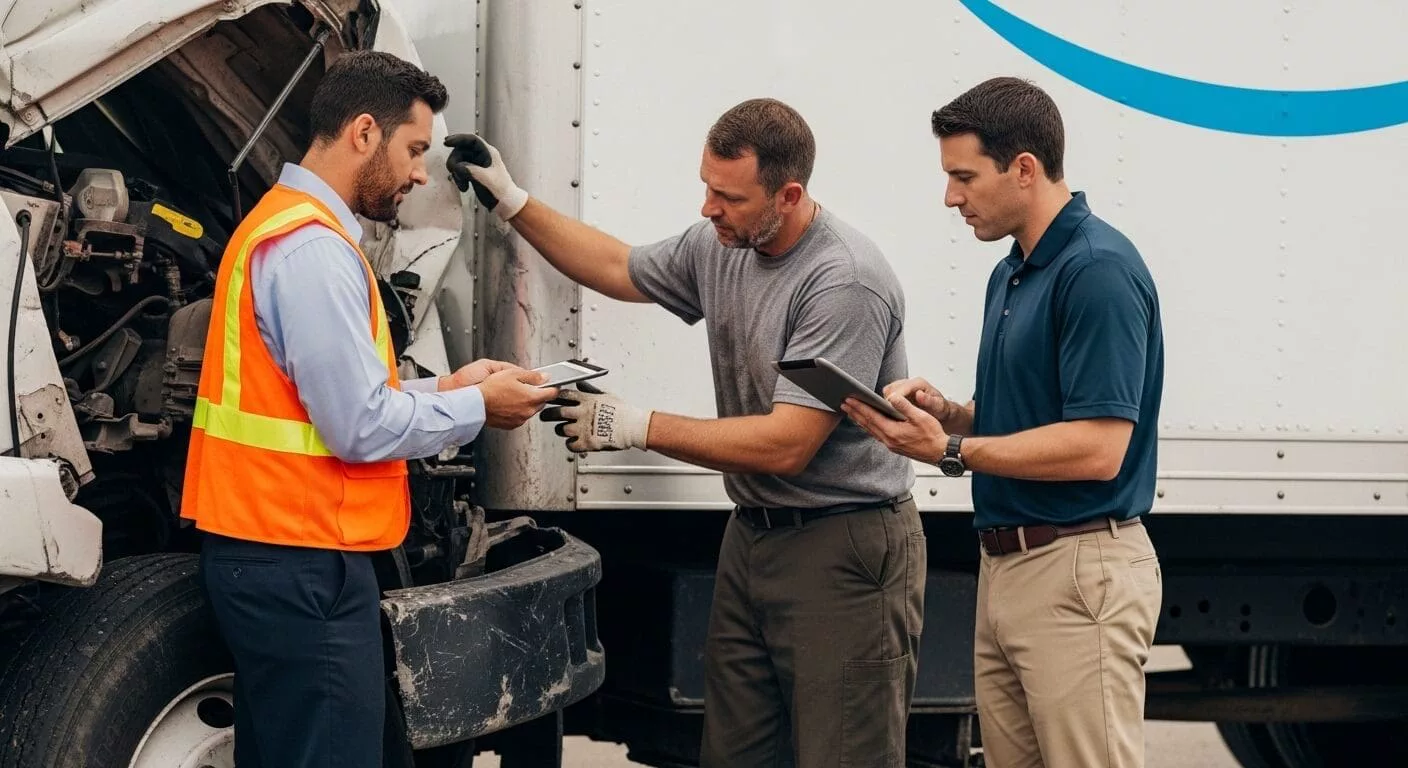
Amazon truck accident cases involving semi-trailers and tractor-trailers differ from standard delivery van crashes. Amazon operates Amazon Relay, a freight brokerage platform that contracts with independent carriers to haul Prime loads between fulfillment centers. Under FMCSA regulations at 49 CFR Part 387, the carrier that books a Relay load must carry its own liability insurance regardless of whose logo is on the trailer. When a crash happens, liability may rest with the driver, the carrier, Amazon, or all three.
Amazon’s freight operation is separate from the blue delivery vans on neighborhood streets. The firm’s Amazon delivery vehicle accident lawyers page covers smaller-vehicle delivery cases. This page covers the semi-trailer side of Amazon’s operation.
Amazon Relay Freight Network
Amazon Relay is Amazon’s load board and freight brokerage. It connects fulfillment centers to thousands of independent motor carriers hauling loads on the middle mile, the long-haul and regional runs between warehouses and sorting facilities. Loads travel in dry van trailers, refrigerated trailers, and intermodal containers.
Amazon holds federal freight broker authority and acts as an arranger of transportation. In Whaley v. Amazon.com, Inc., a February 2024 decision from the federal District of South Carolina, the court let respondeat superior, negligence, and negligent supervision claims against Amazon proceed after a tractor-trailer crash involving an Amazon trailer, while finding the complaint did not state a negligent hiring claim.
Liability Chain in Amazon Freight Crashes
An Amazon Relay crash can involve up to four layers of responsibility.
Driver
The driver is the first party. Under FMCSA Part 392, commercial drivers must follow federal driving rules, and violations, speeding, or distracted driving create direct liability.
Motor Carrier
The carrier that employs or contracts the driver is generally liable for the driver’s actions under respondeat superior. Carriers on Amazon Relay must hold valid FMCSA operating authority and maintain liability insurance of at least $750,000 for general freight and up to $5,000,000 for certain hazardous materials.
Amazon as Freight Broker
As a broker, Amazon arranges transportation and argues it bears no responsibility for the carrier’s actions. On May 14, 2026, the United States Supreme Court decided Montgomery v. Caribe Transport II, holding that the Federal Aviation Administration Authorization Act does not preempt a state-law negligent hiring claim against a freight broker. The firm’s analysis of freight broker liability after a truck crash covers the ruling.
Amazon as Shipper and Controller
In November 2025, a Clark County, Nevada judge denied Amazon Logistics’ motion for summary judgment in a Relay crash, ruling that questions about Amazon’s control over Relay drivers had to go to a jury. The driver testified that the Relay app directed him to make a U-turn that left his trailer blocking both lanes of travel.
FMCSA Rules That Apply to Amazon Freight Trucks
Under FMCSA’s electronic logging device rule in 49 CFR Part 395, most commercial drivers must use a registered ELD that records driving hours and vehicle location.
Drivers on Relay loads may drive up to 11 hours after 10 consecutive hours off duty under the hours-of-service rules. A driver who exceeds these limits creates direct carrier liability.
Under 49 CFR Part 382, carriers must drug and alcohol test drivers before hire, after qualifying crashes, and at random. Carriers must also document inspections under FMCSA Part 396, and brake failures, tire blowouts, and lighting defects that cause crashes often trace back to missed inspections.
Evidence in Amazon Relay Cases
- ELD data: records driving hours, location, and duty status changes. Carriers are only required to keep ELD records for six months under 49 CFR 395.8(k).
- Black box (ECM) data: the engine control module records speed, braking, and throttle position in the seconds before impact. The firm works with trucking evidence professionals who preserve and interpret this data.
- Relay load records: the public Amazon Relay carrier page describes the program as a way for carriers to book work with Amazon, so the load history, rate confirmation, and app instructions show how the Relay shipment was assigned.
A black box download needs context. A braking event, a GPS ping, and a camera clip can sit on different clocks. The National Highway Traffic Safety Administration explains what an event data recorder may capture.
Multiple Parties in Amazon Freight Cases
A typical truck accident case involves one driver and one carrier. Amazon freight crashes can involve three or four parties, each with its own lawyers and insurer working to shift blame.
Amazon’s standard argument is that Relay carriers are independent contractors, so Amazon bears no responsibility. The Whaley decision, the Nevada summary judgment ruling, and the Supreme Court’s Montgomery decision on broker negligent hiring claims each show that this defense is not automatic.
Carrier Safety and Insurance Records
Federal rules require motor carriers to keep driver qualification and maintenance records. The driver qualification file rule and the inspection, repair, and maintenance rule are two examples of records that bear on a commercial vehicle crash.
Federal financial responsibility rules in 49 CFR Part 387 set minimum public liability coverage levels for motor carriers. Those minimums are a starting point when identifying the insurance layers connected to the carrier, trailer, broker, shipper, and any excess policies.
The FMCSA Safety Measurement System and SAFER Company Snapshot can show carrier identifiers, inspections, out-of-service history, crash history, authority status, and insurance information. Those records frame the carrier’s safety background but do not decide a case by themselves.
Truck Crash Video Sources
A Relay crash can leave video on the tractor, at the warehouse dock, or on a DSP van that used the same route. Home and business cameras along the path can capture the crash as well, and outside vendors often will not search without a specific time and camera location.
Injured by an Amazon Relay Truck?
Amazon Relay crashes can involve the carrier, the driver, Amazon’s freight network, and sometimes a delivery service partner, each with its own policy and records. Sorting out that chain is work for the dedicated trucking team at Sam Aguiar Injury Lawyers, which also tracks down dashcam, dock, and roadside video tied to your crash. Most cases qualify in under 10 minutes. Start your free case review.
Frequently Asked Questions
1How is an Amazon semi-trailer crash different from an Amazon delivery van crash?+
2Can Amazon be held liable for a crash caused by an Amazon Relay carrier’s driver?+
3What insurance applies to an Amazon Relay carrier’s truck?+
4What records need to be preserved quickly in an Amazon freight crash?+
5Does the Supreme Court’s freight broker ruling affect Amazon Relay crashes?+
Latest Articles
Kentucky Diminished Value Claims
Kentucky drivers may pursue a repaired vehicle’s leftover market loss from the at-fault driver as part of a.
FMCSA Revoked ELDs: Fleet Compliance and Enforcement Deadlines
FMCSA removed five electronic logging devices from the registered list on August 6, 2026, and set an October.
FMCSA English Proficiency Rule and OOS Enforcement
FMCSA English Proficiency Rule Sam Aguiar Injury Lawyers August 11, 2026 7 minute read On This Page.