

T-Bone Accident Lawyers
Injured in a T-Bone Accident?
Key Takeaways
- Side-impact crash physics differ from rear-end and head-on crashes, because the struck vehicle’s door and side structure offer less protection than the front or rear crumple zones.
- T-bone crashes often involve a dispute about who had the right of way, since each driver typically claims the other ran the light or failed to yield.
- Traffic camera footage, signal timing records, and event data recorder information are often the deciding evidence in a T-bone case where fault is disputed.
Kentucky T-Bone Accident Claims
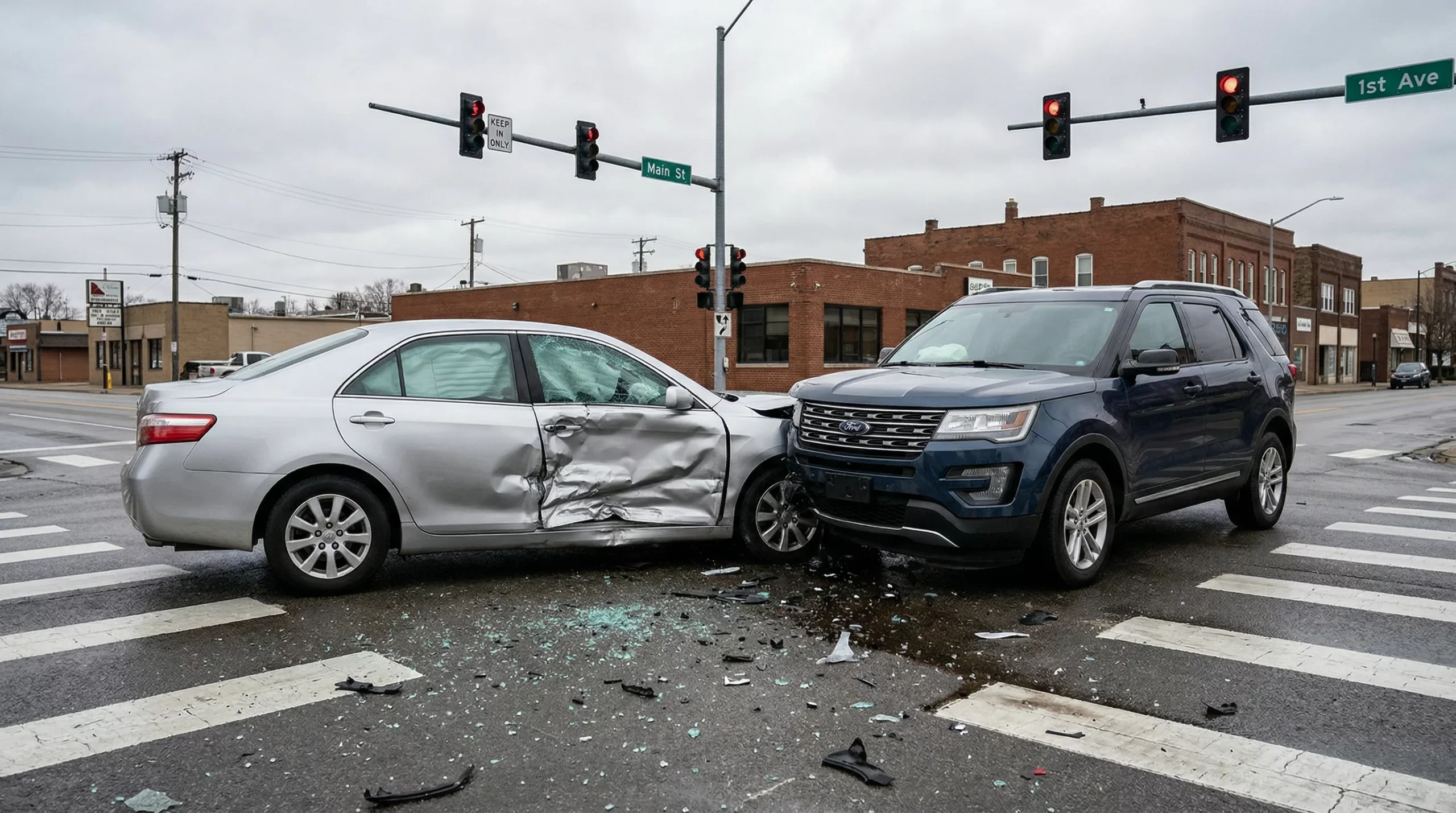
T-bone crashes, also called side-impact or broadside collisions, occur when the front of one vehicle strikes the side of another, typically at an intersection where one driver failed to stop, yield, or accurately judge the other vehicle’s path. According to the Insurance Institute for Highway Safety (IIHS), side impacts accounted for 22% of passenger vehicle occupant deaths in 2024. An NHTSA study found that about 40 percent of the estimated 5,811,000 crashes in the United States in 2008 were intersection-related.
Why T-Bone Crashes Are So Dangerous
In the IIHS data, side impacts are the second-deadliest impact type after frontal impacts, which accounted for 59% of occupant deaths in 2024. A car door has only a few inches of metal, glass, and trim between the road and the passenger compartment. In a rear-end crash, the trunk, crumple zones, and bumpers absorb much of the energy, and a front-end crash channels energy into the engine bay. In a T-bone, the striking vehicle’s front end hits a door panel with limited crush space, and the energy goes directly into the occupant’s head, torso, and pelvis.
Side-impact crashes are particularly dangerous for children in the rear seat and for older adults whose bones and organs are more fragile. The Insurance Institute for Highway Safety (IIHS) reports that side airbags with head protection reduce a car driver’s risk of death in driver-side crashes by 37% and an SUV driver’s risk by 52%.
Common T-bone injuries include traumatic brain injury from head impact with the door or window, cervical spine fractures, rib fractures, internal organ damage from door intrusion, hip and pelvis fractures in the near-side occupant, and arm injuries from bracing. The full range of car accident injuries is severe in T-bone crashes because the occupant absorbs the energy of the striking vehicle with minimal structural buffer.
Common Causes of T-Bone Crashes in Louisville
T-bone crashes in Louisville trace to five common causes.
- 1
Running Red Lights and Stop Signs
A driver who runs a red light or a stop sign enters an intersection where cross-traffic has the right of way, on a direct collision course with the sides of crossing vehicles. According to IIHS red-light running data, 1,119 people were killed in crashes that involved red light running in 2024. The page on whether drivers who run red lights are always at fault covers how fault is assigned in those crashes.
- 2
Failure to Yield on Left Turns
A driver who turns left through an intersection without yielding to oncoming traffic causes a broadside impact to the vehicle traveling straight. NHTSA’s study of intersection-related crashes attributes left-turn crashes at signals and stop signs to a turning driver’s obstructed view or misjudgment of the gap or the other vehicle’s speed.
- 3
Distracted Driving
A driver approaching an intersection while texting or looking at a phone may not process the signal change, the cross-traffic, or a pedestrian. Distracted driving contributes to intersection crashes because a brief moment of inattention is enough to miss a red light or a stop sign entirely.
- 4
Impaired Driving
Alcohol and drug impairment reduce reaction time, judgment, and the ability to perceive signal status and traffic flow.
- 5
Mechanical Failure
Brake failure, tire blowouts, and steering failures can send a vehicle into an intersection against the driver’s intentions. When mechanical failure causes a T-bone, the driver may not be negligent, and the vehicle manufacturer or a maintenance provider may be liable for the underlying defect.
How Fault Is Determined in T-Bone Crash Claims
Fault in a T-bone crash turns on who had the legal right of way at the moment of the crash, and each driver usually claims the light was in their favor or that they arrived first.
Right of Way and Fault
- Red lights: under KRS 189.338, a driver facing a steady red signal must stop and remain stopped until a green indication is shown, and a driver facing a green signal must still yield to vehicles lawfully within the intersection. Traffic camera footage, signal timing records, and witness statements establish when the light changed.
- Stop signs: under KRS 189.330(4), a driver must stop and then yield to any vehicle in the intersection or approaching so closely as to be an immediate hazard.
- Yield signs: under KRS 189.330(5), when a driver passes a yield sign without stopping and collides with a vehicle in the intersection, the collision is prima facie evidence that the driver failed to yield.
- Left turns: under KRS 189.330(9), a driver turning left must yield to any vehicle approaching from the opposite direction that is within the intersection or so close as to be an immediate hazard.
- Intersections without signs or signals: under KRS 189.330(1), when two vehicles enter from different roadways at approximately the same time, the driver on the left yields to the vehicle on the right, and who arrived first becomes a factual question resolved by witness testimony and physical evidence.
A traffic violation does not end the fault question. Under KRS 411.182, the jury assigns each party a percentage of fault based on its conduct and how much that conduct caused the damages, so a driver who failed to yield can share fault with a driver who was speeding or distracted.
Six evidence sources resolve right-of-way disputes.
- 1
Traffic Camera Footage
Sam Aguiar Injury Lawyers has direct real-time access to six-month rolling archives of DOT and TRIMARC traffic camera footage. Business cameras at adjacent buildings can also capture the signal and the impact.
- 2
Event Data Recorder (EDR) Data
An event data recorder, in a vehicle that has one, records speed, braking, and throttle in the seconds before impact. Brake application timing shows which driver attempted to stop and which continued through the intersection.
- 3
Signal Timing Records
Signal timing logs kept by the agency that operates the signal can document when signals changed on the day of the crash. When a driver claims the light was yellow, signal timing data can confirm or contradict that claim.
- 4
Skid Marks and Physical Evidence
Skid mark starting positions, vehicle rest positions, and impact gouge marks in the roadway establish each vehicle’s trajectory and speed.
- 5
Cell Phone Records
When distraction is suspected, cell records confirm whether the at-fault driver was using a phone at the moment of impact.
- 6
Witness Statements
Passengers, pedestrians, and other drivers waiting at the light are often the most reliable accounts of which driver had the green light.
Third-Party Liability in a T-Bone Crash
A government agency that failed to maintain a malfunctioning traffic signal, or a third party whose negligence obstructed a driver’s view of the intersection, can share liability for a T-bone crash with the two drivers involved, depending on the facts. A negligence claim against a Commonwealth agency such as the Kentucky Transportation Cabinet goes to the Kentucky Board of Claims, which has exclusive jurisdiction and, under KRS 49.040, caps a single award at $250,000 and all claims from one act of negligence at $400,000.
Hurt in a Kentucky T-Bone Crash?
Right-of-way disputes in a T-bone crash are settled with signal timing logs, camera footage, and event data recorder downloads, and fault is shared by percentage under Kentucky law. After an accident, the insurance company doesn’t waste time. Neither should you.
Sam Aguiar Injury Lawyers takes T-bone cases under the Bigger Share Guarantee®. Clients always walk away with more money than the firm after medical bills, liens, and case expenses are paid. If the client’s share would ever be less than the legal fee, the firm cuts its fee. Flat contingency fee that never increases if your case goes to trial. Call 502-888-8888 to get a free case review of your T-bone crash.
Why Clients Choose Sam Aguiar
Ready to Take Action on Your Case?
After a serious injury, medical bills pile up while the insurance company looks for ways to pay you less. Most law firms take their cut first and leave you with whatever is left. Sam Aguiar Injury Lawyers does things differently. With our exclusive Bigger Share Guarantee®, you always get more. Every client gets a dedicated three-person team: an attorney, a case manager, and a legal assistant. We never raise our fee rate if we have to go to court, and you pay $0 Out-Of-Pocket Forever.
Frequently Asked Questions
1Who is at fault when a driver runs a red light and causes a T-bone crash?+
Under KRS 189.338, a driver facing a steady red signal must stop and remain stopped until the light turns green, so running the light is strong evidence of fault. Kentucky still apportions fault by percentage under KRS 411.182, so the other driver’s speed or distraction can reduce what that driver recovers.
2Why are T-bone crash injuries often so severe?+
A car door has only a few inches of metal, glass, and trim between the road and the passenger compartment, so a side impact sends the striking vehicle’s energy directly into the occupant. The front and rear of a vehicle have crumple zones that absorb much more of that energy.
3How is fault determined when both drivers claim they had a green light?+
Traffic camera footage, signal timing logs, and event data recorder information from both vehicles are the evidence most often used to resolve a dispute over which driver had the right of way.
4Can a malfunctioning traffic signal make a government agency liable for a T-bone crash?+
It can. A government agency that failed to maintain a malfunctioning signal can share liability. A claim against a Commonwealth agency such as the Kentucky Transportation Cabinet goes to the Kentucky Board of Claims, where KRS 49.040 caps a single award at $250,000.
5Who is at fault in a left-turn T-bone crash?+
Usually the turning driver. Under KRS 189.330(9), a driver turning left must yield to any vehicle approaching from the opposite direction that is within the intersection or close enough to be an immediate hazard. Fault can still be shared under KRS 411.182 if the other driver was speeding or distracted.