

Distracted Driving Accident Attorneys
Distracted Driving Accidents in Kentucky
 ★★★★★
Over 1,000 Five-Star Reviews
•
Available 24/7. $0 Out-Of-Pocket Forever.
★★★★★
Over 1,000 Five-Star Reviews
•
Available 24/7. $0 Out-Of-Pocket Forever.
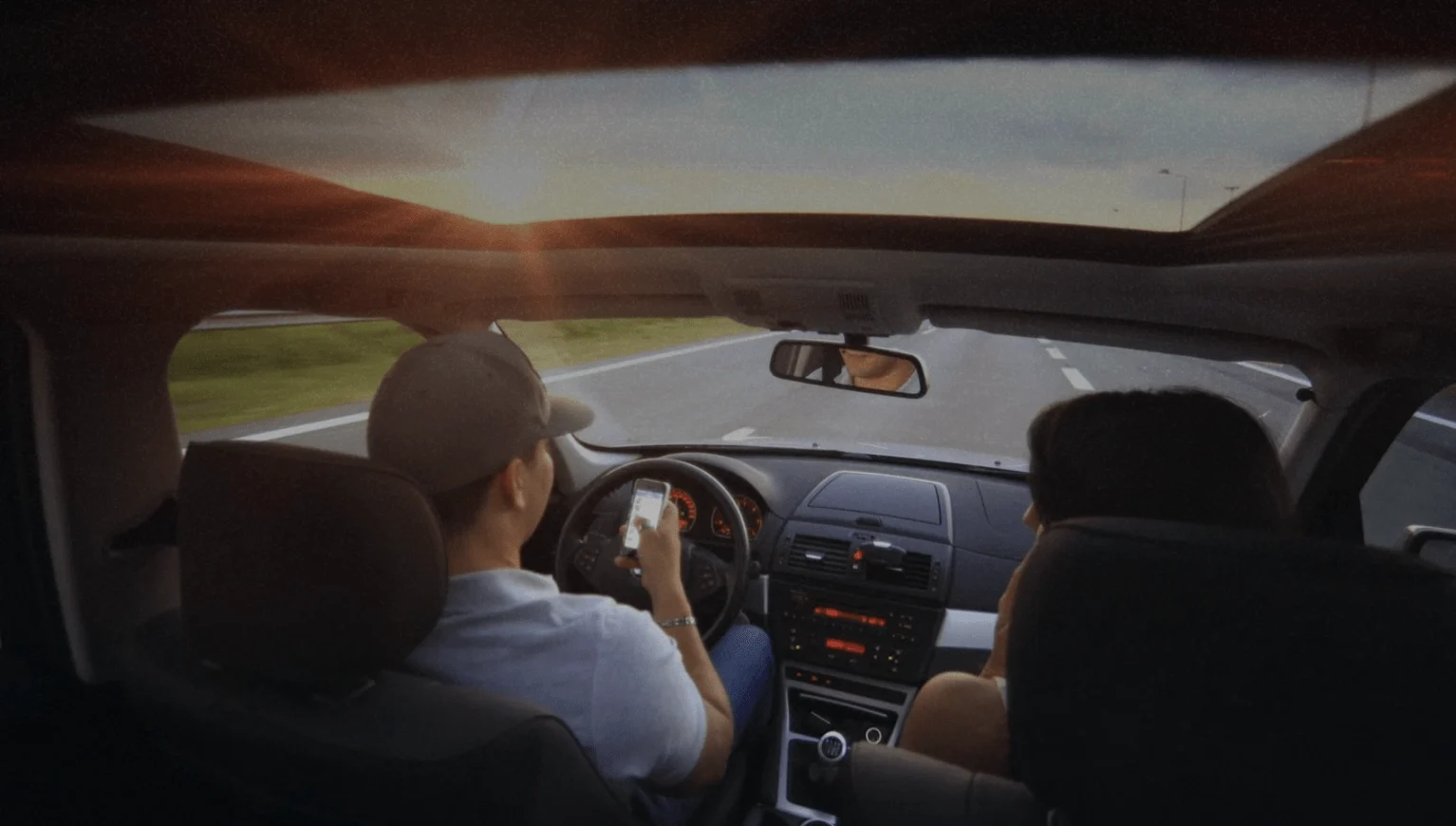
Kentucky Texting and Driving Laws
Kentucky passed its texting-while-driving ban in 2010. KRS 189.292 bars any driver of a motor vehicle in motion on the traveled portion of a roadway from writing, sending, or reading text-based communication, such as a text message, instant message, or email, on a personal communication device. The ban does not apply to a device’s GPS feature, a navigation system built into the vehicle, reading, selecting, or entering a phone number or name to make a call, an emergency or public safety vehicle operator using the device for official duties, or a text sent to report illegal activity, summon medical help or law enforcement, or prevent injury to a person or property.
For a driver under 18 with an instruction permit, intermediate license, or operator’s license, KRS 189.294 bars any use of a personal communication device while driving, except to summon medical help or law enforcement in an emergency. A stand-alone or built-in navigation system and CB or amateur radio are excluded, and manually entering information into a phone’s GPS feature counts as use.
Under KRS 189.990(30), a violation of KRS 189.292 or 189.294 carries a $25 fine for a first offense and $50 for each later offense, and 601 KAR 13:025 assigns three points to a license for texting while driving.
Negligence Per Se in a Distracted Driving Case
Under Kentucky’s negligence per se doctrine, a driver who violates a statute designed to protect others from harm, such as KRS 189.292, is negligent as a matter of law. KRS 446.070 lets a person injured by the violation of a statute recover the damages sustained because of the violation. The injured person does not have to prove separately that the driver was unreasonably careless, and still has to show the violation caused the injury.
Three Types of Distraction
Distraction comes in three main types: visual distraction, taking your eyes off the road to read a text or check GPS; manual distraction, taking your hands off the wheel to eat or adjust the radio; and cognitive distraction, taking your mind off driving during a phone call or an intense conversation. Texting combines all three. In naturalistic driving studies, texting made the risk of a crash or near-crash 23.2 times as high for truck drivers, and dialing a phone made it 2.8 times as high for car drivers, compared with non-distracted driving. Hands-free phone use still produces cognitive distraction that measurably slows reaction time, enough at highway speeds to travel a significant distance without full awareness of the road ahead.
Distracted Driving Evidence
Evidence of distraction usually comes from several sources, since most drivers will not admit it. Phone records and carrier data obtained through formal legal discovery can show call logs, text message timestamps, and app activity at the time of the accident, and deleted messages can sometimes be recovered through the carrier.
Traffic camera footage, when preserved before it is overwritten, and independent witness accounts corroborate the phone records. In some cases, a vehicle’s event data recorder shows that a driver braked late or failed to react at a point where an attentive driver would have, which can support a distraction argument even without direct phone evidence.
Damages in a Distracted Driving Accident
An injured person in a Kentucky distracted driving accident can pursue the same damages available in any car accident case: medical expenses, lost wages and reduced earning capacity, and pain and suffering once the injuries clear Kentucky’s tort threshold under KRS 304.39-060. A negligence per se finding tied to a proven distracted driving violation, with causation shown, can simplify the liability side of the case and move the focus to documenting the full extent of the harm.
How Sam Aguiar Injury Lawyers Handles Distracted Driving Accident Cases
Sam Aguiar Injury Lawyers builds distracted driving cases around phone records, traffic camera footage, and witness accounts.
Bigger Share Guarantee®: clients always walk away with more money than the firm after medical bills, liens, and case expenses are paid. If the client’s share would ever be less than the legal fee, the firm cuts its fee.
- Dedicated three-person team: a top-rated attorney, an experienced case manager, and a skilled legal assistant.
- Flat contingency fee that never increases if your case goes to trial.
- $0 Out-Of-Pocket Forever.
Phone records and carrier data in a distracted driving case come through formal legal discovery, and traffic camera footage can be overwritten. Ask Sam Aguiar Injury Lawyers for a free case review after a distracted driver hit you.
Key Takeaways
Was the Other Driver on Their Phone?
Kentucky bans texting while driving, and when the driver who hit you broke that law, the violation itself can support your case. Sam Aguiar Injury Lawyers seeks phone records, witness accounts and any available video to show what the driver was doing in the seconds before impact. You pay $0 Out-Of-Pocket Forever, and the flat contingency fee never increases, even if your case goes to trial. Call today for a free case review.