

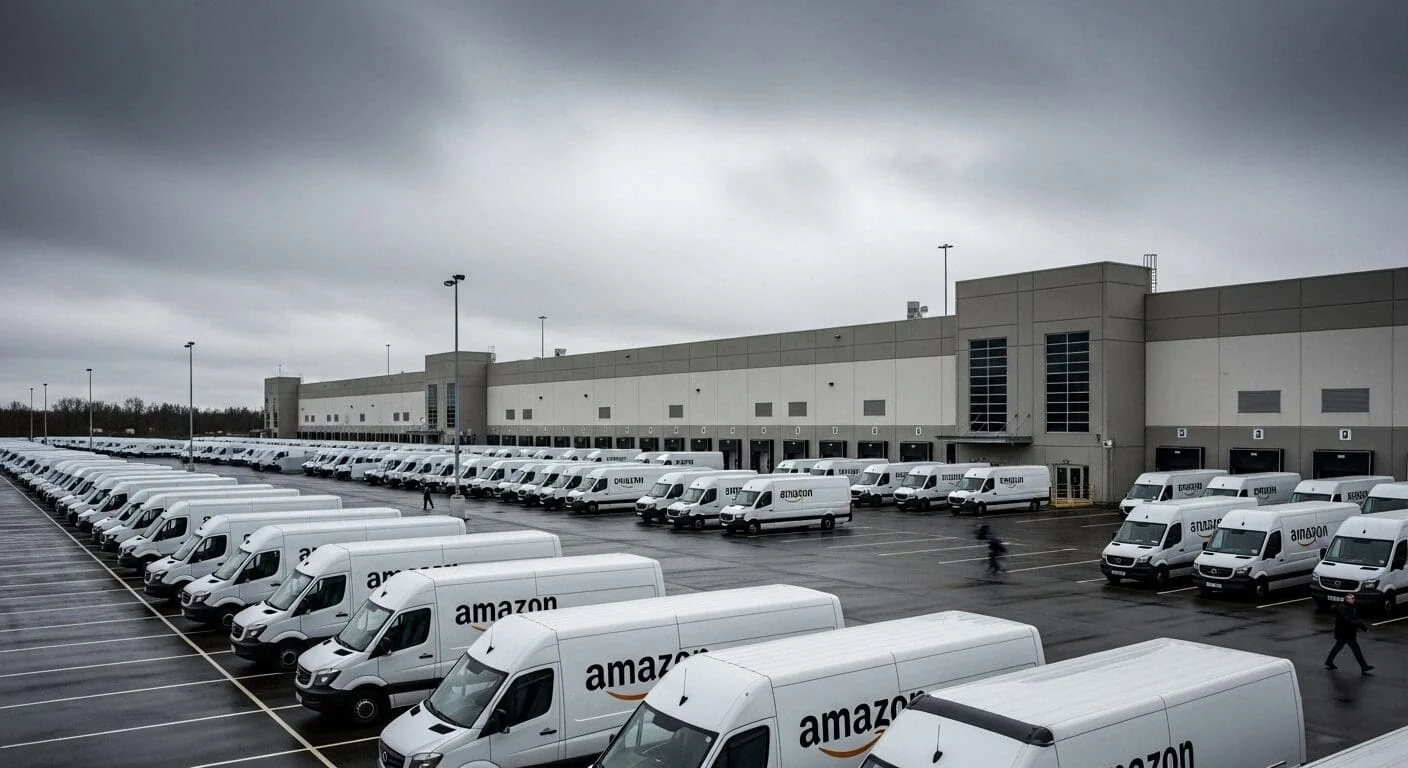
Amazon Delivery Accidents Are Rising
Amazon now delivers 17.2 million packages per day in the U.S. More vehicles, more pressure, more crashes, and a corporation that defaults to blaming a contractor when things go wrong.
Amazon processed 6.3 billion U.S. deliveries in 2024, up 6.78% from the prior year and still accelerating. That volume requires hundreds of thousands of drivers operating under brutal delivery quotas, minimal training, and constant algorithmic pressure. When one of those drivers hits your car, Amazon’s first move is almost always the same: point at the Delivery Service Partner (DSP) contractor and walk away. But courts are seeing through it, and so do we. If an Amazon delivery vehicle hit you in Kentucky, our commercial vehicle team knows exactly how to build the case.
The Scale of Amazon’s Delivery Network, and the Crash Risk It Creates
Amazon is now the second-largest parcel carrier in the United States, trailing only USPS. According to FMCSA crash data, fatal crashes involving large trucks and buses increased 26.4% from 2016 to 2022, even as the overall traffic death rate was declining. Amazon’s delivery network has grown 688% since 2018. Those two trends are not unrelated.
Amazon controls its drivers through routing apps, real-time GPS monitoring, Netradyne AI cameras, and performance algorithms, but legally classifies most of them as independent contractors through its Delivery Service Partner program. That classification is the foundation of Amazon’s liability defense. It’s also increasingly being rejected by courts.
(Pitney Bowes Parcel Index 2024)
(CBS News / FMCSA data analysis)
(FMCSA data, CBS News investigation)
(FMCSA Crash Causal Factors Program)
A CBS News analysis of six years of FMCSA data found that Amazon’s middle-mile carriers had monthly unsafe driving violation rates that were at least 89% higher in every single month compared to carriers not working for Amazon. University researchers who reviewed the methodology called the difference “stunning”, effects that size are simply not seen in normal carrier comparisons.
Why Amazon Delivery Crashes Keep Happening
The root causes are structural, not accidental. Amazon’s business model depends on keeping delivery costs low and speed high, and that pressure flows directly onto drivers.
Crushing Delivery Quotas
Amazon DSP drivers are typically assigned 250 to 400 packages per shift. During peak seasons, internal Amazon documents show expected delivery rates of one stop every 36 seconds, including drive time. DSP operators themselves have acknowledged this pace “is not sustainable nor safe.” Drivers report running red lights, speeding through neighborhoods, and skipping rest breaks to keep up. These aren’t isolated choices by rogue drivers, they’re the predictable result of a system Amazon designed and profits from.
Inadequate Screening and Extreme Turnover
Amazon’s delivery network experiences average driver turnover of 90 days, with some locations reporting annual turnover rates of 150%. That churn means drivers are perpetually learning routes on the job. Documented cases include drivers with 70+ speeding violations on record who continued delivering for Amazon contractors, violations Amazon’s own tracking systems had flagged. The company took no action until someone died.
Algorithmic Routing That Ignores Safety
Amazon’s routing algorithms optimize for efficiency, not safety. Drivers are routed across multi-lane highways while carrying packages and are prohibited from altering their assigned paths even when safety concerns arise. Internal records show Amazon maintains this level of operational control, the same control it uses to deny employer status when a crash happens.
Distracted Driving Built Into the Job
Delivery management apps, GPS systems, scanner guns, and Amazon’s own Relay platform keep drivers constantly interacting with devices while operating their vehicles. According to NHTSA’s distracted driving data, roughly 3,000 people die nationally each year in crashes involving a distracted driver. For Amazon drivers, distraction is an occupational requirement.
Amazon’s DSP Model: Control Without Accountability
Amazon instructs its DSP drivers what routes to take, how long each stop should take, when to arrive, how many packages to deliver per shift, and the consequences of falling short. Drivers wear Amazon uniforms, use Amazon scanners and telematics, and carry Amazon packages. Amazon’s algorithms monitor every mile in real time.
- Routes are assigned and locked, drivers cannot deviate without penalty
- AI cameras monitor driver behavior inside the vehicle continuously
- Performance scores directly affect DSP contracts with Amazon
- DSPs must report accidents to Amazon immediately
Courts have looked at this level of control and found Amazon vicariously liable for DSP driver actions. The “independent contractor” label is a legal strategy, not a description of how these drivers actually operate.
Types of Amazon Delivery Vehicle Crashes
Amazon’s fleet includes branded delivery vans, unmarked personal vehicles (Flex drivers), and semi-trucks moving freight between fulfillment centers. Each type presents different crash dynamics and different liability issues.
- Rear-end collisions, Driver distraction and tailgating while rushing between stops. These are among the most common crash types involving delivery vehicles, often causing whiplash, spinal injuries, and TBI.
- Sideswipe crashes, Improper lane changes at speed, failing to signal, aggressive merging. Amazon vans frequently make these maneuvers to gain seconds on tight delivery schedules.
- Pedestrian and cyclist strikes, Particularly in dense residential neighborhoods and downtown corridors where delivery density is highest and driver attention is divided across apps and packages.
- Backing accidents, Delivery drivers back into driveways, alleys, and loading zones dozens of times per shift. Rear cameras and sensors handle, but fatigue and time pressure create blind spots.
- Unsecured load hazards, Cargo shifted or falling from vehicles creates road hazards affecting following traffic. Amazon vans carrying 250+ packages are frequently overstuffed, with loads that shift in transit.
- Semi-truck crashes, Amazon Relay contractors operate large commercial vehicles between fulfillment centers. These crashes cause some of the most catastrophic injuries, and they fall squarely under FMCSA commercial trucking regulations.
Who Is Liable When an Amazon Vehicle Hits You?
Liability in an Amazon delivery crash is almost never straightforward. Amazon’s structure is designed to create distance between the company and any individual crash. Understanding how liability actually works is critical to recovering top compensation.
The Driver
Individual drivers can be personally liable for negligent operation, speeding, distracted driving, running red lights, failure to yield. But most DSP drivers carry only personal auto insurance, which may be inadequate for serious injuries.
The Delivery Service Partner (DSP)
DSPs are the businesses Amazon contracts to manage local delivery operations. They employ the drivers and carry commercial insurance. However, many DSPs operate on thin margins and may lack the financial resources to cover catastrophic injuries. DSP insurance policies vary widely, and some are intentionally structured to limit exposure.
Amazon Itself
This is where the real money is, and where Amazon fights hardest. Amazon’s standard defense is that DSP drivers are independent contractors, not Amazon employees. But courts are increasingly rejecting this argument when the evidence shows Amazon’s degree of operational control. In a 2021 South Carolina case, a court found Amazon vicariously liable for a DSP driver’s actions because of the control Amazon exercised over the DSP and the driver’s daily operations.
The evidence that pierces Amazon’s contractor defense includes: routing algorithm data, delivery quota records, telematics showing Amazon’s real-time monitoring, training materials, DSP contract terms, and the AI surveillance systems Amazon deploys inside every delivery vehicle. Building that case requires moving fast, much of this data is subject to litigation holds that must be issued immediately after a crash.
Amazon Flex drivers present a separate issue. These are individuals Amazon recruits through its app to deliver packages in their personal vehicles, with minimal screening. Amazon Flex drivers may not carry commercial auto insurance, meaning victims can face coverage gaps on top of liability disputes. If a Flex driver hit you, the insurance picture is complicated from day one.
Injuries From Amazon Delivery Vehicle Crashes
Amazon vans and trucks are large, heavy vehicles operated at high speeds under significant time pressure. When they hit passenger cars, cyclists, or pedestrians, the injuries are often severe.
- Traumatic brain injuries (TBI), ranging from concussion to permanent cognitive impairment. The CDC reports approximately 190 Americans die daily from TBI-related causes.
- Spinal cord injuries, partial or complete paralysis, requiring lifetime care. Economic damages in spinal cord cases routinely exceed $1 million in future costs alone.
- Bone fractures, often requiring surgery, hardware, and extended rehabilitation
- Internal organ damage, frequently missed on initial exam, requiring follow-up imaging and surgery
- Soft tissue injuries, whiplash, torn ligaments, herniated discs, injuries insurance companies minimize but that cause real long-term pain and disability
- Wrongful death, Amazon delivery crashes kill dozens of people each year, leaving families without financial support and facing the full weight of loss
What Your Amazon Delivery Crash Case Is Worth
Kentucky does not cap compensatory damages in personal injury cases. Recoverable damages include:
- Medical expenses, emergency treatment, surgery, hospitalization, rehabilitation, professionals care, future procedures
- Lost wages and earning capacity, income lost during recovery and reduced future earnings from permanent injury
- Pain and suffering, physical pain, emotional distress, PTSD, loss of enjoyment of life
- Property damage, vehicle repair or replacement
- Long-term care costs, home modifications, assistive devices, ongoing treatment
- Punitive damages, when Amazon or a DSP’s conduct was grossly negligent or reckless. Courts have awarded punitive damages against Amazon in cases involving ignored safety violations.
Under Kentucky’s pure comparative fault rule (KRS 411.182), your compensation is reduced by your share of fault, but you can still recover even if you were partially responsible. Amazon’s insurance teams are trained to inflate the victim’s fault percentage. Strong evidence and documentation from the start are what prevent that from happening.
How Our Team Handles Amazon Delivery Crash Cases
Amazon delivery crash cases require a different approach than a standard car accident claim. There are multiple defendants, layers of insurance, and a well-resourced corporation with experienced defense counsel. Our dedicated commercial vehicle team moves immediately on the evidence that matters most:
-
Litigation hold letters, same day
Amazon retains telematics data, Netradyne camera footage, routing records, and delivery logs, but only if demanded quickly. We issue litigation hold letters immediately to preserve the evidence Amazon would prefer to disappear.
-
Full crash reconstruction
Scene documentation with photographs, video, measurements, and drone imagery. Black box and telematics data. Cell phone forensics. Driver history and screening records. We build the case from the ground up before Amazon’s team can shape the narrative.
-
Identify every insurance layer
Driver personal auto, DSP commercial policy, and Amazon’s own carrier coverage. We pursue all available coverage, not just the easiest or most obvious source.
-
Establish Amazon’s control over the driver
Routing algorithm data, quota records, DSP contract terms, performance monitoring records, and AI surveillance documentation, the evidence that turns “independent contractor” into “direct liability.”
-
Document the full scope of your damages
Medical records, wage documentation, testimony from medical and economic professionals, everything that captures what this crash actually cost you, including future costs insurance adjusters will try to minimize or ignore.
Our Bigger Share Guarantee® means you always get more. We keep less so you take home a bigger share of every settlement. No increased litigation fees contingency fee that never increases, even if your case goes to trial. And you pay $0 Out-Of-Pocket, forever.
Kentucky’s Statute of Limitations for Amazon Delivery Crash Claims
In Kentucky, you generally have two years from the date of the crash, or the date of the last PIP payment, whichever is later, to file a personal injury claim. Wrongful death claims must be filed within one year under KRS 413.140. Missing these deadlines permanently bars your claim, regardless of how strong the evidence is.
In Amazon delivery cases, acting quickly is even more critical than in standard crash claims. Telematics data, camera footage, delivery logs, and driver communications have short retention windows. Evidence that would prove Amazon’s liability can be deleted within weeks if not preserved by a legal hold. The sooner you call, the more we can work with.
Frequently Asked Questions
Can I sue Amazon directly if one of their delivery drivers hit me?
Yes, in many cases. Amazon typically argues that its DSP drivers are independent contractors, not Amazon employees, so Amazon bears no responsibility. But courts have found Amazon vicariously liable when the evidence shows Amazon controlled the driver’s routes, schedules, tools, and performance standards. That control evidence, routing algorithms, telematics data, quota records, and DSP contract terms, is what turns a contractor defense into a losing argument. Liability may be shared among the driver, the DSP, and Amazon itself, and pursuing all three is often the path to full recovery.
What if the Amazon driver was in an unmarked personal vehicle?
Amazon Flex drivers deliver packages in their own personal vehicles with minimal screening or oversight. If a Flex driver hit you, their personal auto insurance may be the first line of coverage, but personal policies often exclude commercial delivery activity, creating a coverage gap. Amazon carries supplemental insurance for Flex drivers during active deliveries, but the terms vary and Amazon contests coverage aggressively. These cases require careful documentation of the driver’s activity status at the time of the crash and fast action to preserve Amazon’s delivery records.
How does driver fatigue factor into Amazon delivery accident cases?
Driver fatigue is a significant factor in many Amazon delivery crashes. Standard DSP shifts run 10 hours, with drivers expected to complete 250 to 400 deliveries per shift. Drivers are often discouraged from taking adequate rest breaks to maintain delivery pace. FMCSA hours-of-service regulations apply to commercial vehicles over 10,000 pounds, and violations of those regulations are direct evidence of negligence. For smaller delivery vans, fatigue evidence comes from delivery logs, routing data, and driver work history. Establishing that Amazon’s quota system created the conditions for fatigued driving is a key part of these cases.
What evidence is most important to preserve after an Amazon delivery crash?
Move fast. The most critical evidence includes: Amazon’s telematics data from the delivery vehicle (GPS, speed, acceleration), Netradyne AI camera footage from inside the van, delivery logs and routing records, the driver’s performance history and violation record, DSP contract terms with Amazon, and Amazon’s internal communications about safety policies. This data has short retention windows and is subject to deletion unless a litigation hold is issued immediately. Call us the same day if possible, the window to preserve this evidence can close in days or weeks.
How long do I have to file a claim after an Amazon delivery accident in Kentucky?
Kentucky generally gives you two years from the date of the crash, or the date of the last PIP payment, whichever is later, to file a personal injury lawsuit. Wrongful death claims must be filed within one year under KRS 413.140. These deadlines are strict: missing them bars your claim permanently. But in Amazon delivery cases, the practical deadline for preserving critical evidence is much shorter. Telematics and camera data can be deleted within weeks. Don’t wait to act.
Start Your Case Review
Fill out the form below and our team will reach out to discuss your options. About 10 minutes to qualify, no cost, no obligation.