

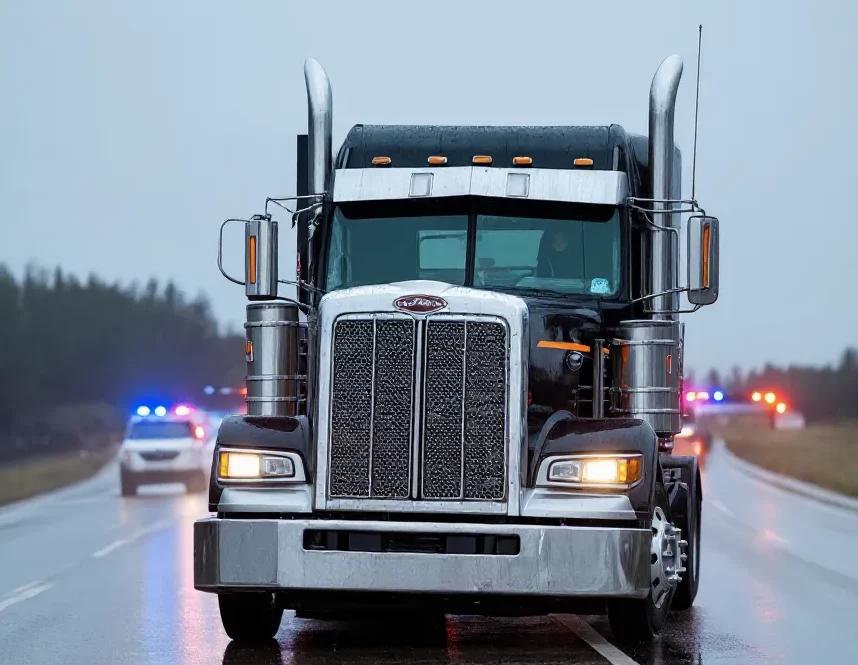
Top Causes of Big Truck Accidents in Kentucky
Kentucky recorded 113 commercial truck-involved fatal crashes in 2023 — about 1 in 10 of all fatal collisions in the state. Driver behavior, mechanical failures, and carrier negligence are the primary causes. Understanding the cause is the first step to proving who is responsible.
Kentucky’s roads carry a disproportionately high volume of commercial truck traffic — the state sits at the intersection of major north-south (I-65) and east-west (I-64) freight corridors, making it one of the most trucking-intensive states in the nation. Kentucky State Police crash data shows 814 total roadway fatalities in 2023, with commercial trucks involved in approximately 113 fatal incidents — roughly 10% of all fatal crashes. The causes are not random. They follow predictable patterns — and those patterns point directly at the driver, the carrier, and in many cases, both.
Kentucky Truck Crash Data — The Numbers That Matter
(Kentucky State Police)
(KSP data)
(KSP data)
(FMCSA)
The Top Causes of Truck Crashes in Kentucky
1. Driver Inattention and Distraction
Driver inattention — including cell phone use, looking away from the road, daydreaming, and looking at roadside events — was the leading driver-related cause of truck crashes in Kentucky in 2023, accounting for approximately 2,800 crashes. Under 49 CFR 392.82, commercial drivers are prohibited from using handheld mobile devices while driving. Phone records subpoenaed after a crash can establish whether a driver was actively using their phone at the moment of impact — a direct federal violation and powerful evidence in a civil case.
2. Driver Fatigue and Hours of Service Violations
Fatigued driving is the second most significant driver-related cause in large truck crashes. The FMCSA Large Truck Crash Causation Study found that fatigued driving was a critical reason in a significant portion of crashes. Hours of service violations — documented through ELD data — create an objective record of whether the driver was legally within their driving limits when the crash occurred. A driver on their 12th hour is as impaired as someone with a measurable BAC.
3. Failure to Yield and Improper Clearance
Failure to yield was involved in over 650 Kentucky truck crashes in 2023. At highway speeds, a truck failing to yield when merging, changing lanes, or entering traffic creates catastrophic consequences — 80,000 lbs of momentum cannot stop in time to correct an error. Improper clearance — misjudging the space between the truck and another vehicle — accounts for a significant share of sideswipe and rear-end crashes on I-65, I-64, and I-71.
4. Loss of Control
Loss of control events — including jackknife crashes and rollovers — represent a distinct category from driver error. These events often have mechanical contributions: improper load distribution, brake adjustment failures, tire defects, and suspension issues. When a rollover or jackknife is traced to a known vehicle defect the carrier failed to repair, or to a load that was improperly secured, the carrier faces direct liability independent of the driver’s actions.
5. Tire and Brake Failures
Mechanical failures contributed to over 200 serious truck crashes in Kentucky in 2023. Tire blowouts and brake failures are the leading mechanical causes. Truck tire blowout accidents on high-speed interstates cause sudden, violent lane departures with no warning to following drivers. Brake failures on downhill grades — common on I-64 through the Appalachian foothills — have caused catastrophic crashes. Driver Vehicle Inspection Reports (DVIRs) and maintenance records document whether the carrier knew about defective equipment before the crash.
6. Speed and Aggressive Driving
Speeding is a factor in a significant share of fatal truck crashes — both exceeding posted limits and driving too fast for conditions (rain, fog, ice, construction zones). A fully loaded semi at 65 mph requires over 525 feet to stop under ideal conditions. At 75 mph or in wet conditions, that distance grows substantially. Federal regulators considered mandating truck speed governors at 60–68 mph — but the proposal was withdrawn in 2025. For now, speeding compliance is entirely on the carrier and driver.
7. Impaired Driving
Commercial drivers face a stricter BAC standard than passenger vehicle drivers: 0.04% under 49 CFR 392.5, half the 0.08% civilian limit. Federal drug and alcohol testing requirements under 49 CFR Part 382 mandate pre-employment, random, and post-accident testing. When a carrier fails to conduct required post-accident testing or returns a driver to duty after a positive test, that failure is direct evidence of carrier liability. See our page on commercial DUI truck accidents.
8. Weather-Related Crashes
Ice, heavy rain, and fog on Kentucky’s interstates — particularly I-64 through central and eastern Kentucky and I-65 near Elizabethtown — create conditions where stopping distance becomes critical. Carriers and dispatchers who pressure drivers to maintain schedule in dangerous weather, rather than allowing them to pull off and wait, bear responsibility for the crashes that result. Weather-related truck accident evidence includes dispatch logs, weather service data, and driver communications showing pressure to continue despite hazardous conditions.
Louisville’s High-Risk Corridors
Jefferson County consistently records the highest crash totals in Kentucky. The most dangerous corridors for truck crashes in Louisville include:
- I-65 through downtown Louisville — the highest-volume freight corridor in the state, with complex interchanges and heavy merge traffic
- I-64 east of Louisville — heavy truck traffic with challenging terrain in the eastern sections
- I-71 between Louisville and Cincinnati — significant reefer and general freight traffic
- Outer Loop (KY-1020) — industrial and warehouse district traffic with high heavy truck volume
Why the Cause of the Crash Determines the Value of Your Case
The cause of a truck crash is not just a factual question — it determines who is liable, what evidence is available, and what damages are recoverable. A distracted driver case produces phone records and federal penalty evidence. A fatigue case produces ELD data and carrier scheduling records. A brake failure case produces maintenance records, DVIRs, and potential manufacturer liability. Our team investigates every category of trucking evidence relevant to the specific cause of your crash — and pursues all liable parties simultaneously.
Most truck crashes involve more than one cause. The FMCSA found that truck crashes typically result from a combination of driver behavior, vehicle condition, and environmental factors. A driver who was fatigued AND driving a truck with deferred brake maintenance AND exceeded their hours is a case against the driver AND the carrier — with a stronger damages picture than either alone would produce.
Frequently Asked Questions
What is the most common cause of fatal truck crashes in Kentucky?
Driver inattention and distraction accounts for the largest single category of truck crashes in Kentucky — approximately 2,800 in 2023 alone according to Kentucky State Police data. Fatigue, failure to yield, loss of control, and mechanical failures (tire and brake) round out the top causes. In most fatal crashes, multiple contributing factors are present simultaneously, which is why the investigation must address all of them.
Can the trucking company be sued when a mechanical failure caused the crash?
Yes. Under 49 CFR Part 396, carriers are legally required to systematically inspect and maintain every vehicle they operate. When a brake failure, tire blowout, or equipment defect contributed to a crash and maintenance records show the carrier knew about the defect — or failed to inspect the vehicle — the carrier faces direct liability independent of the driver’s conduct. Driver Vehicle Inspection Reports (DVIRs) frequently document pre-crash defects that were flagged and never repaired.
Are truck accident rates in Kentucky higher than other states?
Kentucky’s position as a major freight corridor state — with I-65, I-64, and I-71 crossing through Louisville — means the state carries a disproportionate share of the nation’s commercial truck traffic. Kentucky’s 2023 truck-involved fatality rate places it among the higher-risk states nationally, and Jefferson County (Louisville) consistently records the most total crashes of any Kentucky county. The combination of high freight volume, complex urban interchanges, and rural two-lane routes creates a dangerous environment.
What should I do immediately after being hit by a semi-truck?
Get to safety and call 911. Photograph the truck’s DOT number, company name, license plate, and cargo markings before the scene is cleared. Get the police report number. Seek medical attention even if you feel fine — traumatic brain injuries and internal injuries frequently present delayed symptoms. Do not give a recorded statement to the carrier’s insurer. Contact our team immediately — evidence like black box data and dash cam footage begins disappearing within hours of the crash.
Tell Us What Happened
Our team will review your truck accident and reach out to discuss your options — no upfront cost, no obligation.