

Truck Accident Liability FAQs
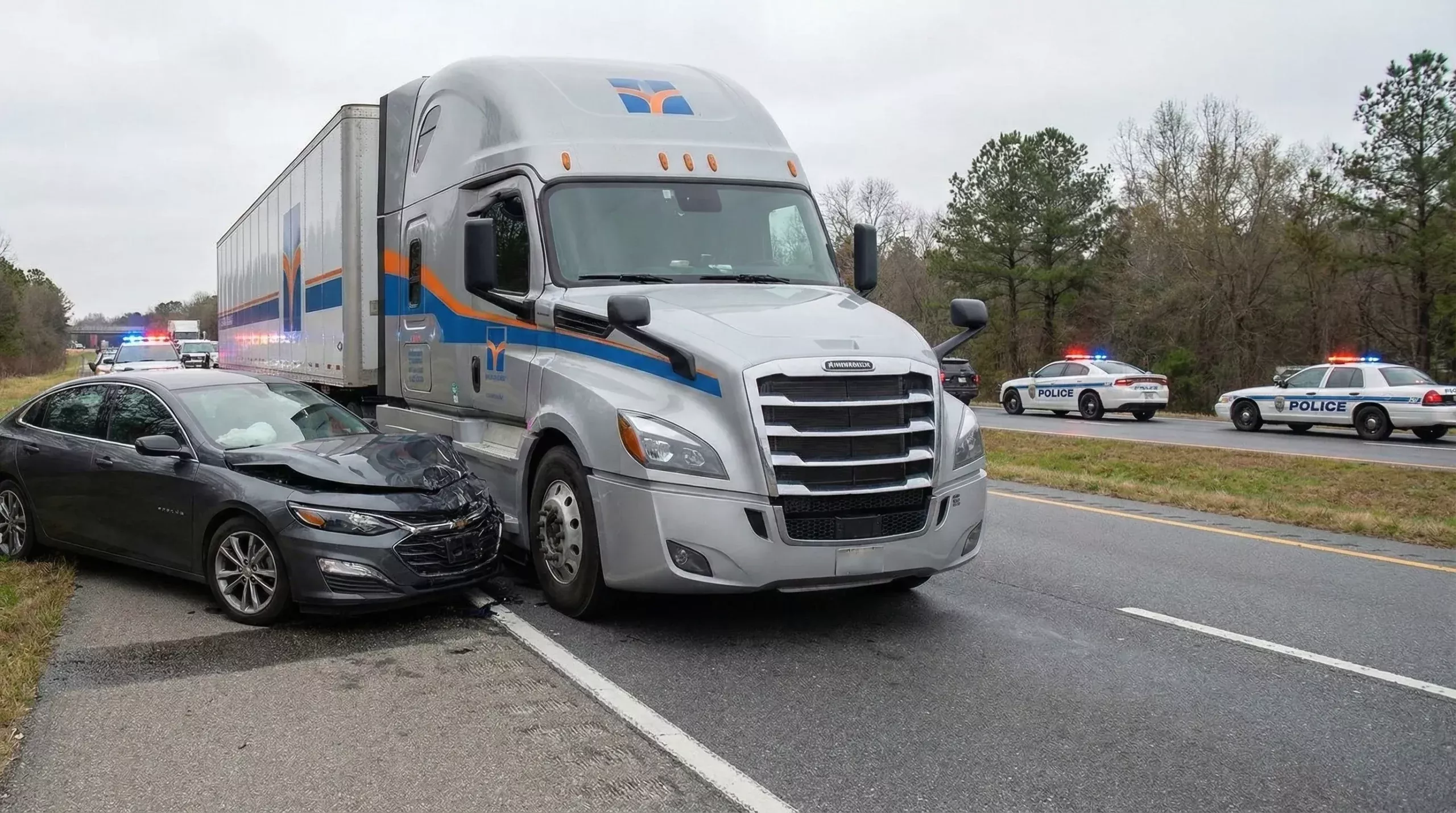
A truck accident case rarely ends with the driver. Trucking runs on a chain of companies, each with separate legal duties and separate insurance policies, and any of them can be responsible for the harm. A loaded tractor-trailer can weigh up to 80,000 pounds under federal limits, and in 2023 NHTSA large truck data showed 5,472 people died in traffic accidents involving large trucks, with 70% of those killed riding in other vehicles. Behind each of those accidents is a set of business relationships that has to be mapped before every liable party is known.
Truck Driver Negligence
The driver is a named defendant in almost every serious truck accident case. Speeding, distraction, fatigue, impairment, and hours-of-service violations are documented through police reports, electronic logging device data, and engine data downloads. 49 CFR Part 391 sets federal driver qualification standards, including minimum age, medical certification, and prior driving history. When a driver failed those standards and a carrier hired the driver anyway, the injured person has a direct negligence claim against both.
Motor Carrier Liability
The motor carrier, the company whose operating authority the truck ran under, is usually the most important defendant in a truck accident case. Carrier liability runs on two tracks.
Respondeat Superior
Under respondeat superior, Latin for “let the master answer,” an employer is liable for an employee’s negligence within the scope of employment. A company driver who causes an accident while hauling freight puts the carrier in that position without a separate showing that the company itself did anything wrong. For interstate trucking, FMCSA’s definition of “employee” in 49 CFR 390.5 includes an independent contractor while operating a commercial motor vehicle, which often creates a statutory employment relationship with owner-operators who lease their trucks to a carrier. Calling a driver an independent contractor does not by itself end carrier liability.
Direct Negligence
A carrier is also directly liable when its own conduct caused or contributed to the accident. Common theories include negligent hiring (failing to check a driver’s motor vehicle record or safety history), negligent retention (keeping a driver with documented violations), inadequate maintenance under 49 CFR Part 396, and pressuring drivers to break hours-of-service rules. A carrier’s inspection and violation history is public in the FMCSA Safety Measurement System.
Federal Insurance Minimums
49 CFR 387.9 sets minimum financial responsibility for interstate motor carriers: $750,000 for nonhazardous property, $1,000,000 for oil and certain hazardous materials, and $5,000,000 for bulk hazardous substances and certain high-hazard materials. Those figures are floors. Actual policy limits are often higher, and each liable company in a multi-party case can bring its own policy. The MCS-90 endorsement adds a public-liability backstop when ordinary coverage would otherwise deny the claim.
Freight Broker Duties
Freight brokers arrange loads between shippers and carriers. Under 49 CFR 387.307, a broker must keep a $75,000 surety bond or trust fund on file with FMCSA. A broker is not automatically liable for a carrier’s negligence. Courts look at how much control the broker exercised over the driver.
In Sperl v. C.H. Robinson Worldwide, 408 Ill. App. 3d 1051 (2011), a jury found the broker vicariously liable and the court entered a $23,775,000 judgment. The Illinois Appellate Court affirmed, pointing to the broker’s delivery deadlines, required check calls, and a system of fines for late deliveries that directed the driver’s conduct during the whole haul. When a broker goes beyond matching loads to carriers and directs the details of the haul, liability can follow.
Without that control, a broker can still face a negligent selection claim for hiring a carrier with a suspended authority, poor safety scores, or lapsed insurance without checking those records. In May 2026, the Supreme Court held in Montgomery v. Caribe Transport II that federal law does not preempt a state-law negligent hiring claim against a broker, as explained on the page covering freight broker liability after a truck accident.
Shipper and Cargo Loader Responsibility
Whoever loaded, secured, or sealed the cargo can be liable when improper loading causes an accident. Under 49 CFR Part 393, Subpart I, cargo must be secured so it cannot shift in a way that affects safe operation. When a steel coil or a poorly blocked load shifts and causes a jackknife, a rollover, or a sudden loss of steering, the shipper that loaded it shares responsibility. Load manifests, weighing records, shipper inspection logs, and the driver’s pre-trip inspection notes show whether the load was secured before it left the dock.
Maintenance Shops and Parts Manufacturers
A third-party maintenance shop that performed defective repairs on the truck or trailer faces direct negligence claims. When a defective tire, brake system, or kingpin contributed to the accident, the parts manufacturer can face product liability claims under strict liability theories that do not require proof of negligence.
| Party | Basis for Liability |
|---|---|
| PartyTruck driver | Basis for liabilityDirect negligence for unsafe driving, including fatigue, speeding, distraction, impairment, and hours-of-service violations |
| PartyMotor carrier | Basis for liabilityRespondeat superior for the driver’s acts, plus direct negligence in hiring, training, maintenance, and dispatch |
| PartyFreight broker | Basis for liabilityControl over the haul, or negligent selection of an unfit carrier |
| PartyShipper or loader | Basis for liabilityCargo securement failures under 49 CFR Part 393 that caused loss of control or a load spill |
| PartyMaintenance shop | Basis for liabilityDefective repairs to brakes, tires, lights, or steering that contributed to the accident |
| PartyParts manufacturer | Basis for liabilityStrict product liability when a defective component caused or worsened the accident |
Source: Federal Motor Carrier Safety Regulations, 49 CFR Chapter III, Subchapter B
Chameleon Carriers
A chameleon carrier is a trucking company that shuts down after building a dangerous safety record and reopens under a new name and USDOT number to hide that history. After a February 3, 2026, accident in Jay County, Indiana, killed four Amish men, FMCSA placed four carriers linked to the wreck out of service while investigating what federal officials described as a chameleon carrier network.
Carrier registration history, prior USDOT numbers, ownership records, and FMCSA safety data can trace a reincarnated carrier back through its full safety history. A carrier’s prior unsatisfactory ratings can support a punitive damages claim even when they were issued under a different company name. The fuller investigation path is on the page covering chameleon carriers in trucking, and the broader set of defendants is in the overview of liable parties in truck accident cases.
Ready to Take Action on Your Injury Claim?
After a serious injury, medical bills pile up while the insurance company looks for ways to pay you less. Most law firms take their cut first and leave you with whatever is left. Sam Aguiar Injury Lawyers does things differently. With our exclusive Bigger Share Guarantee®, you always get more. Every client gets a dedicated three-person team: an attorney, a case manager, and a legal assistant. We never raise our fee rate if we have to go to court, and you pay $0 Out-Of-Pocket Forever.
Frequently Asked Questions
1Can a trucking company be sued when the driver was an independent contractor?+
2What is respondeat superior in a truck accident?+
3How much insurance must a trucking company carry?+
4Can a freight broker be liable for an accident caused by a carrier it hired?+
5Can a shipper be liable for a truck accident?+
6What is a chameleon carrier?+
Latest Articles
Kentucky Diminished Value Claims
Kentucky drivers may pursue a repaired vehicle’s leftover market loss from the at-fault driver as part of a.
FMCSA Revoked ELDs: Fleet Compliance and Enforcement Deadlines
FMCSA removed five electronic logging devices from the registered list on August 6, 2026, and set an October.
FMCSA English Proficiency Rule and OOS Enforcement
FMCSA English Proficiency Rule Sam Aguiar Injury Lawyers August 11, 2026 7 minute read On This Page.