

Driverless Trucks Can Use Warning Beacons Instead of Triangles
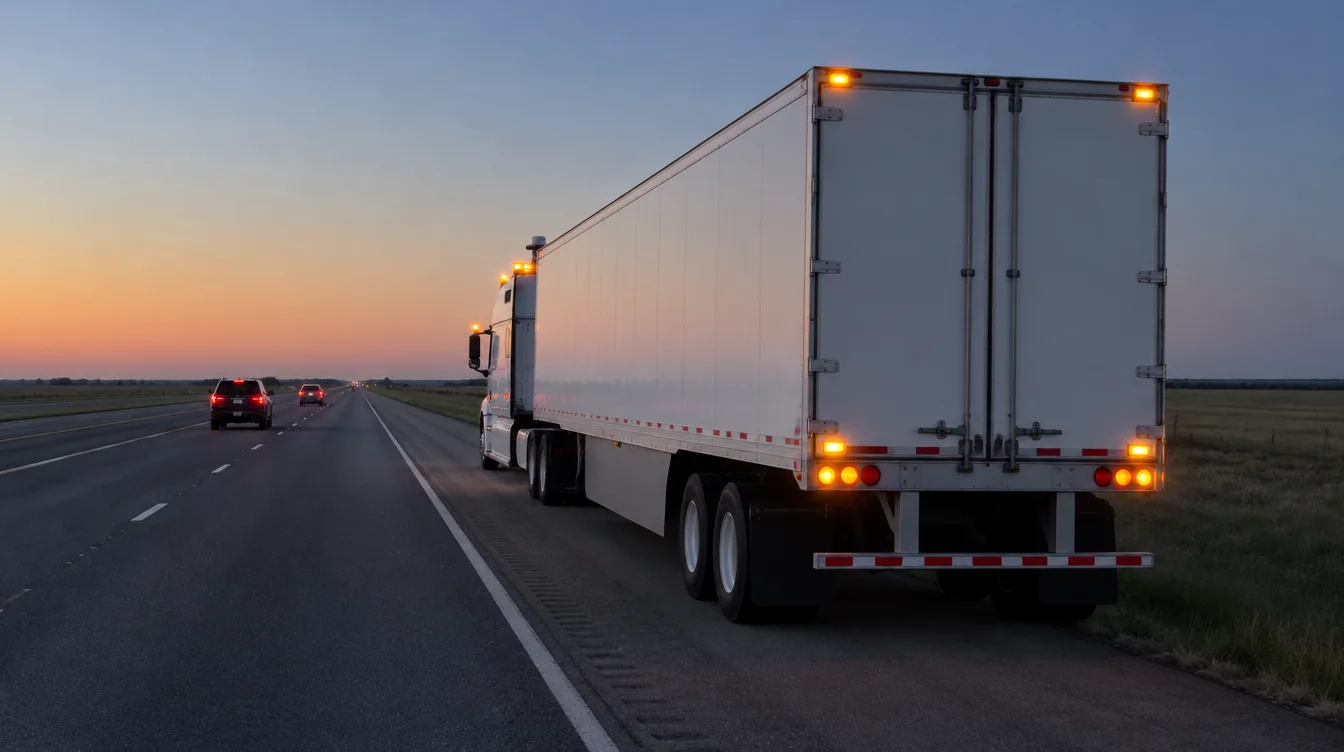
Federal rules have long required a truck driver to walk back from a breakdown and set reflective triangles behind the rig. A driverless truck has nobody on board to do it. A new federal exemption lets qualifying driverless trucks warn approaching traffic with amber beacons mounted high on the cab instead.
New Exemption
The Federal Motor Carrier Safety Administration (“FMCSA”) granted a five-year exemption to Aurora Operations and other carriers that run Level 4 automated trucks. It took effect October 7, 2026, and expires October 7, 2031.
The exemption covers three rules: warning-device placement in 49 CFR 392.22(b), steady-burning lamps in 49 CFR 393.25(e), and the type and number of warning devices in 49 CFR 393.95(f). In their place, a carrier uses cab-mounted beacons and has to meet conditions on the lights, their mounting and power, how fast they activate, and how accidents get reported.
History of Driverless Trucks
Vehicle automation grew out of features that assist a driver. Forward collision warning and lane departure warning came first, then automatic emergency braking and lane centering, then adaptive cruise control and lane keeping. Each of those features still needs a person watching the road, the same issue at the center of self-driving car accident cases.
In the spring of 2025, Aurora began regular driverless deliveries between Dallas and Houston, after more than four years of supervised pilot hauls covering about three million autonomous miles and more than 10,000 customer loads. A person rode along on those pilot hauls. The launch loads ran with nobody in the cab.
Taking the driver out of the cab also took away the person who sets triangles after a breakdown. Aurora first asked for relief from the placement rule in 2023, and FMCSA denied that request in December 2024. The agency then gave Aurora a narrow temporary waiver that began October 10, 2025, and Aurora operated under four three-month waivers before the five-year exemption.
Driverless Truck Technology
A driverless truck detects its surroundings with sensors and drives with onboard computers. Aurora’s system combines lidar, imaging radar, and high-resolution cameras with overlapping fields of view. Lidar measures distance and speed with laser light, radar tracks motion through fog and rain, and cameras read signs and lane markings.
Software turns that picture into a planned path and controls steering, acceleration, and braking. Aurora’s launch trucks carried backup systems for braking, steering, power, sensing, computing, cooling, and communication.
Every automated system has operating limits: the roads, weather, and conditions it was built and tested to handle. The industry calls those limits the “operational design domain.” The exemption allows operation only on roadways inside a truck’s validated operational design domain.
Commercial Routes in Service
In February 2026, Aurora announced a 10-route driverless network linking Dallas, Houston, Fort Worth, El Paso, Laredo, and Phoenix. That count describes one company’s lanes. It is not a count of driverless trucks on American roads.
Deployment numbers measure different things. A supervised test truck has a person on board, and a driverless freight run does not. Planned fleets, operating fleets, route counts, truck counts, and autonomous miles each answer a separate question.
Driving Automation Levels
Driving automation runs on six levels, numbered 0 through 5. Each level sets what the system handles and what stays with the person in the seat.
| Level | What the system does | Person in the seat |
|---|---|---|
| Level 0Momentary driver assistance | What the system doesWarnings and brief emergency intervention, such as automatic braking | Person in the seatDrives the vehicle at all times |
| Level 1Driver assistance | What the system doesSteering or speed control, one at a time | Person in the seatStays fully engaged and attentive |
| Level 2Additional assistance | What the system doesSteering and speed control together | Person in the seatStays fully engaged and attentive |
| Level 3Conditional automation | What the system doesDrives while engaged | Person in the seatMust be ready to take over when prompted |
| Level 4High automation | What the system doesDrives within limited service areas | Person in the seatNot needed inside those areas |
| Level 5Full automation | What the system doesDrives on all roadways in all conditions | Person in the seatNot needed |
Level 4 Driverless Operation
A Level 4 system operates only in limited service areas, and inside those areas a human driver is not needed. The truck can run with the driver’s seat empty. A Level 5 system could drive on any road in any condition. The gap between the two levels decides where a Level 4 truck may run and whether a given trip falls inside its limits.
Roadside Warning Rules for Stopped Trucks
When a commercial truck stops on a highway or its shoulder for anything other than a necessary traffic stop, the driver must activate the hazard flashers immediately.
The driver then has 10 minutes to place three warning devices. On a two-way road, one goes about 10 feet behind the truck on the traffic side, one about 100 feet back toward approaching traffic, and one about 100 feet ahead. On a divided or one-way highway, they go 100 and 200 feet back, with the third within 10 feet of the rear.
Hills and curves change the placement. When the truck stops within 500 feet of a hill crest, curve, or other obstruction, one device goes 100 to 500 feet out toward it, so a driver coming over the crest sees a warning before seeing the truck.
Standard rule
A person places three warning devices within 10 minutes. Hazard flashers run until they are set.
Driverless truck exemption
Amber beacons at least 100 inches high activate within 5 minutes. Hazard flashers run for the whole stop.
Trucking Company Responsibilities Under the Exemption
The beacons must be amber and meet the Class 1 photometric requirements of SAE J595. They mount at least 100 inches above the ground, at or above the upper edge of the side mirrors and below the top of the cab. At least one rear-facing beacon sits on each side of the cab, with at least one forward-facing beacon on the front.
The beacon system needs redundant power so a single power failure cannot disable it, and the beacons must activate as soon as possible and within five minutes. A driver placing triangles gets 10 minutes.
Carriers other than Aurora must notify FMCSA in writing before operating under the exemption and certify under penalty of perjury that they meet its terms. Hazardous materials loads are excluded, along with any operation that would need a hazmat, passenger, or school bus endorsement for a human driver.
| Citation | Authority | Area |
|---|---|---|
| CitationFMCSA Exemption, Aurora Operations, Inc. | Authority Five-year warning-device exemption Lets Level 4 automated trucks use cab-mounted beacons in place of roadside warning devices from October 7, 2026, to October 7, 2031. | AreaEXEMPTION |
| Citation49 CFR 392.22 | Authority Emergency signals; stopped commercial motor vehicles Requires hazard flashers at once and three warning devices within 10 minutes of a stop. | AreaWARNING DEVICES |
| Citation49 CFR 393.25 | Authority Requirements for lamps other than head lamps Requires exterior lamps to burn steadily; paragraph (e) is one of the three rules the exemption covers. | AreaLAMPS |
| Citation49 CFR 393.95 | Authority Emergency equipment on all power units Paragraph (f) sets the warning devices a truck carries: three reflective triangles or at least 6 fusees. | AreaWARNING DEVICES |
| Citation49 U.S.C. 31315 | Authority Waivers, exemptions, and pilot programs Bars a state from enforcing a conflicting law against a carrier operating under the exemption. | AreaPREEMPTION |
Sources opened and read 2026-10-09: FMCSA exemption notice for Aurora Operations, Inc.; 49 CFR 392.22, 393.25, and 393.95 (eCFR); 49 U.S.C. 31315.
Beacon Testing Results
FMCSA found that the exemption would likely achieve a level of safety equivalent to or greater than the rules it replaces. The finding rests on the record Aurora built under the temporary waivers.
34
Aurora trucks operated under the temporary waivers.
500,000+
Miles those trucks traveled under the waivers.
Nearly 10
Hours the cab beacons were active during stops.
Source: Federal Motor Carrier Safety Administration exemption notice.
The mileage describes the trucks’ driving. The beacons themselves logged nearly 10 hours of use during stops. Aurora’s trucks were not involved in, and did not contribute to, any roadway collisions while stopped with the beacons on, and the beacons logged no faults, malfunctions, or power problems.
Placing triangles puts a person on foot next to moving traffic, a risk the beacons remove. Opponents, including the Owner-Operator Independent Drivers Association and the Truck Safety Coalition, argued that a jackknifed or angled trailer could block cab-mounted lights and that the studies did not cover the full range of weather, road, and lighting conditions.
Injury Cases Under the New Exemption
Three questions come first after an accident involving a stopped driverless truck: whether the truck qualified for the exemption, whether its beacons worked, and whether approaching drivers could see them in time.
Missing triangles do not show a warning-device violation by themselves when the truck qualified for the exemption and met its terms. A truck outside those terms has no exemption to stand on, and the standard placement rule applies.
Exemption Eligibility
Eligibility runs through the carrier’s written notice to FMCSA, the truck’s automation level, its beacon configuration, and its backup power. The trip also has to fall inside the truck’s validated operating limits, and the load cannot be hazardous materials.
Roadside Stop
Beacon compliance does not explain why the truck stopped or where it came to rest. A mechanical failure, the automated system’s response to a fault, a blocked travel lane, and the time the truck’s position left approaching drivers are separate questions. Roadway measurements establish sight distance, the same concern behind the placement rule’s 500-foot reach toward hills and curves.
Warning-Light Visibility
A logged activation command shows the system sent the signal. Photographs, video, the truck’s position, and the trailer’s angle show whether the lamps lit and whether an approaching driver could see them. Weather, light, and the approaching vehicle’s speed set how much time that driver had to recognize the hazard. A reconstruction tests visibility from the approaching driver’s seat, especially when the trailer sat at an angle that could hide the cab lights.
Truck Records
Depending on what the system records and keeps, the evidence can include the time and reason for the stop; speed, location, steering, and braking data; camera footage and sensor data; beacon commands, status, and fault reports; power-system warnings; the software version in use; the truck’s operating limits; communications with remote support staff; maintenance and inspection records; and the carrier’s accident report to FMCSA.
The carrier’s report gives the operator’s account of the event. Rebuilding the stop, the warning, and the collision sequence still takes the underlying data.
Responsibility After an Accident
The exemption changes which warning devices a truck must use. Fault for an accident still follows the conduct and equipment connected to the injury.
Under 49 U.S.C. 31315, a state cannot enforce a conflicting law against a carrier operating under a federal exemption. A case accounts for that approval and does not assume an eligible truck still needed the devices it was allowed to replace.
Depending on the evidence, responsibility can rest with the carrier’s operation or maintenance of the truck, the warning equipment, or another driver, and insurance and liability for self-driving trucks add their own questions. Each theory needs a link between the failure and the accident. A full timeline supplies it: the events before the stop, the truck’s position, beacon activation, actual visibility, and the approaching driver’s response.
Driverless Truck Accident Case Review
An accident with a driverless truck leaves a record in the carrier’s systems, in remote support logs, and in its exemption filings. Sam Aguiar Injury Lawyers builds the case from those records. If a driverless truck caused your accident, start a free case review.
Frequently Asked Questions
Do driverless trucks have to put out warning triangles?
How long does the driverless truck beacon exemption last?
Which trucks can use the warning beacon exemption?
How fast must driverless truck warning beacons activate?
Latest Articles
Pre-Trip Inspection Rules in Truck Accident Cases
Federal pre-trip inspection records can show whether a preventable truck defect should have been caught.
Liability and Insurance for Self-Driving Trucks
Who answers for an accident when an automated system drives the truck.
Black Box Data in Truck Crash Cases
What truck recorders capture and how that data rebuilds the seconds before impact.