

FMCSR Truck Crash Evidence

Commercial trucks and other large commercial vehicles operate under a detailed set of federal safety rules known as the Federal Motor Carrier Safety Regulations, or FMCSRs. These rules govern how long a driver can be behind the wheel, what a carrier has to keep in a driver’s personnel file, how often a truck has to be inspected, how long each of those records has to be kept, and what a company has to do after a crash. The Federal Motor Carrier Safety Administration (FMCSA) administers them, and they sit in Title 49 of the Code of Federal Regulations.
Federal Trucking Rules After a Truck Crash
FMCSRs create documents, and those documents are evidence for an injured person. A crash on I-64 or the Watterson Expressway looks like a two-vehicle collision from the roadside, but behind the tractor there is usually an electronic log, a dispatch record, a maintenance file, a daily inspection report, and an annual inspection certificate. Each of those documents exists because a federal regulation required it. Each one has a retention clock attached to it. Almost all of them are in the possession of the trucking company, and the person who was hurt has none of them.
Sam Aguiar Injury Lawyers works the regulatory paper trail behind a commercial vehicle crash: duty status logs, driver qualification files, inspection and repair records, post-crash testing records, and the carrier’s own accident register. These records are frequently the only independent account of what the driver and the company were doing in the hours and months before impact.
Commercial Motor Vehicle Definition
Not every large vehicle on a Kentucky road is a commercial motor vehicle in the federal sense, and the distinction decides which records exist. Under 49 CFR 390.5, a commercial motor vehicle is a self-propelled or towed vehicle used on a highway in interstate commerce to transport passengers or property when it has a gross vehicle weight rating or gross combination weight rating, or an actual gross vehicle or combination weight, of 10,001 pounds or more, whichever is greater.
The same definition also reaches vehicles designed or used to carry more than 8 passengers including the driver for compensation, vehicles designed or used to carry more than 15 passengers including the driver without compensation, and any vehicle carrying hazardous material in a quantity that requires placarding. A tractor-trailer, a box truck, a dump truck, a passenger van running a shuttle route, and a placarded tanker can all fall inside the same regulatory scheme even though they look nothing alike.
Federal rules do not displace Kentucky traffic law. 49 CFR 392.2 states that every commercial motor vehicle must be operated in accordance with the laws, ordinances, and regulations of the jurisdiction in which it is being operated, and that where an FMCSA regulation imposes a higher standard of care than the state or local rule, the federal regulation must be complied with. A Kentucky truck crash claim can therefore involve a state traffic violation, a federal safety violation, or both at once.
Hours of Service Limits
The fatigue rules for property-carrying trucks are set out in 49 CFR 395.3. A driver may not drive without first taking 10 consecutive hours off duty. Once the driver comes on duty after that break, driving is prohibited after a period of 14 consecutive hours has passed, whether or not the driver spent all of it driving. Within that 14-hour window, total driving time is capped at 11 hours.
The rule also has an interruption requirement. Driving is not permitted if more than 8 hours of driving time have passed without at least a consecutive 30-minute interruption in driving status. Off-duty time, sleeper berth time, on-duty not driving time, or any combination of the three can satisfy that interruption, which is why a log showing a loading-dock wait can carry as much weight as one showing a rest stop.
Two longer limits sit on top of the daily rules. A driver may not drive after having been on duty 60 hours in any period of 7 consecutive days if the employing carrier does not run commercial vehicles every day of the week, or 70 hours in any period of 8 consecutive days if the carrier does run every day. Either period may end with the beginning of an off-duty period of 34 or more consecutive hours, which is the restart provision. When a crash happens late in a long week, the weekly total is often the decisive number.
Duty Status Logs and Supporting Documents
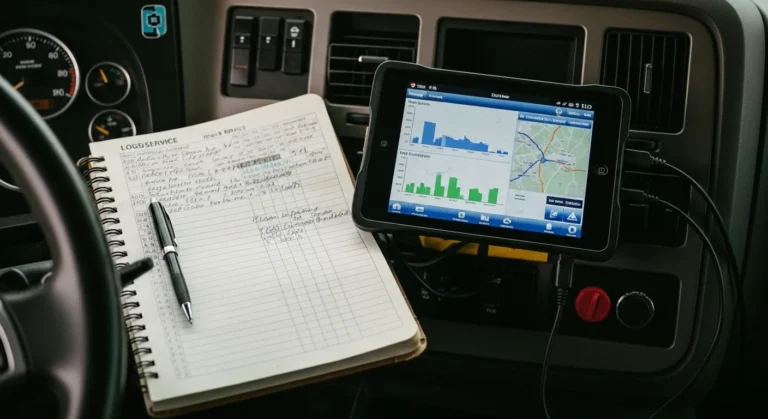
Hours-of-service limits would be unenforceable without a record, and 49 CFR 395.8 supplies it. Since December 18, 2017, a carrier operating commercial motor vehicles has generally been required to install and use an electronic logging device, or ELD, to record each driver’s duty status. A narrow set of operations may still record duty status manually, including drivers who complete a record of duty status on not more than 8 days within any 30-day period, driveaway-towaway operations, and vehicles manufactured before model year 2000 as reflected in the vehicle identification number.
Duty status is recorded in four categories: off duty, sleeper berth, driving, and on-duty not driving. A driver must submit the record of duty status to the carrier within 13 days of the 24-hour period it covers, and must keep a copy of the record for the previous 7 consecutive days in the driver’s possession and available for inspection while on duty.
The retention rule creates urgency after a crash. Under 395.8(k)(1), a carrier must retain records of duty status and supporting documents for each of its drivers for a period of not less than 6 months from the date of receipt. Supporting documents are the fuel receipts, bills of lading, dispatch records, and toll records that either corroborate a log or contradict it. Six months is a minimum, and a carrier that receives no preservation demand may treat it as an expiry date.
Driver Qualification Files
Under 49 CFR 391.51, every motor carrier must maintain a driver qualification file for each driver it employs, and that file may be combined with the driver’s personnel file. The regulation lists what has to be in the file, so a gap in the file carries meaning.
The file must include the driver’s application for employment completed in accordance with 391.21, a copy of the motor vehicle record received from each licensing authority under 391.23(a)(1), and the certificate of the driver’s road test issued under 391.31(e) or an accepted equivalent under 391.33. It must also include the motor vehicle record returned in response to the annual driver record inquiry required by 391.25(a) and a note relating to the annual review of the driver’s driving record required by 391.25(c)(2).
Medical qualification is documented in the same file. The carrier must hold the medical examiner’s certificate required by 391.43(g) or a legible copy, and for commercial driver’s license holders whose state record carries medical certification status information, the carrier must obtain the CDLIS motor vehicle record from the current licensing state and place it in the qualification file. If the driver holds a medical variance, a Skill Performance Evaluation certificate issued under 391.49, or a federal medical exemption, that documentation belongs in the file as well.
Read together, those requirements mean a carrier is supposed to know its driver’s history before dispatch and to re-check it every year. A qualification file with no annual review note, no current medical certificate, or no motor vehicle record can indicate that the company never ran the checks the regulation requires.
Post-Crash Drug and Alcohol Testing
Post-crash testing is governed by 49 CFR 382.303, and the triggers are specific. As soon as practicable after a crash involving a commercial motor vehicle on a public road in commerce, the employer must test a surviving driver for alcohol if the driver was performing safety-sensitive functions and the crash involved the loss of human life. The employer must also test if the driver receives a citation within 8 hours under state or local law for a moving traffic violation arising from the crash, and the crash involved either bodily injury to a person who immediately received medical treatment away from the scene, or disabling damage to one or more vehicles requiring a tow away.
Controlled substance testing follows the same structure with a longer citation window. A test is required where the crash involved a fatality, or where the driver receives a citation within 32 hours for a moving traffic violation arising from a crash involving injury with immediate treatment away from the scene or disabling damage requiring a tow.
The timing rules generate their own records. If an alcohol test is not administered within 2 hours after the crash, the employer must prepare and maintain on file a record stating why the test was not promptly administered, and if it is not administered within 8 hours the employer must stop trying and prepare the same record. For controlled substances the employer must cease attempts after 32 hours and prepare a comparable record. Those explanatory memos are discoverable, and their absence can be as informative as their contents.
Vehicle Inspection and Maintenance Records
Federal rules require three layers of vehicle records: ongoing maintenance files, daily driver inspection reports, and annual inspection reports. Each layer has its own content and retention rules.
Maintenance and Repair Records
49 CFR 396.3 requires every motor carrier to systematically inspect, repair, and maintain, or cause to be inspected, repaired, and maintained, all vehicles subject to its control, and it requires parts and accessories to be in safe and proper operating condition at all times. The regulation specifically names frames and frame assemblies, suspension systems, axles and attaching parts, wheels and rims, and steering systems alongside the equipment standards in Part 393.
The recordkeeping side is equally concrete. A carrier must maintain records for each vehicle it controls for 30 consecutive days, and those records must identify the vehicle by company number, make, serial number, and year, name the person furnishing the vehicle if the carrier does not own it, indicate the nature and due date of each inspection and maintenance operation to be performed, and record inspections, repairs, and maintenance with their date and nature.
Retention is set by 396.3(c): the records must be kept where the vehicle is either housed or maintained for a period of 1 year, and for 6 months after the vehicle leaves the carrier’s control. The second clause often decides whether records survive. A tractor involved in a crash is frequently sold, returned to a lessor, or scrapped, and once it leaves the fleet the retention obligation begins running out.
Driver Vehicle Inspection Reports
The daily inspection paperwork is governed by 49 CFR 396.11. Every carrier must require its drivers to report, and every driver must prepare, a written report at the completion of each day’s work on each vehicle operated. The report has to cover at least service brakes including trailer brake connections, the parking brake, the steering mechanism, lighting devices and reflectors, tires, the horn, windshield wipers, rear vision mirrors, coupling devices, wheels and rims, and emergency equipment.
The report must identify the vehicle and list any defect or deficiency discovered by or reported to the driver that would affect safe operation or result in a mechanical breakdown, and the driver must sign it. A driver who finds no defect is not required to prepare a report at all, so the absence of a report is not automatically a violation. If a driver operates more than one vehicle in a day, a separate report is required for each.
The repair duty creates liability exposure. Before requiring or permitting a driver to operate the vehicle, the carrier or its agent must repair any listed defect or deficiency likely to affect safe operation, and must certify on the report that the defect has been repaired or that repair is unnecessary. The carrier must keep the driver vehicle inspection report, the certification of repairs, and the certification of the driver’s review for three months from the date the written report was prepared. Three months is the shortest retention window in this area, and it is frequently gone before a claim is filed.
Annual Inspection Records
On top of daily reports, 49 CFR 396.17 requires a periodic inspection of every commercial motor vehicle covering, at a minimum, the components listed in appendix A to Part 396. Each unit in a combination counts separately: for a tractor, semitrailer, and full trailer combination, the tractor, the semitrailer, and the full trailer including any converter dolly must each be inspected.
A carrier must not use a commercial motor vehicle unless each component identified in appendix A has passed an inspection at least once during the preceding 12 months and documentation of that inspection is on the vehicle. The documentation may be the inspection report itself or a sticker or decal based on it, provided it carries the inspection date, the name and address of the entity holding the report, information uniquely identifying the vehicle, and a certification that the vehicle passed.
49 CFR 396.21 then sets out what the inspector’s report must contain and how long it lives. The report identifies the inspector, the carrier, the date, and the vehicle, describes the components inspected and the results including any component that did not meet the appendix A standards, and certifies the accuracy and completeness of the inspection. The responsible party must retain the original or a copy for fourteen months from the date of the report, keep it where the vehicle is housed or maintained, and make it available on demand to an authorized federal, state, or local official.
Accident Registers and Crash Reporting
Carriers keep a record of their own crash history. 49 CFR 390.15 requires each motor carrier to make all records and information pertaining to an accident available to an authorized FMCSA representative, an authorized state or local enforcement representative, or an authorized third-party representative within the time the request or investigation specifies, and to cooperate in the investigation, including a full, true, and correct response to any question.
The same section requires carriers to maintain an accident register for 3 years after the date of each accident. The register must list, for each accident, the date, the city or town where it occurred or the nearest one and the state, the driver’s name, the number of injuries, the number of fatalities, and whether hazardous materials other than fuel spilled from the fuel tanks of a vehicle involved were released. It must also include copies of all accident reports required by states, other governmental entities, or insurers.
For an injured person, the register is useful in two directions. It confirms what the carrier itself recorded about the crash in question, and it shows what else the same carrier has been involved in over the preceding three years.
Record Retention Periods
Each category of trucking record has its own federal minimum retention period, and those deadlines decide whether a document still exists when someone asks for it.
Inspection Reports Expire First Among Federal Trucking Records
Minimum federal retention periods for carrier records, shortest first
Driver vehicle inspection reports: three months from the date the written report was prepared, together with the certification of repairs and the certification of the driver’s review, under 49 CFR 396.11(a)(4).
Duty status logs and supporting documents: not less than 6 months from the date of receipt for each driver, under 49 CFR 395.8(k)(1). The driver separately carries the previous 7 consecutive days.
Maintenance and repair records: 1 year while the vehicle is under the carrier’s control, plus 6 months after it leaves that control, kept where the vehicle is housed or maintained, under 49 CFR 396.3(c).
Annual inspection reports: fourteen months from the date of the inspection report, retained where the vehicle is housed or maintained, under 49 CFR 396.21(b)(1).
Accident register: 3 years after the date of each accident, including copies of accident reports required by states, other governmental entities, or insurers, under 49 CFR 390.15(b).
Post-crash testing records: records explaining why a required alcohol or controlled substance test was not administered inside the 2-hour, 8-hour, or 32-hour windows, prepared and maintained on file under 49 CFR 382.303(d).
Carrier Records After a Crash
No single document decides a truck case. A driver who was past the 11-hour driving limit, a qualification file with no annual review note, a daily inspection report listing a brake defect with no certification of repair, and an annual inspection that was never performed each describe a different failure. Together they describe how a company was operating.
Custody is the practical problem. The logs sit on the carrier’s ELD platform or its vendor’s servers. The maintenance file sits at the terminal where the tractor is housed. Dispatch records and supporting documents stay in the carrier’s back office. Telematics and in-cab camera footage often sit with a third-party technology provider under a contract the injured person has never seen. The person who was hurt has none of it, and the shortest federal retention period in the set is three months.
A written preservation demand, sent early and addressed to the carrier, its insurer, and any equipment or telematics provider, does more work than any other early step in a truck case. It converts a routine document-destruction schedule into a known obligation to hold specific categories of records. Once the retention window closes and the records are gone in the ordinary course, no amount of later effort brings them back. Sam Aguiar Injury Lawyers handles Kentucky truck crash claims, and the firm’s overview of how FMCSR violations cause truck crashes covers the violations these records expose.
Ready to Take Action on Your Injury Claim?
After a serious injury, medical bills pile up while the insurance company looks for ways to pay you less. Most law firms take their cut first and leave you with whatever is left. Sam Aguiar Injury Lawyers does things differently. With our exclusive Bigger Share Guarantee®, you always get more. Every client gets a dedicated three-person team: an attorney, a case manager, and a legal assistant. We never raise our fee rate if we have to go to court, and you pay $0 Out-Of-Pocket Forever.
Frequently Asked Questions
1What are the Federal Motor Carrier Safety Regulations?+
2Which vehicles count as commercial motor vehicles?+
3How many hours can a truck driver legally drive?+
4How long does a trucking company have to keep its records?+
5When is a truck driver tested for drugs or alcohol after a crash?+
6How quickly should FMCSR records be requested after a truck crash?+
Latest Articles

Kentucky Diminished Value Claims
Kentucky drivers may pursue a repaired vehicle’s leftover market loss from the at-fault driver as part of a.
FMCSA Revoked ELDs: Fleet Compliance and Enforcement Deadlines
FMCSA removed five electronic logging devices from the registered list on August 6, 2026, and set an October.

FMCSA English Proficiency Rule and OOS Enforcement
FMCSA English Proficiency Rule Sam Aguiar Injury Lawyers August 11, 2026 7 minute read On This Page.