
Flight Data Recorders and Cockpit Voice Recorders in Aviation Accidents
A cockpit voice recorder captures flight deck audio and a flight data recorder captures aircraft data; the NTSB reads out both, and federal law sharply limits how voice recordings and transcripts can be released and used in court.
What Each Recorder Captures
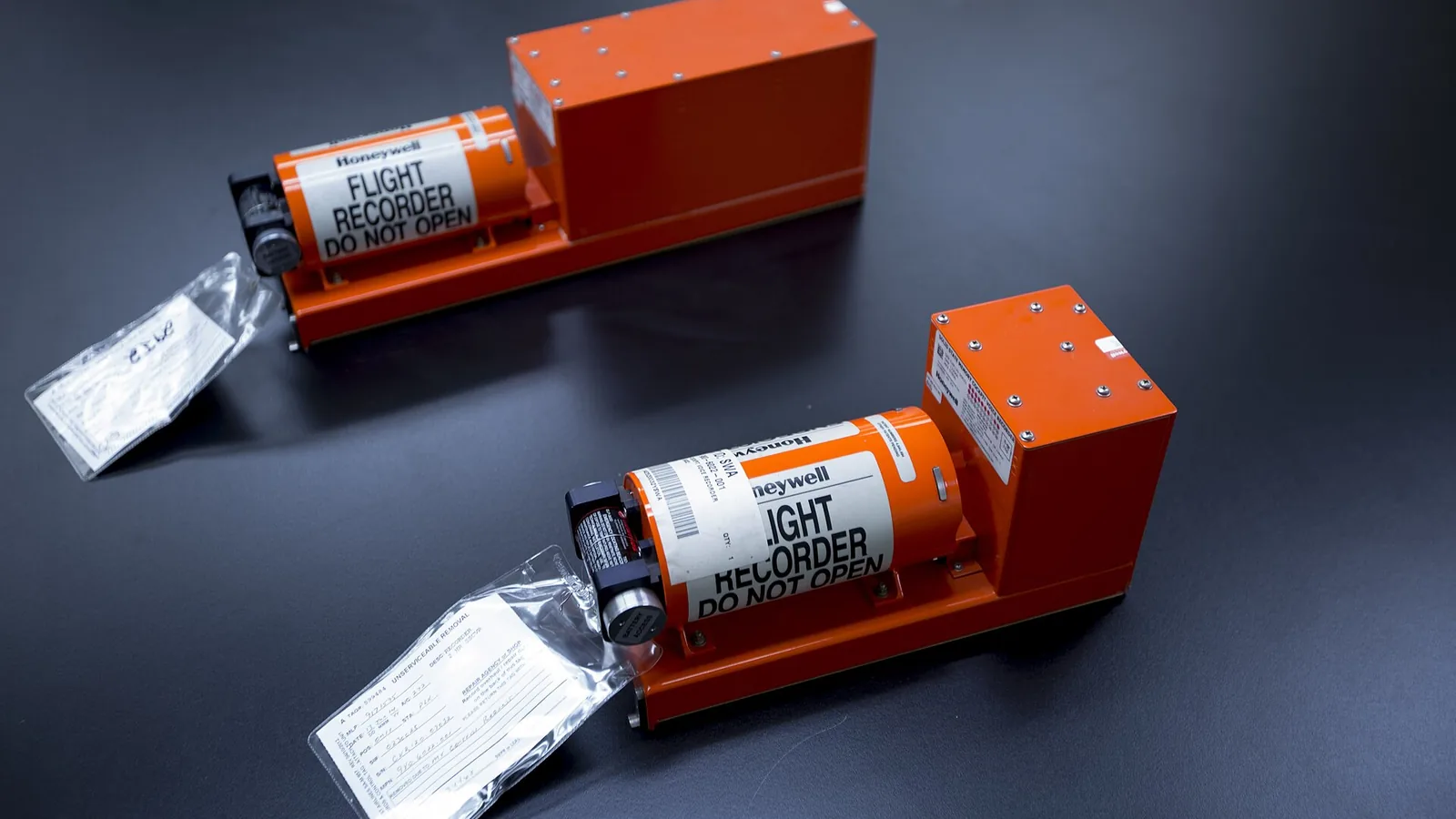
A cockpit voice recorder records sound on the flight deck, and a flight data recorder records measurements from the aircraft itself. Both are installed in the most survivable part of the aircraft, usually the tail section, and the National Transportation Safety Board (NTSB) uses both to reconstruct events. After an accident the law treats them differently: federal law bars the NTSB from publicly releasing cockpit voice recordings and limits what a court can order produced, and those protections are written for voice and video recordings, not flight data.
Under 14 CFR 25.1457(a), a cockpit voice recorder on a transport category airplane must record radio voice communications, the voices of flight crewmembers on the flight deck, interphone communications, audio that identifies navigation and approach aids, and, where installed, datalink messages. A cockpit area microphone also picks up the sounds of the flight deck. Background sounds, such as engine noise and clicks from the landing gear, can reveal engine speed and timing of events.
A digital flight data recorder on a Part 121 turbine-powered transport category airplane must record the operational parameters listed in 14 CFR 121.344(a), including time, pressure altitude, indicated airspeed, heading, pitch and roll attitude, thrust or power of each engine, autopilot engagement, and control inputs and control surface positions. The list runs to 91 numbered parameters, and which ones apply depends on the airplane’s manufacture date and equipment. Investigators use the data to build a computer animation of the flight.
| Feature | Cockpit voice recorder | Flight data recorder |
|---|---|---|
| What it records | Crew voices, flight deck sounds, radio and interphone audio, datalink messages | Digital measurements such as altitude, airspeed, heading, attitude, thrust, and control inputs |
| Main FAA rules | 121.359, 125.227, 135.151, 91.609; design in 25.1457 | 121.344, 125.226, 135.152, 91.609; design in 25.1459 |
| Recording duration | Last 2 hours; last 25 hours on aircraft built after the dates in the 2026 rule | At least 25 hours |
| Read out by | NTSB laboratory; a cockpit voice recorder group writes the transcript | NTSB laboratory; a flight data recorder group validates the data |
| Legal protections | Audio not released; transcript timing set by 49 U.S.C. 1114(c); discovery limited by 49 U.S.C. 1154(a); no FAA civil penalty or certificate use | Not covered by the cockpit voice recorder statutes; parties may not release it before the NTSB does (49 CFR 831.13) |
Sources: 14 CFR 121.359; 14 CFR 121.344; 14 CFR 135.152; 91 FR 4447; UPS Flight 2976, DCA26MA024; 49 U.S.C. 1114; 49 U.S.C. 1154; Cockpit Voice and Flight Data Recorders.
Which Aircraft Must Carry Recorders
Recorder requirements depend on the type of operation, the engines, and the seating. Each operating part of the FAA’s regulations in Title 14 carries its own recorder paragraphs. Under 14 CFR 121.359(a), an airline may not operate a large turbine-engine-powered airplane unless it has an approved cockpit voice recorder that runs continuously from the start of the checklist before engine start to completion of the final checklist at the end of the flight. Smaller multiengine turbine airplanes with 10 to 30 passenger seats have their own cockpit voice recorder paragraphs in the same section.
Part 135 (commuter and on-demand operations) requires a cockpit voice recorder on a multiengine, turbine-powered airplane or rotorcraft with six or more passenger seats for which two pilots are required, and a flight data recorder on certain multiengine turbine-powered aircraft with 10 to 19 passenger seats that must retain no less than 25 hours of aircraft operation. Part 125 has parallel rules for digital flight data recorders and cockpit voice recorders, and 14 CFR 91.609 sets recorder rules for certain multiengine turbine aircraft in private operations.
Recording Duration and the 25-Hour Standard
The two-hour standard for cockpit voice recorders is being replaced by a 25-hour standard in stages, and the stage that applies depends on the aircraft’s manufacture date and size. Flight data recorders already keep more: a Part 121 operator must keep the last 25 hours of recorded data, and a Part 135 flight data recorder must retain no less than 25 hours. A cockpit voice recorder on an airplane built before May 16, 2025 retains the last 2 hours of recorded information.
The NTSB pressed for the change because it has investigated numerous accidents and incidents in which relevant cockpit voice recorder data were overwritten before investigators could secure them. It recommended a 25-hour standard in 2018, and in 2024 it told the Department of Transportation that at least 14 more events had been hampered by overwritten cockpit voice recordings since then.
Congress set the first date. Section 366(a)(1) of the FAA Reauthorization Act of 2024 (Public Law 118-63, May 16, 2024) bars a covered operator from operating a covered aircraft manufactured after May 16, 2025 unless it has a cockpit voice recorder that retains the last 25 hours of recorded information on a recorder meeting Technical Standard Order C123c. A covered aircraft is one operated by an air carrier under Part 121, or a transport category aircraft designed for air carrier operations and type-certificated for 30 or more passengers, including all-cargo and combi derivatives. Section 366(a)(2) goes further and requires covered operators to have a 25-hour cockpit voice recorder in every covered aircraft not later than six years after enactment, which is May 16, 2030. The FAA treats this requirement for existing aircraft as self-enacting and enforceable without additional rulemaking.
The FAA then published a final rule on February 2, 2026 at 91 Fed. Reg. 4447, amending 14 CFR 91.609, 121.359, 125.227, and 135.151, and a correcting amendment on May 8, 2026 fixed typographical and formatting errors. The rule applies to newly manufactured aircraft and does not require retrofit of the existing fleet. An aircraft that must carry a cockpit voice recorder needs the 25-hour version if it was manufactured:
- on or after May 16, 2025, if it is a Part 121 airplane or a transport category aircraft type-certificated with 30 or more passenger seats;
- on or after February 2, 2027, if it operates under Part 91, 125, or 135 with a maximum certificated takeoff weight of 59,525 pounds or more and 29 or fewer passenger seats; or
- on or after February 2, 2029, if it operates under Part 91, 125, or 135 with a maximum certificated takeoff weight of 59,524 pounds or less.
Aircraft built before the applicable date keep the two-hour requirement, except that covered airline-type aircraft must be upgraded by May 16, 2030. The Act also directed the FAA to issue further rules within three years of enactment, including one to protect cockpit voice recorder data from unauthorized disclosure and from deliberate erasure after a reportable event, and the FAA had not published that rule as of November 7, 2026, ahead of a May 16, 2027 statutory deadline.
Survivability and Underwater Locator Beacons
Recorders are mounted to survive. Under 14 CFR 25.1457(e), the container must be located and mounted to minimize the chance of rupture from impact and heat damage from fire, as far aft as practicable and away from aft-mounted engines that could crush it. A cockpit voice recorder must have an independent power source that supplies 10 minutes of power to the recorder and area microphone, and an automatic means to stop recording and prevent erasure within 10 minutes after impact.
Typical recorder specifications include an impact tolerance of 3,400 Gs for 6.5 milliseconds, fire resistance of 1,100 degrees Celsius for 30 minutes, and the ability to withstand submersion at 20,000 feet. Each recorder also carries an underwater locator beacon, a device the NTSB calls a pinger, that activates in water and transmits an acoustic signal on 37.5 kilohertz that a special receiver can detect from depths down to 14,000 feet. The regulations require an underwater locating device on or adjacent to the container, secured so that it is not likely to separate on impact.
How the NTSB Reads Out Recorders
Control of the recorders passes quickly from the operator to the NTSB. The operator must preserve all recording mediums of flight and voice recorders until the NTSB takes custody, and after an accident that ends a flight it must remove the recorder and keep the data for at least 60 days or longer at the request of the NTSB or FAA. The NTSB may take possession of records, and only persons the investigator-in-charge authorizes may have access to them. Both recorders are then removed from the site and taken to NTSB headquarters in Washington, D.C., where the data are extracted as one of many tools in the NTSB’s investigation toward a probable cause.
The NTSB forms a cockpit voice recorder committee, usually including members from the NTSB, the FAA, the operator, the airplane and engine manufacturers, and the pilots’ union, to listen to the recording and write a transcript. Air traffic control recordings with time codes are used to assign local times to events. A separate flight data recorder group validates the data.
- Notice and preservationThe operator notifies the NTSB and preserves the recording mediums of the flight and voice recorders until the NTSB takes custody.
- Removal and retentionAt least 60 daysThe operator removes the recorder and keeps the data for at least 60 days, or longer if the NTSB or FAA asks.
- Laboratory readoutThe NTSB Vehicle Recorders Laboratory downloads the data. If the exterior is damaged, technicians can read the memory module through a laboratory unit.
- Group reviewA cockpit voice recorder group writes a transcript. A flight data recorder group validates the data. The two recordings are correlated in time.
- Public releaseAudio is not released. A transcript is released at the public hearing or when most factual reports reach the docket. Flight data appear in group factual reports.
- Court discoveryA party may obtain the recording or unreleased transcript only after the court reviews it privately and issues a protective order.
Sources: 49 CFR 830.10; 14 CFR 121.344; 14 CFR 121.359; Cockpit Voice and Flight Data Recorders; Cockpit Voice Recorder Group Chairman’s Factual Report, DCA26MA024; 49 U.S.C. 1114; 49 U.S.C. 1154.
The NTSB’s investigation of UPS Flight 2976 at Louisville on November 4, 2025 illustrates the process. Both recorders were recovered and sent to the NTSB Vehicle Recorders Laboratory, and data from both were downloaded successfully. The cockpit voice recorder’s exterior showed heat damage, but its crash-protected memory module did not, and the audio was downloaded through a laboratory surrogate unit. Because the airplane was built in 1991, it was required to carry a cockpit voice recorder retaining at least the last two hours; the recorder held about 2 hours and 4 minutes of audio, and the flight data recorder held about 63 hours of data spanning 24 flights with about 450 parameters.
Limits on Cockpit Voice Recordings and Transcripts
Congress treats cockpit recordings as especially sensitive. Under 49 U.S.C. 1114(c), the NTSB may not publicly disclose any part of a cockpit voice or video recording or transcript, with one exception: it must make public the parts of a transcript it decides are relevant, at the public hearing or, if there is no hearing, when a majority of the other factual reports are placed in the docket. The NTSB may still refer to recorder information at any time in making safety recommendations. The transcript of the UPS Flight 2976 cockpit voice recording appears as an exhibit in the investigative hearing docket, and a cockpit voice recorder transcript is not a precise science and should be read with the other evidence.
Court discovery is limited by 49 U.S.C. 1154(a). A party in a judicial proceeding may not use discovery to obtain a cockpit recording or any part of a transcript the NTSB has not made public. A court may allow it only after reviewing the material privately, and only if it decides that what has been made public does not give the party “sufficient information for the party to receive a fair trial” and that more is necessary. If the court allows discovery, it must issue a protective order limiting use to the case and barring dissemination to anyone who does not need access, and the material can be admitted into evidence only if placed under seal. How those requests fit into discovery in an aviation accident lawsuit depends on the case and the court.
A separate set of limits keeps cockpit voice recordings out of FAA enforcement. The operating rules provide that the Administrator does not use the record in any civil penalty or certificate action, and the 2024 Reauthorization Act adds that the Administrator or a covered operator may not use a cockpit voice recording for a certificate action, civil penalty, or disciplinary proceeding against a flight crewmember.
How Flight Data Differs From Voice Recordings
The statutes that protect cockpit voice recordings address voice and video recorders. Section 1114(c) and section 1154(a) do not mention flight data recorders, and cockpit voice recordings are treated differently from the other factual information obtained in an investigation. Flight data are still investigative information: the NTSB’s regulation lists flight data and cockpit voice recorder information among the information that parties may not release before the NTSB does.
In practice, flight data reach the public through reports the NTSB publishes. A flight data recorder group chairman’s factual report, such as the one in the docket for NTSB investigation ERA24FA110, describes the recorder, how the data were converted and correlated, and plots and tables of the recorded parameters. In a major investigation, group chairman factual reports are factual accident reports, and the NTSB does not object to their admission in litigation. That is a different position from the NTSB’s Board accident report, which no civil damages case may use. The NTSB investigation process produces both kinds of document, and federal law treats them differently in a civil damages case.
Cockpit Image Recorders and Open Recommendations
Image recorders would add video of the flight deck to audio and data. The disclosure limits in 49 U.S.C. 1114(c) and 1154(a) already apply to video recordings and to still images taken from them, and the NTSB must take appropriate action to protect the identity of individuals before it releases a still image.
The NTSB has long called for cockpit image recorders. The FAA has not mandated them, and no commercial airliner cockpit carries an FAA-required image recorder. Recommendation A-15-7 asks the FAA to require existing Part 121 and Part 135 aircraft that carry a cockpit voice recorder and a flight data recorder to be retrofitted with a crash-protected cockpit image recording system, and recommendation A-15-8 asks for the same equipment on newly manufactured aircraft; both appear on the NTSB’s list of open recommendations.
Neither the 2024 law nor the 2026 rule requires cockpit image recorders. Whether the FAA will act on the image recorder recommendations remains an open question.
Aviation Accident Recorder Questions
Sam Aguiar Injury Lawyers reviews aviation accident cases for injured people and families, including cases in which recorder data or a cockpit transcript is part of the record. A review can identify what the public NTSB record contains and what other evidence a case may require. You pay $0 out-of-pocket forever. Start your free case review today.
Frequently Asked Questions
Are flight recorders black?
No. The regulations require the recorder container to be bright orange or bright yellow with reflective tape on its exterior to make it easier to find, including under water. The name black box is common usage, and the NTSB uses it as well.
How long must an airline keep recorder data after an accident?
An airline must keep the recorded information for at least 60 days, or longer if the NTSB or FAA asks, after an accident or other event that requires immediate NTSB notification and ends the flight.
Can anyone listen to a cockpit voice recording?
No. 49 U.S.C. 1114(c) bars the NTSB from publicly disclosing any part of a cockpit voice recording, and 49 U.S.C. 1154(a) limits a party’s ability to obtain it in court. The public can read the transcript parts the NTSB releases.
Latest Articles
How an NTSB Investigation Works After an Aviation Accident
How the NTSB investigates, which reports it publishes, and what courts can use.

How Aviation Accident Lawsuits Work
How a civil case after an aviation accident moves through the courts.
Airworthiness Directives and Service Bulletins
When an FAA airworthiness directive binds an operator and how a service bulletin differs.