

Private Plane Accident Cases
A private plane accident case runs alongside an NTSB investigation the family cannot join, and its outcome depends on Part 91 duties, aircraft insurance limits, and the evidence that survives.

General Aviation Flights Under Part 91
A private plane accident case is a civil case over an accident in general aviation, the flying done outside airline and charter service. The NTSB defines general aviation as all civil aviation operations in the United States except Part 121 air carrier operations and Part 135 commuter and on-demand operations, and it consists mostly of noncommercial flying under 14 CFR Part 91. Who answers for the flight, which rules applied, and which insurance policy responds all follow from that classification.
Each Part of Title 14 is a separate rulebook. Part 91 sets the general operating and flight rules. Part 135 adds operating requirements for commuter and on-demand flights, the charter market. Part 121 covers domestic, flag, and supplemental operations, which are airline flights. A private flight answers to Part 91 alone, so the added pilot, maintenance, and operating requirements of Part 135 and Part 121 never applied to it. The structure of Title 14 explains how those Parts fit together.
The legal question underneath every private flight is operational control: the exercise of authority over initiating, conducting, or terminating a flight. Under 14 CFR 91.3(a), the pilot in command is directly responsible for, and is the final authority as to, the operation of the aircraft. Under 14 CFR 91.403(a), the owner or operator is primarily responsible for keeping the aircraft airworthy, including compliance with the airworthiness directives in Part 39.
Those duties land on different people depending on how the aircraft was flown. When an owner flies the owner’s own airplane, the same person is owner, operator, and pilot in command. When a pilot rents from a flight school or flies a flying club’s airplane, the renter flies as pilot in command while the school or club keeps the owner’s maintenance duties. A school that gives flight instruction for hire in an aircraft it provides must have an annual or 100-hour inspection within the preceding 100 hours of time in service, in addition to the 12-month annual inspection. A managed aircraft can fly both ways: the owner’s own trips stay under Part 91, while a flight that carries paying passengers belongs under a certificate holder that has operational control of the flight, such as a Part 135 operator.
An illegal charter is a flight sold to passengers but flown as if it were private. A private pilot may not act as pilot in command for compensation or hire, and a sham dry lease that bundles an aircraft with a pilot for a passenger does not turn a charter into a Part 91 flight. One FAA red flag is a lessor that provides the aircraft and a crewmember yet tries to hand operational control to the passenger. The classification shapes the case in three ways: it identifies the person who held operational control, it shows which pilot and maintenance rules were skipped, and it can put the insurance in doubt, because aircraft policies define the purposes of use they cover.
NTSB Role in Private Plane Accidents
The National Transportation Safety Board is an independent establishment of the United States government. It is not part of the Department of Transportation or affiliated with the FAA, has no regulatory or enforcement authority, and does not investigate criminal activity. The FAA writes and enforces the rules; the NTSB investigates what happened when an accident occurs under them.
Its job is fact-finding. By statute the Board investigates and establishes the facts, circumstances, and cause or probable cause of the aircraft accidents within its authority, and it uses those results to issue safety recommendations meant to prevent a similar accident. The sequence of an NTSB investigation follows from that purpose: collect the facts, analyze them, and publish a probable cause.
The NTSB does not decide who is at fault. Its investigations are fact-finding proceedings with no adverse parties, and they are not conducted to determine the rights, liabilities, or blame of any person or entity. A probable cause finding is a safety conclusion. Legal responsibility is decided by a judge or jury under the law that governs the case, on the evidence the parties present.
Rules Governing NTSB
The NTSB’s authority comes from Chapter 11 of Title 49 of the United States Code. 49 U.S.C. 1111 creates the agency and sets its Board: five members appointed by the President with the advice and consent of the Senate, with no more than three from the same political party. 49 U.S.C. 1131 gives it the duty to investigate aircraft accidents, and 49 U.S.C. 1154 limits how its reports reach civil litigation.
Three Parts of the federal regulations in Title 49 govern a private plane accident:
- 49 CFR Part 830 sets the definitions of an accident and a serious injury, the operator’s duty to notify the NTSB, and the operator’s duty to preserve wreckage and records.
- 49 CFR Part 831 sets investigation procedure: the investigator-in-charge’s authority, the party system, access to wreckage, and release of evidence.
- 49 CFR Part 835 controls when NTSB employees may testify in civil cases and what they may say.
The FAA is the one organization with a right to be a party to an NTSB investigation, but the investigation stays the NTSB’s. Even when the FAA or another federal agency has done fact-finding, determining the probable cause is exclusively the right and duty of the NTSB.
Accidents That Trigger an NTSB Investigation
The NTSB’s notification rules start with the definition in 49 CFR 830.2. An aircraft accident is an occurrence associated with the operation of an aircraft, between the time anyone boards with the intention of flight and the time everyone has disembarked, in which a person suffers death or serious injury or the aircraft receives substantial damage.
Both terms are defined. A serious injury includes hospitalization for more than 48 hours that begins within 7 days of the injury, a fracture of any bone other than a simple fracture of a finger, toe, or nose, severe hemorrhage or nerve, muscle, or tendon damage, injury to an internal organ, and second- or third-degree burns or burns over more than 5 percent of the body. Substantial damage is damage or failure that adversely affects the aircraft’s structural strength, performance, or flight characteristics and would normally require major repair. Damage limited to one engine, bent fairings, dented skin, small punctures, ground damage to propeller blades, and damage to landing gear, wheels, tires, flaps, brakes, or wingtips does not count.
When an accident occurs, the operator must notify the nearest NTSB office immediately, by the most expeditious means available. The same rule covers listed serious incidents, such as an in-flight fire or a flight control failure, even when no one is hurt.
The NTSB investigates every civil aviation accident, but its investigators do not launch to every scene. It assigns each investigation a class:
- Class 1 investigations cover very significant accidents, generally involving transport category aircraft and commercial operations, and a large NTSB team.
- Class 2 investigations have a broad scope across several investigative areas.
- Class 3 investigations look for the safety issues behind the cause, and the team may travel to the scene or work remotely.
- Class 4 investigations seek the cause, are generally conducted remotely, and end in a final report within 6 months.
When NTSB staff stay home, the on-scene work can still be done under NTSB authority. An FAA employee designated by the investigator-in-charge has the same authority as an NTSB investigator for that work, and the investigation remains the NTSB’s.
NTSB Investigation Process
The investigator-in-charge picks the parties to the investigation. Party status is limited to organizations whose employees, functions, activities, or products were involved in the accident and that can supply qualified technical people. Except for the FAA, no one has a right to be a party, and no party representative may hold a legal position or be someone who also represents claimants or insurance companies.
In a private plane accident, that means the maker of the airframe or engine can sit inside the investigation as a party, while the family and the family’s lawyers cannot. Parties collect factual information for the NTSB but cannot take part in its analysis, and they may not release investigative information before the NTSB does. A witness interviewed by the NTSB may bring one representative, who may be an attorney but may not add to the witness’s testimony.
The NTSB controls the physical evidence. An investigator may take possession of wreckage, records, or other information when the investigation needs it, and only people authorized by the investigator-in-charge may reach the wreckage. The NTSB decides when and how evidence is tested and examined. It can also hold pilot and aircraft logbooks and personal electronic devices and return them after the investigation. Wreckage is released when the NTSB has no further need for it, and the person who receives it signs an acknowledgment of release.
The public record arrives in stages. A preliminary report summarizing the on-scene facts is typically available within two weeks. The docket, which holds the factual material, opens at an appropriate time during the investigation or at its end and can be searched online. The final report adds the analysis, findings, and probable cause; general aviation investigations often require 12 to 24 months, while a Class 4 investigation ends within 6 months.
Civil Litigation During an NTSB Investigation
The civil case does not wait for the NTSB, and the first steps protect evidence the NTSB will not keep forever. Until the NTSB takes custody or grants a release, the operator must preserve the wreckage and all records of the aircraft’s operation and maintenance, and it must keep its internal records, reports, and memoranda about the accident until the NTSB authorizes otherwise. Preservation letters extend that demand to everyone else who holds evidence: the owner, the maintenance shop, the fixed-base operator, the companies that hold the hull insurance or the salvage, and the makers of avionics and engine-monitoring equipment.
Kentucky treats lost evidence as a trial problem rather than a separate lawsuit. In Monsanto Co. v. Reed, 950 S.W.2d 811 (Ky. 1997), the Kentucky Supreme Court declined to create a tort for spoliation of evidence and chose to handle destroyed or missing evidence through evidentiary rules and missing-evidence instructions. A joint, non-destructive inspection protocol protects every party against a later dispute over missing evidence: all agree in writing on who examines a part, with what method, and before any cut or teardown.
Records requests can start at once. The FAA’s aircraft registry inquiry identifies the registered owner, and its airmen inquiry shows a pilot’s certificates along with medical information from FAA medical records. Air traffic control audio is time-sensitive: facility recorders keep audio for 45 days by default, and recordings saved for an accident are retained under a separate FAA order.
Expert work begins outside the NTSB because it has to. NTSB employees will not give opinion testimony, and the regulation says plainly that litigants must obtain their expert witnesses from other sources.
A lawsuit does not have to wait for the investigation to end; the NTSB’s own rules address civil litigation pending before its factual report is issued. After the August 27, 2006 accident at the Lexington airport, families filed in Fayette Circuit Court that year, and the federal court decided where those cases belonged in April 2007 in In re Air Crash at Lexington, 486 F. Supp. 2d 640 (E.D. Ky. 2007).
Two limits apply while the investigation runs. As long as the NTSB holds the wreckage, only people authorized by the investigator-in-charge may reach it, so any inspection by the family’s experts needs that authorization. When the NTSB has no further need for the wreckage, it releases it to a recipient who signs an acknowledgment of release, such as the owner or the hull insurance company, and later inspections are arranged with that holder. A request to depose an NTSB investigator is not approved until the factual accident report is issued.
| Stage | NTSB Investigation | Civil Case |
|---|---|---|
| Notification | Operator notifies the NTSB immediately; the operator preserves wreckage and records until the NTSB takes custody. | Preservation letters go to the owner, operator, maintenance shop, and insurance companies. |
| Field work | NTSB staff or a designated FAA employee documents the scene; parties collect facts. | Families and their lawyers stay outside the party system and gather public records. |
| Preliminary report | Typically within two weeks. | Independent experts review the preliminary facts. |
| Evidence custody | The NTSB decides when and how evidence is tested. | A case can be filed; access to the wreckage needs the investigator-in-charge’s authorization. |
| Wreckage release | Released when the NTSB has no further need; the recipient signs. | Parties agree on a joint, non-destructive inspection protocol. |
| Docket and final report | Docket of factual material; final report with probable cause, often 12 to 24 months. | Factual reports can be offered; the Board’s report cannot. |
Sources: 49 CFR 830.10; 49 CFR 831.12; 49 CFR 835.2; NTSB General Aviation Accident Investigations.
Using NTSB Findings in a Civil Aviation Case
Federal law splits NTSB material into two kinds. Under 49 U.S.C. 1154(b), no part of a report of the Board related to an accident or its investigation may be admitted into evidence or used in a civil action for damages resulting from a matter mentioned in the report. NTSB regulations define that barred Board accident report as the report containing the Board’s determinations, including probable cause. A factual accident report, the investigator’s report of the investigation, faces no statutory bar, and the NTSB does not object to its admission.
The D.C. Circuit adopted the same line in Chiron Corp. v. National Transportation Safety Board, 198 F.3d 935 (D.C. Cir. 1999): the Board’s actual report is inadmissible in a civil suit, while an investigator’s factual report is not a report of the Board and is not barred by the statute. Clearing the statute is only the first step; the court’s evidence rules still decide whether a particular factual report comes in.
Investigator testimony is narrow by design. NTSB employees may testify only to the factual information they obtained during the investigation, and they may not give expert or opinion testimony. That testimony comes through depositions or written interrogatories, not live in court, and a request must go to the NTSB’s General Counsel with a showing that the information is not available from other sources.
In practice, the docket is a starting point for the family’s own experts in an aviation accident lawsuit. Photographs, wreckage documentation, maintenance records, and the factual reports in the docket show what the investigators saw. The probable cause stays out of the courtroom, and fault is argued through independent experts and the evidence itself.
Parties Responsible for a Private Flight
Responsibility for a private flight follows the duties federal regulations and state law assign, and more than one person can hold a duty at the same time. The NTSB’s finding does not settle any of them. The parties who can be liable in a private plane accident case include:
- The pilot in command, through the pilot’s estate when the pilot died, because the pilot is the final authority on the operation and is responsible for determining whether the aircraft is in condition for safe flight.
- The owner or operator, who is primarily responsible for maintaining the aircraft in airworthy condition and must keep the maintenance records that show it.
- The renter, who flies a rented or borrowed aircraft as pilot in command.
- The flight school or flying club, as owner of the aircraft and, when it gives instruction for hire in its own aircraft, as the party that owed 100-hour inspections.
- The maintenance shop and the mechanics who performed and signed the annual inspection that approved the aircraft for return to service.
- The manufacturers of the airframe, engine, propeller, avionics, or a component, whose product cases proceed under state product-liability law, subject to the federal preemption questions described below.
- A fuel supplier, when the fuel delivered to the aircraft is part of the accident.
- An airport operator, when a runway, obstruction, or lighting condition is part of the accident.
- The United States, when an FAA employee such as an air traffic controller is part of the accident.
Each one comes with its own defenses. A government airport is the clearest Kentucky example. In Comair, Inc. v. Lexington-Fayette Urban County Airport Corp., 295 S.W.3d 91 (Ky. 2009), the Kentucky Supreme Court held that the Lexington airport board and its airport corporation are agencies of the urban county government that provide essential transportation infrastructure, so both are covered by sovereign immunity and cannot be held liable in tort. The court left open whether a wholly municipal airport board would be treated the same way.
Aircraft Liability Insurance Limits
Aircraft insurance has no standard form. Auto and homeowners policies mostly use industry-standard forms, but light aircraft underwriters write their own, and terms differ from company to company. A typical light aircraft policy carries liability coverage for bodily injury and property damage, medical payments coverage, and hull coverage for physical damage to the aircraft itself.
The liability limit is written one of two ways. A smooth limit, such as a $1,000,000 combined single limit, is available for any mix of injured people. A sublimited policy caps what any one person can receive inside that headline figure, as in $1,000,000 limited to $100,000 per person, and perhaps 90 percent of light aircraft policies have sublimits. The two kinds of sublimit differ. A per-passenger sublimit caps only the people on board, while a per-person sublimit also caps anyone hurt on the ground or in another aircraft.
That is why the limit printed on the policy can overstate what passengers collect. With three passengers whose losses exceed the limits, a $100,000 per-passenger sublimit caps the passengers together at $300,000 even though the policy says $1,000,000:
| Payment | Smooth Limit | $100,000 per Passenger | $100,000 per Person |
|---|---|---|---|
| Each passenger | Shares the $1,000,000 | $100,000 at most | $100,000 at most |
| All three passengers | Up to $1,000,000 | $300,000 at most | $300,000 at most |
| Person on the ground | Shares the $1,000,000 | Up to the $700,000 left | $100,000 at most |
| Most the policy pays | $1,000,000 | $1,000,000 | $400,000 |
Each injured person’s losses exceed the limits shown. Sources: AOPA, Understanding aircraft insurance; AOPA, Renter insurance.
Other policies sit beside the owner’s liability coverage, and each has limits of its own:
- Hull coverage pays for the aircraft on a stated-value basis, and the hull insurance company can declare a constructive total loss and sell the aircraft for salvage, which puts the wreckage in a new set of hands after the NTSB releases it.
- A fixed-base operator’s or flight school’s policy has coverage for itself; some extend liability coverage to renters, but that protection shares the same limit that protects the business.
- A renter’s or non-owned aircraft policy covers the pilot personally, and its terms vary, including limits on legal defense costs in some policies.
- Homeowners and umbrella policies can exclude aircraft entirely. In Aridas v. Royal Insurance Co. of America, 462 F. Supp. 2d 76 (D. Me. 2006), a homeowners policy and an umbrella policy both excluded bodily injury arising out of the use of an aircraft, and the court held there was nothing to collect under either for deaths in an airplane accident.
Coverage also grows with every defendant. A manufacturer, a maintenance shop, or another responsible party answers with its own assets and its own liability insurance, and the owner’s policy limit does not cap what a separately liable defendant owes.
Common Insurance Coverage Denial Reasons
Aircraft policies tie coverage to who flies and what condition the aircraft is in, and those conditions are where coverage disputes arise:
- Pilot warranties, which require the pilot to have minimum experience, the right ratings, a current medical certificate, and a current flight review.
- Named-pilot clauses, which cover only the pilots listed on the policy; being listed as a named pilot is not the same as being a named insured.
- Airworthiness exclusions, which deny coverage when the airworthiness certificate is not in force or required inspections were not done.
- Household exclusions, which bar coverage for injury to members of a named insured’s household.
Kentucky courts read these provisions closely. In Sutherland v. Great Fidelity Life Insurance Co., 707 S.W.2d 344 (Ky. 1986), the Kentucky Supreme Court construed an aircraft exclusion in an accidental death policy liberally in favor of the insured and refused to add a requirement the policy did not contain. In Marshall v. Peerless Insurance Co., 428 S.W.2d 190 (Ky. 1968), a student-pilot exclusion did not apply because a qualified pilot was pilot in command and was operating the aircraft. But plain words are enforced: in National Insurance Underwriters v. Lexington Flying Club, Inc., 603 S.W.2d 490 (Ky. Ct. App. 1979), the Kentucky Court of Appeals applied a household exclusion in a flying club’s policy as an ordinary reader would understand it and reversed a judgment requiring the insurance company to defend the club.
The harder question is whether the breach must have caused the accident, and states answer it differently. In Puckett v. U.S. Fire Insurance Co., 678 S.W.2d 936 (Tex. 1984), the Texas Supreme Court held that an insurance company cannot avoid liability under an aviation policy for a missed inspection unless the missed inspection was the sole cause or one of several causes of the accident. In Economic Aero Club, Inc. v. Avemco Insurance Co., 540 N.W.2d 644 (S.D. 1995), the South Dakota Supreme Court enforced an unambiguous exclusion for a pilot without a current medical certificate and held that no causal connection had to be shown. In Griffin v. Old Republic Insurance Co., 133 P.3d 251 (Nev. 2006), the Nevada Supreme Court applied an airworthiness exclusion without any showing of causation because the exclusion was unambiguous, narrowly tailored, and essential to the risk the insurance company took on. The Ninth Circuit, certifying that question to Nevada in Old Republic Insurance Co. v. Griffin, 402 F.3d 876 (9th Cir. 2005), called the case law sufficiently divergent that it declined to label either side the majority.
No reported Kentucky appellate decision has answered the causation question for an aviation policy. Marshall and Lexington Flying Club were decided on the policy language without reaching it. In a Kentucky case, the answer would come from Kentucky’s general rules for reading insurance contracts, and the dispute would be litigated the way it was in Puckett and Griffin: a declaratory judgment action between the insurance company and the people claiming coverage.
Can the Federal Government Be Responsible for an Aviation Accident?
Yes, when a federal employee’s negligence is part of the accident, and only through the Federal Tort Claims Act. Under 28 U.S.C. 1346(b)(1), federal district courts have exclusive jurisdiction over damages actions against the United States for injury or death caused by a government employee acting within the scope of employment, when a private person would be liable under the law of the place where the act or omission occurred. In aviation, the federal employees involved are air traffic controllers and other FAA employees.
The Federal Tort Claims Act changes the shape of the case. Before suing, the family must present the claim to the agency, here the FAA, and exhaust it: the lawsuit can follow the agency’s written denial, or, if the agency makes no final decision within six months, the family may treat that silence as a denial. The case can be filed only where the plaintiff resides or where the act or omission occurred. A judge decides it, because an action under section 1346 is tried without a jury. And the United States is not liable for punitive damages or interest before judgment.
Kentucky’s federal court has tried exactly this kind of case. In Foster v. United States, 728 F. Supp. 3d 473 (E.D. Ky. 2024), a private pilot who was not qualified to fly in instrument conditions was flying three passengers in a Piper PA-32-260 from Union City, Tennessee, toward Somerset, Kentucky, with radar flight following from the FAA’s Memphis Center. The families sued over the controller’s handling of the flight. The court recognized that a controller owes a duty of care that includes separating aircraft, communicating known weather and other hazards, and responding to requests that signal distress. After a six-day bench trial with expert testimony on air traffic control, piloting, meteorology, and accident reconstruction, the court concluded the controller did not breach his duty and entered judgment for the United States.
Foster shows both sides of these cases. Air traffic control and weather cases against the United States are real and are tried on the merits. They are also measured against the pilot’s own role as the final authority on the flight, and the court decides them without a jury.
Jurisdiction and Venue in Aviation Cases
Jurisdiction decides which court system can hear a private plane accident case, and venue decides which courthouse within that system. Most private plane cases are state-law cases for negligence, wrongful death, and product liability, and they can be filed in a Kentucky circuit court. Against a defendant who lives in Kentucky, an injury action must be brought in the county where the defendant resides or where the injury was done.
A federal court can hear the same case through diversity jurisdiction, which requires that the case be between citizens of different States with more than $75,000 in controversy. Federal aviation law does not by itself move a case to federal court: in In re Air Crash at Lexington, 486 F. Supp. 2d 640 (E.D. Ky. 2007), the court held that the Federal Aviation Act does not completely preempt state wrongful death actions and sent the cases back to Fayette Circuit Court. The special statute for mass-casualty accidents, 28 U.S.C. 1369, requires at least 75 deaths at a discrete location, a threshold written for mass-casualty accidents. In federal court, venue lies in a district where the defendants reside or where a substantial part of the events occurred. A case against the United States goes only to federal court, in the district set by the Federal Tort Claims Act.
Manufacturers raise a second question: whether a Kentucky court has personal jurisdiction over a company based elsewhere. In Ford Motor Co. v. Montana Eighth Judicial District Court, 592 U.S. 351 (2021), the United States Supreme Court held that when a company serves a market for a product in a State and that product causes injury in the State to one of its residents, the State’s courts may hear the resulting suit. In Bristol-Myers Squibb Co. v. Superior Court of California, 582 U.S. 255 (2017), the Court required an affiliation between the forum and the specific claims, so a nonresident whose case has no connection to the State cannot borrow a resident’s connection. An engine or avionics maker that sells into Kentucky can face a Kentucky resident’s suit over a Kentucky accident; a case with no Kentucky tie belongs elsewhere.
State and Federal Laws That Apply in Aviation Cases
Choice of Law
A private flight can cross state lines, carry passengers from more than one state, and involve parts made in others, so the court must decide which state’s law applies. Kentucky’s rule for tort cases asks whether Kentucky has enough contacts with the case to justify applying Kentucky law. In In re Air Crash at Lexington, No. 5:06-cv-316 (E.D. Ky. Mar. 5, 2008), the court applied that rule to the estate of a passenger whose family sought New Mexico law, held that Kentucky law governed the damages, and denied the request to apply New Mexico wrongful death damages law.
Federal Preemption
Because federal regulations govern so much of flying, courts disagree about how much state law survives. The Third Circuit held in Abdullah v. American Airlines, Inc., 181 F.3d 363 (3d Cir. 1999), that federal law establishes the standards of care in the field of air safety, while state tort remedies remain available. The same court later held in Sikkelee v. Precision Airmotive Corp., 822 F.3d 680 (3d Cir. 2016), that this field does not include product manufacture and design, which stays under state tort law subject to ordinary conflict preemption, and that a type certificate does not by itself preempt design and manufacturing claims. The Ninth Circuit takes a subject-by-subject approach: in Martin v. Midwest Express Holdings, Inc., 555 F.3d 806 (9th Cir. 2009), it held that federal law preempts state claims only in an area where the FAA has issued pervasive regulations.
The practical effect depends on the court. In one court a pilot’s conduct may be measured against federal regulations such as 14 CFR 91.3 and 91.7; in another, the state standard of care applies unless pervasive federal regulation of that subject displaces it. In both circuits a product case can proceed under state law, with the manufacturer free to argue that a specific federal requirement conflicts with the state-law case.
Accidents Over Water
An accident on water does not automatically bring admiralty law. In Executive Jet Aviation, Inc. v. City of Cleveland, 409 U.S. 249 (1972), the Supreme Court held that a plane going down on navigable waters is not enough; the wrong must bear a significant relationship to traditional maritime activity. Without legislation saying otherwise, flights by land-based aircraft between points in the continental United States fall outside admiralty, so a private flight that ends in the Ohio River is not an admiralty case for that reason alone. Farther out, the Death on the High Seas Act applies to a death caused by wrongful act or neglect beyond 3 nautical miles from the shore of the United States, and the personal representative brings that action for the decedent’s spouse, parent, child, or dependent relative.
Evidence in a Private Plane Accident Case
The record that rebuilds a private flight falls into these groups, and the family holds almost none of it at the start:
- Wreckage and components, which stay in NTSB custody until release and then pass to the owner, the hull insurance company, or a salvage buyer.
- Aircraft, engine, and propeller logbooks, which the owner must keep with the total time in service, the status of life-limited parts, the time since overhaul, and the current inspection status, and which transfer with the aircraft when it is sold.
- Airworthiness directive records, which must show the current status of applicable directives, the method of compliance, and when any recurring action comes due. Operating an aircraft that does not meet an applicable airworthiness directive violates 14 CFR 39.7.
- Engine monitor and avionics data, along with phones and tablets, which can hold stored flight and engine information; the NTSB can subpoena personal electronic devices for its own investigation.
- Flight tracking data broadcast by Automatic Dependent Surveillance-Broadcast equipment, which sends the aircraft’s position, altitude, and velocity at least once per second while airborne.
- FAA aircraft registry and airman records, including the registered owner, the pilot’s certificates and ratings, and medical certificate information.
- Air traffic control audio and radar data, which the FAA holds and which recorders keep for 45 days unless saved for an accident.
When the aircraft carried no flight data or cockpit voice recorder, the case is rebuilt from these other sources, and that work is done by experts. The trial in Foster v. United States used experts in air traffic control, piloting, meteorology, and accident reconstruction on both sides. Other private plane cases add metallurgists, engine and propeller specialists, avionics data specialists, human factors experts, and economists who calculate the loss to the family.
Applying Wrongful Death Statutes to Aviation Cases
When a private plane accident kills someone and Kentucky law governs, the case is a Kentucky wrongful death case brought under KRS 411.130. Damages may be recovered from the person who caused the death or whose agent or servant caused it, and if the act was willful or the negligence gross, punitive damages may be recovered. The action is prosecuted by the personal representative of the person who died, the person appointed through probate to act for the estate.
The recovery goes to the family in a fixed order rather than through the estate, except in the last situation below. After funeral expenses, the cost of administration, and the costs of recovery, KRS 411.130(2) sends the money to the kindred in a fixed order:
- A surviving spouse, when the person who died left no children or descendants, receives all of the recovery.
- A surviving spouse and children divide it in half: one-half to the spouse and one-half to the children.
- Children with no surviving spouse receive all of it.
- Parents receive it when there is no spouse or child, in equal shares if both are living.
- With no spouse, child, or parent, it becomes part of the estate and, after debts, passes to more remote relatives.
Two more statutes shape the case. KRS 411.133 lets the personal representative recover in the same action for the death and for the injuries the person suffered before death, including every element of damages in both. When the person who died was a minor child, KRS 411.135 lets the surviving parents recover for the loss of the child’s affection and companionship during the child’s minority, in addition to the other wrongful death damages.
Kentucky’s statute governs only when Kentucky law governs. When the choice-of-law rule points to another state, that state’s death statute decides who brings the action, who shares the recovery, and what damages are available, and an accident far enough offshore falls under the Death on the High Seas Act instead.
Resolving an Aviation Disaster Case
An aviation disaster case resolves through one of several paths, and the available insurance shapes which one fits.
- An early policy-limits tender, when the liability insurance company offers the full limit because the losses plainly exceed it. Kentucky lets a personal representative compromise and settle a claim for injury to or the death of the decedent, so the estate can accept the limit while the case continues against others.
- A coverage declaratory judgment action, when the insurance company disputes coverage over a pilot requirement or an airworthiness exclusion. Puckett began as one, and so did the federal action behind Griffin.
- Adding defendants with separate coverage, such as a maintenance shop, a manufacturer, or the United States, when the owner’s policy cannot cover the losses.
- Dividing limited proceeds among several families. When claimants who are citizens of different states compete for a limit too small to pay everyone, the insurance company may deposit the money with a federal court through statutory interpleader and let the court decide how it is shared.
- Mediation. Every federal district court requires litigants in civil cases to consider alternative dispute resolution, and mediation is one of the processes a court may require.
- A jury trial in state court or in a federal diversity case, under Kentucky’s constitutional guarantee that trial by jury remains inviolate.
- A bench trial in a Federal Tort Claims Act case, where the judge decides both fault and damages.
Some settlements need a judge’s approval. When a child is injured and a guardian settles the child’s case, the guardian may settle subject to the approval of the court where the case is filed, or of the District Court where the guardian qualified when no case has been filed.
Across all of these paths, three findings shape the result more than anything the NTSB publishes: who held operational control of the flight, which insurance policies respond and at what limits, and what physical and electronic evidence survived until the family’s own experts could examine it.
Private Plane Accident Case Review
Sam Aguiar Injury Lawyers reviews private plane accident cases for injured people and for families who lost someone. A review can cover who held operational control of the flight, which insurance policies may respond, and what evidence the NTSB investigation leaves for the family’s own experts. You pay $0 out-of-pocket forever. Start your free case review today.
Frequently Asked Questions
Can a family take part in the NTSB investigation of a private plane accident?
No. Party status is limited to organizations whose employees, functions, activities, or products were involved and that can supply technical experts, and no party representative may be someone who also represents claimants or insurance companies. Families receive the preliminary report, the docket, and the final report, and NTSB specialists who serve families answer their questions.
Can the NTSB probable cause finding be used in a private plane accident lawsuit?
No. Under 49 U.S.C. 1154(b), no part of a Board report may be admitted into evidence or used in a civil action for damages. Investigators’ factual accident reports face no statutory bar, and NTSB employees may testify only to the facts they gathered.
Is the pilot always responsible for a private plane accident?
No. The pilot in command is the final authority on the operation of the aircraft, but the owner or operator is primarily responsible for airworthiness, and maintenance shops, manufacturers, airport operators, and air traffic controllers carry their own duties. A judge or jury decides responsibility; the NTSB’s probable cause finding does not.
Who files a wrongful death case after a private plane accident in Kentucky?
The personal representative of the person who died files it under KRS 411.130, and the recovery goes to the spouse, children, parents, or other kindred in the order that statute sets. When another state’s law governs, that state’s statute decides instead.
What happens when the plane’s insurance is not enough to cover the losses?
Perhaps 90 percent of light aircraft policies carry a sublimit, such as $1,000,000 limited to $100,000 per person. Recovery beyond that cap comes from other responsible parties and their own coverage, such as a maintenance shop, a manufacturer, or the United States in a case involving air traffic control.
Latest Articles
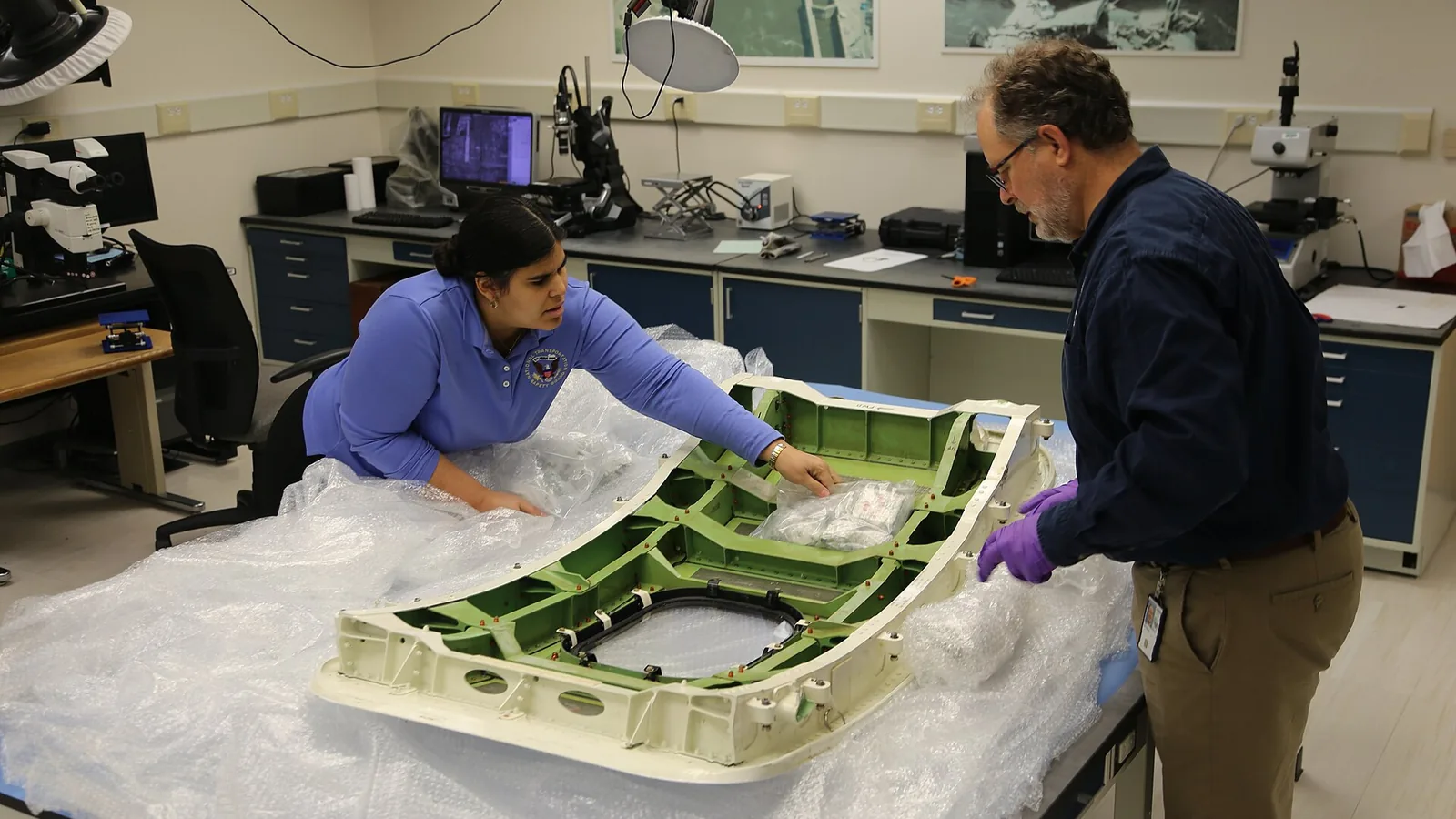
How an NTSB Investigation Works After an Aviation Accident
How the NTSB investigates, which reports it publishes, and what courts can use.
Who Can Be Liable After an Aviation Accident
Which carriers, manufacturers, repair stations, and agencies can be responsible.
How Aviation Accident Lawsuits Work
How a civil case after an aviation accident moves through the courts.