

Amazon Driver Crash Evidence
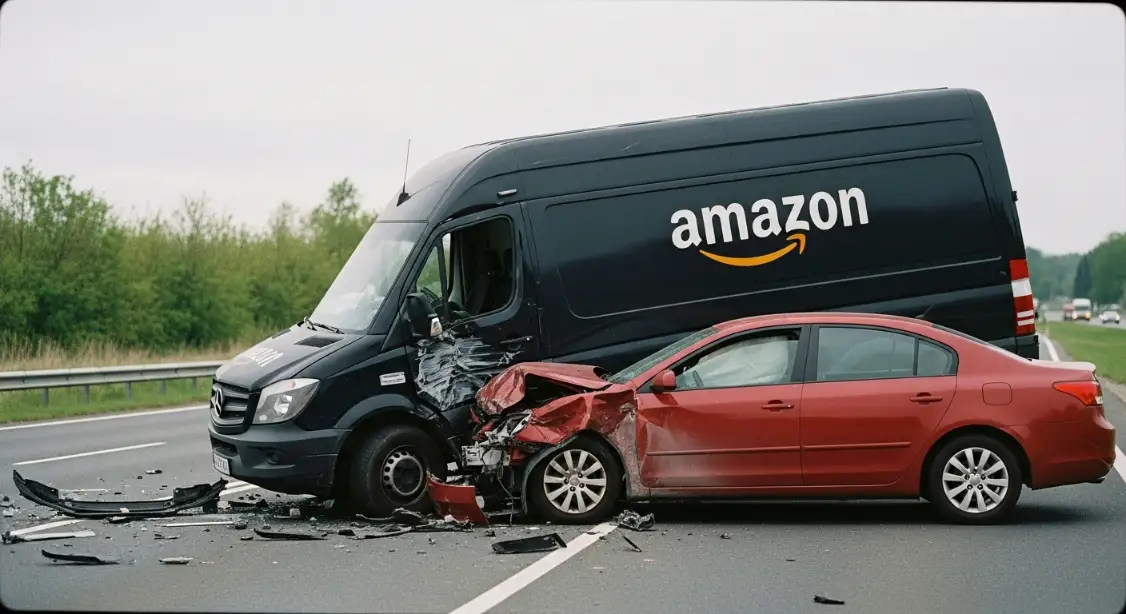
When a crash involves an Amazon delivery driver, the evidence differs from a standard car accident. Delivery Service Partner employment records, delivery app data, in-cab camera footage, and layered insurance documentation all bear on the claim, and the window to preserve some of that material is short.
Amazon Crash Evidence Sources
A two-car fender bender leaves behind a police report, some photographs, and two insurance policies. An Amazon delivery crash leaves behind far more, because much of what the driver does on a route is recorded, scored, and stored by a third party. That digital trail can show how fast the van was moving, whether the driver was distracted, how many stops were packed into the shift, and whether the route created an unsafe pace. The records sit on Amazon’s systems, on the Delivery Service Partner’s systems, and on the camera vendor’s servers.
Amazon structures its last-mile network around thousands of small contracting companies. Each one is a separate business that hires the drivers, leases the vans, and carries its own insurance, a model covered on the firm’s Amazon DSP contractor model page. Because the data and the money are spread across multiple companies, the evidence is spread across multiple companies too.
Some categories, like camera footage, can be overwritten within days or weeks. Others, like training and scorecard records, sit in corporate systems until someone with legal authority demands them in writing. A camera clip cycles off the drive, a route file rolls into an archive, and a scorecard is replaced by the next week of trips, all through routine storage management. The same crash, investigated two weeks apart, can leave two very different evidentiary records, so each company that holds part of the file should receive written notice to preserve it.
DSP Employment and Training Records
The at-fault driver almost always works for a Delivery Service Partner. That contracting company holds the records that show who it put behind the wheel and how it prepared that person to drive a loaded van through residential streets. Hiring files, driving history checks, onboarding documentation, disciplinary history, and qualification paperwork all sit with the DSP. When a delivery company puts an underqualified or previously flagged driver on the road, those records become central to the claim.
Amazon also requires contracted delivery drivers to use a safety scoring app. CNBC reported that Amazon uses the Mentor by eDriving app to track and score driving behavior and to discipline drivers. A pattern of low scores or repeated distraction flags in the weeks before a crash shows a different history than a clean record.
A DSP that kept a low-scoring driver on the road, skipped required onboarding steps, or assigned a route count that left no margin for safe driving made its own decisions, separate from anything the driver did behind the wheel. Those choices appear in the hiring file, the training logs, and the daily route assignments. Records to request from the DSP include:
- The driver’s hiring file, motor vehicle record check, and onboarding paperwork
- Training and orientation records the DSP was required to complete
- Mentor by eDriving safety scores and any distraction or speeding flags
- Disciplinary records, prior incident reports, and route reassignments
- The DSP’s contract with Amazon and its certificate of insurance
- The driver’s schedule and stop count for the day of the crash
Delivery App and Telematics Data
The in-cab camera is the clearest example of an Amazon van reporting on itself. CNBC reported in 2021 that Amazon began rolling out AI-equipped Netradyne Driveri cameras, with four lenses that capture the road, the driver, and both sides of the vehicle, in vans at contracted delivery partners. Five U.S. senators then wrote to Amazon questioning the cameras and driver monitoring. That same footage can show what happened in the seconds before a crash.
Camera footage is also the most fragile evidence in the case. Event clips and continuous recordings cycle off the system on a rolling basis, so a clip that exists on the day of the crash may be gone within days or weeks if nobody preserves it. A written preservation demand to Amazon, the DSP, and the camera vendor keeps that footage available.
The delivery itself generates a stream of data. The routing and driver apps log GPS position, timestamps, package scan events, and the number of stops assigned for the shift. That record can establish where the van was at impact and whether the driver was racing an unrealistic schedule. The same kinds of records appear in commercial vehicle accident cases, where electronic logs and onboard data often decide fault.
The Mentor app records trip-by-trip readings on acceleration, braking, cornering, speeding, and phone handling. Paired with the route data, the scoring record gives a timestamped account of how the driver was operating the van.
Insurance Layers in an Amazon Crash
An Amazon case rarely involves just one policy. The DSP’s commercial auto policy is usually the first layer of coverage, and for severe injuries that policy may not be enough on its own. The firm’s delivery driver insurance gaps page covers how stacked policies interact and where gaps appear.
A Capital University Law Review analysis reports that Amazon’s DSP contracts require the delivery companies to defend, indemnify, and hold Amazon harmless for bodily harm, which keeps claims pointed at the smaller company first. The full policy language, beyond a one-page declarations summary, shows the order in which the layers respond and whether an excess or umbrella policy sits above the primary limit.
When the driver cannot be identified or fled the scene, the injured person’s own coverage can fill the gap through underinsured and uninsured motorist coverage. Because so much of the coverage question depends on documents held by Amazon and the DSP, the policy paperwork is itself evidence to demand early.
Driving Status Evidence
The driver’s delivery status often decides which insurer pays. Under KRS 304.39-048, a Kentucky insurer may exclude coverage and the duty to defend or indemnify for injury or loss during a delivery available period or delivery service period, so evidence of the driver’s app status at the moment of impact directly affects the claim.
The statute was created by 2024 Kentucky Acts and applies to policies issued or renewed on or after January 1, 2025, so the policy in force on the crash date is part of the record alongside the driver’s app status.
Operational Records in a Delivery Case
Amazon states that it provides Delivery Service Partners with logistics technology and that those partners manage day-to-day delivery operations, according to Amazon. Package, route, and delivery status records therefore exist within the operating relationship between Amazon and its partners, and they can confirm whether a driver was actively delivering.
The delivery model also points to different records. Amazon describes both the independent-contractor Delivery Service Partner structure and the Amazon Flex personal-vehicle model, and identifying which model applied determines which company’s records, and which insurer, a claim should reach.
Injury Documentation
Medical evidence starts with a structured trauma evaluation. A StatPearls trauma care review explains that the trauma secondary survey documents the events leading up to the injury and information about how severe the trauma was, gathered through the S.A.M.P.L.E. history. The same review notes that imaging such as X-ray, CT, and FAST ultrasound confirms the clinician’s examination, producing objective records of injury.
Responsibility Beyond the Driver
Amazon’s contracts place responsibility on the delivery company. The Capital University Law Review analysis describes the defend and indemnify requirement and concludes that the DSP program lets Amazon take the position that it is not liable for crashes caused by DSP drivers. Courts look past the contract label to how the work was controlled.
Under respondeat superior, a company can be held responsible for the negligence of someone it controls, and Amazon controls the route, the schedule, the package volume, the in-cab camera, and the scoring software used to discipline drivers. The employment files, scorecards, and route data described above show both how the crash happened and who should answer for it.
A van that meets the federal weight threshold can also bring trucking regulations into play. Under 49 CFR 390.5, a commercial motor vehicle includes a vehicle with a gross vehicle weight rating of 10,001 pounds or more used in interstate commerce, and the Federal Motor Carrier Safety Administration confirms that the weight rating, not a commercial license, triggers those rules. Larger delivery vans can clear that line, which adds another set of records and standards, as covered on the firm’s delivery truck accident page.
Ready to Take Action on Your Injury Claim?
After a serious injury, medical bills pile up while the insurance company looks for ways to pay you less. Most law firms take their cut first and leave you with whatever is left. Sam Aguiar Injury Lawyers does things differently. With our exclusive Bigger Share Guarantee®, you always get more. Every client gets a dedicated three-person team: an attorney, a case manager, and a legal assistant. We never raise our fee rate if we have to go to court, and you pay $0 Out-Of-Pocket Forever.
Frequently Asked Questions
1What is the Mentor app and what does it show in a crash case?+
2Does Amazon have camera footage of crashes involving its drivers?+
3Have lawmakers raised concerns about Amazon’s driver monitoring?+
4What federal rules apply to Amazon delivery vehicle drivers?+
5Why does Amazon’s Delivery Service Partner structure complicate liability?+
6Which insurance applies when an Amazon delivery driver causes a crash?+
Latest Articles
Kentucky Diminished Value Claims
Kentucky drivers may pursue a repaired vehicle’s leftover market loss from the at-fault driver as part of a.
FMCSA Revoked ELDs: Fleet Compliance and Enforcement Deadlines
FMCSA removed five electronic logging devices from the registered list on August 6, 2026, and set an October.
FMCSA English Proficiency Rule and OOS Enforcement
FMCSA English Proficiency Rule Sam Aguiar Injury Lawyers August 11, 2026 7 minute read On This Page.