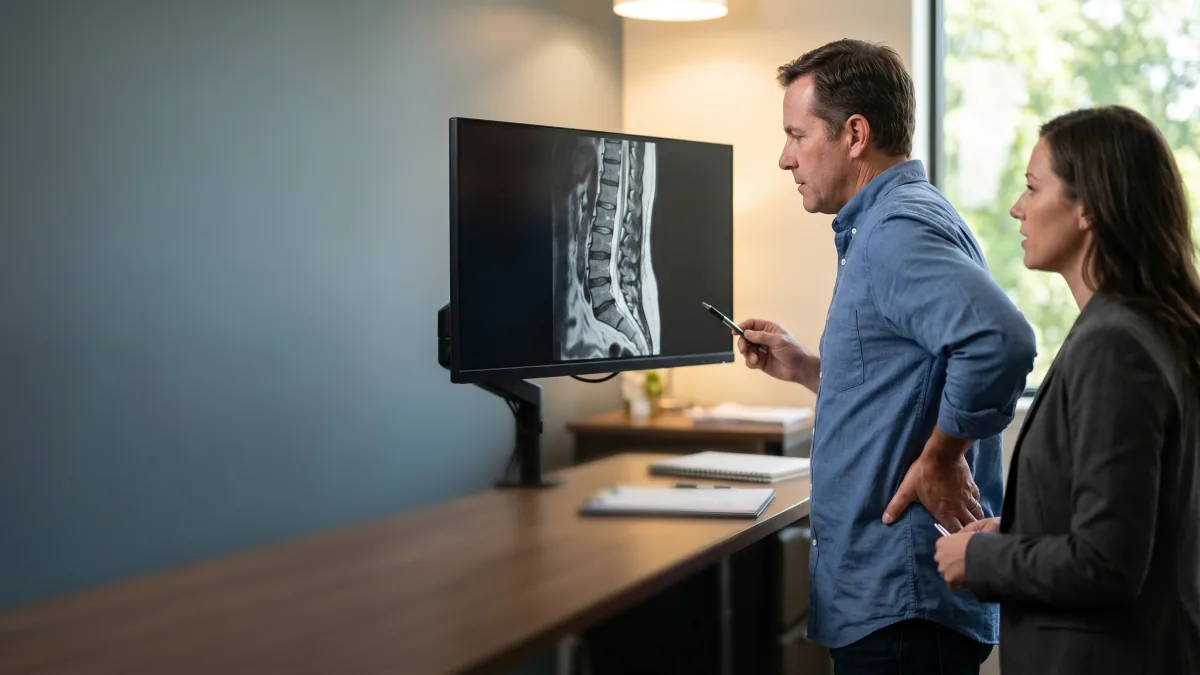
Person holding lower back after car accident lumbar spine injury in kentucky

Kentucky Lumbar Spine Injury From a Car Accident

Forbes Best-In-State Top Lawyer
Super Lawyers 2017–2026
1,000+ Five-Star Reviews — 4.9/5
$0 Out-Of-Pocket Forever

A lumbar spine injury from a car accident in Kentucky can include disc herniation, radiculopathy, vertebral fracture, or ligament damage at the L1–L5 levels. When conservative treatment fails, these injuries often progress to fluoroscopic epidural steroid injections and, in the most serious cases, lumbar fusion surgery with permanent lifting restrictions. Research published in BMC Musculoskeletal Disorders confirms that lumbar disc derangement is significantly associated with head-on and side-swipe collisions, the two crash types most common on Kentucky’s two-lane state highways.

What Happens to Your Lower Back in a Car Crash

The lumbar spine, the five vertebrae between your lower ribcage and your pelvis, carries the majority of your body’s weight and absorbs the forces of almost every movement you make. In a collision, those forces arrive all at once. The sudden compression, flexion, and rotational loading that your lower back absorbs in the fraction of a second of impact can rupture the outer wall of a disc, fracture vertebral endplates, or tear the ligaments that hold the lumbar motion segments in alignment.

The most common result is a herniated disc. When the disc’s gel-like nucleus pushes through the torn annulus fibrosus, it can press directly on the nerve roots that exit the lumbar spine at each level. These nerve roots feed sensation and motor function down through the buttocks, thighs, calves, and feet. The result is lumbar radiculopathy: the pain, numbness, tingling, or weakness that travels down one or both legs and is commonly called sciatica.

Crash type matters for your lumbar spine. According to research in BMC Musculoskeletal Disorders, patients in head-on collisions showed the highest frequency of lumbar disc derangement among all crash types studied. The compressive loading of the lumbar spine during a head-on or side-swipe collision is significantly different from the cervical flexion-extension loading of a rear-end crash, which means the injury pattern, the documentation required, and the case value are all different.

Lumbar injuries from a crash often include more than one structure. A disc herniation at L4-L5 may occur alongside a contusion to the lumbar musculature, a stress fracture of the pars interarticularis, or a disruption of the sacroiliac joint. MRI imaging captures what plain X-rays miss, which is why getting to the right imaging quickly after a crash is essential to both your medical care and your claim.

What a Lumbar Injury Actually Takes From You

A lumbar disc herniation does not just show up on an MRI. It shows up when you cannot bend down to tie your shoes in the morning without bracing yourself against the wall. It shows up when your grandchild reaches up for you at a family gathering and you have to tell them you cannot pick them up anymore, not today, maybe not ever. It shows up when you sit down at your son’s basketball game and have to stand up and stretch against the bleachers every ten minutes because the pain radiating down your leg becomes unbearable before halftime.

For the warehouse worker, the construction laborer, the home health aide who transfers patients all day, the impact is more immediate. A lumbar fusion with a permanent 20-pound lifting restriction does not just change how you feel. It ends the career you have spent years building. The forklift operator who has worked the same Louisville distribution center for eleven years. The patient care tech who lifted and repositioned patients every shift. The framing carpenter whose whole trade depends on carrying lumber and swinging a hammer from awkward positions. A lifting restriction is not an inconvenience for these workers. It is the end of their livelihood.

Even sitting becomes a problem. Extended driving, desk work, and commuting all load the lumbar discs in ways that aggravate a herniation or post-fusion pain. Many lumbar injury patients discover they cannot get through a full workday at a sedentary job without interruptions for pain management. Sleep suffers too. The position that relieves the pain in one moment causes a new flare the next, and the sleep deprivation compounds the already significant cognitive and emotional burden these injuries carry.

Lumbar Spine Injury: What the Recovery Road Looks Like

Insurance adjusters present lumbar injuries as nuisances that resolve in a few weeks of rest. The medical literature tells a different story. The timeline below reflects the documented challenging course for a lumbar disc herniation that does not respond to initial conservative care, which is a common outcome for crash-related disc injuries in younger, previously active patients.

Lumbar Spine Injury: What Recovery Can Look Like

Based on published medical literature. Individual recovery varies. This represents a documented challenging recovery course.

Weeks 1–4

Acute Disc Herniation

Severe lower back and radiating leg pain. Rest, anti-inflammatories, muscle relaxants. Imaging ordered. Per the AAOS, early conservative management is standard for acute disc herniation.

Weeks 4–12

Conservative Treatment

Physical therapy, core stabilization, pain management. Persistent or worsening radiculopathy triggers referral to spine surgeon or interventional pain physician.

Months 3–6

Fluoroscopic Injections

Transforaminal epidural steroid injections under fluoroscopic guidance. Spine-health reports 40–80% of disc herniation patients see improvement from a series of injections, though long-term recurrence rates are high.

Months 6–12

Failed Conservative Care

Continued radiculopathy, documented neurological deficits, and failure of injection series triggers surgical evaluation. Functional Capacity Evaluation (FCE) documents lifting restrictions and vocational impact.

Months 12–18

Lumbar Fusion Surgery

One to three-level fusion performed. Hospital stay 1–4 days. The fused segment continues to solidify for up to 18 months post-op per Spine.MD. Only 59% of patients achieve meaningful functional improvement within one year of surgery.

18+ Months

Residual Pain or FBSS

Permanent lifting restrictions enforced. Risk of Failed Back Surgery Syndrome (10–40% of lumbar surgery patients per the Journal of Pain Research). Adjacent segment disease can develop above or below the fusion level.

Sources: Journal of Pain Research, International Journal of Spine Surgery, American Academy of Orthopaedic Surgeons

Seeing the Right Specialist After a Lumbar Injury

The type of physician who treats your lumbar spine injury matters for both your recovery and the documentation your case depends on. Primary care and urgent care providers are appropriate for the first days after a crash, but lumbar disc herniations with radiculopathy require a higher level of specialist care. Seeing the right physician early produces better-organized records, more complete impairment ratings, and a more defensible medical history when the insurer challenges causation.

Spine Surgeon or Interventional Pain Management

For surgical evaluation, you need a spine surgeon who completed a fellowship in spinal surgery, whether through an orthopedic or neurosurgical training pathway. Look for a surgeon with experience in both decompression and fusion procedures who takes a conservative-first approach but is prepared to operate when the clinical picture calls for it.

For non-surgical management, an interventional pain physician who performs their own fluoroscopic-guided injections is significantly more valuable to your case than a physician who simply manages pain medications. A physician who personally performs fluoroscopic epidural steroid injections documents the procedure in detail, including the level treated, the needle approach, the contrast spread, and the clinical response. That documentation becomes part of your medical record and supports your claim in ways that a prescription for oral steroids never can.

For related spinal conditions in general, the broader network of care for serious lumbar injuries is described in our spine injuries in vehicle accidents overview and the herniated disc page, which covers how disc injuries interact with pre-existing degenerative changes.

What Kentucky Juries Actually Award for Lumbar Spine Claims

What Kentucky Juries Actually Award for Lumbar Spine Cases

The Kentucky Trial Court Review tracks 28 years of jury verdict data across Kentucky courts. For lumbar spine cases involving disc herniation, radiculopathy, and fusion surgery, jury awards consistently exceed what insurance companies offer in pre-litigation settlement. Insurance adjusters use proprietary software formulas that consistently undervalue the vocational and functional impact of permanent lifting restrictions. Kentucky jury data tells a different story. At Sam Aguiar Injury Lawyers, we use the Kentucky Trial Court Review’s verdict data to anchor your demand to what Kentucky juries have actually awarded for injuries like yours, not what an insurance algorithm says you deserve.

How a Forensic Economist Calculates What Your Lumbar Injury Is Worth

When a lumbar fusion results in permanent lifting restrictions, the economic impact often exceeds what any insurance adjuster’s internal formula can capture. This is where a forensic economist becomes one of the most important members of your case team.

A forensic economist is a credentialed academic or consulting economist retained to calculate lifetime lost earning capacity. After a lumbar fusion with a documented 20-pound lifting restriction, the process works like this:

  1. Vocational evaluation first

    A vocational rehabilitation counselor reviews the medical records, the Functional Capacity Evaluation, and the patient’s prior work history. The counselor identifies which occupations the person can no longer perform and what positions, if any, remain accessible to them given their restrictions, age, and education.

  2. Pre-injury vs. post-injury wage comparison

    The economist compares the patient’s documented pre-injury earnings with the wage range available to them in their post-injury occupation category. A warehouse worker earning $22 per hour who can now only work light-duty sedentary positions at $14 per hour has a calculable wage differential.

  3. Work-life expectancy projection

    The economist applies actuarial work-life tables to project how many years of productive employment remain. A 38-year-old with a documented lumbar fusion and permanent restrictions has potentially 25 or more years of reduced earning capacity ahead of them.

  4. Present value calculation

    All future losses are discounted to present value using accepted economic methodology. The resulting number represents the lump sum that, if invested today at a standard discount rate, would replicate the stream of income lost over the claimant’s remaining work-life.

This figure can represent the single largest component of a serious lumbar spine claim and is the most important reason these cases require attorney representation from the outset. To learn more about how economists and other professional witnesses build the financial case, see our full page on expert witnesses in personal injury cases.

What Our Demand to the Insurance Adjuster Looks Like

Sample: Pre-Litigation Demand Correspondence

This is a simplified example of the type of correspondence we send to insurance adjusters for lumbar spine claims. Actual demands include full medical documentation, billing summaries, imaging reports, FCE results, and the forensic economist’s earning capacity analysis.

Re: [Client Name] / Claim No. [XXXXX] / Date of Loss: [XX/XX/XXXX]

Dear [Adjuster Name],

Please find enclosed our demand for resolution of the above-referenced claim.

Liability: Our client was struck by your insured’s vehicle at the intersection of [Street] and [Street] in Louisville, Kentucky. Your insured ran a red light and struck our client’s vehicle on the driver’s side at estimated highway speed. The police report cites your insured for the violation. Liability is clear and not in dispute.

Injuries and Treatment: Our client sustained a lumbar disc herniation at L4-L5 with documented radiculopathy, confirmed on MRI obtained [X weeks] post-crash at [Facility]. The treating spine surgeon, [Dr. Name, MD], documented left-sided L5 radiculopathy with a positive straight-leg raise and EMG/NCS confirmation of L5 nerve root involvement. Following a failed course of physical therapy and a series of three fluoroscopic transforaminal epidural steroid injections that provided only temporary relief, our client underwent a one-level lumbar fusion at L4-L5 on [date]. Operative report and post-operative records are enclosed.

Medical Documentation: Enclosed: itemized billing summary, complete medical records from [Facilities], MRI report with images, EMG/NCS report, operative report, post-operative follow-up records, and Functional Capacity Evaluation dated [date].

Functional Capacity Evaluation / Lifting Restrictions: The FCE, conducted by [Facility], documents a permanent 20-pound lifting restriction with no repetitive bending, twisting, or forward flexion. These restrictions are permanent per the treating surgeon’s written recommendation.

Vocational and Economic Impact: Our client was employed as a [warehouse supervisor / construction laborer / home health aide] earning [wages] annually. The permanent lifting restriction precludes return to this occupation. A vocational rehabilitation report by [Counselor] and a lifetime lost earning capacity analysis by [Forensic Economist, Ph.D.] are enclosed. The economist’s report projects lifetime lost earning capacity at [range], which represents the difference between our client’s pre-injury earning trajectory and the wage range available in occupations accessible given the permanent restrictions.

Demand: Based on the documented disc herniation and surgical fusion, the permanent lifting restrictions, the documented vocational impact, and Kentucky Trial Court Review jury verdict data for comparable lumbar fusion cases in Jefferson County, we demand the policy limits for resolution of this claim.

We request your response within 30 days. Should your insurer decline to make a fair-value offer, we are prepared to file suit and will pursue all available damages, including bad faith penalties under KRS 304.12-230.

Respectfully,
Sam Aguiar Injury Lawyers

Note: This is a representative sample. Every demand we send is customized to the specific facts, medical evidence, applicable insurance coverage, and documented vocational impact in your case.

Related Pages in This Series

Lumbar injuries are part of a broader pattern of spine injuries in vehicle accidents. For injuries at other levels of the spine, see our pages on cervical spine injuries and thoracic spine injuries. For catastrophic spinal cord damage, see the spinal cord injury practice area. For disc-specific information, including how pre-existing degenerative changes affect your claim, see herniated discs. This page is part of the car accident injuries series.

Get More. Get It Faster. Get It With Sam Aguiar.

Our Bigger Share Guarantee® means you always walk away with more than we do after your case resolves. Average pre-litigation resolution under seven months. Named to 2026 Super Lawyers. No fee increase if your case goes to litigation.

We handle everything so you can focus on getting better.

Call us today: Louisville (502) 888-8888 · Lexington (502) 888-8888

Frequently Asked Questions

How does a car accident cause a lumbar disc herniation?

During a collision, the lumbar spine absorbs sudden compressive and flexion forces that can rupture the outer wall of an intervertebral disc. Research in BMC Musculoskeletal Disorders confirms lumbar disc derangement is most common in head-on and side-swipe collisions. The herniated disc material then presses on nearby nerve roots, producing the radiating leg pain and numbness known as radiculopathy.

What is lumbar radiculopathy and how is it diagnosed?

Lumbar radiculopathy is nerve root irritation in the lower back that produces radiating pain, numbness, tingling, or weakness down one or both legs. Diagnosis combines MRI imaging to visualize disc herniation with an EMG/nerve conduction study to confirm nerve involvement. A positive straight-leg raise test during physical examination also strongly suggests lumbar nerve root compression at the L4, L5, or S1 level.

When is lumbar fusion surgery recommended after a car accident?

Spine surgeons typically consider lumbar fusion when conservative treatment including physical therapy, anti-inflammatory medications, and fluoroscopic epidural steroid injections has failed to provide lasting relief over three to six months. Surgical candidates have MRI-confirmed disc herniation or instability causing significant nerve compression with documented functional deficits. The American Academy of Orthopaedic Surgeons recommends exhausting non-surgical options before proceeding to fusion.

What is failed back surgery syndrome and how common is it?

Failed back surgery syndrome (FBSS) describes persistent or recurring back and leg pain after lumbar surgery despite a technically successful procedure. Research in the Journal of Pain Research found FBSS affects approximately 20.6% of lumbar surgery patients, with broader estimates of 10%–40%. Multi-level fusion procedures carry the highest rates, approaching 10% within the first year according to PubMed data covering more than 100,000 lumbar surgeries.

What permanent lifting restrictions come with lumbar fusion?

Most spine surgeons impose permanent lifting limits of 20 to 40 pounds after lumbar fusion, along with restrictions on repetitive bending, twisting, and forward flexion. In multi-level fusions at L4-L5, patients may permanently lose the ability to bend forward to retrieve objects from the floor, per Premia Spine. These restrictions directly disqualify warehouse, construction, nursing, and manufacturing workers from their prior occupations.

How does a forensic economist calculate lost earning capacity after lumbar fusion?

A forensic economist calculates lifetime lost earning capacity by comparing pre-injury earnings against post-injury vocational capacity. After lumbar fusion with permanent lifting restrictions, a vocational counselor first documents what jobs can no longer be performed. The economist then projects the wage differential over remaining work-life expectancy, adjusted for inflation and present value. This figure often represents the largest single component of a serious lumbar spine claim.

How long does lumbar fusion recovery take?

Most patients remain in the hospital one to four days after lumbar fusion. The fused segment continues to solidify for up to 18 months post-surgery per Spine.MD. Research in the International Journal of Spine Surgery found only 59% of lumbar fusion patients achieve meaningful functional improvement within one year, meaning a significant portion continue to struggle with pain and limitation well beyond that mark.

Will the insurance company accept my lumbar spine diagnosis from a car accident?

Insurance adjusters routinely argue that lumbar disc herniations are pre-existing or age-related rather than crash-caused. A strong claim requires MRI imaging performed close to the date of loss, a treating spine surgeon or interventional pain physician who documents the causal connection, and a Functional Capacity Evaluation quantifying lifting restrictions and vocational impact. Attorney representation ensures this documentation is assembled properly before any demand is submitted.