

Car Accident Thoracic Spine Injuries
Key Takeaways
- In a study in The Spine Journal of crash occupants, compression fractures made up 57.5% of major thoracic and lumbar spine injuries, and burst fractures made up 24.9%.
- The same study found thoracic or lumbar spine injuries in 35.3% of properly belted occupants and 11.6% of unbelted occupants, though belt use was tied to lower fatality and less neurological injury.
- The American Academy of Orthopaedic Surgeons says flexion-distraction (Chance) fractures, which can occur when a lap belt holds the pelvis in a head-on crash, are typically unstable and often require surgery.
Anatomy of the Thoracic Spine
The thoracic spine is the middle section of the backbone. Cleveland Clinic describes it as starting at the base of the neck and ending at the bottom of the ribs, with 12 vertebrae labeled T1 through T12. It is the longest section of the spine, and its vertebrae are the ones that provide attachments for the ribs.
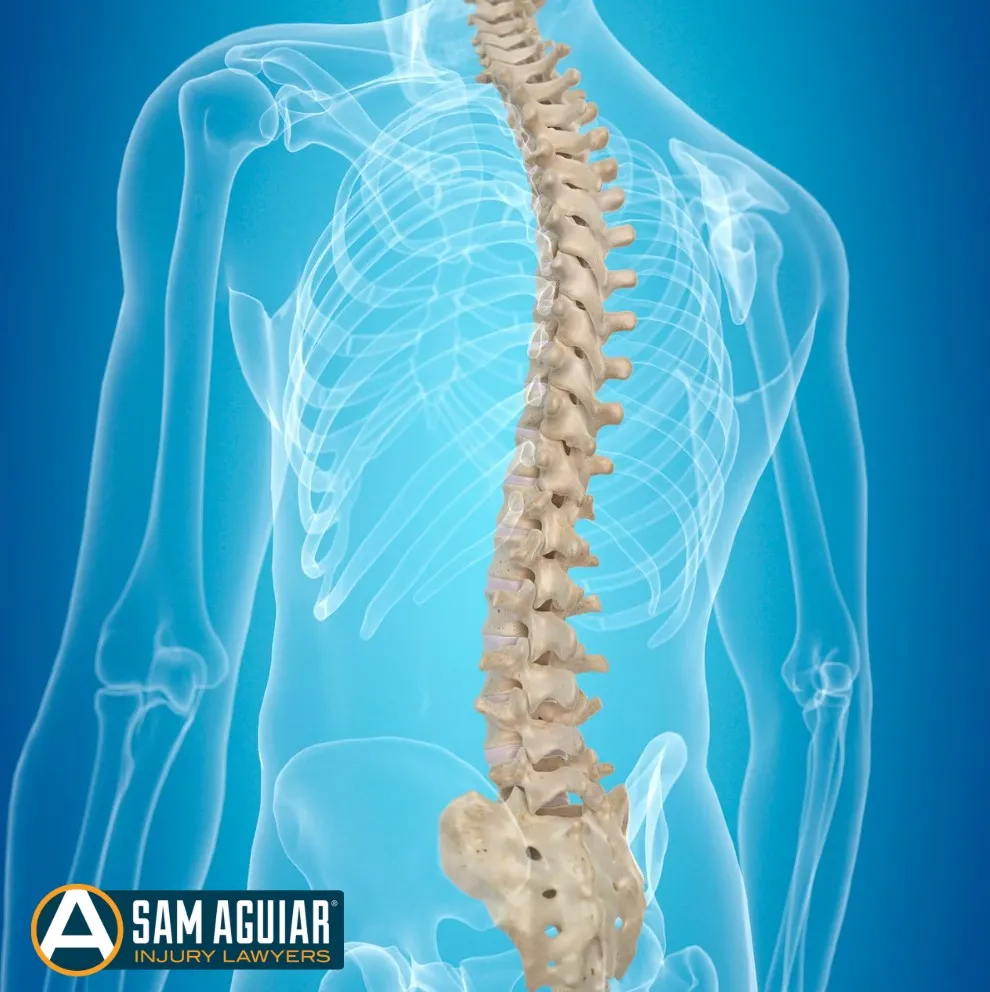
That link to the rib cage makes the region stiff. Cleveland Clinic says the thoracic spine and rib cage stabilize each other and together protect the heart and lungs, and that it takes a lot of force to fracture the thoracic spine because of that rigidity. The spinal cord runs through a canal in the center of the vertebrae. In the thoracic spine that canal is relatively narrow, which the same page says makes the region prone to spinal cord damage.
Crash Forces on the Mid-Back
The American Academy of Orthopaedic Surgeons (AAOS) lists car and motorcycle collisions first among the high-energy events that fracture the thoracic and lumbar spine. Most spinal fractures happen in those two regions or where they meet, a stretch called the thoracolumbar junction.
A study in The Spine Journal reviewed 631 crash occupants with thoracic or lumbar spine injuries drawn from the Crash Injury Research and Engineering Network (CIREN), a database of moderately to severely injured occupants kept by the National Highway Traffic Safety Administration. The authors note that motor vehicle collisions account for between 22.5% and 51% of all thoracic and lumbar spine injuries in different series. Of the 329 major injuries in the series, 41% sat at the thoracolumbar junction (T11 to L2) and 33.7% in the thoracic spine above it (T1 to T10).
Chest injuries traveled with these fractures more than any other kind. The same study found moderate or worse chest injuries in 65.6% of the 631 occupants, and 21.7% also had a cervical spine injury. The authors point to the rib cage, sternum, and chest wall as the structures that stabilize the thoracic spine, and wrote that multiple rib fractures add to the instability of a thoracic spine fracture.
Seat Belts and Spinal Loading
Seat belts change the pattern of injury without removing it. In the CIREN study, 35.3% of properly belted occupants in the database had a thoracic or lumbar spine injury, compared with 11.6% of unbelted occupants. Proper use of a three-point belt was still associated with a lower fatality rate, a lower overall injury severity score, and less neurological injury.
The authors suggested a mechanism. As the body moves forward in a crash, the seat pan keeps loading the spine, and a stiff seat front with an upward contour may add compressive force that makes compression or burst fractures more likely in a restrained occupant.
Belt fit also mattered. In the CIREN study, 12 of the 18 occupants who wore a lap-only belt, or a shoulder belt tucked behind the back or under the arm, had flexion-distraction injuries. A case report in The Ochsner Journal notes that this kind of fracture is also called the seat belt fracture because of its frequent link to lap belts. The firm’s page on seat belt injuries covers the chest and abdominal injuries a belt can leave behind.
Symptoms After a Thoracic Injury
The AAOS says a thoracic or lumbar fracture causes moderate to severe back pain that gets worse with movement. When the spinal cord or nerves are involved, a person may also have numbness, tingling, or weakness in the arms or legs, along with bowel or bladder problems.
Cleveland Clinic describes thoracic nerve damage as pain, weakness, or tingling that radiates into the arms, legs, or around the rib cage. It lists difficulty breathing, loss of feeling in the genital or rectal area, and loss of bladder or bowel control among the related symptoms.
The AAOS explains that after a high-energy event such as a motor vehicle collision, other injuries may hurt more than the spinal fracture, so it has to be assumed that the spine is fractured.
Mayo Clinic lists these emergency symptoms of a spinal cord injury after an accident.
Spinal Cord Emergency Signs
- Serious back pain or pressure in the neck, head, or back
- Weakness, loss of coordination, or loss of control in any part of the body
- Numbness, tingling, or loss of feeling in the hands, fingers, feet, or toes
- Loss of bladder or bowel control
- Trouble with balance and walking
- Trouble breathing after the injury
- A twisted neck or back
Why Kentucky Hires
Sam Aguiar Injury Lawyers
Compression, Burst and Chance Fractures
Spine surgeons sort these fractures by pattern. In a compression fracture, the AAOS explains, the front of the vertebra breaks and the back does not. This type is usually stable and rarely tied to neurologic problems. Cleveland Clinic adds that more than half of all compression fractures are wedge-shaped, with the broken front of the bone collapsing into a wedge.
A burst fracture breaks both the front and the back of the vertebra. The AAOS says it can sometimes compress nerves, can be stable or unstable, and may need surgery depending on stability and nerve injury.
A flexion-distraction fracture, also called a Chance fracture, pulls the vertebra apart. The AAOS says it can occur in a head-on collision when the upper body is thrown forward while a lap belt holds the pelvis, and that these fractures are typically unstable and often need surgery. The Ochsner Journal reports that Chance fractures occur almost exclusively at the thoracolumbar junction, that associated abdominal injuries have been reported in as many as 50% of cases, and that abdominal CT is recommended when the abdominal wall shows signs of a seat belt injury.
At the far end sits the fracture-dislocation, in which one vertebra shifts off the one next to it. The AAOS calls these injuries unstable, says they frequently cause serious spinal cord compression, and says they require surgery. Transverse process fractures come from rotation or sideways bending and usually do not affect stability.
Stable Versus Unstable Injuries
Stability shapes most of what follows. Cleveland Clinic defines a stable fracture as one where the broken bone usually does not move out of place, and an unstable fracture as one that moves bone pieces out of place and may press on nearby nerves, typically when other fractures or spinal ligament injuries are also present.
One common framework is the three-column model of the spine described by orthopedic surgeon Francis Denis. The Ochsner Journal explains that a Chance fracture is classified as unstable because at least two of the three columns are disrupted. The table below lines up the four major patterns using the AAOS and Ochsner Journal descriptions, with each pattern’s share of the major injuries in the CIREN study.
| Feature | Compression | Burst | Chance | Fracture-Dislocation |
|---|---|---|---|---|
| What breaks | Front of the vertebra only | Front and back of the vertebra | Vertebra pulled apart | Vertebra shifts off the one next to it |
| Stability | Usually stable | Stable or unstable | Typically unstable | Unstable |
| Nerve involvement | Rare | Sometimes nerve compression | Neurologic effects in about 15% | Frequent serious cord compression |
| Surgery | Usually not needed | Depends on stability and nerve injury | Often needed | Required |
| Share of major crash injuries (CIREN) | 57.5% | 24.9% | 8.8% (all flexion-distraction) | 2.4% |
Imaging the Thoracic Spine
In the emergency room, the AAOS describes a head-to-toe exam that tests the ability to move and feel all four limbs, checks reflexes, and looks for bowel and bladder problems that may point to spinal cord injury. A radiologic evaluation follows, which may include x-rays, CT, and MRI of several areas, including the thoracic and lumbar spine.
Each scan answers a different question. RadiologyInfo.org says the most frequent use of spinal CT is to detect or rule out spinal column damage in injured patients, and that CT shows the bony vertebrae clearly. The same page notes that spinal CT does not consistently show enough detail to assess the spinal cord itself. The CIREN authors wrote that a CT scan of the entire thoracic and lumbar spine is justified in every occupant with moderate to severe chest injuries.
RadiologyInfo.org calls MRI the most sensitive imaging test available for the spine and says it helps diagnose or rule out acute spinal cord compression when an exam shows weakness or paralysis. It also calls MRI the best available method to evaluate ligament injuries, while noting that in some patients vertebral fractures may be better detected by CT.
Bracing and Conservative Care
Many thoracic fractures heal without an operation. The AAOS says most flexion injuries, including compression fractures and stable burst fractures, can be treated without surgery and sometimes benefit from bracing, with activity and rehabilitation exercises added gradually. Extension fractures that run only through the vertebral body are watched closely while the patient wears a brace or cast for about 12 weeks.
For compression fractures, Cleveland Clinic says a back brace supports the vertebrae and eases pain by limiting spine movement, and that it may be worn for four to 12 weeks. Physical therapy then works on stretches and exercises that strengthen the muscles around the spine.
Surgical Stabilization and Kyphoplasty
The AAOS says surgery is typically required for unstable burst fractures with many bone fragments, severe loss of vertebral height, severe deformity, significant nerve injury, or ligament damage that makes the spine unstable. A laminectomy removes the bony arch at the back of the spinal canal to take pressure off the cord, and the surgeon then stabilizes the fracture with screws placed above and below it. Rods and cages are also used.
Kyphoplasty is a smaller procedure for compression fractures. Cleveland Clinic describes a balloon-like device inflated inside the broken vertebra to help regain height, followed by bone cement that keeps the bone from collapsing further. The procedure takes less than an hour for one section of the spine, and Cleveland Clinic names osteoporosis or a spinal injury as the most common causes of the fractures it treats.
Recovery Time and Lingering Pain
Cleveland Clinic says pain from a healing compression fracture may ease after about four weeks and that the bone should heal completely after 12 weeks, with age and other factors changing that timeline. Many compression fractures heal after a few months of rest and limited movement.
The AAOS says the goals of rehabilitation are to reduce pain, restore mobility, and return the patient as closely as possible to the pre-injury state. It also says continued back pain for several months is not uncommon, and that a fracture left out of alignment, a neurologic injury, or a deformity that worsens over time can delay or complicate recovery.
Spinal Cord Damage at Chest Level
A fracture that reaches the cord changes the outlook. Mayo Clinic says an injury to the spine at chest level or in the lower back can affect the trunk, legs, bowel, bladder, and sexual function. Paralysis that affects all or part of the trunk, legs, and pelvic organs but spares the arms is called paraplegia. An injury is complete when all feeling and movement are lost below it and incomplete when some remain.
Cleveland Clinic says the T3 through T5 nerves go into the chest wall and help control the rib cage, lungs, diaphragm, and breathing muscles, while T6 through T12 affect the abdominal and back muscles and help with balance, posture, and coughing. Mayo Clinic adds that when an injury affects the nerves to the stomach and chest muscles, breathing and coughing may become hard. The firm’s spinal cord injury page covers paralysis cases in more depth.
Kyphosis and Other Complications
Complications can come from the fracture itself or from the surgery used to repair it. The AAOS lists blood clots in the pelvis and legs, pulmonary embolism, pneumonia, and pressure sores among the complications of thoracic and lumbar fractures, and bleeding, infection, spinal fluid leaks, instrument failure, and bones that do not heal among the risks specific to spine surgery.
Collapse of the vertebra can change the shape of the spine. Cleveland Clinic lists kyphosis, a forward-curving spine with a hunched-over look, along with chronic pain and bladder or bowel problems among the long-term effects of a compression fracture. Its kyphoplasty page says that curve can limit breathing or the function of the abdominal organs, and a review in the International Journal of Spine Surgery states that fracture kyphosis can impair lung function. The Ochsner Journal adds that untreated Chance fractures are more likely to progress to kyphosis or constant back pain.
Records That Track the Injury
Each stage of care leaves its own record. The emergency note documents the first exam and neurologic findings, the CT and MRI reports describe the fracture pattern and whether the cord or ligaments were involved, and the brace order, surgical report, and therapy notes show how the injury was treated over the following weeks.
Physical marks matter as well. In the case described in The Ochsner Journal, the exam noted bruises that matched the location of the seat belt. Photos of belt marks taken early tie the injury to the forces of the crash.
A thoracic fracture is often pieced together in stages, from the emergency CT to a later MRI and the brace or surgery that follows. Keeping each imaging report, the bracing or surgical orders, and the therapy notes in one file shows how the injury was found and treated over time.
Mid-Back Fracture Changing Your Daily Life?
A thoracic fracture can mean weeks in a brace, months of back pain, and a job that has to wait, while an insurer points to the seat belt or an older back problem to explain the damage. Sam Aguiar Injury Lawyers lines up the emergency CT, the MRI, and the treating doctors’ notes so the record shows what the crash did to your spine. Under our Bigger Share Guarantee®, you always walk away with more than the firm after bills, liens, and case costs. Start with a free case review.