

Hit by an Amazon Flex Driver?
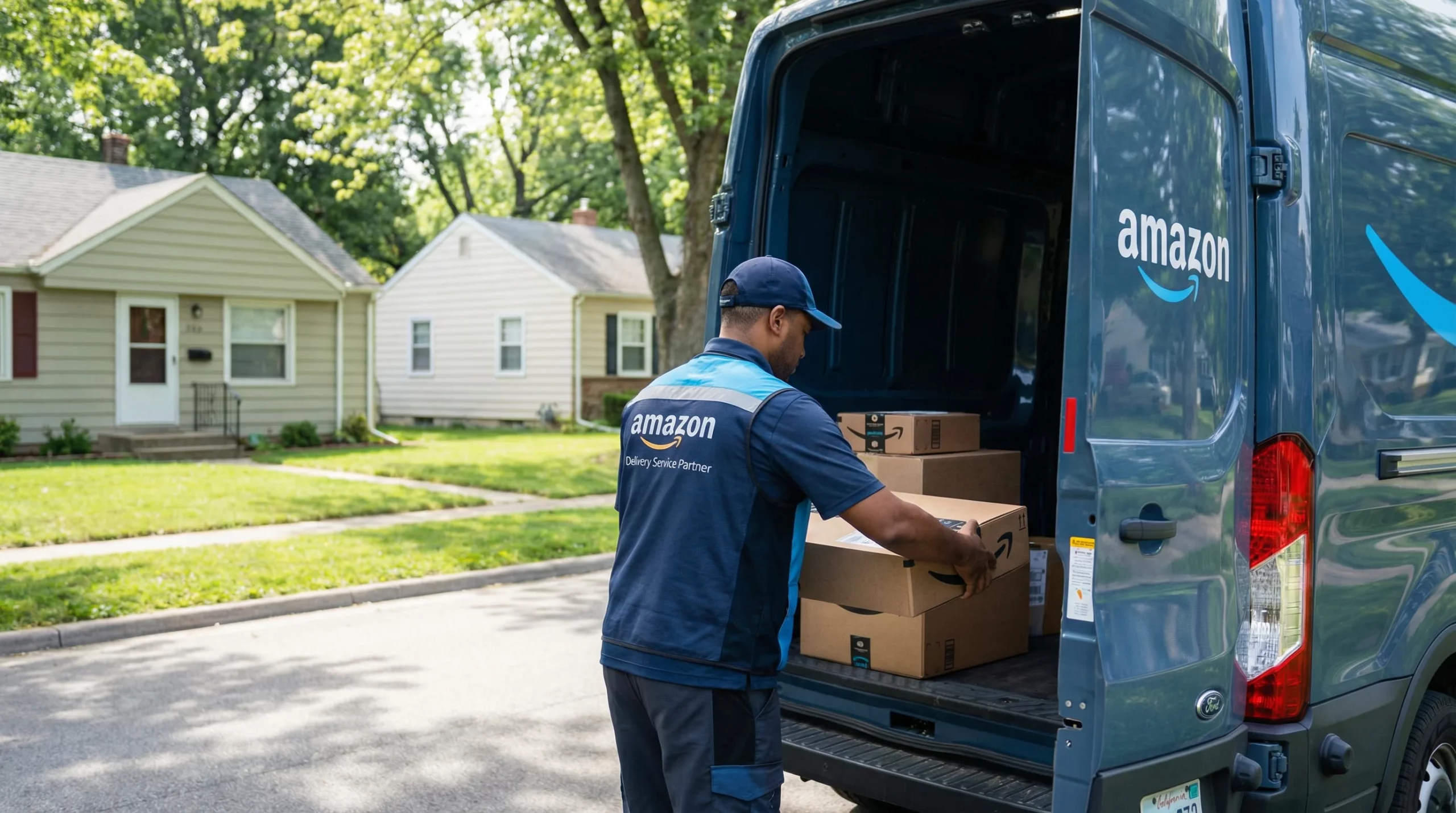
Amazon Flex drivers deliver in their own cars while the Amazon Flex app is running, and Amazon identifies them as independent contractors who participate in its delivery network. When a Flex driver causes a crash in Kentucky, the driver’s app status at the moment of impact can decide whether a delivery-period policy or the driver’s personal policy responds. KRS 365.532 sets the insurance requirements for delivery network companies and their drivers during delivery activity.
Amazon also uses Delivery Service Partner van drivers. The name on the vehicle is not always the company that pays, and Kentucky no-fault rules and the delivery-period exclusion change who pays medical bills first.
Amazon Flex Delivery Program
Amazon describes Flex participants as independent contractors within a delivery network that also includes Delivery Service Partners and Hub Delivery businesses. Flex drivers use personal vehicles, while Delivery Service Partner drivers work for independently owned delivery businesses.
The distinction shapes a crash case because the driver’s relationship with the delivery network, app activity, and insurance coverage each require separate review. The firm’s Amazon DSP driver negligence page addresses crashes involving drivers employed by Delivery Service Partners.
Flex and DSP Drivers
Flex and Delivery Service Partner drivers work in different parts of Amazon’s delivery network, and each arrangement produces different records and insurance policies after a crash.
Vehicle Ownership
Flex drivers use personal vehicles. Delivery Service Partners are independently owned businesses that operate delivery routes, so the vehicle owner and employer records must be confirmed for the driver involved in the crash.
Employment Classification
Amazon separates Delivery Service Partner businesses from Flex independent contractors. That separation determines the driver’s employer, the contracting entities, and the available insurance policies.
Insurance Structure
Delivery Service Partner drivers work for a company that runs its own delivery business, while Flex drivers deliver in their personal vehicles. Which coverage responds can depend on the driver’s delivery status, because KRS 304.39-048 lets a personal auto insurer exclude coverage during a delivery available period or delivery service period.
Oversight and Monitoring
Available digital records depend on the delivery arrangement and the systems used for that route. App activity, dispatch information, location data, and delivery records can show whether the driver was waiting for work or completing a delivery when the crash occurred.
The Amazon delivery vehicle accident practice area covers both Flex and Delivery Service Partner cases, including the different insurance and contracting records tied to each model.
Delivery Periods Under Kentucky Law
Kentucky law divides a delivery driver’s app time into two defined periods, and the insurance obligations attach to those periods. Under KRS 365.530, a delivery available period is the time a driver operating a personal vehicle is logged on to a digital network and eligible to receive delivery requests. A delivery service period begins when the driver starts driving to pick up goods for a delivery or series of deliveries, continues while the driver transports them, and ends when the goods reach the customer or a designated location.
App Off
When the Flex driver is not logged on to the app, neither delivery period applies and the claim runs through the driver’s personal auto insurance. Kentucky requires $25,000 per person and $50,000 per accident in bodily injury liability under KRS 304.39-110, and many drivers carry only those minimums.
Logged On or Delivering
During a delivery available period or delivery service period, KRS 365.532 requires the delivery network driver, the delivery network company, or both to maintain liability coverage of at least $50,000 per person, $100,000 per accident for bodily injury, and $25,000 for property damage, plus basic reparation benefits. If the driver’s coverage has lapsed or does not provide the required coverage, the company’s insurance must pay from the first dollar of the claim and defend it.
The hardest question in most Flex crashes is which period the driver was in at the moment of impact. The Flex app’s location logs, delivery assignment timestamps, and package scan records are the evidence that answers it.
Kentucky No-Fault and the Delivery-Period Exclusion
Kentucky’s no-fault system normally gives a crash victim a right to basic reparation benefits. Under KRS 304.39-030, every person suffering loss from injury arising out of the use of a motor vehicle has a right to basic reparation benefits when the accident occurs in the Commonwealth, unless that person rejected the tort limitation. Those benefits are paid regardless of who caused the crash.
For a gig delivery driver, a 2024 change complicates that starting point. Under KRS 304.39-048, a Kentucky motor vehicle liability insurer may exclude any and all coverage, and the duty to defend or indemnify, for injury or loss that occurs during a delivery available period or a delivery service period, including liability, uninsured and underinsured motorist, basic reparation benefits, medical payments, comprehensive, and collision coverage.
On-App Status and Coverage
The driver’s delivery status decides whether the personal policy responds. Because KRS 304.39-048 ties the exclusion to a delivery available period or delivery service period, personal auto coverage can drop out whenever the app was active at the moment of the crash.
That rule reaches Amazon Flex drivers directly. Amazon says drivers can deliver part-time with their own vehicles through the Amazon Flex program, according to Amazon Business, which is the personal-vehicle situation the delivery-period exclusion was written to address.
The statute also requires the company to produce the timeline. Under KRS 365.532, a delivery network company or its insurer must provide, on request, the precise times a driver began and ended delivery available periods and delivery service periods in the 24 hours before and after the crash. If a dispute exists about when a period began or ended and the company cannot or does not provide that information, the company’s insurer assumes primary liability for the claim.
Insurer Recovery Rights
The 2024 law gives insurers a path to recover from one another. Under KRS 304.39-048, an insurer that defends or indemnifies a claim against a delivery network driver may seek recovery against the insurer providing delivery-period coverage when the claim occurs during a delivery period and the personal policy excludes it.
The change is recent and forward-looking. The same statute was created by 2024 Kentucky Acts and applies to policies issued or renewed on or after January 1, 2025, so the rules for a given crash depend on the date of the policy in force. KRS 365.534 also bars a delivery network company from letting a driver make deliveries until it discloses in writing the coverage it provides and that the driver’s own policy might not cover delivery periods. The firm’s analysis of delivery driver insurance gaps covers how these policies stack.
Liability for an Amazon Flex Driver Crash
Liability in Flex crashes is more contested than in DSP cases because Amazon classifies Flex drivers as independent contractors using personal vehicles. Classification alone does not decide liability. Kentucky courts examine the working relationship between Amazon and the driver, beyond the contractual label.
Amazon’s Responsibility
Amazon argues it is a technology platform that connects drivers with delivery opportunities. The Flex app sets the delivery sequence and time windows, Amazon tracks the driver’s location during a block, Amazon sets the pay rate, and Amazon can deactivate a driver’s account.
Under agency principles described in the Restatement (Second) of Agency, control factors like these can make a company a principal even when the worker is formally classified as an independent contractor. Kentucky courts apply a right-to-control test that examines the whole relationship.
Amazon may also face direct negligence theories tied to how it screens Flex drivers, how it monitors driving safety, and whether tight delivery windows push drivers to speed.
Flex Driver’s Personal Liability
The Flex driver is personally liable for a crash caused by the driver’s negligence. Outside a delivery period, the driver’s personal auto insurance responds. During a delivery period, the personal insurer may exclude the claim and the coverage required by KRS 365.532 applies.
Insurer Obligations
Both the driver’s personal insurer and the delivery-period insurer must respond to valid claims. Common insurer tactics in Flex driver cases include:
- Denying coverage based on delivery exclusions in the personal auto policy
- Disputing which period the driver was in at the time of the crash
- Arguing the Flex driver was an independent contractor to limit Amazon’s exposure
- Slow-walking the claims process while medical bills accumulate
- Offering low initial settlements before the full extent of injuries is known
Flex drivers operate personal vehicles with no Amazon branding. After a crash, the injured driver may not know the other driver was making Amazon deliveries, and the at-fault driver may not volunteer it. Packages in the vehicle and Flex app records are often the only link to delivery-period coverage.
Evidence in Amazon Flex Cases
A Flex driver crash case depends on records unique to the gig delivery model. Amazon does not volunteer this information, so it is requested through preservation demands and, when needed, formal discovery.
Amazon Flex App Data
The Flex app records the driver’s login and logout times, delivery block acceptance, location tracking, package scan timestamps, and delivery confirmation photos. This data shows which period the driver was in at the time of the crash and whether the driver had left the assigned route. A preservation demand to Amazon keeps the data from being overwritten or purged.
Driver Route and Delivery Records
Amazon keeps records of each delivery block assigned to a Flex driver, including the number of packages, delivery addresses, delivery sequencing, and completion rates. These records can show whether the driver was rushing to finish within Amazon’s time windows and whether the crash occurred on the assigned route.
Personal Vehicle Insurance Policies
The Flex driver’s personal auto policy shows coverage limits, delivery exclusions, and gaps. A personal policy that excludes delivery activity shifts the claim to the delivery-period coverage.
Delivery-Period Insurance Documentation
The policy maintained to satisfy KRS 365.532 shows limits, deductibles, and conditions the insurer may invoke. The statute requires insurers to disclose applicable coverages, exclusions, and limits on request by another insurer involved in the claim.
Driver History and Background Records
The driver’s motor vehicle record, prior crash history, and Amazon’s internal records on safety complaints or deactivation warnings can show a pattern. A pattern of prior incidents can support a punitive damages claim under Kentucky law.
Common Injuries in Amazon Flex Driver Crashes
Amazon Flex drivers use a wide range of personal vehicles, from sedans to SUVs to pickup trucks. These vehicles are smaller than Amazon-branded delivery vans, yet collisions still produce serious injuries from speed, app distraction, and intersection crashes in residential delivery areas.
- Traumatic brain injury: even moderate-speed collisions can produce concussions, contusions, and diffuse axonal injuries. The CDC tracks traumatic brain injury data that includes motor vehicle crashes, and symptoms may not appear for hours or days.
- Spinal cord and back injuries: herniated discs, compression fractures, and spinal cord damage often follow rear-end and T-bone collisions and can require surgery and long rehabilitation.
- Fractures: broken bones in the extremities, ribs, pelvis, and face are common in broadside and head-on collisions, and complex fractures can take six months to a year or longer to heal.
- Soft tissue injuries: whiplash, sprains, strains, and ligament tears can produce chronic pain, limited range of motion, and lasting limits on work.
- Internal organ damage: blunt-force trauma from seatbelt compression or steering-column impact can cause organ lacerations and internal bleeding that are not apparent at the scene.
Ready to Take Action on Your Injury Claim?
After a serious injury, medical bills pile up while the insurance company looks for ways to pay you less. Most law firms take their cut first and leave you with whatever is left. Sam Aguiar Injury Lawyers does things differently. With our exclusive Bigger Share Guarantee®, you always get more. Every client gets a dedicated three-person team: an attorney, a case manager, and a legal assistant. We never raise our fee rate if we have to go to court, and you pay $0 Out-Of-Pocket Forever.
Frequently Asked Questions
1Is an Amazon Flex driver an Amazon employee?+
2Which insurance applies if a Flex driver hits me?+
3Does Amazon track Flex drivers during deliveries?+
4Can Amazon be held responsible for a Flex driver’s crash?+
5What injuries are common in Amazon Flex driver collisions?+
6What should I do after being hit by an Amazon Flex driver?+
Latest Articles
Kentucky Diminished Value Claims
Kentucky drivers may pursue a repaired vehicle’s leftover market loss from the at-fault driver as part of a.
FMCSA Revoked ELDs: Fleet Compliance and Enforcement Deadlines
FMCSA removed five electronic logging devices from the registered list on August 6, 2026, and set an October.
FMCSA English Proficiency Rule and OOS Enforcement
FMCSA English Proficiency Rule Sam Aguiar Injury Lawyers August 11, 2026 7 minute read On This Page.