

Car Accident Seatbelt Injuries
Key Takeaways
- Buckling up in the front seat of a passenger car can reduce the risk of fatal injury by 45% and the risk of moderate to critical injury by 50%.
- A seat belt mark after an accident is called a seat belt sign, and it sits at the mild end of a range of belt injuries that extends to intra-abdominal trauma, pneumothorax, and vertebral fractures.
- The rate of intra-abdominal injury alongside a Chance fracture, the lap belt spine fracture, can be as high as 50%.
Seatbelt Injury Basics
A seatbelt injury happens when crash forces pass through the belt into the body and cause blunt trauma, most often to the neck, chest, and abdomen. Buckling up in the front seat of a passenger car can reduce the risk of fatal injury by 45% and the risk of moderate to critical injury by 50%, and the drop in fatal injury risk is 60% for people in a light truck.
Seat belt injury, also known as seat belt syndrome, is a range of injury patterns tied to belt use. They run from bruising and abrasions along the belt’s path to intra-abdominal trauma, pneumothorax, and vertebral fractures, and delayed bowel perforation, spinal cord injury, and chronic pain are among the possible complications.
Seat belt injuries are typically less severe than the injuries that might result from not wearing a belt, and going without a belt is not the safer choice.
Crash Energy at Restraint Contact Points
A modern three-point belt rests across the shoulder, chest, and abdomen. The belt is designed to pass crash energy into the collarbone, the chest wall, and the top of the pelvis, particularly the bony point at the front of the hip called the anterior superior iliac spine.
When the belt rests on the neck or rides above those hip bones, the force goes into the softer tissue of the neck and the more vulnerable abdominal organs. The belt can also act as a fulcrum: the contact point stays fixed while the body above and below it keeps moving forward.
Seat Belt Marks After an Accident
A belt mark is a bruise or abrasion along the strap’s path, and these marks are grouped under the name seat belt signs. The term goes back to 1962, when Garrett and Braunstein described a band of bruising across the abdominal wall that matched the position of the lap belt.
Marks on the neck and chest are generally less predictive of severe injury underneath and appear in fewer than 5% of patients, while injuries to the abdomen and lumbar spine are more commonly seen in patients with outside signs of trauma. The data on that link remain inconsistent.
A seatbelt sign across the abdomen should greatly elevate concern for a Chance fracture and intra-abdominal injury, and the sign can also be seen on CT as stranding in the fat under the skin of the front abdominal wall.
Soreness after a crash, and the diagnosis of sprain or strain injuries from seat belts, typically come 24 to 72 hours after the collision, and many patients do not realize how badly they are hurt until they wake up the next day.
Clinicians are advised to keep a high index of suspicion for spine, hollow organ, and blood vessel injuries when a patient has obvious external signs of seat belt injury. The findings below point toward deeper damage.
Signs That Need Prompt Care
- Abdominal pain, tenderness, or swelling after a lap belt bruise
- A rigid belly or guarding when the abdomen is touched
- Bleeding from the rectum
- Shortness of breath, or chest pain that worsens with deep breaths or coughing
- Back pain with weakness, numbness, or loss of bladder or bowel control
- Extreme pressure in a bruise that is large or very painful
- A bump or deformity over the collarbone
Why Kentucky Hires
Sam Aguiar Injury Lawyers
Rib and Sternum Fractures
Sternal fractures occur in 3% to 6.8% of motor vehicle collisions, and seat belt laws requiring shoulder restraints have contributed to an increase in these fractures. The usual complaint is pain at the front of the chest that deep breathing and coughing can make worse, and up to one-fifth of patients also have shortness of breath.
The injuries that come with a sternal fracture usually weigh more than the break itself. Up to two-thirds of sternal fractures come with other injuries, while isolated sternal fractures have an excellent prognosis and an overall mortality rate of 0.7%.
Ribs 4 through 10 are typically the most vulnerable, a standard chest x-ray can diagnose only about 50% of isolated rib fractures, and chest CT is the gold standard for detecting them. Three or more ribs broken in two places can create a flail chest, a floating segment that moves against the rest of the chest wall, with a mortality rate between 10% and 15%.
Bruising of the chest wall without a break is a bruised rib, an injury to the soft tissue over a rib with no break in the bone.
Collarbone and Neck Injuries
When a seat belt presses on the neck, cervical vascular injury, cervical spine fractures, and clavicle fractures are among the injuries clinicians may diagnose.
For those vessel injuries, early diagnosis is important, although some carotid or vertebral artery injuries can result in irreversible neurological impairment even when they are recognized promptly.
Clavicle fractures are most often caused by a direct blow to the shoulder, including in a motor vehicle collision, and a clavicle fracture can be very painful and may make it hard to move the arm, with other signs that may include a bump or deformity over the break. Among clavicle fractures caused by traffic accidents, more than 25% involve car drivers or passengers.
Whiplash is a neck injury caused by forceful, rapid back-and-forth movement of the neck, and the collarbone is one of the three bones that meet at the shoulder.
Abdominal Trauma in Seatbelt Syndrome
Seat belt syndrome is the combination of musculoskeletal and visceral injuries associated with the forces transmitted through the belt. In the abdomen, bowel and mesenteric injuries are common, and lacerations of the liver and spleen and injuries to the pancreas and kidneys are also possible.
Tears of the mesentery or bowel can be very small, and many may not be detectable on CT.
Motor vehicle accidents are the chief cause of blunt abdominal trauma in the United States, and the diagnosis can be difficult and often time-consuming. Besides pain, a patient may have bleeding from the rectum, unstable vital signs, or signs of peritonitis, and the exam may show lap belt marks, bruising, a swollen abdomen, or tenderness.
Damage to the mesentery or bowel can cause severe morbidity if it is not found early, but with timely surgery most patients recover without long-term complications. The liver, spleen, and kidneys can be injured too, and the spleen is relatively easy to injure, especially by blunt trauma to its outer capsule.
Chance Fractures of the Lower Spine
A Chance fracture is an unstable spine fracture, usually at the junction of the thoracic and lumbar spine, that runs horizontally from back to front through the spinous process, pedicles, and vertebral body. It is also called a seat belt fracture because it usually results from rapid deceleration in a crash, when the spine forcibly flexes over the lap belt. In most adults it sits between T10 and L2.
Chance fractures can be overlooked on the clinical exam because patients rarely have a neurological deficit, and they typically arrive with back pain alone. Even so, the rate of intra-abdominal injury alongside a Chance fracture can be as high as 50%, most often bowel perforation and mesenteric laceration.
The flexion-distraction fracture first described by G.Q. Chance in 1948 was not recognized before lap belts arrived, and reports of these transverse fractures increased as belts spread across North America in the late 1960s. A Chance fracture can occur in a head-on accident when a lap belt holds the pelvis while the upper body is thrown forward.
Telling Surface Bruising From Deeper Injury
Bruises form when small blood vessels break and leak into the tissue under the skin. They range from subcutaneous bruises just beneath the skin to bone bruises, the most severe and painful type, and car accidents are among the causes.
A belt bruise still carries information. The seat belt sign can predict underlying injuries with a relatively high degree of accuracy, though modern CT scanners detect most, if not all, of these injuries.
Burst fractures and compression fractures, both caused by axial loading, sit on the differential for a Chance fracture, and the difference is that a Chance fracture runs horizontally through the posterior elements. For a sternal fracture, rib fractures, flail chest, pneumothorax, hemothorax, cardiac and pulmonary contusions, and intra-abdominal injuries are among the conditions clinicians must rule out.
The table below compares four common belt injuries.
| Feature | Surface Bruise | Sternum Fracture | Bowel or Mesentery Tear | Chance Fracture |
|---|---|---|---|---|
| Belt contact | Anywhere along the belt’s path | Shoulder strap across the chest | Lap belt across the abdomen | Lap belt acting as a fulcrum |
| Common signs | Discoloration that changes color as it heals | Front chest pain, worse with deep breaths or coughing | Abdominal pain, tenderness, or swelling | Back pain, usually without nerve symptoms |
| Usual imaging | Identified by its look and color | Lateral chest x-ray or chest CT | CT in stable patients, though small tears may not show | CT with coronal and sagittal views; MRI for ligament or cord injury |
| Typical course | Most fade within two weeks | Isolated fractures heal over an average of 10 weeks | Ranges from observation to surgery | Cast for 8 to 12 weeks or a brace, or surgery |
Imaging After a Belted Crash
Plain x-rays of the chest and pelvis are typically performed for patients with a significant mechanism of trauma, and ultrasound through the Focused Assessment with Sonography for Trauma (FAST) exam is used for unstable patients.
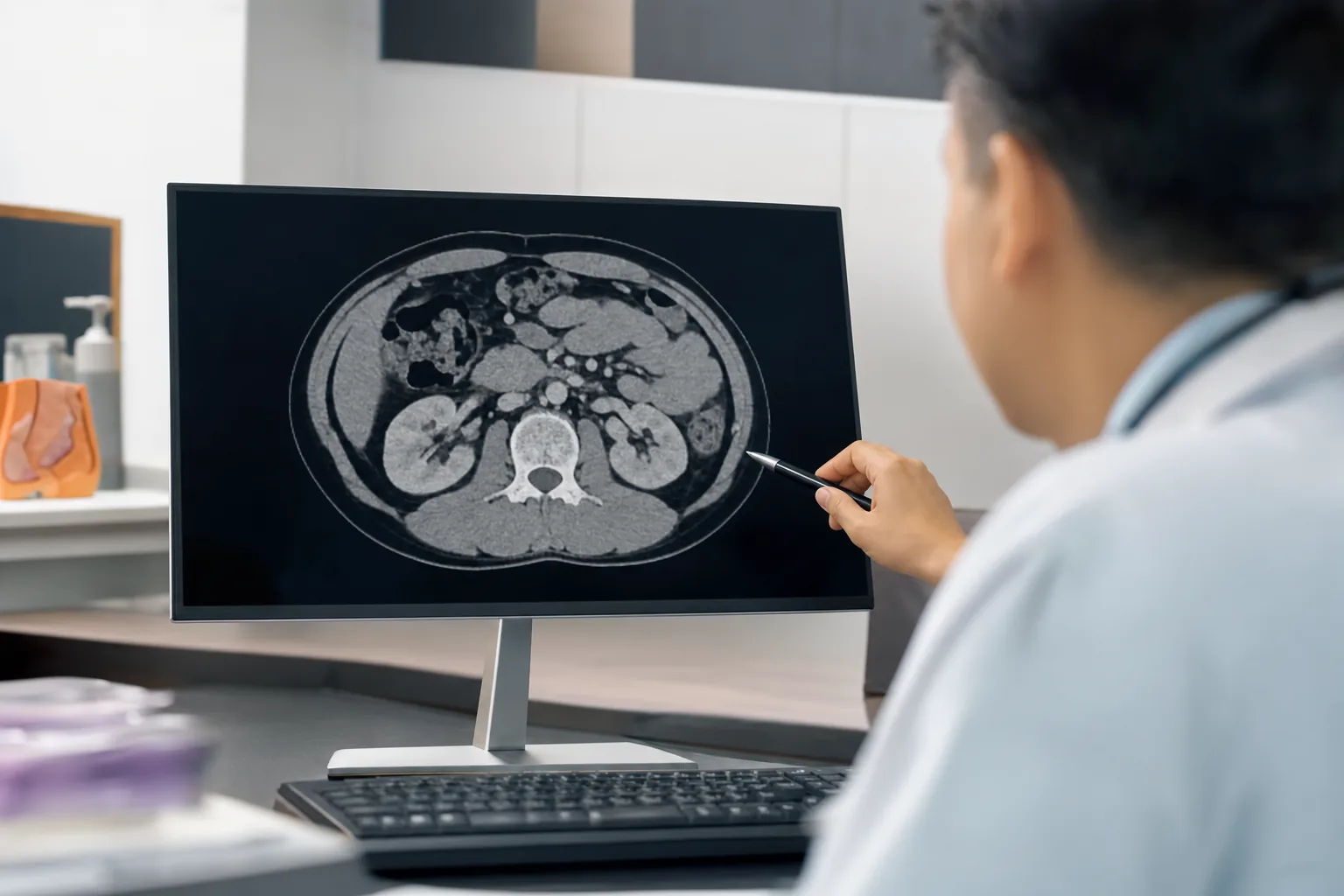
A pan-scan approach, with CT of the head, cervical spine, chest, abdomen, and pelvis, has been shown to save time and reduce diagnostic delays, though a patient must be hemodynamically stable to undergo CT. For a stable patient with suspected abdominal injury, CT is the ideal test for solid-organ injury.
For patients 16 and older with suspected thoracic or lumbar spine trauma, CT is the most appropriate first study under the American College of Radiology Appropriateness Criteria, and the spine images from a chest, abdomen, and pelvis CT are sufficient on their own. Coronal and sagittal reformations are needed because a Chance fracture runs horizontally, and MRI is superior to CT for injuries to ligaments, the spinal cord, and discs.
An anteroposterior chest x-ray detects only about 50% of sternal fractures, while a lateral view increases sensitivity and is usually diagnostic. A clean x-ray does not rule out a ligament tear or disc injury, because bone x-rays give little information about muscles, tendons, or joints.
Treatment From Observation to Surgery
Treatment of seat belt injuries depends entirely on the type and severity of the injury. Patients with vascular, visceral, or spinal injuries should be admitted, preferably to a trauma center, while rib, sternum, and soft tissue injuries are generally managed conservatively, often on an outpatient basis, with a focus on pain management.
In blunt abdominal trauma, signs of peritonitis, frank bleeding, or worsening clinical signs require an immediate laparotomy. Otherwise, nonsurgical treatment depends on the clinical features, hemodynamic stability, and CT results.
A purely bony Chance fracture with no neurological deficit can be treated in a cast or a thoracolumbosacral orthosis (TLSO), with the cast kept on for 8 to 12 weeks. Neurological deficits and ligament injury are indications for surgery, and the literature predominantly supports long-segment posterior fixation with pedicle screws.
Isolated rib fractures are usually treated with pain control, rest, and ice, along with an incentive spirometer to prevent pulmonary atelectasis, and surgical stabilization is an option for flail chest, nonunion, or chest wall deformity. Many broken collarbones can heal in a sling without surgery, though a surgeon may recommend an operation when the broken ends are very displaced.
Healing Ranges for Fractures and Bruises
Most bruises fade within two weeks without treatment, while more severe bruising and hematomas may last a month or longer. A bruise turns from pinkish red to bluish, then greenish-yellow, and finally returns to normal skin color.
Clavicle fractures typically reach clinical union between 6 and 12 weeks in adults, and patients typically may resume full daily activity about 6 weeks after injury. Healing can take several months, and may take longer in people with diabetes or who smoke.
In adults, Chance fractures with less than 15 degrees of kyphosis can be treated successfully with an extension cast or orthosis, and more than 90% of fractures stabilized surgically have good results after one year. In a significant number of people, low back pain may be a major complaint later on.
Complications of a Delayed Diagnosis
Missed abdominal injuries, delays in diagnosis and treatment, intra-abdominal sepsis, and delayed splenic rupture are all complications of blunt abdominal trauma.
For Chance fractures, residual low back pain, residual deformity leading to kyphosis, and pressure sores are possible complications, and a delay in diagnosis significantly impacts clinical outcomes.
Painful breathing after a sternal fracture may lead to atelectasis and pneumonia, and rib fractures may progress to acute respiratory failure from poor breathing effort. After plate surgery for a collarbone fracture, some patients find that seat belts irritate the area, and the hardware can be removed once the bone has healed.
Medical Records From the First Visit
Photos record what a chart describes in words. Bruises change color and fade as they heal, so dated photos from the first days show the width, angle, and position of a belt mark before it is gone.
Each later visit note records the symptoms, the exam, and the plan, so the chart shows whether chest, abdominal, or back pain eased, spread, or changed over time. A gap in medical care does not end a car accident case, but it puts more weight on the medical records and on a clear account of why care was delayed.
A short written timeline of when each symptom started, from the first sore spot to the first scan, is easier to keep in the weeks after a crash than to rebuild later. Copies of discharge papers and imaging reports from every facility belong in the same folder.
Still Hurting After the Belt Bruise Faded?
A belt bruise fades on its own, and an insurer may point to the faded mark as evidence that the crash was minor while the cracked sternum or the bowel injury underneath is still healing. Sam Aguiar Injury Lawyers lines up the photos, the CT reports, and each follow-up visit so the record shows what the belt did. Under our Bigger Share Guarantee®, you always walk away with more than the firm after bills, liens, and case costs. Start with a free case review.