

Kentucky Car Accident Liability
Pure comparative negligence, multi-party fault, and why every percentage point matters , KRS 411.182 explained by the firm with 40+ seven-figure results.
Kentucky is one of approximately 12 states that follow pure comparative negligence. Under KRS 411.182, every party involved in a car accident is assigned a percentage of fault , and your compensation is reduced by your share, but never eliminated. Even a driver who is 80% at fault can still recover 20% of their damages. That single rule shapes how every Kentucky car accident case is investigated, negotiated, and tried.
How Pure Comparative Negligence Works in Kentucky
The concept is straightforward: the jury (or judge, in a bench trial) reviews the evidence and assigns a fault percentage to every party. Your damages are then reduced by whatever percentage is attributed to you.
KRS 411.182 directs the trier of fact to consider “both the nature of the conduct of each party at fault and the extent of the causal relation between the conduct and the damages claimed.” That means the analysis goes beyond who ran the red light , it includes whether a party was speeding, distracted, failed to wear a seatbelt, or made other decisions that contributed to the severity of the crash.
This is different from modified comparative fault states, where you’re barred from recovery if your fault exceeds 50% or 51%. In Kentucky, there is no cutoff. The Kentucky Supreme Court adopted this approach in Hilen v. Hays (1984), and the legislature codified it with KRS 411.182 in 1988.
How Insurance Companies Use Comparative Fault Against You
Insurance adjusters understand this rule deeply , and they use it strategically. Every percentage point of fault they can shift onto you directly reduces what they have to pay. Common tactics include:
- Inflating your speed , even by 5 mph , to argue you contributed to the crash severity
- Claiming you failed to avoid the collision , even if you had fractions of a second to react
- Using seatbelt non-use , to argue you contributed to your own injuries (though Kentucky’s seatbelt law does not create a presumption of negligence in civil cases)
- Pointing to prior injuries , to argue the crash didn’t cause the damage you’re claiming
- Taking recorded statements early , before you have legal representation, to lock you into a version of events that benefits their fault allocation
Read more about common myths about injury claims that insurance companies exploit.
Multi-Party Liability in Kentucky Car Accidents
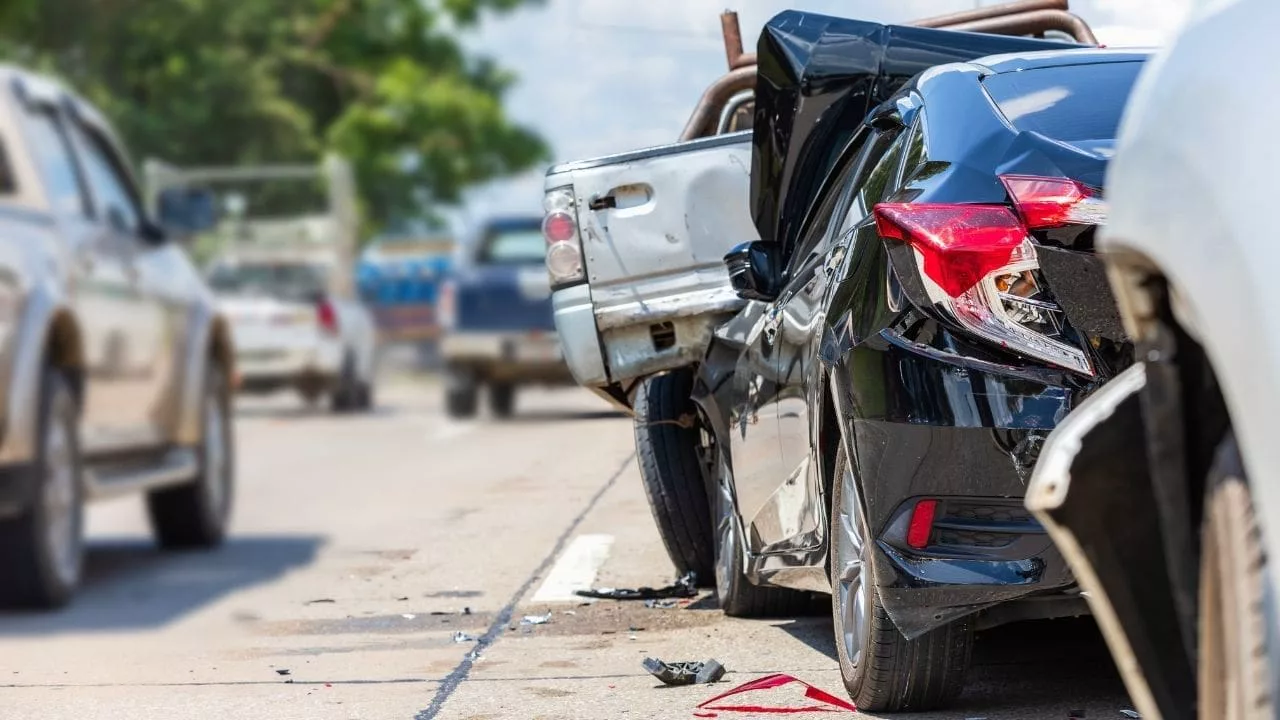
Many crashes involve more than two drivers. Interstate pileups, intersection T-bone collisions, and construction zone crashes often involve three, four, or more parties who may share liability. Under KRS 411.182, the jury assigns a fault percentage to every party , including parties not at the trial table.
When the Government May Be Liable
If a road defect, missing signage, or poorly designed intersection contributed to your crash, a government entity , the Kentucky Transportation Cabinet (KYTC), a county road department, or a city , may share liability. Government liability claims have shorter notice requirements and specific procedural rules that make early investigation critical.
When an Employer Is Liable
If the at-fault driver was working at the time of the crash , making a delivery, driving a company vehicle, or transporting goods , their employer may be vicariously liable under the doctrine of respondeat superior. Commercial trucking cases almost always involve employer liability, but the same principle applies to any employee driving on company business.
When a Vehicle Defect Contributed
Brake failures, tire blowouts, and electronic system malfunctions can shift some or all liability from the driver to the vehicle manufacturer or maintenance provider. These claims require rapid evidence preservation , the vehicle must be inspected before it’s repaired or scrapped.
Why Fault Percentages Make or Break Your Case
On a $300,000 case, the difference between 10% fault and 30% fault is $60,000 , money that stays in the insurer’s pocket instead of yours. At Sam Aguiar Injury Lawyers, we build every case around the evidence that keeps your fault percentage accurate: crash reports, traffic camera footage, accident reconstruction analysis, witness statements, and cell phone records. Insurance companies count on victims not having this level of documentation. We make sure you do.
Proving Liability: What Evidence Matters Most
- Police crash report , the investigating officer’s findings on fault, citations issued, and contributing factors
- Traffic and surveillance camera footage , critical on Louisville’s high-traffic corridors, but footage often overwrites within days
- Witness statements , independent witnesses who saw the crash from a different vantage point
- Cell phone records , to prove the other driver was texting or on a call at the time of impact
- Vehicle black box (EDR) data , speed, braking, and steering inputs in the seconds before impact
- Accident reconstruction , professional analysis of speed, impact angles, and vehicle dynamics
- Medical records , linking your injuries directly to the forces involved in this crash
Acting quickly matters. Evidence from Kentucky crash scenes degrades fast , camera footage overwrites, skid marks fade, and vehicles get repaired. Under Kentucky’s statute of limitations, you have two years to file , but the evidence window is measured in days, not years.
Every percentage point of fault matters. Our Bigger Share Guarantee® means you take home more of every dollar recovered. No increased litigation fees contingency that never increases. $0 Out-Of-Pocket Forever. Call us today.
Frequently Asked Questions
Can I recover compensation if I was mostly at fault for the accident?
Yes. Kentucky’s pure comparative negligence rule under KRS 411.182 allows recovery regardless of how much fault is assigned to you. If your damages total $100,000 and you are found 70% at fault, you recover $30,000. There is no threshold that eliminates your claim entirely.
How is fault determined in a Kentucky car accident?
Fault is determined by evaluating all available evidence , police reports, witness statements, camera footage, vehicle data, and accident reconstruction. In a trial, the jury assigns a percentage of fault to each party. In settlement negotiations, the same evidence shapes the insurer’s internal fault evaluation.
What if more than two drivers were involved in the crash?
Each party is assigned their own fault percentage. You can recover from any at-fault party, and each party is responsible for their proportionate share. Identifying all liable parties , including employers, government entities, and vehicle manufacturers , is critical because it expands the total available coverage and distributes fault more accurately.
Does not wearing a seatbelt affect my claim in Kentucky?
Kentucky’s seatbelt law (KRS 189.125) is a primary enforcement law, but seatbelt non-use does not create a legal presumption of negligence in civil cases. However, an insurer may still argue that failing to wear a seatbelt contributed to the severity of your injuries. Strong medical evidence linking your injuries to crash forces , not seatbelt non-use , is the best defense.
Start Your Free Case Review
Fill out the form below and our team will reach out to discuss your options.