

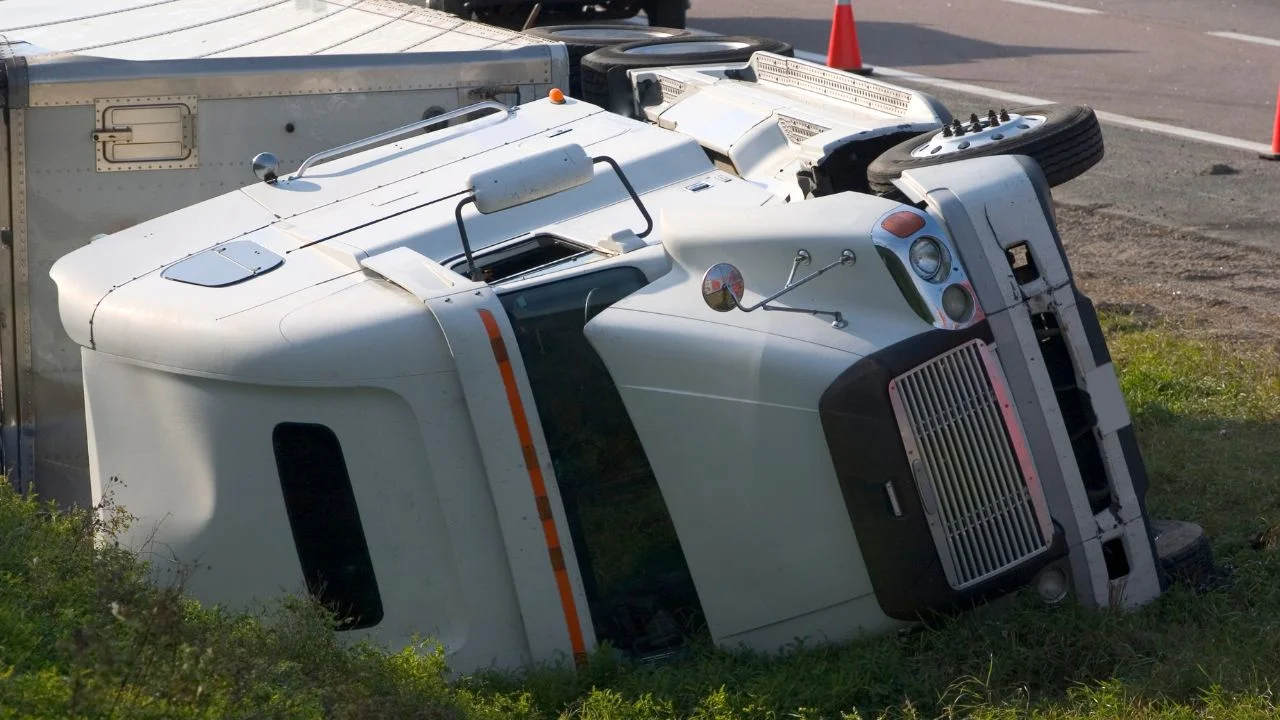
Rollover Truck Accident Lawyers
Truck rollovers kill more passenger-vehicle occupants than almost any other crash type. They are also among the most preventable , driven by speed, poor loading, and driver error. Our dedicated trucking team builds the case that proves it.
Truck rollovers account for only about 4% of fatal large-truck crashes, yet they kill a disproportionate number of people in nearby vehicles. According to NHTSA research, rollovers represent just 7% of all truck crashes but account for 29% of all passenger-vehicle occupant fatalities in those crashes. The FMCSA’s Large Truck Crash Causation Study found that approximately 80% of truck rollovers involve driver error as a contributing factor , and speed plays a role in roughly 45% of cases. These are not freak accidents. They are the predictable result of specific, documented failures. Our dedicated trucking team investigates every one of them.
Why Truck Rollovers Are So Destructive
An 80,000-pound tractor-trailer tipping onto its side generates a catastrophic sweep radius. Vehicles directly alongside the truck are crushed under the trailer. Vehicles behind it face a sudden wall of steel across multiple lanes. Oncoming traffic on divided highways has almost no warning when a rollover crosses the median. And unlike a rear-end collision where crumple zones absorb some impact, a rollover’s secondary contact is often with the occupant compartment of a passenger vehicle directly.
The injuries in rollover crash cases , traumatic brain injuries, spinal cord damage, crush injuries, internal organ trauma , are frequently permanent and life-altering. The damages in these cases reflect that reality.
(NHTSA)
(FMCSA LTCCS)
(FMCSA data)
(NHTSA)
What Causes Truck Rollovers?
Most rollovers follow a pattern. By the time our team is done investigating, there is almost always a clear chain of cause and effect , and a party that violated a federal rule or standard of care at every link.
Excessive Speed on Curves and Ramps
A loaded semi-trailer has a high center of gravity. The same curve that a passenger car takes easily at posted speed can tip a loaded truck if entered just 10–15 mph over the design speed. Kentucky’s KYTC-designated ramps on I-65, I-64, I-71, and I-75 are engineered with posted advisory speeds that commercial drivers are required to follow. When carriers push drivers through dispatch pressure to maintain impossible delivery windows, speed violations on curves are inevitable.
Improper Cargo Loading
Load distribution directly controls a truck’s rollover threshold. High-stacked loads with a displaced center of gravity can roll at speeds that would be safe for a properly loaded truck. Liquid cargo that shifts in tanker compartments creates dynamic instability on curves. Our team reviews cargo loading records and weight distribution documentation as part of every rollover investigation.
Oversteering and Overcorrection
Many rollovers begin with a lane departure , a fatigued or distracted driver drifts onto the shoulder, then overcorrects. The sudden steering input at highway speed can trip the trailer and initiate a rollover. This is a well-documented pattern that electronic stability control (ESC) systems are specifically designed to prevent , which is why our team also examines whether the truck’s safety systems were functional and properly maintained.
Driver Fatigue
Fatigue degrades the fine motor control and reaction time needed to handle a fully loaded commercial truck. A fatigued driver is slower to recognize an approaching curve, more likely to drift, and less capable of managing the vehicle through emergency maneuvers. Hours of service records, ELD data, and dispatch logs all become key evidence in fatigue-related rollover cases.
FMCSA Electronic Stability Control Rule
Since 2017, federal regulations have required Electronic Stability Control (ESC) on new heavy trucks. ESC automatically applies individual brakes and reduces engine torque to prevent rollover. When an older truck without ESC remains in service, or when a carrier fails to maintain an ESC-equipped truck’s system, that failure is directly relevant to liability in a rollover crash.
Who Bears Liability in a Kentucky Truck Rollover?
-
The truck driver
Speed, fatigue, distraction, and poor steering decisions are direct driver failures. Driver logs, ELD data, cellphone records, and dashcam footage all go into our investigation of driver conduct.
-
The trucking carrier
Carriers that pressure drivers to maintain unrealistic delivery schedules , and those that fail to maintain safety systems like ESC , bear independent liability beyond the driver’s acts. We review dispatch records, driver scorecards, and safety audit histories.
-
The cargo loader or shipper
If improper load distribution contributed to the rollover, the party responsible for loading bears a share. Loading manifests, weight tickets, and cargo inspection records are critical evidence.
-
The truck manufacturer or equipment supplier
If a brake failure, suspension defect, or ESC malfunction contributed to the rollover, the equipment manufacturer may be named as an additional defendant under product liability theory.
Evidence disappears fast. Federal rules require carriers to preserve post-crash data, but they don’t enforce themselves. Our team sends immediate legal preservation letters to ensure ECM/black box data, dashcam footage, and maintenance records are locked down before they’re overwritten or destroyed.
Evidence Our Team Pursues in Rollover Cases
- Black box (ECM) data , speed, braking, steering angle, engine load in the seconds before the crash
- Electronic logging device (ELD) records , actual driving hours vs. hours of service limits
- Dashcam and roadside surveillance footage , documents the sequence of events
- Cargo manifests and weight distribution records , establish load stability at the time of the crash
- Accident reconstruction analysis , expert calculation of speed, rollover dynamics, and crash sequence
- Electronic stability control system maintenance logs , was the ESC functional?
- Dispatch records and driver communication logs , reveal schedule pressure and dispatcher awareness
- The carrier’s CSA safety rating and prior violations , pattern of prior safety failures
Frequently Asked Questions
What is the most common cause of commercial truck rollovers?
The FMCSA’s Large Truck Crash Causation Study found that approximately 80% of truck rollovers involve driver error, with excessive speed being a factor in roughly 45% of cases. The combination of excessive entry speed on curves or ramps with a high-center-of-gravity loaded truck is the most common pattern. Improper cargo loading and driver fatigue are the next most significant contributors.
Can I make a claim if I was hit by a rolling or sliding truck trailer?
Yes. Any vehicle that was struck, pushed, or run over by a rolling, tipping, or sliding commercial truck and its trailer may have a claim against the driver, the carrier, or both. The investigation focuses on what caused the rollover , whether speed, load, equipment failure, or driver error , and which parties bear responsibility for each contributing cause.
How long do I have to file a truck accident claim in Kentucky?
Kentucky’s statute of limitations for personal injury claims is generally two years from the date of the crash. However, acting quickly matters , critical evidence like ECM data can be overwritten within days, and dashcam footage is often stored only for a short period. Reaching out to our team as soon as possible after a crash protects your ability to recover.
What makes a rollover case different from a regular truck accident case?
Rollover cases typically involve more severe injuries, more complex liability analysis (multiple contributing causes), and often require accident reconstruction experts to establish the exact sequence of events. They also frequently involve load stability analysis, ESC system examination, and an investigation into the carrier’s dispatch practices and delivery schedule pressure. Our dedicated trucking team handles this full investigative scope from day one.
Tell Us About Your Case
Our trucking team will reach out quickly to discuss your options.