

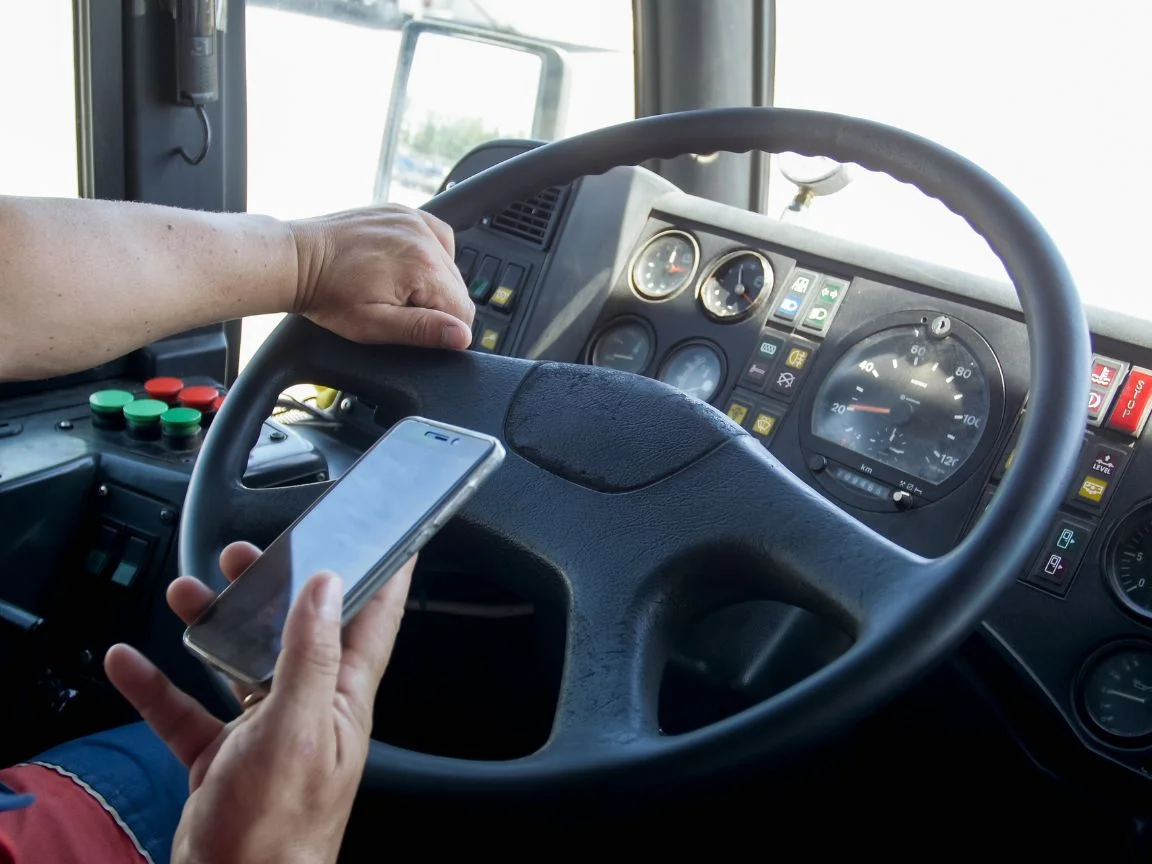
Federal Cell Phone Rules for Commercial Truck Drivers
Federal law bans handheld cell phone use by commercial truck drivers while driving — with fines up to $2,750 per violation. When a trucker was on their phone at the time of a crash, phone records become some of the most powerful evidence in the case.
Under 49 CFR 392.82, commercial motor vehicle drivers are prohibited from using a handheld mobile telephone while operating a CMV. This is a federal rule — not a state traffic law — and it applies to every commercial driver in the country, regardless of which state they are driving in. The rule’s practical standard is straightforward: no reaching for a phone, no holding a phone, no dialing, no texting, no reading messages while driving. A single violation exposes the driver to a fine of up to $2,750 and the carrier to fines of up to $11,000. Repeat violations can trigger CDL disqualification.
Exactly What the Federal Rule Prohibits
The FMCSA’s handheld phone rule is broader than most state distracted driving laws. It covers any use that requires the driver to hold the device — which includes:
- Dialing by pressing more than a single button
- Holding the phone to the ear during a call
- Reading, composing, or sending a text message or email
- Browsing the internet or using any app while the vehicle is in motion
- Reaching for a phone that is not within immediate reach while seated with a seatbelt fastened
(FMCSA)
(FMCSA)
(FMCSA crash data)
(FMCSA research)
What Is Allowed: Hands-Free Operation
Commercial drivers are permitted to use a mobile phone hands-free — but the federal rule is strict about what “hands-free” actually means. The device must be operable with a single button press while the driver remains in the normal seating position with the seatbelt fastened. Most fleets require one-ear headsets or Bluetooth earpieces so the driver maintains awareness of external traffic sounds with the other ear. Speakerphone placed on the seat does not qualify as hands-free under the federal rule if the driver must reach for it.
The One-Button Rule
The FMCSA summarizes compliant hands-free use with a simple test: the driver must be able to initiate, answer, or end a call with a single button — without reaching, without holding the device, without looking away from the road. Any setup that requires more than one button press to make a call does not comply.
Compliant setups typically include: Bluetooth headsets with a single accept/end button, earpiece headsets with inline call controls, or integrated cab communication systems built into the truck’s dashboard.
CDL Disqualification for Repeat Violations
The consequences of cell phone violations go beyond individual fines. Under 49 CFR 383.51, two or more serious traffic violations within a three-year period — including handheld phone violations — can result in CDL disqualification for 60 or 120 days. A driver with two handheld phone violations on their record within three years loses their CDL for at least 60 days. These violations are also entered into the FMCSA’s Safety Measurement System (SMS), affecting the carrier’s safety rating and insurance costs. For our clients, a driver’s prior violation history is directly relevant to their case — and our team pulls that record as part of the investigation.
How Phone Records Win Truck Crash Cases
When a driver violates 49 CFR 392.82, they create a documented federal violation — and phone records can prove it happened at the exact moment of the crash. Here is how our team uses that evidence:
Subpoenaing the Phone Records
Wireless carrier records show every call, text, data transmission, and app activity timestamped to the second. When we overlay that record against the crash time documented in the police report and black box (ECM) data, we can establish precisely whether the driver was using their phone at the moment of impact. This is direct, objective evidence of a federal violation — no interpretation required.
Carrier Liability for Phone Policies
Under 49 CFR 392.82(b), carriers are prohibited from requiring or allowing drivers to use handheld devices while driving. This means if a carrier’s dispatchers routinely called or texted drivers while they were on the road — or if the carrier’s workflow required drivers to respond to dispatch messages while moving — the carrier bears direct liability for the crash, not just the driver. We subpoena dispatch logs, communication software records, and carrier phone policies as part of every distraction investigation. See our page on trucking evidence for the full scope of what our team collects.
The Punitive Damages Connection
Distracted driving by a commercial driver is not just negligence — it is a federal regulatory violation. When a carrier’s own records show that phone-while-driving was a known pattern the company ignored, or that dispatch was routinely contacting drivers during active trips, that conduct can support a claim for Kentucky punitive damages — additional compensation designed to punish willful disregard for safety. Driver cell phone violations are among the clearest paths to a punitive damages argument in truck accident cases.
Don’t wait on phone records. Wireless carriers retain detailed records, but those records can be overwritten or become difficult to obtain over time. The moment you contact our team, we take immediate steps to preserve all digital evidence — phone records, ECM data, dash cam footage, and dispatch logs. Delay costs evidence. Evidence is the case.
Cell Phone Violations in the Broader Picture of Driver Distraction
The FMCSA’s Large Truck Crash Causation Study found that driver recognition errors — including inattention, distraction, and looking outside the vehicle — were the most common driver-related factor in large truck crashes. Cell phone use is one component of a broader distraction problem. Our team investigates all forms of distraction, but phone use is uniquely valuable because it produces a timestamped, objective record that directly ties the driver’s behavior to the moment of the crash. That record — combined with the clear federal prohibition — makes phone-distracted truck crashes among the most straightforward cases to establish liability.
For the full picture of driver behavior, carrier policy failures, and mechanical factors that lead to truck crashes, see our page on the top causes of big truck accidents in Kentucky. For information on how hours of service violations combine with distraction to create compounding risk, see our hours of service overview. And if you need to understand the full scope of evidence available in a truck crash case, visit our trucking evidence page.
Frequently Asked Questions
What is the federal cell phone rule for truck drivers?
Under 49 CFR 392.82, commercial motor vehicle drivers are prohibited from using a handheld mobile telephone while operating a CMV. This means no holding the phone, no dialing more than a single button, no texting, no reading messages, and no reaching for a phone that is not within immediate reach while seated with a seatbelt fastened. Hands-free use with a single-button operation is permitted. The rule applies nationwide to all commercial drivers regardless of the state they are in.
How do you prove a truck driver was on the phone at the time of a crash?
We subpoena wireless carrier records, which document every call, text, data session, and app activity with precise timestamps. We overlay that data against the crash time documented in the police report and black box (ECM) data from the truck. If the driver was making a call, texting, or using an app at the moment of impact, those records will show it. This evidence is objective, timestamped, and directly ties the driver’s phone activity to the crash — making it one of the strongest forms of negligence evidence available in truck accident cases.
Can the trucking company be held responsible for a driver’s cell phone use?
Yes. Under 49 CFR 392.82(b), carriers are prohibited from requiring or allowing drivers to use handheld devices while driving. If a carrier’s dispatch routinely contacted drivers by phone or text while they were on the road, or if the company’s workflow required drivers to respond to messages while moving, the carrier bears direct liability for the resulting crash — not just the driver. Dispatch records, communication software logs, and company phone policies are all subject to discovery and can establish carrier knowledge of and participation in the violation.
What fines does a truck driver face for using a handheld phone while driving?
The driver faces civil penalties of up to $2,750 per violation. The carrier faces fines of up to $11,000 per violation for requiring or allowing the prohibited use. Beyond fines, two or more serious traffic violations — including handheld phone violations — within a three-year period can result in CDL disqualification of 60 to 120 days. Violations also appear in the FMCSA’s Safety Measurement System, which affects the carrier’s safety rating, insurance premiums, and audit risk. In your civil case, these violations are also direct evidence of federal regulatory non-compliance.
Does using a GPS or navigation app count as a violation?
Using a GPS application can be a violation if it requires the driver to hold the device or interact with the screen while driving. Navigation apps that are mounted and operate without requiring hand-held use or multi-button interaction are generally compliant. However, a driver who is looking at a phone to read GPS directions rather than watching the road has committed a distraction violation regardless of whether the phone is technically in a holder — and crash causation is proven by whether the driver was paying attention to the road, not by the technical mechanics of how the device was positioned.
Tell Us What Happened
Our team will review your truck accident and reach out to discuss your options — no upfront cost, no obligation.