

Medical Helicopter Accident Cases
Federal air ambulance rules decide which records exist after a medical helicopter accident, and Kentucky law gives a patient and a working crew member different cases against different companies.
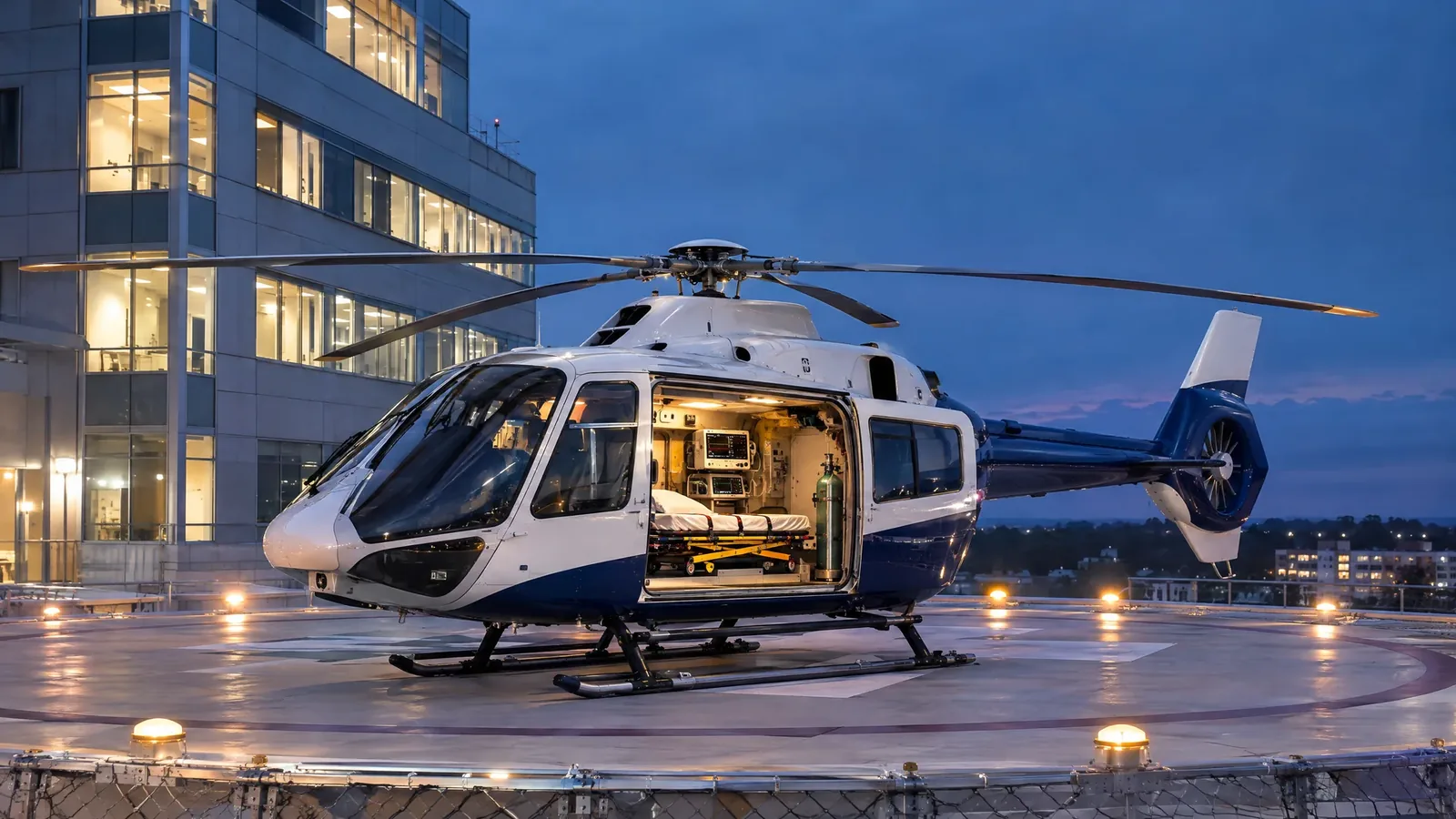
Helicopter Air Ambulance Operations
A medical helicopter crash involves a flight that federal regulations call a helicopter air ambulance operation: a flight with a patient or medical personnel on board, for medical transportation, by a company that holds a Part 135 certificate. Since 2014, every such flight has been subject to the commercial rules in Part 135, including the air ambulance requirements in its Subpart L, and the definition includes the flight to pick up a patient and the flight back to base afterward.
Those regulations require a signed preflight risk analysis, a terrain awareness and warning system, and flight data monitoring, and the records they produce are where an accident case starts. Who employed each person on board, and which company controlled the flight, then decide who can be sued in Kentucky.
Air Ambulance Accident History
The National Transportation Safety Board studied 55 emergency medical aircraft accidents from January 2002 through January 2005, which killed 54 people and seriously injured 18. Forty-one of the 55 were helicopter accidents. In 35 of the 55, medical crew members were aboard and no patient was. Those flights operated under the general aviation rules in Part 91, which are less demanding than the commercial rules in Part 135.
In 2006 the NTSB asked the Federal Aviation Administration to require Part 135 operating rules on every flight with medical personnel aboard, along with formal flight risk evaluation, dispatch and flight-following procedures that use current weather, and terrain awareness and warning systems on air ambulance aircraft.
Calendar year 2008 was the deadliest year on record for helicopter emergency medical services, with 8 fatal accidents and 29 deaths. The NTSB placed air ambulance safety on its Most Wanted List on October 28, 2008, and held a four-day public hearing in February 2009. It then recommended scenario-based training for pilots facing unplanned flight into clouds or fog, safety management systems, flight data recording, night vision imaging systems, and autopilots for helicopters flown without a second pilot.
Federal Safety Requirements for Medical Flights
The FAA published its helicopter air ambulance rule on February 21, 2014, and it took effect April 22, 2014. The rule addressed 62 air ambulance accidents from 1991 through 2010 that killed 125 people. Four conditions recurred in those accidents: unplanned flight into clouds or fog, loss of control, flying a helicopter that was under control into the ground, water, or an obstacle, and night conditions.
| Requirement | What the Regulation Requires | Record Kept |
|---|---|---|
| Pilot Instrument Rating | The pilot in command holds a helicopter instrument rating, required since April 24, 2017 | Pilot certificate and rating |
| Terrain Warning System | A helicopter terrain awareness and warning system, required since April 24, 2017, with flight manual procedures for responding to its warnings | Equipment approval and flight manual procedures |
| Flight Data Monitoring | A system that records flight performance data starting at power-up before takeoff, required since April 23, 2018 | Recorded flight data |
| Route Planning | A minimum safe cruise altitude that clears terrain and obstacles by 300 feet by day and 500 feet at night | Highest obstacle on the route, documented before departure |
| Preflight Risk Analysis | Review of terrain and obstacles, the landing zone, fuel, crew fatigue, weather, and whether another company refused the flight | Worksheet signed by the pilot with the date and time, kept at least 90 days |
| Operations Control Center | For companies with 10 or more air ambulance helicopters, specialists who check the risk analysis and follow the flight | Specialist’s written acknowledgment with the date and time |
| Medical Crew Briefing | A safety briefing before each flight, or 8 hours of approved training within the preceding 24 calendar months | Training record kept 24 calendar months |
Applies to every Part 135 helicopter air ambulance operator, including those flying in Kentucky. Source: 14 CFR Part 135, Subpart L.
On January 29, 2019, an air ambulance flying to pick up a patient struck forested terrain near Zaleski, Ohio, and the pilot, a flight nurse, and a flight paramedic died. Two other air ambulance companies had turned down the same request because of the weather. Neither the pilot who accepted the flight nor the pilot who flew it completed the preflight risk analysis that 14 CFR 135.617 requires, and the operator’s procedure at the time did not ask whether another company had refused the flight. The NTSB determined that the probable cause was the operator’s inadequate management of safety, which had normalized noncompliance with risk analysis procedures. Inadequate FAA oversight of the operator’s risk program contributed, along with the FAA’s failure to require safety management systems for Part 135 operators.
Offering a declined flight to another company is called helicopter shopping, and Subpart L requires every risk analysis to include a procedure for finding out whether another air ambulance operator refused or rejected the flight. Part 135 operators certificated before May 28, 2024, must also have a safety management system in place by May 28, 2027.
Kentucky Air Ambulance Licensing
Under 202 KAR 7:510, no company may provide air ambulance service that originates in Kentucky without a license from the Kentucky Board of Emergency Medical Services. Every licensed provider must offer service 24 hours a day, 7 days a week, subject to the safety and weather limits in Part 135.
The regulation also sets the crew. A rotor-wing advanced life support helicopter flies with a pilot and two medical attendants: a paramedic and a registered nurse, two registered nurses, or a physician and a registered nurse. One attendant stays in the patient compartment with the patient for the entire transport. A flight with a patient aboard therefore carries at least four people, and they hold three different legal positions after an accident: patient, medical crew, and pilot.
NTSB Investigations of Kentucky Air Ambulance Accidents
The Kentucky air ambulance accidents the NTSB investigated involve the same conditions as the national accidents: fog and darkness, and wires and obstacles near landing zones. Three of the five investigations below were positioning or repositioning flights with no patient aboard that operated under Part 91, the gap the NTSB described in 2006, and two of those three killed everyone on the helicopter. Under Subpart L, those legs are part of the air ambulance operation.
| Accident | Flight | Injuries | Probable Cause |
|---|---|---|---|
| June 14, 1999, Jackson | Part 91 positioning flight at night in fog, with two pilots and two medical crew members | 4 killed | Pilot in command did not adequately supervise the copilot or maintain a positive climb; fog and dark night |
| December 20, 2003, Morehead | Part 91 positioning flight dispatched to a medical evacuation | 3 uninjured | Ground personnel did not identify a 3-foot hydrant inside the lit landing zone; blowing snow and night |
| June 6, 2013, Manchester | Part 91 repositioning flight back to base after a patient transfer | 3 killed | Spatial disorientation, a false sense of the helicopter’s position and motion, after an unplanned entry into night fog |
| February 7, 2017, Beattyville | Part 135 air medical flight to an accident scene | 3 uninjured | Pilot did not maintain control while landing; hard landing and rollover |
| October 7, 2024, Owenton | Part 135 air medical flight approaching a landing zone beside a high school | 3 killed | Not yet determined; witnesses saw the helicopter strike a guy wire supporting a television tower |
Selected federal investigations of air ambulance flights in Kentucky; injuries cover everyone aboard. Source: National Transportation Safety Board.
The Manchester report also records the pilot’s preflight risk score: 30 points, below the 35 points at which the operator required a longer assessment and a call to its operations control center.
The Owenton helicopter carried a terrain awareness and warning system with visual and audible obstacle advisories. The guy wire supported a 601-foot tower on the high school campus, next to the landing zone. The NTSB has issued only a preliminary report on Owenton, and no probable cause has been determined.
Preserving Evidence After a Helicopter Accident
During an NTSB investigation, only people the investigator in charge authorizes may reach the wreckage and records, and families are not part of the investigation. Party status is limited to organizations whose employees, functions, activities, or products were involved and that can supply qualified technical staff, and no party representative may also represent claimants or insurance companies. The Owenton investigation listed the FAA, the helicopter manufacturer, the engine manufacturer, and the operator as participants.
Federal law keeps the Board’s own report out of a civil case for damages, while the factual reports its investigators write face no statutory bar, and NTSB employees may testify only to facts. The probable causes in the Kentucky table above are those barred determinations, so a family’s case rests on its own analysis of the wreckage, the data, and the records, by experts hired outside the NTSB.
The records Subpart L requires are the first place to look, along with maintenance records that must show the helicopter’s total time in service, the status of life-limited parts, its inspection status, and its compliance with airworthiness directives, the FAA’s legally enforceable safety rules for aircraft and engines. The worksheet for the accident flight falls under the NTSB’s record-keeping rule, but the 90-day minimum still governs worksheets from earlier flights, and those earlier worksheets are where a pattern of skipped or understated risk analyses would appear. For pilots assigned under the hospital emergency medical evacuation rule in 14 CFR 135.271, duty and rest records show whether the pilot had at least 10 consecutive hours of rest before reporting and stayed within 8 hours of flight time in any 24 hours of the assignment, unless an evacuation ran long.
The Manchester investigation used Kentucky State Police witness statements, the operator’s radio recordings, and tracking data recorded every 5 seconds. The Owenton investigation used Kentucky State Police communication records and ADS-B data, the position signal the helicopter broadcast.
When the NTSB has no further need for the wreckage, it releases it to a recipient who signs for it, and the operator’s federal duty to preserve the wreckage ends with that release. An independent inspection depends on the wreckage still existing afterward, so a written preservation request to the owner and operator belongs before the release.
Responsibility for a Medical Helicopter Accident
The companies that can be responsible include the operator, an outside maintenance company, the maker of the helicopter or one of its parts, and, in some arrangements, a hospital. The company holding the Part 135 certificate is responsible for operational control, which federal regulations define as authority over starting, conducting, or ending a flight. It is also primarily responsible for airworthiness, meaning the condition of the helicopter, its engine, its rotors, and its parts.
An operator may hire another company for maintenance, but it must make sure that work follows its manual and federal regulations, so an outside maintenance company and the operator that relied on it can both answer for a maintenance failure. A defect in the helicopter, its engine, or a component can make the manufacturer or a parts supplier responsible.
Hospitals run air ambulance programs of their own: in 2009 the industry had an estimated 750 helicopters, 70 commercial operators, and 60 hospital-based programs. A hospital can also own a helicopter and lease it to the operator. Operational control of the flight, however, is never delegated to a customer hospital, and the program’s aeromedical director is responsible for patient care without authority over flight decisions. A lease that leaves the hospital appearing to keep control has historically led to undue pressure on risk analysis and flight release decisions, so the hospital’s own role in the decision to fly can become part of the case.
The landing zone also comes into the analysis: who set it up and checked it, and what the crew knew about wires and towers nearby. Both questions apply to the Morehead and Owenton accidents.
Kentucky Injury Cases for People on Board
Whether a person was working on the flight decides which Kentucky law applies first.
Patient Injury Cases
A patient is aboard for medical care and has no employer on the flight, so the patient’s injury case runs directly against the companies responsible for the accident. In an emergency, a patient may be unable to decide whether to fly, and cannot choose between companies when the responding helicopter is the first one called or the only one in the area. The flight chart and the bill identify the company that flew the patient. The case covers the harm the accident caused, which has to be separated from the illness or injury that put the patient on the helicopter. Another passenger aboard who was not working stands in the same position as the patient.
Medical Crew Injury Cases
Flight nurses, paramedics, and physicians are at work during the flight. Workers’ compensation covers their medical treatment and part of their lost wages, and under KRS 342.690(1), an employer that carries that coverage is protected from an injury lawsuit by the worker or the worker’s family. Under KRS 342.700(1), a separate injury case can proceed against someone other than the employer whose legal liability caused the injury. The worker may pursue both but may not collect from both: an employer or insurance company that paid benefits recovers them from the other party, up to what it paid, less a share of the worker’s legal fees and expenses.
The crew’s employer decides which companies count as that other party. Kentucky also treats a business that hires another company for work that is a regular or recurrent part of its own business as a contractor, and a contractor shares the employer’s protection from suit. When a hospital and a flight company share a crew, which company hired which, and for what work, can decide whether a nurse or paramedic can bring an injury case against the other company.
Pilot Injury Cases
A pilot employed by the company that holds the Part 135 certificate receives workers’ compensation through that company, which is protected from the pilot’s injury lawsuit when it carries that coverage. The pilot’s injury case runs against others whose conduct caused the accident, such as the manufacturer of a failed helicopter, engine, or part, an outside maintenance company, or a business responsible for a hazard at the landing zone. The same contractor rule applies to the pilot.
Wrongful Death Cases From Air Ambulance Accidents
Kentucky’s wrongful death statute, KRS 411.130, allows damages from the person who caused a death or whose agent or servant caused it, and only the personal representative of the person who died can bring the case. The recovery goes to the family in the order the statute sets: a surviving spouse, children, or parents, before more distant relatives or the estate. Under KRS 411.133, the personal representative recovers in the same action for the injuries the person suffered before death.
When the person killed was a flight nurse, paramedic, or pilot at work, workers’ compensation pays death benefits to the surviving spouse and dependents under KRS 342.750, and the employer’s protection from suit extends to the worker’s family. A wrongful death case can still proceed against a company that was not the worker’s employer, such as a manufacturer or an outside maintenance company. For a patient or another passenger, the wrongful death case runs directly against the companies responsible, as the injury case would have.
Medical Helicopter Accident Case Review
Sam Aguiar Injury Lawyers handles aviation accident cases, including air ambulance helicopter accidents, for injured patients and crew members and for families who lost someone. You pay $0 out-of-pocket forever. Start your free case review today.
Latest Articles

Private Plane Accident Cases
How Part 91 duties, NTSB rules, and aircraft insurance limits shape a private plane accident case.
Flight Data Recorders and Cockpit Voice Recorders in Aviation Accidents
What flight data and cockpit voice recorders capture and who controls the recordings.

Ground Victims of Cargo Plane Accidents
How Kentucky law handles injury, death, and property cases on the ground after a cargo plane accident.