

Truck Driver Cell Phone Laws
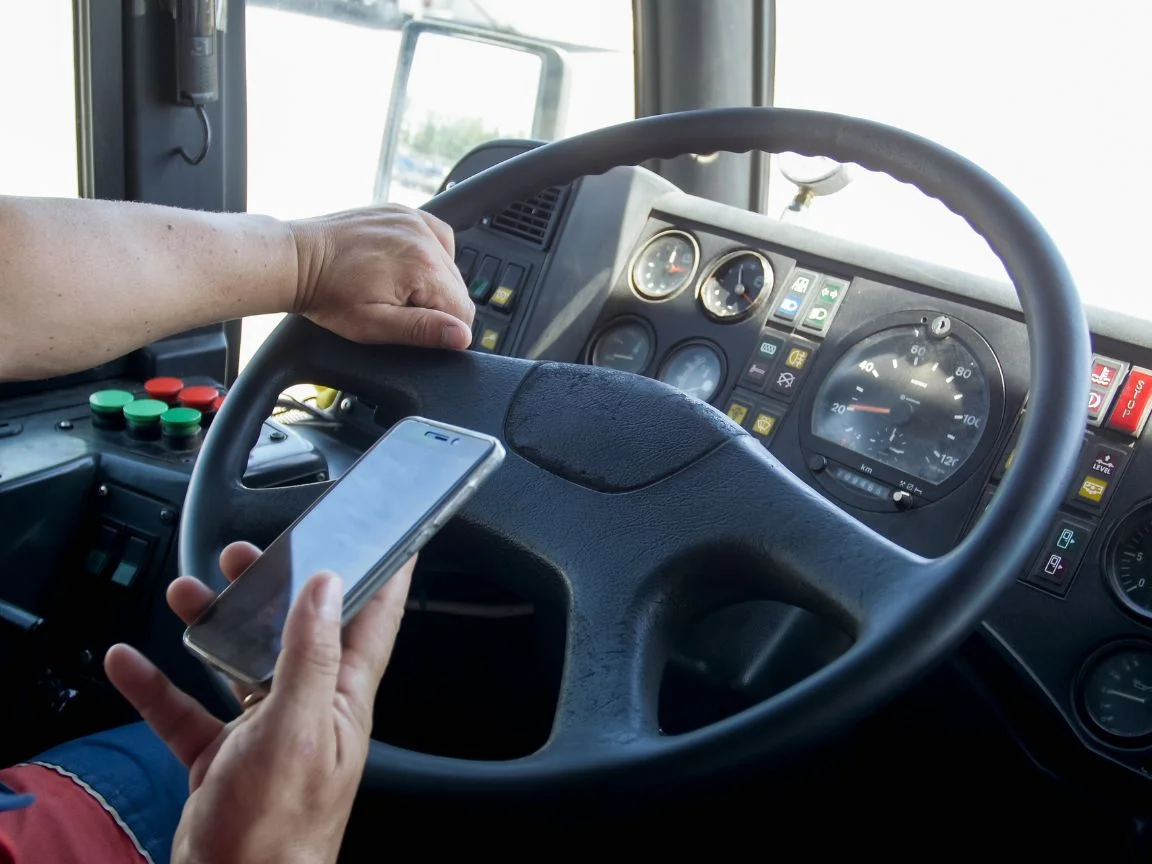
Federal law bans commercial truck drivers from using a hand-held phone while driving, and it bans the trucking company from allowing or requiring it. The rule applies nationwide, covers texting and dialing as well as calls, and leaves a record that can be matched to the moment of a crash.
Hand-Held Phone Ban
The hand-held phone ban sits in 49 CFR 392.82, adopted in 2011 as part of the Federal Motor Carrier Safety Regulations. Its first sentence is short: “No driver shall use a hand-held mobile telephone while driving a CMV.” The next sentence reaches the employer: no motor carrier shall allow or require its drivers to do so. Because the rule is federal, it travels with the truck. A driver hauling freight on I-65 through Louisville is bound by the same prohibition in Kentucky as in Tennessee or Indiana, regardless of what any state’s own traffic code says about phones.
The rule also reaches more vehicles than most people picture when they hear the word truck. A commercial motor vehicle under 49 CFR 390.5 is any vehicle used on a highway in interstate commerce that weighs or is rated at 10,001 pounds or more, is designed or used to carry more than 8 passengers for compensation, carries more than 15 passengers without compensation, or hauls placarded hazardous materials. That definition sweeps in tractor-trailers, tankers, dump trucks, buses, and a large share of the box trucks and delivery vehicles on the I-64, I-65, I-71, and I-75 corridors through Kentucky. The classification follows the vehicle, so a driver who never held a CDL can still be bound by the federal phone rules.
Hand-held use is defined in the same section of 49 CFR 390.5, and the definition is wider than most drivers assume. Any one of these is a violation:
- Holding the phone with at least one hand to make or take a voice call
- Dialing or answering by pressing more than a single button
- Reaching for the phone in a way that pulls the driver out of a seated, belted driving position
The third prong carries weight in litigation. A phone mounted across the cab, a phone in a jacket on the passenger seat, a phone that slid into the footwell: if the driver had to lean out of the belted driving position to grab it, the violation was complete before a single word was spoken or a single message was read.
The rule’s definition of driving is just as strict. Under 49 CFR 392.82(b), driving includes operating a CMV on a highway “while temporarily stationary because of traffic, a traffic control device, or other momentary delays.” A trucker answering a call in stopped traffic is violating federal law. The section recognizes two narrow exceptions: the vehicle has been moved to the side of, or off, the highway and halted where it can safely remain, or the driver is contacting law enforcement or other emergency services.
Texting Ban for Commercial Drivers
Texting has its own prohibition. Under 49 CFR 392.80, no driver shall engage in texting while driving, and no motor carrier shall allow or require it. The federal definition of texting in 49 CFR 390.5 covers far more than text messages. Manually entering or reading text on any electronic device qualifies, including email, instant messages, a command to pull up a web page, and pressing more than a single button to start or end a phone call. That last item is why the one-button standard shows up in both rules: a multi-step dial sequence is texting under one section and hand-held use under the other, and a driver doing it commits both violations at once.
The research behind the rule explains why it was written so broadly.
23.2x
Higher odds of a safety-critical event for CMV drivers who text while driving
4.6 sec
Average time texting drivers took their eyes off the road
6x
Higher odds of a safety-critical event while dialing a phone
At 55 mph, 4.6 seconds works out to roughly the length of a football field traveled without looking at the roadway. A loaded tractor-trailer covering that distance with nobody watching the road is the scenario these rules exist to prevent. When it happens anyway and someone is injured, the violation becomes the centerpiece of a civil case.
Hands-Free Phone Use
Hands-free phone use is legal for commercial drivers, and FMCSA describes exactly how it has to work: the phone sits close enough to be operable while the driver stays restrained by properly adjusted safety belts, the driver uses an earpiece or the speakerphone function, and calls are started, answered, and ended with voice commands or a one-button touch.
One-Button Test
A compliant setup works with a single button press, no holding, and no reaching out of the belted seating position. Speakerphone counts only when the phone is close enough to operate without leaning for it. Mounted phones with one-touch answer, Bluetooth earpieces with a single control button, and communication systems built into the cab all qualify.
Navigation has its own carve-out, with limits. The texting definition in 49 CFR 390.5 excludes entering, selecting, or reading information on a GPS or navigation system. The hand-held rule still applies to the device itself: a driver who holds the phone to follow directions, or who pages through an app’s menus while the truck is moving, is back inside 392.82. The compliant version is a device that is mounted, programmed before the trip, and left alone.
The narrowness of the standard works in an injured person’s favor. An insurance adjuster has little to argue about: either the setup met the one-button, no-holding, no-reaching standard or it did not, and the phone records usually settle which one it was.
Penalties for Drivers and Carriers
FMCSA lists civil penalties of up to $2,750 for a driver caught texting or using a hand-held phone, and up to $11,000 for a motor carrier that requires or allows it.
Repeat violations cost the license itself. Under 49 CFR 383.51, convictions for texting or hand-held phone use while driving a CMV are serious traffic violations. A second conviction in a separate incident within three years disqualifies the driver from operating a CMV for 60 days. A third or subsequent conviction within three years brings a 120-day disqualification. A conviction under any state or local law prohibiting texting or restricting hand-held phone use while driving a CMV counts toward the same disqualification clock.
The violations also follow the company. Per FMCSA, phone and texting violations affect both the carrier’s and the driver’s Safety Measurement System results, and texting and hand-held calling carry the maximum violation severity weighting in that system. A driver with prior phone violations, or a carrier whose fleet keeps generating them, has a documented history, and that history is discoverable in a civil case.
Phone Records as Case Evidence
Phone use is one of the few forms of distraction that creates its own record, so the violation can be established. Every distracted trucking case has to answer two questions: was the driver on the phone when the crash happened, and did the company know about or contribute to the behavior. The wireless records answer the first. The carrier’s own dispatch and policy records answer the second.
Wireless Records Subpoenas
Wireless carriers log every call, every text, and every data session against the clock. Once a case is in litigation, those records can be subpoenaed and laid alongside the timeline fixed by the police report and the truck’s own black box (ECM) data. If the driver’s phone was handling a call or moving data at the moment of impact, the overlay shows it. Timestamps either line up or they do not, and the record does not depend on anyone’s memory.
Carrier Liability for Dispatch Practices
The rule’s second sentence reaches past the driver. Under 49 CFR 392.82(a)(2), no motor carrier shall allow or require its drivers to use a hand-held phone while driving. A dispatcher who keeps calling a driver mid-route, a load platform that expects instant responses, a company culture where drivers answer or lose work: each is evidence that the company took part in the violation. Dispatch logs, fleet communication platforms, and the carrier’s written phone policy are all discoverable, and they sit at the center of the broader trucking evidence in these cases.
Punitive Damages Under Kentucky Law
Kentucky allows punitive damages in addition to compensatory damages when the evidence clears a high bar. As the overview of Kentucky punitive damages explains, KRS 411.184 and KRS 411.186 require clear and convincing evidence that the defendant acted with oppression, fraud, malice, or gross negligence, meaning a conscious disregard for the rights or safety of others. A documented federal phone violation goes directly to that standard. A carrier’s own records showing that dispatch contacted drivers on the road, or that known violations went unaddressed, go further. Whether punitive damages apply in a given case depends on its facts; the phone records supply the conduct evidence such a claim is built on.
Phone Evidence Preservation
Wireless carriers, trucking companies, and dispatch platforms each control their own slice of the digital record, and none of them work for the injured person. The earlier preservation demands and subpoenas go out, the more of that record survives to be matched against the moment of the crash.
Distraction in Large Truck Crashes
Phone use is one piece of a larger distraction problem that federal research has measured. In the FMCSA Large Truck Crash Causation Study, 87 percent of the large trucks assigned the critical reason for a crash traced that reason to the driver, and recognition failures, the category covering inattention and distraction, accounted for 28 percent of the trucks coded with a critical reason. The study’s truck-by-truck factor analysis measured distraction directly as well: external distraction was coded for an estimated 11,000 of the large trucks studied, 8 percent of the total, and internal distraction for another 3,000.
Phone distraction differs from everything else in that study because it leaves a paper trail. A daydream leaves nothing behind, while a phone leaves a record measured in seconds. Set against a federal rule with bright lines, that record makes phone cases unusually provable: the regulation says exactly what is banned, and the records show exactly what the driver did.
Phone use rarely stands alone in these cases. It shows up next to the schedule pressure and fatigue addressed by the hours of service rules, and it sits high on the list of the top causes of truck accidents. The phone records, logbooks, dispatch data, and the carrier’s compliance history are reviewed together as one investigation.
Ready to Take Action on Your Injury Claim?
After a serious injury, medical bills pile up while the insurance company looks for ways to pay you less. Most law firms take their cut first and leave you with whatever is left. Sam Aguiar Injury Lawyers does things differently. With our exclusive Bigger Share Guarantee®, you always get more. Every client gets a dedicated three-person team: an attorney, a case manager, and a legal assistant. We never raise our fee rate if we have to go to court, and you pay $0 Out-Of-Pocket Forever.
Frequently Asked Questions
1What is the federal cell phone rule for truck drivers?+
2Can a truck driver use a hand-held phone at a red light?+
3Does GPS or navigation app use violate the federal phone rules?+
4What penalties does a truck driver face for using a hand-held phone?+
5Can the trucking company be liable for its driver’s phone use?+
6How do phone records show a truck driver was distracted?+
Latest Articles
Kentucky Diminished Value Claims
Kentucky drivers may pursue a repaired vehicle’s leftover market loss from the at-fault driver as part of a.
FMCSA Revoked ELDs: Fleet Compliance and Enforcement Deadlines
FMCSA removed five electronic logging devices from the registered list on August 6, 2026, and set an October.
FMCSA English Proficiency Rule and OOS Enforcement
FMCSA English Proficiency Rule Sam Aguiar Injury Lawyers August 11, 2026 7 minute read On This Page.