

Coup Contrecoup Brain Injuries in Car Accidents
Key Takeaways
- A coup-contrecoup injury bruises the brain at the point of impact and on the opposite side, in one accident.
- The head does not have to hit anything. The brain itself strikes the inside of the skull.
- A normal CT scan does not rule out this injury. Symptoms can appear days after the accident.
Coup-Contrecoup Injury Basics
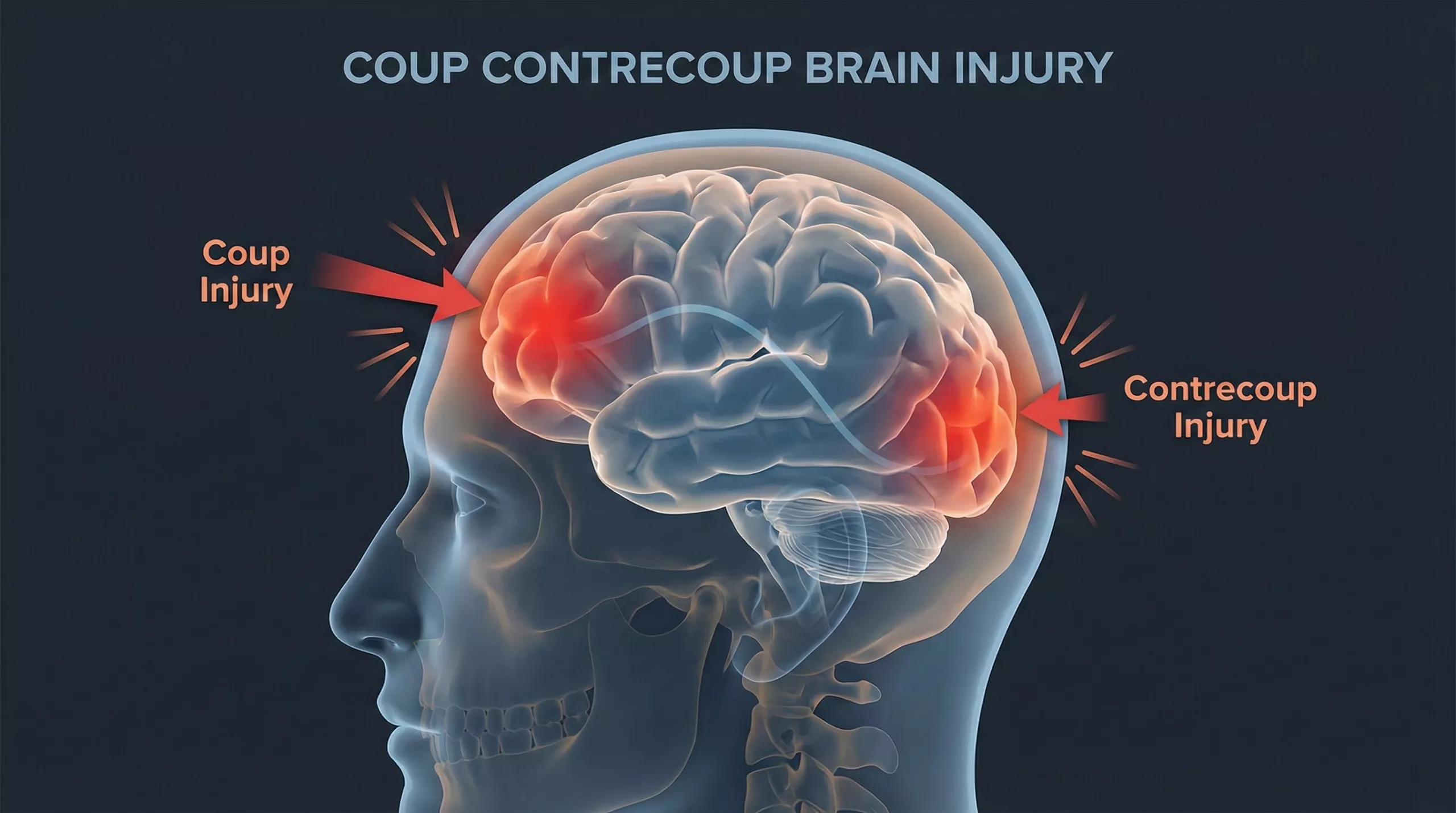
A coup-contrecoup injury is a bruise on the brain in two places at once: at the spot the head struck and on the opposite side of the skull. The word contrecoup comes from the French for counterblow, and that is an accurate picture of what happens. When a moving head stops suddenly, the brain keeps moving, strikes the inside of the skull, and rebounds into the opposite wall.
The injury pattern is well documented in the medical literature. StatPearls, a physician-authored reference published through the National Institutes of Health, defines a contrecoup injury as a brain contusion that occurs at a location distant from, and typically opposite to, the site of impact. The National Institute of Neurological Disorders and Stroke describes the same mechanism: when the head abruptly decelerates, the brain bounces back and forth within the skull, and a high-speed car accident is one of the events that produces exactly that motion.
Two details stand out after a car accident. First, the injury on the opposite side is often the worse of the two, because the rebound strikes the brain against the skull’s hard interior surfaces. Second, a contrecoup injury can exist even when there is no bruise at the point of impact at all. The rebound does the damage on its own.
Crash Mechanics Behind the Injury
Impact Mechanics
Inside the skull, the brain sits in cerebrospinal fluid, which cushions it during ordinary movement. The protection has limits. In a car accident, the vehicle stops abruptly and the occupant’s body is restrained by the seat belt, but the head keeps traveling at the speed the car was moving a moment before. The skull stops against the headrest, the window, the airbag, or nothing at all, and the brain continues forward and then backward inside the skull. Johns Hopkins Medicine describes the result as rapid movement and shaking of the brain inside the bony skull, bruising and tearing brain tissue and blood vessels.
Rotational Forces and Diffuse Axonal Injury
A straight-line impact is only part of the mechanism. Many accidents rotate the head as well as stopping it, and rotational acceleration stretches the long fibers that connect one part of the brain to another. When those fibers tear, the injury is called diffuse axonal injury. StatPearls notes that road traffic collisions account for the majority of diffuse axonal injuries among adults. A coup-contrecoup bruise and diffuse axonal injury can occur in the same accident, which is one reason symptoms sometimes extend far beyond the point of contact.
Secondary Injury Cascade
The damage does not stop when the car stops. Johns Hopkins Medicine describes a secondary phase of injury that evolves over hours to days, as cellular and chemical changes continue destroying brain tissue. StatPearls reports that bleeding around a contusion progresses in a large share of cases, usually within the first twelve to twenty-four hours, and can continue for up to a week. It also explains a pattern many people report: feeling dazed but functional at the scene, then worse over the following day.
Frontal and Temporal Lobe Damage
The underside of the skull is not smooth. Behind the eyes and above the ears, the bone carries ridges and pockets that press against the lower surfaces of the brain. StatPearls attributes contrecoup injuries to shear forces acting on these bony protuberances, and a 2024 peer-reviewed review identifies the forceful contact of the underside of the frontal and temporal lobes against the skull base as the main cause of contusion at the far side of the impact. Radiopaedia, a radiologist-authored reference, lists the inferior surface of the frontal lobes and the temporal poles as the areas most frequently affected. The pattern has a direction, too: an impact to the back of the head frequently produces a contrecoup bruise on the frontal lobes, while a frontal impact rarely produces one on the occipital lobe.
More types of brain injury from car accidents can share this mechanism, including injuries that never leave a bruise on the skull’s outer surface.
Symptoms of a Coup-Contrecoup Brain Injury
The symptoms of a coup-contrecoup injury are the symptoms of a brain injury: they depend on which regions absorbed the bruising, not on a distinctive signature. No source in the medical literature identifies symptoms unique to this injury pattern compared with other concussive injuries, and this page will not invent any. What the sources do document is the range.
Cognitive Symptoms
Problems remembering, concentrating, and making decisions are the most commonly documented cognitive effects. The National Institute of Neurological Disorders and Stroke lists difficulty concentrating and memory problems; Johns Hopkins Medicine adds shortened attention span, problem-solving deficits, and impaired judgment. StatPearls notes that frontal lobe lesions often produce nothing more specific than disorientation and confusion, which is one reason the injury is easy to dismiss in an emergency room.
Physical Symptoms
Headache is the most common symptom, according to Cleveland Clinic. Alongside it, the documented physical effects include dizziness and loss of balance, nausea and vomiting, blurred or double vision, ringing in the ears, fatigue, changed sleep patterns, and sensitivity to light and sound. Temporal lobe involvement can produce speech changes or weakness on one side of the body, and some patients present with seizures.
Emotional and Behavioral Changes
The National Institute of Neurological Disorders and Stroke records mood changes, agitation, anxiety, and depression among the recognized effects, and notes that frustration and irritability tend to develop during recovery. Johns Hopkins Medicine lists emotional instability and disinhibition, including temper flare-ups. StatPearls describes apathy and personality changes that persist for three months or longer in some patients. Families often notice these changes before the injured person does. When concussion symptoms after a car accident follow this pattern for weeks, the injury needs a medical follow-up, not a wait-and-see approach.
Why Clients Choose Sam Aguiar
Normal CT Scan Limits
The most common scenario after a suspected coup-contrecoup injury is a CT scan read as normal while the person does not feel normal. The medicine explains why, and the explanation affects both treatment and any injury claim.
CT is the right first test in an emergency. It is fast and reliable for detecting blood and skull fractures, which is what an emergency physician needs to rule out first. Its limits appear after that. The National Institute of Neurological Disorders and Stroke states that MRI is more sensitive and can detect subtle brain changes that a CT scan misses, and that current imaging technologies cannot always detect damage from mild concussive injuries. StatPearls adds a specific reason: a small contusion near the base of the skull can be missed because of how the scan renders that region.
The numbers put the gap in perspective. A 2023 peer-reviewed study of more than 1,800 mild traumatic brain injury patients found that only 5.5 percent had any injury visible on CT. Roughly nineteen of twenty CT scans in that population read normal.
Timing widens the gap further. The National Institute of Neurological Disorders and Stroke notes that contusions can appear after a delay of hours to a day. A scan taken in the first hours after the accident can honestly show nothing, and the injury can still develop overnight. That is why StatPearls calls for close monitoring with a repeat head CT at twelve or twenty-four hours in known contusion cases, and why symptoms that arrive or worsen the next day are a reason to return to medical care, not to assume the all-clear.

Clinical Diagnosis
Diagnosis does not rest on imaging alone. A neurological examination tests motor and sensory function, hearing and speech, coordination and balance, mental status, and mood, and StatPearls describes a detailed examination as mandatory in suspected contrecoup injury.
When symptoms persist, the evaluation deepens. Neuropsychological testing measures attention, memory, information processing, executive function, reaction time, and problem solving through batteries that the British Columbia Medical Journal describes as taking four to five hours. A neuropsychological assessment is the accepted method for defining the nature and severity of cognitive complaints, and the same source recommends referral sooner rather than later, since many symptoms should dissipate within three months if the injury is uncomplicated. StatPearls notes that an MRI is appropriate when a patient still reports symptoms more than a month after the injury.
Advanced imaging fills a narrower role. Diffusion tensor imaging can identify damage to the brain’s white matter tracts, and peer-reviewed research supports its use in assessing traumatic axonal injury. The same literature is explicit about its limits: individual-patient conclusions require strict conditions, the optimal timing after injury is not established, and courts have scrutinized the method. Physicians and retained medical experts use it alongside the rest of the evaluation.
One habit carries through every stage: consistent, documented reporting of symptoms to treating providers, with the date of injury, the mechanism, any loss of consciousness, and how each symptom has changed over time. StatPearls lists exactly these items as critical documentation, and the record they create becomes the backbone of both treatment and any later claim. Visiting a doctor promptly after an accident also protects a later claim, as the firm’s page on hospital visits after an accident explains.
Building the Record
A brain injury claim is built from records and testimony, and the building starts on the day of the accident. The evidence below is the work every case of this kind runs on.
Evidence That Documents a Brain Injury
Initial Medical Records
Emergency room notes, imaging reports, and physician notes from the accident date, including the mechanism of injury and any loss of consciousness.
Follow-Up Notes
Records from every visit where symptoms are reported, showing how each symptom changed relative to the date of injury.
Imaging History
CT and MRI studies over time, including repeat imaging, read by the treating physicians.
Neuropsychological Results
Formal testing of memory, attention, processing speed, and executive function by a qualified neuropsychologist.
Expert Evaluation
Neurologist and neuropsychologist involvement in defining the injury and its cause.
Before and After Witnesses
Family members, coworkers, and friends who can describe the difference in memory, temperament, and capacity since the accident.
The pattern of the claim is well understood on both sides. The Brain Injury Association of America documents that insurers have rejected brain injury claims as mild while the person experienced profound mood swings, memory deficits, and personality changes, and that subjective symptoms are the ones carriers question hardest. Peer-reviewed legal medicine makes the same point from the other direction: many people with normal brain scans have significant cognitive deficits measured by neuropsychological tests, and a normal scan does not end the medical conversation.
Sam Aguiar Injury Lawyers builds these claims with the medical record at the center. Every client works with a three-person team of an attorney, a case manager, and a legal assistant, and the firm retains neurologists, neuropsychologists, and other medical experts where a case requires them. For anyone weighing whether a brain injury claim is worth pursuing, the firm’s traumatic brain injury practice handles these cases across Kentucky.
Recovery Time and Long-Term Effects
Most people with a mild traumatic brain injury recover. StatPearls reports that in 85 to 90 percent of cases the injury is self-limited and does not progress to post-concussion syndrome, with symptoms typically resolving within ten to fourteen days. Cleveland Clinic puts ordinary concussion recovery at two to six weeks.
For the remainder, symptoms persist. Mayo Clinic defines persistent post-concussive symptoms as those lasting longer than three months, and notes they can last a year or more. Cleveland Clinic estimates that about 15 percent of people with a concussion develop post-concussion syndrome, and reports that researchers have strong reason to believe even that figure is an underestimation, in part because executive function changes can go undocumented.
Recovery is not uniform. The National Institute of Neurological Disorders and Stroke identifies age and the number of prior brain injuries as two critical factors: older adults are more likely to have lasting symptoms, and recovery from a second or third concussion is generally slower. Mayo Clinic adds that persistent symptoms do not track how severe the initial injury appeared, and that a history of anxiety is a strong risk factor. None of this is predictable at the scene of an accident. It is a reason to take the injury seriously from the first day, follow medical guidance, and let the record build.
If a car accident caused a brain injury, Sam Aguiar Injury Lawyers can review the accident records, treatment history, and available insurance coverage. Call (502) 888-8888 or request a free case review.