

How to Read a Kentucky Police Report
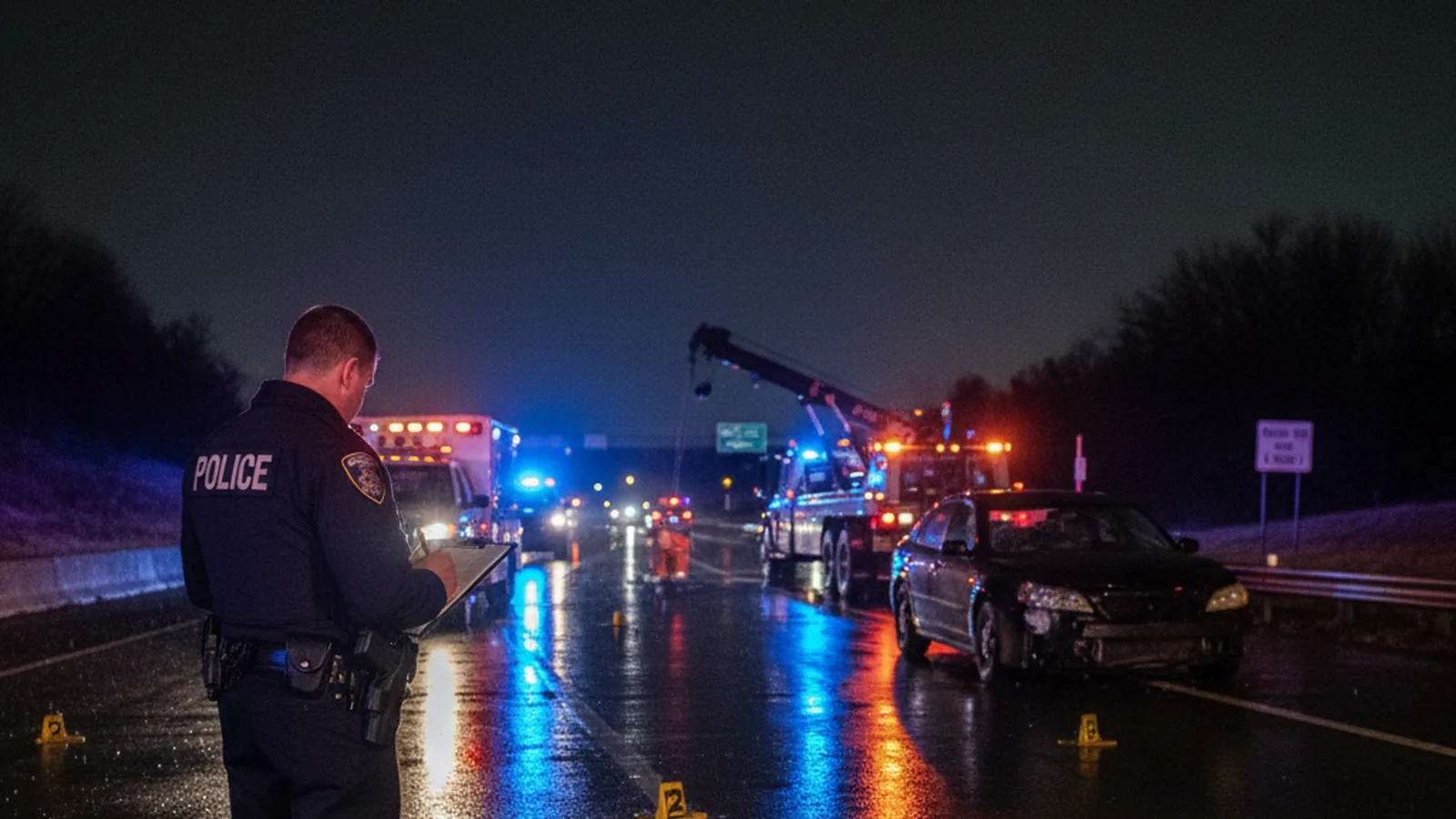
A Kentucky police report is a set of linked sections that have to be read together: collision details, unit pages, the diagram, the officer narrative, and coded fields. Officers file required reports through the E-CRASH system in KYOPS under 502 KAR 15:010, so the same field families appear across agencies even when an electronic layout differs from an older paper sample.
Report Layout and Reading Order
Each section of a collision report answers a different question, and reading them in a set order keeps people and vehicles from being mixed up. The diagram shows position, direction, point of impact, and final rest. The unit pages show who was in which vehicle, along with injury codes, restraints, and EMS transport. The narrative gives the officer’s written sequence, including any overflow notes outside the main box.
Kentucky Collision Reports Read in Five Linked Sections
Recommended reading order for an officer-completed report
Collision details: report number, investigating agency, date, time, roadway or mile point, weather, light, surface condition, and manner of collision.
Unit pages: one page family per vehicle or other unit, with operator rows, occupant rows, injury codes, restraints, and transport fields.
Collision diagram: a compass-oriented drawing of travel direction, point of impact, and final positions, with labels matched back to the unit pages.
Officer narrative: the investigator’s written sequence, which can continue into the diagram area or onto an added sheet.
Coded fields: numeric entries for actions, manner of collision, injury, restraints, and related factors, read with the code sheet for that report version.
Source: KYOPS frequently asked questions and the archival Kentucky report samples hosted by NHTSA.
Collision Details
The first block of the report sets the scene. On the archival KSP 74 sample, it includes the report identifier, investigating agency, date and time, roadway or mile point, weather, light, surface condition, and manner of collision. Current electronic reports can rearrange those fields, but they answer the same questions.
The report number ties every later page together. Date and time fix when the crash occurred, location fields fix where it occurred, and environmental fields describe the setting the diagram and narrative refer to. Kentucky law assigns the statewide reporting system to the Kentucky State Police under KRS 189.635.
Unit Pages
Each unit page keeps one vehicle or party together with the people inside it. Unit type and vehicle action describe what the unit was and what it was doing, and the operator and occupant rows tie each person to that unit. Reading every row for Unit 1 before opening Unit 2 keeps names from being attached to the wrong vehicle.
Injury location and severity are often coded, and so are restraint, airbag, ejection, and transport fields. A unit number only labels the party in the report. Unit 1 is not a finding of fault.
Collision Diagram
The diagram places the units on the roadway. Under the KYOPS instructions, it is drawn to compass direction, so the north marker is the starting point. Typical drawings label each unit, show the direction of travel, mark the point of impact, and show final positions.
Every label on the drawing should be matched back to the unit pages before an arrow is read as a conclusion. The diagram is strongest on position and movement, and the narrative is strongest on sequence. KYOPS also notes that the numbered property damage entries do not have to correspond to Unit 1, Unit 2, and Unit 3.
Officer Narrative
The narrative is the investigator’s written account of the crash. KYOPS allows it to continue into the diagram area or onto an added sheet when more room is needed, so the full account may sit in more than one place.
The narrative is read end to end and then compared with the unit names and numbers on the unit pages and the diagram. Small wording differences are worth noting. The narrative is one section of the report, not a stand-alone verdict on fault.
Report Codes
Many official fields are stored as numbers. The archival Kentucky code sheet shows how those field families work by pairing numbers with written descriptions. Code meanings can change between report versions, so the code sheet that matches the report controls.
The field family comes first and the number second. A number in a manner-of-collision field does not answer the same question as the same number in a restraint, injury, ejection, or transport field. The NHTSA-hosted sheet is useful for field-family structure, not as a universal decoder for every current electronic layout.
Errors and Corrections
A suspected error is easiest to evaluate when it is pinned to a page, field name, unit number, person row, and code number, then compared with the related diagram, narrative, or unit page. When another record is involved, the comparison stays field by field.
The KYOPS instructions warn that a copy given out before the Kentucky State Police process the report may be returned to the agency for correction, and agencies may mark such a copy as a draft, so an early copy can differ from the finished version. A property damage entry that does not line up with the unit numbers is not automatically an error under KYOPS.
Before relying on any single page, a careful review confirms these points:
- The report number matches on every page in use.
- Each unit label on the diagram matches the operator and vehicle on the same unit page.
- The narrative was read through any overflow into the diagram area or an added sheet.
- Every numeric code was checked against the code sheet for that report version.
- Property damage entries were not forced to match Unit 1, Unit 2, and Unit 3.
- An early copy was treated as a possible draft pending processing.
Getting a Copy of the Report
Kentucky keeps collision reports confidential and available to the parties and other groups named by statute in KRS 189.635. The originating agency remains responsible for providing copies to authorized parties, whether that agency is the Kentucky State Police or a local department that handled a Louisville car accident.
Under 502 KAR 15:010, a paper copy costs $5 and a copy obtained through the Kentucky State Police website costs $10. A civilian collision report is a separate process used when law enforcement did not investigate, explained on the Kentucky State Police civilian collision reports page.
The report is one piece of the evidence in a crash claim. It works alongside the hospital record from the day of the crash and the insurer’s own investigation, covered in how insurance companies investigate car accident fault.
Ready to Take Action on Your Injury Claim?
After a serious injury, medical bills pile up while the insurance company looks for ways to pay you less. Most law firms take their cut first and leave you with whatever is left. Sam Aguiar Injury Lawyers does things differently. With our exclusive Bigger Share Guarantee®, you always get more. Every client gets a dedicated three-person team: an attorney, a case manager, and a legal assistant. We never raise our fee rate if we have to go to court, and you pay $0 Out-Of-Pocket Forever.
Frequently Asked Questions
1Does Unit 1 mean that driver was at fault in a Kentucky police report?+
2Where is the officer’s description of a Kentucky collision?+
3Which code sheet applies to a Kentucky collision report?+
4Can a Kentucky collision report change after it is submitted?+
5Who can get a copy of a Kentucky collision report?+
6Is a civilian collision report the same as an officer’s report?+
Latest Articles
Kentucky Diminished Value Claims
Kentucky drivers may pursue a repaired vehicle’s leftover market loss from the at-fault driver as part of a.
FMCSA Revoked ELDs: Fleet Compliance and Enforcement Deadlines
FMCSA removed five electronic logging devices from the registered list on August 6, 2026, and set an October.
FMCSA English Proficiency Rule and OOS Enforcement
FMCSA English Proficiency Rule Sam Aguiar Injury Lawyers August 11, 2026 7 minute read On This Page.