
Self-Driving Car Accidents in Kentucky
Autonomous systems now share Kentucky roads, and responsibility for an accident can reach the driver, the vehicle maker, and other parties.
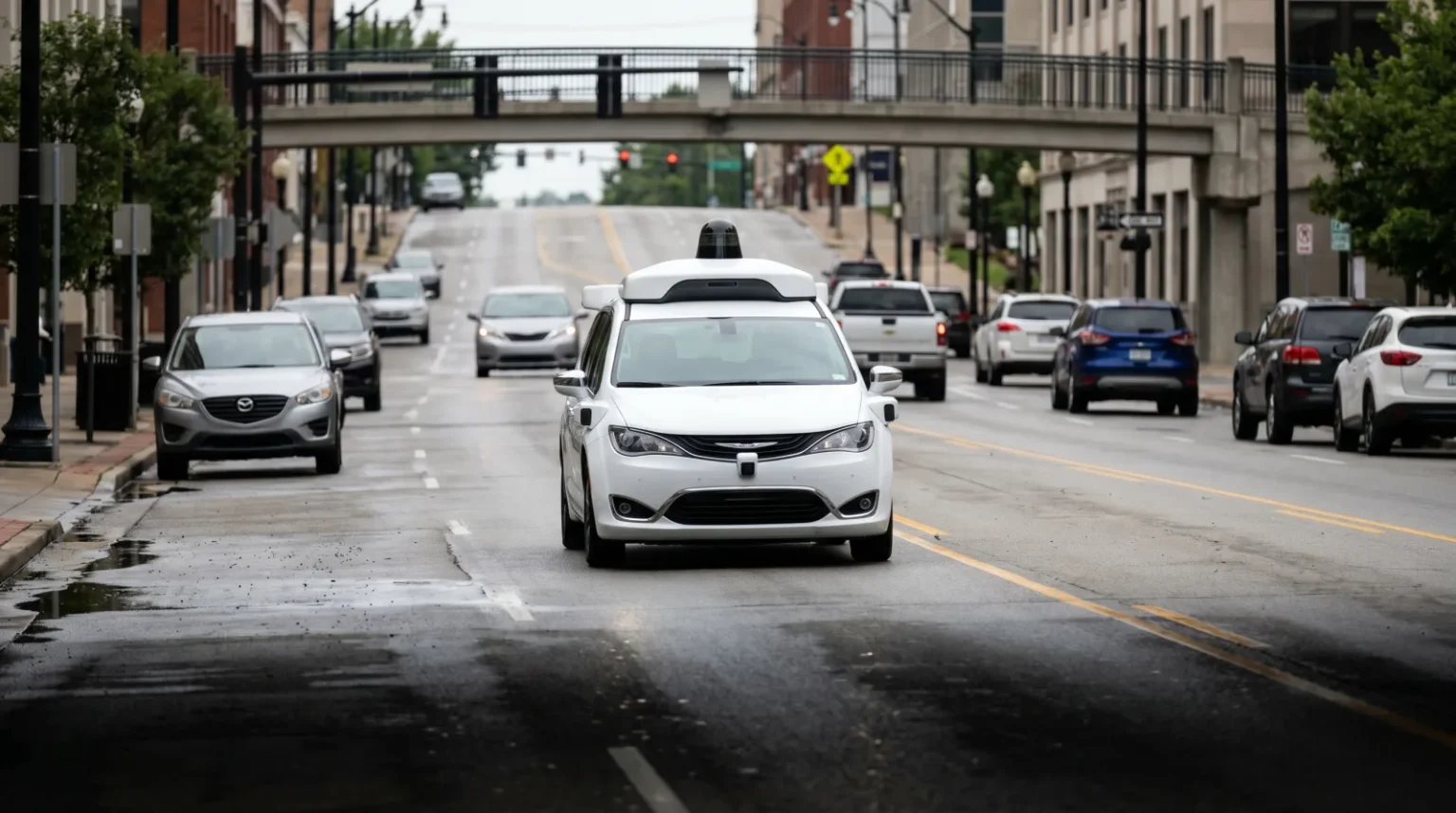
Cars that steer, brake, and sometimes drive themselves now operate on public highways alongside ordinary traffic. Some use driver support packages such as Tesla’s Full Self-Driving software or Ford’s BlueCruise, where a human driver must stay attentive and supervise the road. Others are fully driverless vehicles built to run with nobody behind the wheel. When an accident happens, legal responsibility depends on how much of the driving task the system handled and how Kentucky’s autonomous vehicle statutes allocate operator duties.
Driving Automation Levels
The National Highway Traffic Safety Administration (NHTSA) sorts driving automation into six automation levels. At Level 2, the vehicle controls steering and speed together while the human driver stays engaged and legally responsible for driving. Only at Levels 4 and 5 does the automated system take over the entire driving task so occupants ride as passengers. Even the most advanced driving automation currently sold to consumers still requires full driver engagement and undivided attention.
| Level | What the System Does | Person in the Vehicle |
|---|---|---|
| Level 0 | Gives warnings, alerts, or momentary emergency intervention | Driver performs all driving tasks and stays engaged |
| Level 1 | Supports braking and speed or steering, not both at once | Driver stays engaged and attentive |
| Level 2 | Steers and controls speed at the same time | Driver stays engaged and responsible for driving |
| Level 3 | Performs driving tasks under specific conditions | Driver must remain ready to take over |
| Level 4 | Drives itself within a defined service area | Occupants ride as passengers |
| Level 5 | Drives itself in all roadway conditions | Occupants ride as passengers |
These classifications progress from momentary driver assistance at Level 0 to full automation at Level 5.
Federal Standing General Order Reporting
Identified manufacturers and vehicle operators must submit notifications to NHTSA for qualifying accidents involving automated driving systems or Level 2 driver support features under the Standing General Order. For a Level 2 vehicle, the mandate applies when the system was active within 30 seconds of impact and a vulnerable road user was struck, someone died, an airbag deployed, or a person went to a hospital for treatment. The most severe incidents must be reported within five days.
Published totals are not normalized for exposure, because reporting companies do not disclose fleet size or total miles driven. A raw tally alone cannot establish the rate at which a given system is involved in an accident per mile.
Kentucky Law on Fully Autonomous Vehicles
Kentucky enacted its autonomous vehicle law in 2024 through House Bill 7, codified as Acts Chapter 176 within KRS Chapter 186. Under KRS 186.760, a fully autonomous vehicle is a motor vehicle equipped with an automated driving system designed to function without a human driver as a Level 4 or Level 5 system under the SAE J3016 standard.
Driverless highway operation is permitted under KRS 186.763 whenever the automated driving system is engaged and statutory conditions are met:
- If a system failure prevents the automated driving system from handling the driving task, the vehicle must achieve a minimal risk condition, defined in KRS 186.760 as a condition that reduces accident risk when a trip cannot or should not continue.
- From July 15, 2024 through July 31, 2026, any fully autonomous vehicle with a declared gross weight over 62,000 pounds had to carry a properly credentialed human driver to monitor operation and intervene if needed.
- Before operating without a human driver, a person must file a law enforcement interaction plan with the Kentucky Transportation Cabinet and Kentucky State Police explaining how to contact fleet support staff, move and tow the vehicle, and determine whether the system is engaged.
Liability insurance minimums for driverless vehicles sit far above ordinary passenger car requirements. Under KRS 186.766, a fully autonomous vehicle that is not a motor carrier must document financial responsibility to the Transportation Cabinet with single-limit liability coverage of at least $1,000,000 before running on a Kentucky highway without a human driver. By contrast, KRS 304.39-110 allows an ordinary Kentucky motorist to satisfy tort liability minimums with split limits of $25,000 per person, $50,000 per accident, and $25,000 for property damage.
During the 2026 legislative session, House Bill 223 proposed barring school districts from operating fully autonomous vehicles as school buses or for student transport and barring autonomous operation of vehicles requiring a commercial driver’s license (CDL). The House referred the measure to the Transportation Committee on January 14, 2026, its last recorded action, and the bill did not become law.
Owner Treated as the Legal Operator
Kentucky law identifies who stands in the driver’s shoes when no human operates the wheel. Under KRS 186.410, whenever an automated driving system is installed and engaged on a fully autonomous vehicle, the vehicle owner is legally treated as the operator. That owner must comply with traffic and motor vehicle laws whether physically inside the vehicle or not, and the automated driving system is treated as licensed to operate it.
Ownership, rather than ridership, controls legal operator status. A passenger who hails a driverless ride does not own the car, so the statutory operator in an accident is the owner, which may be the fleet company running the service.
Police notification duties follow the same statutory structure. Under KRS 189.635, an accident causing injury, death, or a disabled vehicle must be reported without delay to a law enforcement officer. When a fully autonomous vehicle is involved, that obligation rests with the vehicle owner or a person acting on the owner’s behalf.
Common Causes of Self-Driving Accidents
Multiple factors can converge in the same automated vehicle accident, spanning software decisions, sensor limitations, driver inattention, and roadway conditions.
Automated System Failures
An automated driving system must recognize when it can no longer perform safely and respond accordingly. Kentucky codifies that standard in KRS 186.763, requiring a fully autonomous vehicle to reach a minimal risk condition after a system failure. A vehicle that stays in motion in traffic after losing reliable system function raises immediate questions about software behavior and fault-handling design.
Sensor Limits in Poor Visibility
Cameras and roadway sensors can lose accuracy when environmental visibility degrades. In October 2024, NHTSA opened a defect probe covering four reduced-visibility accidents in which a Tesla entered sun glare, fog, or airborne dust with Full Self-Driving engaged, including one fatal pedestrian impact. Federal investigators subsequently upgraded that review to an engineering analysis covering nine accidents.
Overreliance on Driver Support Features
Level 2 driver support features still demand an attentive human behind the wheel. During NHTSA’s federal review of Tesla Autopilot, investigators identified at least 13 fatal accidents, along with additional serious-injury accidents, in which foreseeable driver misuse played an apparent role. Both the driver’s supervision and the adequacy of the system’s safeguards against misuse can become contested issues.
Public Agency Road Maintenance
When negligent road maintenance by a state agency contributes to an accident, Kentucky routes the action to a specialized forum. Exclusive jurisdiction over negligence damage actions against the Commonwealth and its cabinets and agencies belongs to the Kentucky Board of Claims under KRS 49.060, and KRS 49.040 caps recovery on a single award.
Parties Who May Share Fault
Depending on the facts, civil responsibility in a self-driving accident case can involve more than one party, including:
- The vehicle owner, treated under Kentucky statute as the operator of a fully autonomous vehicle while its automated driving system is engaged.
- The vehicle manufacturer, which designs and builds the vehicle platform, sensors, and integrated driving software.
- A separate software developer, when an outside company wrote the automated driving or driver-support code.
- The human driver of a Level 2 or Level 3 vehicle who failed to monitor traffic or intervene when conditions required action.
- A repair shop or service provider that altered, miscalibrated, or poorly maintained sensors and related hardware.
- A public agency, when negligent road maintenance contributed to the accident.
Ford BlueCruise Safety Investigations
On March 31, 2026, the National Transportation Safety Board (NTSB) completed two highway investigations involving 2022 Ford Mustang Mach-E sport utility vehicles operating in hands-free BlueCruise partial automation (HWY24FH006 and HWY24FH008, issued together in Report HIR-26-02). Both records represent established March 2026 federal safety findings rather than newly opened probes or judicial product-defect rulings.
The first accident took place at 9:48 p.m. on February 24, 2024, on eastbound Interstate 10 in San Antonio, Texas. Traveling at a system-recorded 74.7 mph in a 70 mph zone while operating in hands-free BlueCruise, the 2022 Mustang Mach-E struck a stationary Honda CR-V stopped in the center lane, killing the Honda driver and causing minor injuries to the Ford driver. Neither driver-applied nor system-applied braking or steering was recorded before impact. Investigators determined the probable cause was the Ford driver’s failure to respond because of distraction, likely from the in-vehicle navigation system, stemming from overreliance on hands-free partial automation and disengagement from driving. Contributing factors included the inability of Ford’s partial automation and automatic emergency braking systems to detect and respond to the stationary highway vehicle, along with the Honda’s center-lane position, possibly due to driver impairment.
Seven days later, at 3:16 a.m. on March 3, two more motorists died in a 45 mph work zone near the Betsy Ross Bridge in Philadelphia, Pennsylvania. Operating on northbound Interstate 95 (reduced from 55 mph) in hands-free BlueCruise at a system-recorded 72.4 mph on March 3, 2024, the 2022 Mustang Mach-E struck two stationary vehicles in the left lane, hitting a 2012 Hyundai Elantra stopped behind a 2006 Toyota Prius and pushing them into a passing 2018 Toyota Corolla. Both the Prius and Elantra drivers died, the Ford driver sustained minor injuries, and the Corolla driver was uninjured, again with neither driver-applied nor system-applied braking or steering recorded before impact. Investigators determined the probable cause was the driver’s failure to respond due to alcohol impairment that may have been worsened by cannabis use, combined with distraction likely from cell phone use, stemming from overreliance on and misuse of hands-free partial automation. Contributing factors were traveling about 27 mph above the 45 mph work-zone speed limit and Ford Motor Company’s inadequate integration of its active speed management system with its partial automation system.
System Design Gaps in Both Accidents
Across both highway investigations, NTSB documented recurring limits in hands-free driving design and driver oversight. Drivers could turn off automatic emergency braking while running hands-free BlueCruise and could set Intelligent Adaptive Cruise Control up to 20 mph above posted speed limits. Existing driver monitoring systems missed accumulated short off-road glances and failed to separate forward on-road gazes from attention directed at cell phones held in the forward line of sight.
No federal regulation required Level 2 vehicles to log partial-automation state data before an impact, leaving gaps in routine accident reconstruction when manufacturer telematics are unavailable.
March 2026 Federal Safety Recommendations
Alongside its final findings on March 31, 2026, NTSB issued six new safety recommendations and reiterated an earlier alcohol-detection recommendation:
- H-26-1 calls on the U.S. Department of Transportation to publish comprehensive partial-automation guidelines addressing concurrent automatic emergency braking engagement, active intelligent speed assistance, driver monitoring, driver engagement, automation complacency, and maximum operating speeds.
- H-26-2 calls on NHTSA to require automatic telematics accident notification on new Level 2-capable passenger vehicles to support Standing General Order 2021-01 reporting.
- H-26-3 calls on NHTSA to amend 49 CFR Part 563 so new Level 2-capable passenger vehicles record partial-automation and active-safety event data, including availability, engagement, activation denial, driver alerts, and system faults across automatic emergency braking, forward collision warning, driver monitoring, lane departure prevention, lane centering, and partial automation.
- H-26-4 calls on NHTSA to require driver monitoring systems on new Level 2-capable passenger vehicles capable of flagging accumulated short glances, separating on-road gazes from cell phones in the forward line of sight, and issuing timely multi-modal alerts.
- H-26-5 and H-26-6 call on Ford Motor Company to upgrade driver monitoring to meet those standards and modify BlueCruise on new vehicles to require automatic emergency braking engagement and appropriate speed tolerances in Intelligent Adaptive Cruise Control.
- Reiterated recommendation H-22-22 urges NHTSA to advance passive vehicle-integrated alcohol-impairment detection or advanced driver monitoring systems.
Tesla Autopilot Recall
Tesla filed Recall 23V838 on December 12, 2023, covering an estimated 2,031,220 vehicles equipped with any version of Autopilot. Tesla classified Autopilot as a Level 2 driver support system and acknowledged that its controls might not be sufficient to prevent driver misuse.
Federal scrutiny continued after the software update rolled out. NHTSA opened a recall query in April 2024 following post-remedy accidents and early agency testing, pointing out that part of Tesla’s remedy required owner opt-in and allowed drivers to reverse the setting.
Full Self-Driving Engineering Analysis
Separate federal review focuses on Tesla’s Full Self-Driving software. NHTSA classifies Full Self-Driving as a partial automation system and is examining whether drivers in nine reduced-visibility accidents remained unaware of system limits or of their duty to take control. Developments in that review affect how liability and Full Self-Driving driver supervision are evaluated after a roadway impact.
Withdrawn AV STEP Proposal
In January 2025, NHTSA issued a proposed voluntary oversight framework for automated driving system vehicles, titled the ADS-equipped Vehicle Safety, Transparency, and Evaluation Program and known as AV STEP. On June 26, 2026, NHTSA withdrew that rulemaking proposal.
Vehicle Data After an Accident
Onboard electronics hold much of the objective evidence after an automated or driver-support vehicle impact. Under 49 CFR Part 563, federal regulations standardize the format, survivability, and required data elements for event data recorders voluntarily installed in light passenger vehicles manufactured on or after September 1, 2012. An event data recorder captures brief pre-impact intervals measured in seconds rather than minutes, logging vehicle speed, accelerator pedal position, brake status, seat belt use, airbag deployment timing, and longitudinal and lateral delta-V readings used to evaluate impact severity.
Existing 49 CFR Part 563 standards currently leave an evidentiary gap for hands-free driving features. Those federal regulations do not require Level 2 partial-automation systems to record availability, engagement, activation denial, driver alerts, or system faults, which is the exact gap NTSB Recommendation H-26-3 asks NHTSA to close through rulemaking.
Pre-accident capture duration is expanding under a phased NHTSA schedule. After a December 18, 2024 rule extended pre-impact recording from 5 seconds at 2 Hz to 20 seconds at 10 Hz with an original September 1, 2027 deadline, NHTSA issued a May 18, 2026 final rule (91 FR 28432, effective June 17, 2026) adopting a four-year phase-in beginning September 1, 2028. Equipped light vehicles must meet the 20-second at 10 Hz standard at 25 percent from September 1, 2028 to August 31, 2029, 50 percent from September 1, 2029 to August 31, 2030, 75 percent from September 1, 2030 to August 31, 2031, and 100 percent on and after September 1, 2031, with small-volume and limited-line manufacturers complying September 1, 2032, altered and multi-stage vehicles complying September 1, 2033, voluntary early compliance permitted, and annual manufacturer reporting under 49 CFR Part 585, Subpart P.
Access to that onboard record is governed by federal privacy law and physical preservation. Under the Driver Privacy Act of 2015, reaffirmed in 91 FR 28432, data retained on an event data recorder belongs to the vehicle owner or lessee and may be retrieved only with owner or lessee consent, a lawful court or administrative order, or a specified statutory exception. Qualifying accidents under Standing General Order 2021-01 also generate manufacturer or operator notifications to NHTSA. Because vehicle modules sit with the owner, manufacturer, or fleet operator, repair, salvage, or return to service can overwrite or destroy stored records unless a preservation request goes out promptly. Heavy commercial trucks involve separate commercial truck black box records, and accidents involving driverless commercial trucks raise additional motor carrier insurance and federal compliance layers.
Kentucky Autonomous Vehicle Statutes
| Citation | Authority | Area |
|---|---|---|
| CitationKRS 186.760 | Authority Definitions. Defines a fully autonomous vehicle as one designed to function without a human driver as a Level 4 or Level 5 system. | AreaScope |
| CitationKRS 186.763 | Authority Use of fully autonomous vehicles. Allows driverless operation with conditions, required a human driver over 62,000 pounds until July 31, 2026, and requires a law enforcement interaction plan. | AreaOperation |
| CitationKRS 186.766 | Authority Insurance requirements. Requires at least $1,000,000 in single-limit liability coverage for a fully autonomous vehicle that is not a motor carrier. | AreaInsurance |
| CitationKRS 186.410(6) | Authority Owner as operator. Treats the owner as the operator when the automated driving system is engaged. | AreaOperator Status |
| CitationKRS 189.635 | Authority Accident reports. Places the duty to notify law enforcement after a fully autonomous vehicle accident on the owner. | AreaReporting |
Source: Kentucky Revised Statutes.
Injured in an Accident With a Self-Driving Car?
An accident involving a driverless car or a hands-free system can involve the vehicle owner, a fleet operator, the manufacturer, and a software developer at once, and onboard data can be lost if the vehicle is repaired or returned to service before a preservation request goes out. Sam Aguiar Injury Lawyers investigates every company and driver whose actions contributed to your injuries. With our Bigger Share Guarantee®, you always get more. Start a free case review to discuss what happened.
Frequently Asked Questions
Are Self-Driving Cars Legal in Kentucky?
Who Is at Fault When a Self-Driving Car Causes an Accident?
Has Kentucky Considered New Limits on Driverless Vehicles?
Who Reports an Accident Involving a Fully Autonomous Vehicle?
What Is the Difference Between Tesla Autopilot and Full Self-Driving?
Does a Hands-Free System Like Ford BlueCruise Remove Driver Responsibility?
Latest Articles
Tesla Full Self-Driving Investigation
Federal defect inquiries into reduced-visibility driving behavior, system limits, and driver supervision duties.

Car Accident Delta-V and Injury Risk
What delta-V is and how it relates to injury risk in a car accident.
Liability and Insurance for Self-Driving Trucks
Liability and insurance when a self-driving truck causes an accident.