

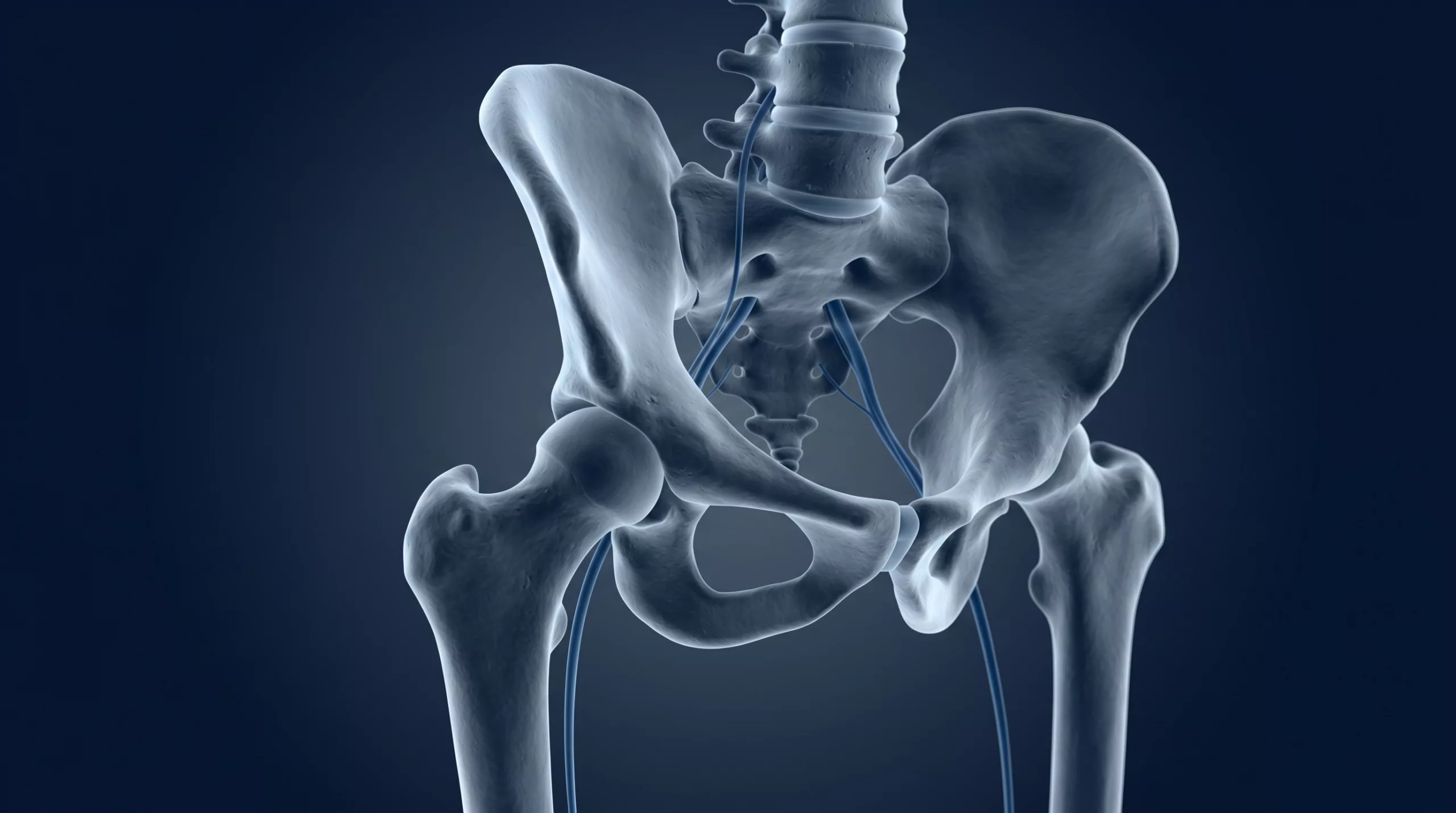
Hip Injuries From a Kentucky Car Accident
On This Page
A hip injury from a Kentucky car accident can range from a fractured acetabulum requiring open reduction and internal fixation (ORIF) surgery to a traumatic hip dislocation that damages surrounding nerves and blood vessels. According to the American Academy of Orthopaedic Surgeons, acetabular fractures typically require 9 to 12 months to fully heal, with patients restricted from full weight-bearing for up to three months post-surgery. Post-traumatic arthritis develops in approximately 13% to 44% of acetabular fracture patients, often setting the stage for total hip replacement years after the crash.
What Happens to the Hip in a High-Energy Crash
The hip is the deepest ball-and-socket joint in the body. The femoral head sits inside the acetabulum, wrapped by a ring of cartilage called the labrum, held by thick ligaments, and fed by a small artery that runs up the femoral neck. In a car crash the whole lower limb becomes a lever: the knee slams into the dashboard, the force travels up the thigh, and the femur drives backward into the socket. That single mechanism can dislocate the hip, fracture the back wall of the acetabulum, break the femoral neck, tear the labrum, and injure the sciatic nerve.
The reason hip injuries are difficult to understate is the blood supply. The medial circumflex femoral artery, which feeds the femoral head, travels up the back of the femoral neck through the joint capsule. When the hip dislocates or the neck fractures, that artery is stretched, kinked, or torn. Once the blood supply is interrupted for more than a few hours, the femoral head begins to die, a condition called avascular necrosis (AVN). AVN can be invisible on x-ray for 6 to 12 months, which is exactly why insurance adjusters try to close hip files early.
The National Highway Traffic Safety Administration documents frontal-impact crashes as the highest-risk mechanism for hip injury, driven by knee-to-dashboard contact. Lateral T-bone collisions add a direct side-loading force on the greater trochanter and pelvis that produces different fracture patterns requiring separate imaging interpretation.
The principal hip injuries seen in Kentucky car accident cases include:
Acetabular Fracture
A break in the hip socket (acetabulum). Almost always requires ORIF surgery with plates and screws to restore the joint surface.
Hip Dislocation
The femoral head is forced out of the socket. Requires emergency closed or open reduction. Risk of avascular necrosis increases with delay.
Femoral Head/Neck Fracture
A break at the top of the thigh bone. Blood supply to the femoral head is at risk, which can lead to collapse of the bone over time.
Labral Tear + FAI
The labrum can tear from the acetabular rim on high-energy impact. Requires MR arthrogram to diagnose; arthroscopic repair to treat.
Hip Injuries We See Most After Crashes
The card grid above names the injuries. The clinical detail below is what drives case value, insurance strategy, and long-term risk.
1. Posterior Hip Dislocation
Posterior hip dislocation happens when the knee hits the dashboard with the hip flexed and slightly adducted. The femoral head pops out the back of the socket, often shearing off a piece of the posterior wall on the way out. The leg ends up shortened, adducted, and internally rotated. This is an emergency. StatPearls and the Journal of Orthopaedic Trauma both recommend reduction within about six hours because the blood supply to the femoral head runs through the capsule and is stretched while the hip is out. Most emergency physicians and orthopedic surgeons aim for under two hours.
2. Acetabular Fracture
The acetabulum is the cup-shaped socket of the hip. Fractures are classified using the Letournel system, which divides them into elementary types (posterior wall, posterior column, anterior wall, anterior column, transverse) and associated types. The posterior wall fracture is the most common in dashboard-mechanism crashes. Most acetabular fractures with articular step-off greater than 1 to 2 millimeters require ORIF by a pelvic trauma surgeon. Non-anatomic reduction is the primary driver of post-traumatic arthritis later in life. A study published in PubMed reviewing 204 MVC hip dislocation patients found acetabular fracture in over 53% of cases.
3. Femoral Neck Fracture
Femoral neck fractures are classified as displaced or non-displaced (Garden type I through IV). Non-displaced fractures (Garden I and II) are sometimes treated with cannulated screw fixation. Displaced fractures (Garden III and IV) in younger patients are treated with ORIF to preserve the femoral head. In older patients, surgeons proceed directly to hemiarthroplasty or total hip replacement. The complication that drives long-term case value is avascular necrosis: even with perfect surgery, a displaced neck fracture carries AVN rates of 15 to 30 percent depending on the displacement and the time to reduction.
4. Hip Labral Tear and FAI
The labrum is a ring of fibrocartilage that deepens the hip socket and acts as a seal, maintaining negative intra-articular pressure. In high-energy crashes, especially dashboard impacts and lateral T-bone collisions, the labrum can tear from the acetabular rim. Labral tears are invisible on standard MRI. They require an MR arthrogram: a gadolinium-contrast study where dye is injected directly into the joint before imaging. Tears are repaired arthroscopically in most cases, with suture anchors reattaching the torn labrum to the acetabular rim.
Femoral acetabular impingement (FAI) is a related condition the crash can unmask even if it did not cause it. FAI occurs in two morphologies: cam-type (extra bone on the femoral head-neck junction) and pincer-type (over-coverage of the acetabulum). Many patients have pre-existing FAI morphology they were unaware of. Insurers use the pre-existing FAI finding to argue the labral tear is degenerative, not traumatic. The counter-argument: the patient was asymptomatic and functional before the crash.
5. Hip Contusion and Pointer
A hip pointer is a direct-impact contusion to the iliac crest, usually from the door panel in a side collision or from the seatbelt in a frontal crash. The injury is painful and limits rotation and side-bending but does not involve the joint itself. Most pointers resolve in 6 to 12 weeks with rest, ice, and progressive physical therapy. They are real injuries with real functional limits.
Signs Your Hip Injury Needs More Than Ice and Rest
If any of the following are true after a crash, get imaging and an orthopedic consult. Do not wait for urgent care to send you home with a hip sprain diagnosis.
Inability to Bear Weight
You cannot put weight on the leg or cannot walk without a limp. This is not a soft-tissue pattern.
Leg Position Change
The leg looks shorter, rotated inward, or the knee is pointing at the other leg. Classic posterior dislocation presentation.
Groin Pain on Rotation
Pain in the groin when you rotate the leg, not pain over the outside of the hip, points to the joint itself rather than the trochanteric bursa or a muscle strain.
Numbness or Weakness Below the Knee
Sciatic nerve involvement. Foot drop is the severe version. Any numbness, tingling, or weakness in the foot or lower leg after a hip injury warrants an EMG at 3 to 6 months.
Pain That Worsens After 48 Hours
A bruise gets better. A fracture, dislocation, or labral tear gets worse or stays the same. If you are worse at day 2 than you were at the scene, the ER diagnosis was probably incomplete.
Why the ER Often Underestimates Hip Injuries
Three reasons. First, the standard first-line imaging in most ERs is an AP pelvis x-ray. That film will show an obvious dislocation or a badly displaced fracture, but it misses posterior wall fragments, non-displaced femoral neck fractures, and marginal impaction in roughly one-quarter to one-third of acetabular fractures, according to Journal of Orthopaedic Trauma data. A CT scan picks those up.
Second, the labrum and the femoral head cartilage are invisible on x-ray. They need an MRI, and for the labrum a contrast study. Most ERs do not order those on day one.
Third, pain behavior is unreliable at the scene and in the first hours. Adrenaline, shock, and competing injuries mask hip pain. Patients who limp into triage with a hip that is “just sore” are often sent home and told to follow up with their primary care physician. The orthopedic consult happens a week later, after the hip has had time to declare itself.
The documentation gap this creates is real: if the ER report says “no acute fracture on x-ray” and the patient waits two weeks to see an orthopedist, the insurer will argue the delay proves the injury is minor. The counter-narrative is built from the mechanism documentation, the first ER visit notes, and the imaging series that follows.
Imaging and Diagnostics That Actually Answer the Question
The sequence that orthopedic trauma surgeons use, and the sequence that holds up in an insurance claim, looks like this.
| Study | What It Rules In / Out | When to Order |
|---|---|---|
| AP Pelvis X-Ray | Obvious dislocation, displaced fracture, hemipelvis injury | Day of crash |
| Judet Oblique Views | Anterior and posterior acetabular columns | Same day if fracture suspected |
| CT Pelvis (thin-cut, 2mm) | Posterior wall fragments, marginal impaction, femoral head impaction | Same day for any high-energy crash with hip pain |
| MRI Hip (non-contrast) | Occult femoral neck fracture, bone bruise, early AVN, soft-tissue edema | Within 7 to 14 days if pain persists |
| MR Arthrogram | Labral tear, chondral flap, loose bodies, FAI morphology | 4 to 6 weeks if mechanical symptoms persist |
If a CT scan was not done in the ER and the hip is still painful at 1 week, push for it. Insurance adjusters regularly argue that delayed imaging means delayed injury. The counter-argument is the mechanism of injury documented at the scene and at the first ER visit. Keep those records.
Treatment Roadmap: From Conservative Care to Total Hip Replacement
Conservative (Non-Surgical) Track
Non-surgical care is reserved for non-displaced or minimally displaced fractures of the acetabulum or femoral neck, and for most hip contusions and small labral tears. The patient is kept non-weight-bearing (often 6 to 8 weeks), treated with anticoagulants to prevent deep vein thrombosis, and followed with serial x-rays every 2 weeks. Physical therapy starts with range of motion and progresses to strengthening around week 8 to 12.
Non-surgical does not mean easy. Keeping a patient non-weight-bearing on one leg for 2 months requires a walker, a shower chair, a raised toilet seat, and often a first-floor bedroom or stair accommodation. Those durable medical equipment costs are compensable and should be itemized in the claim.
Arthroscopic Surgery
Hip arthroscopy addresses labral tears, FAI morphology (cam osteoplasty, pincer rim trimming), chondral flaps, and loose intra-articular fragments. Most labral repairs use suture anchors to reattach the torn labrum to the acetabular rim. Patients are typically non-weight-bearing for 2 to 6 weeks post-operatively, then progress through a structured PT protocol over 3 to 6 months.
Open Reduction and Internal Fixation (ORIF)
ORIF is the standard for acetabular fractures with articular step-off greater than 1 to 2 millimeters, displaced femoral neck fractures in younger patients, and some posterior wall fractures with instability. Surgery uses plates, screws, and sometimes bone graft to restore the joint surface. Patients are typically non-weight-bearing for 6 to 10 weeks post-ORIF, followed by a lengthy PT course.
Total Hip Arthroplasty (THA)
Total hip replacement is the endpoint for displaced femoral neck fractures in older patients, for femoral heads that develop avascular necrosis after any hip injury, and for acetabular fractures that develop post-traumatic arthritis despite anatomic reduction. The American Academy of Orthopaedic Surgeons notes that younger THA recipients face a higher lifetime revision risk, a factor that directly increases the long-term cost projection for a crash-related claim. Each procedure carries a different permanent impairment rating under the AMA Guides to the Evaluation of Permanent Impairment.
Recovery Timeline by Phase
| Phase | What Happens | Typical Window |
|---|---|---|
| Acute | ER, reduction if dislocated, imaging, admission, pain control, DVT prophylaxis | Day 0 to Day 7 |
| Early Post-Op | Surgery if indicated, hospital stay 3 to 7 days, inpatient PT, home with walker | Day 7 to Day 21 |
| Non-Weight-Bearing | Strict no-weight protocol, DME at home, outpatient PT for range of motion | Week 3 to Week 12 |
| Weight-Bearing Progression | Toe-touch to partial weight to full weight, strengthening, gait retraining | Week 12 to Week 24 |
| Maximum Medical Improvement | Final functional capacity test, impairment rating, permanent restrictions (if any) | 9 to 18 months |
Insurance companies regularly try to close files at month 6 with an early offer that assumes full recovery. For serious hip injuries, maximum medical improvement often does not arrive until month 12 to 18. For acetabular fractures or dislocations with AVN risk, the 2-year mark is often the right window to complete the permanent picture before any resolution.
Hip Injury Recovery: What the Difficult Path Looks Like
When a crash causes an acetabular fracture, the recovery timeline is measured in months, not weeks. For many patients, the road runs through multiple surgeries, extended non-weight-bearing periods, and eventual joint replacement.
Acetabular Fracture: What Recovery Can Look Like
Based on published medical literature. Individual recovery varies.
Day 1–7
Emergency & Surgery
Hip dislocation requires emergency reduction. ORIF surgery typically follows within days for displaced acetabular fractures. Per the PubMed hip dislocation study, delay in reduction increases complication risk.
Weeks 1–12
Non-Weight-Bearing
The AAOS notes patients may remain non-weight-bearing for up to 3 months. Crutches or a walker are required.
Months 3–12
Physical Therapy & Plateau
Gradual weight-bearing and PT begin. The AAOS notes it can take 6–18 months to return to vigorous activities.
Year 1–3+
Post-Traumatic Arthritis
Research in Frontiers in Surgery found a median PTOA onset of 18 months post-surgery.
Year 3–10+
Total Hip Replacement
When PTOA becomes end-stage, total hip arthroplasty (AAOS) is the primary intervention.
Sources: AAOS OrthoInfo, Frontiers in Surgery
What a Hip Injury Actually Takes From You
A hip fracture or dislocation does not just show up on imaging. It shows up in every corner of your life.
It shows up when you cannot walk up a single flight of stairs without gripping the railing and pausing on each step. When you used to take two at a time without thinking about it.
It shows up at church. You cannot kneel. That matters to people. It changes something. You sit while everyone around you kneels, and you feel set apart in a way you never expected from a car crash.
It shows up in the car. Long drives used to be nothing. Now sitting for more than 30 minutes sends a deep ache through the hip and into the lower back. Visiting family three hours away becomes a production. You have to stop twice and get out and walk around.
For warehouse workers, forklift operators, construction workers, and nurses in Louisville and Lexington who are on their feet all day: a permanent limp is not just a medical finding. It is the end of a career. A gait analysis following hip fracture repair documents exactly how far from normal your walk has become.
Long-Term Complications We Track Before Closing a Claim
A hip case cannot be fully documented if the long-term risks are not accounted for. The three most common post-crash hip complications are:
Avascular Necrosis (AVN) of the Femoral Head
The femoral head blood supply is fragile. A delayed-reduced dislocation, a displaced femoral neck fracture, or even a well-treated acetabular fracture can interrupt it. The AAOS reports AVN rates up to 15 to 20 percent after high-energy hip trauma. It can appear 6 months to 2 years out. Untreated, it leads to femoral head collapse and total hip replacement. A claim closed at 6 months without accounting for AVN risk is closed too early.
Post-Traumatic Arthritis
Any injury to the articular cartilage carries arthritis risk, even with perfect surgical reduction. For acetabular fractures, the Journal of Bone and Joint Surgery has reported long-term arthritis rates above 25 percent even with anatomic reduction. That means a future total hip replacement is a realistic line item in the permanent picture for any serious acetabular fracture case.
Sciatic Nerve Injury
The sciatic nerve runs just posterior to the hip joint. A posterior dislocation can stretch or contuse it. StatPearls documents sciatic nerve injury in 8 to 19 percent of posterior hip dislocations. Symptoms range from foot numbness to foot drop. Full recovery occurs in some patients but not all, and EMG studies at 3 to 6 months are the correct way to document the residual deficit.
What Insurance Adjusters Say About Hip Injuries and How We Counter It
Hip cases are high-value because the surgeries are expensive and the permanent picture can be severe. That makes them a target for predictable defense tactics. We plan for each one before the demand goes out.
“Your Hip Pain Was Pre-Existing.”
Radiologists read nearly every adult MRI as showing some degenerative change. Adjusters seize on that language. The answer is the pre-crash medical record: if the hip was asymptomatic and fully functional before the crash, the degenerative label does not reduce the claim. A pre-existing FAI morphology does not mean the labral tear was not caused by the crash, it means the crash exposed a structural vulnerability.
“You Did Not Complain of Hip Pain at the Scene.”
Adrenaline suppresses pain for hours. Lap belts can obscure injury while EMS focuses on obvious bleeding or airbag injuries. The first ER visit is what matters, and the imaging is what matters. If hip pain appears at 24 to 72 hours post-crash, that is clinically normal and well-documented in orthopedic literature.
“You Did Not Follow Up Fast Enough.”
Emergency rooms frequently do not schedule orthopedic follow-ups. Patients assume they will be called. We counter this by scheduling orthopedic appointments directly and documenting the referral chain. The file must show a continuous, logical treatment progression from ER to orthopedist to surgeon to PT.
“The Surgery Was Not Related to the Crash.”
This is the defense applied to labral repairs and THA conversions that happen months after the crash. The answer is the MR arthrogram, the surgeon’s operative note, and the biomechanical timeline from the crash mechanism to the first symptom to the imaging to the surgical finding. Documented mechanism, documented imaging, documented surgeon opinion: that chain is what breaks the delayed-causation argument.
Getting the Right Surgeon From the Start
Not all orthopedic surgeons are the same. Hip fractures from car accidents, especially acetabular fractures, are among the most technically demanding cases in orthopedic surgery. Who you see from the start affects both your outcome and your documentation.
What to Look for in a Hip Surgeon
For a crash-related hip injury, you need an orthopedic surgeon with fellowship training in adult reconstruction or orthopedic trauma. The right surgeon has experience with both ORIF for acute fractures and total hip arthroplasty for end-stage disease. Ask specifically about revision rates and whether they regularly treat post-traumatic arthritis cases, which are more complex than primary osteoarthritis cases.
The right surgeon also knows to order a gait analysis when indicated, document functional deficits in detail, and refer for life care planning when the injury has long-term consequences. That documentation, built from the beginning, is the foundation of a serious demand.
Future Costs the Insurance Company Does Not Want to Calculate
Here is what adjusters typically do with a hip fracture claim: they look at what you have already spent, add a small multiple, and call it an offer. What they do not build in is everything that comes after.
When post-traumatic arthritis develops, the costs are not finished at your last physical therapy session. They are just getting started. Ongoing pain management, injection series, home health visits, mobility aids, assistive devices, home modifications for grab bars and ramps, and eventually total hip replacement: these are documented, projected, and calculable. They are just not calculated by the insurance company.
What a Life Care Planner Does for a Hip Injury Case
A life care planner is a credentialed professional, typically a nurse or physician with specialized certification, who projects the full future cost of care for someone with a serious injury. For a crash-related hip injury that is likely to progress, a life care planner documents: ongoing pain management and injection costs, the anticipated timing and cost of total hip replacement, the likelihood and cost of revision surgery, assistive device needs, home modification costs (grab bars, ramp construction), and potential need for home health support during recovery periods.
What Kentucky Juries Actually Award for Hip Injuries
The Kentucky Trial Court Review tracks 28 years of jury verdict data across Kentucky. For hip fracture and dislocation cases involving surgical intervention, documented functional limitation, and future care needs, jury awards consistently exceed what insurance companies offer in pre-litigation settlement. Insurance adjusters use proprietary software that treats your claim as a formula. Kentucky juries treat it as what it is: a person whose life was permanently changed by someone else’s negligence.
At Sam Aguiar Injury Lawyers, we use the Kentucky Trial Court Review’s jury verdict data when building your demand. We base our approach on what Kentucky juries have actually awarded for injuries like yours, not what an insurance algorithm says you deserve.
What a Demand Letter for a Hip Injury Case Looks Like
Insurance companies respond to organized, documented, specific demands. Here is a representative example of the type of pre-litigation correspondence we send for hip injury claims involving ORIF and post-traumatic arthritis.
Sample: Pre-Litigation Demand Correspondence
This is a simplified example of the type of correspondence we send to insurance adjusters for hip injury claims. Actual demands include full medical documentation, billing summaries, operative reports, impairment ratings, gait analysis, life care plan, and supporting exhibits.
Re: [Client Name] / Claim No. [XXXXX] / Date of Loss: [XX/XX/XXXX]
Dear [Adjuster Name],
Please find enclosed our demand for resolution of the above-referenced claim.
Liability: Our client was a front-seat passenger in a vehicle struck in a frontal collision. The at-fault driver ran a red light at speed, causing a direct dashboard impact. Liability is established by police report, witness statements, and intersection camera footage.
Injuries and Treatment: Our client sustained a displaced acetabular fracture with concurrent posterior hip dislocation, confirmed on CT imaging obtained at University of Louisville Hospital. Emergency closed reduction was performed followed by open reduction and internal fixation (ORIF) with posterior plating within 72 hours of injury. Postoperative course required 10 weeks of non-weight-bearing. Most recent follow-up at 18 months post-injury documents radiographic evidence of post-traumatic osteoarthritis with joint space narrowing. The treating orthopedic surgeon has documented a 22% whole-person impairment rating per AMA Guides, 6th Edition.
Future Care Documentation: Enclosed is the life care plan prepared by a board-certified life care planner projecting future pain management, physical therapy, assistive device needs, home modification costs, anticipated total hip arthroplasty, and the probability of one or more revision surgeries.
Demand: Based on the documented injuries, the impairment rating, the gait analysis findings, the life care plan projecting future surgical needs, and Kentucky Trial Court Review jury verdict data for comparable hip fracture cases in Jefferson County, we demand the policy limits for resolution of this claim.
We request your response within 30 days. Should your insurer fail to make a solid offer, we are prepared to file suit and will pursue all available damages, including bad faith penalties under KRS 304.12-230.
Respectfully,
Sam Aguiar Injury Lawyers
Note: This is a representative sample. Every demand we send is customized to the specific facts, medical evidence, and applicable insurance coverage in your case.
What To Do After a Hip Injury From a Car Crash
The steps you take in the first two weeks determine what the file looks like a year from now.
- Get the Right Imaging. If the ER only did an x-ray and your hip will not bear weight, go back for a CT scan of the pelvis. Request Judet oblique views if a fracture is suspected. If you are at day 7 to 14 and still in pain, ask about an MRI or MR arthrogram.
- Get Into an Orthopedic Trauma or Hip Surgeon. General orthopedists are capable; trauma fellowship-trained surgeons are better for acetabular fractures and femoral neck fractures. The difference in outcome and in the quality of the operative note is significant.
- Preserve Scene Evidence. Photos, dashcam footage, the at-fault driver’s information, and any DOT or TriMarc camera footage near major Kentucky interstates and intersections. Footage is overwritten in days to weeks.
- Do Not Give a Recorded Statement. The at-fault driver’s adjuster will call within 72 hours. You are not required to give a recorded statement to the other driver’s insurance company. Anything you say before imaging is complete can be used to minimize the injury.
- Keep a Pain and Activity Log. A daily note of what you cannot do, what hurts, and what changed since yesterday is one of the most underutilized tools in a hip injury claim. It documents the functional reality that imaging cannot show.
Related Injuries & Resources
— Jill M.“I was one of those people who felt injury lawyers were not necessary if it was 100% the other party’s fault. I was so wrong. My mother was injured in a car vs pedestrian accident. The insured had what I would consider a very reputable insurance carrier, and there were eyewitnesses. I attempted to work with them without legal counsel. Their first offer would have given me more for my lost wages than my elderly Mom would have received for her broken pelvis. I called Sam Aguiar, and it was the best thing I’ve ever done. They received over five times the amount initially offered and got the medical bills covered. Lesson learned. Insurance companies don’t want to be reasonable anymore.”
Frequently Asked Questions: Hip Injuries From a Car Accident
What is the most common hip injury from a car accident?
Acetabular fractures (fractures of the hip socket) and posterior hip dislocations are the most common serious hip injuries in car crashes. A study published in PubMed reviewing 204 MVC hip dislocation patients found acetabular fracture as the most common concurrent injury, present in more than 53% of cases. These injuries result from dashboard impact forces transmitting through a flexed knee into the hip joint.
How do I know if my hip is dislocated, broken, or just bruised?
You cannot know from the outside. The most reliable signs of something serious are inability to bear weight, visible shortening or rotation of the leg, deep groin pain with rotation, or numbness in the leg or foot. Those presentations require a CT scan of the pelvis, not just an x-ray. A contusion or hip pointer usually improves meaningfully within 2 weeks. A fracture, dislocation, or labral tear usually does not.
How long does recovery take after acetabular fracture ORIF surgery?
According to the American Academy of Orthopaedic Surgeons, patients are typically restricted from full weight-bearing for up to three months after ORIF surgery. Full fracture healing takes 9 to 12 months. Returning to vigorous activities can take 6 to 18 months, and many patients never fully return to their pre-injury activity level due to residual stiffness, pain, or the onset of post-traumatic arthritis.
Is a labral tear a real injury or something insurance companies always deny?
Both. Labral tears are real, frequently disabling, and documented in crash-mechanism cases. They are also denied routinely by insurance adjusters who point to degenerative findings on standard MRI. The path to a successful claim is imaging done correctly, an MR arthrogram with contrast, not a standard MRI, combined with the surgeon’s operative note describing the tear pattern and the injury mechanism.
What is post-traumatic arthritis and how likely is it after a crash-related hip injury?
Post-traumatic osteoarthritis (PTOA) is degenerative joint disease that develops after traumatic injury, even following successful surgical repair. Research in Frontiers in Surgery found PTOA develops in 13% to 44% of acetabular fracture patients, with a median onset of 18 months after surgery. When PTOA progresses to end-stage disease, total hip replacement becomes necessary to relieve pain and restore function.
Will I need a total hip replacement after my crash injury?
Possibly. The two most common paths to a post-crash total hip replacement are a displaced femoral neck fracture with subsequent avascular necrosis, and an acetabular fracture that develops post-traumatic arthritis. Younger patients typically receive fixation first and convert to replacement only if AVN or arthritis develops. The realistic possibility of a future conversion should be documented and accounted for before any case resolution. Per the same Frontiers in Surgery systematic review, up to 22% of acetabular fracture patients ultimately convert to THA.
Why are posterior hip dislocations treated as emergencies?
The artery feeding the femoral head runs up the femoral neck through the joint capsule. When the hip is dislocated, that capsule is stretched and the artery is compressed. The longer the hip remains out of the socket, the higher the risk of avascular necrosis. Orthopedic literature generally recommends closed reduction within 6 hours; most trauma surgeons aim for under 2 hours. If the hip was not reduced quickly at the ER, that timing is a documented prognostic factor for AVN.
What does a life care planner do in a hip injury case?
A life care planner projects the full future cost of care for someone with a serious injury. For a crash-related hip injury with post-traumatic arthritis, the plan documents anticipated pain management, physical therapy, assistive device needs, home modifications (grab bars, ramps), projected total hip replacement timing and cost, and the probability of future revision surgeries. This documented projection is a central exhibit when building the demand and presenting the case at trial.
What is avascular necrosis and can it happen after a crash-related hip injury?
Avascular necrosis (AVN) of the femoral head is the death of bone tissue caused by disrupted blood supply. Traumatic hip dislocation puts the blood supply to the femoral head at significant risk. A case report in the Journal of Orthopaedic Case Reports identifies AVN as one of the most common complications following traumatic hip dislocation. AVN can collapse the femoral head and lead to total hip replacement, sometimes within a year or two of the crash.
What is the deadline to file a car accident hip injury claim in Kentucky?
Kentucky gives you 2 years from the date of the crash or 2 years from the date of the last PIP payment, whichever is later, under KRS 304.39-230. PIP payments often run 4 to 6 months in serious hip cases, which can push the actual filing deadline past the 2-year crash anniversary. Do not assume you know your deadline; confirm it early.