

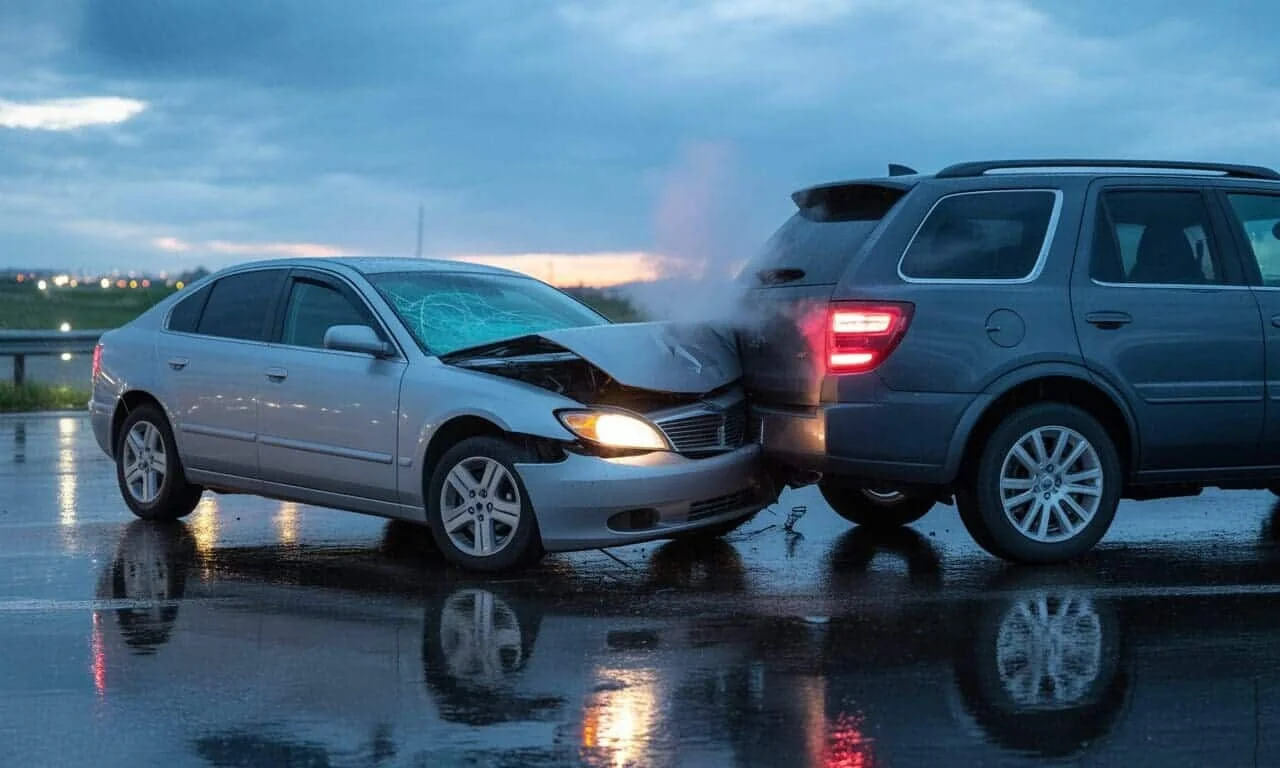
How Car Crash Forces Cause Injuries
The physics of a collision determine which body parts take the most damage. Understanding crash biomechanics — and how attorneys use that science — makes the difference between a dismissed claim and full compensation.
Nearly 6 million collisions occur on U.S. roads each year. Each one sets off a chain of biomechanical forces — deceleration, angular acceleration, compression, and rotation — that transfer energy from the vehicle to the human body. Where those forces concentrate determines the injury. According to NHTSA crash injury research, side-impact crashes have the highest fatality rate among collision types, followed by head-on and then rear-end crashes. The type and severity of injuries depends on speed, direction of impact, restraint use, and vehicle characteristics. Understanding this science matters for your case — it’s how causation gets proven.
The Physics Behind Crash Injuries
A collision stops a vehicle in a fraction of a second. The occupant’s body, however, continues moving at the vehicle’s pre-crash speed — until it’s stopped by the seatbelt, airbag, steering column, dashboard, or door panel. This transfer of kinetic energy to human tissue is what creates injuries.
The key forces in crash biomechanics:
- Linear acceleration/deceleration — the forward-backward whipping motion most common in rear-end collisions, causing cervical strain and disc injury
- Angular acceleration — rotational forces on the brain, associated with diffuse axonal injury and concussion even without direct head contact
- Compression — direct force on body structures from contact with vehicle components or another vehicle’s intrusion
- Lateral force — side-to-side forces in sideswipe and T-bone crashes, creating shoulder, neck, and thoracic injuries
- Torsional forces — twisting of the spine during multi-directional impacts
(NHTSA)
(NHTSA)
(NHTSA injury data)
Rear-End Collision Injury Mechanisms
Rear-end crashes are the most common collision type on U.S. roads. The physics produce a rapid, uncontrolled forward-then-backward motion of the head and neck — called whiplash — as the torso is pushed forward by the seat while the head lags behind. Key injury mechanisms include:
- Cervical strain/sprain (whiplash) — overstretching or micro-tearing of cervical muscles, ligaments, and tendons from hyperextension-flexion forces
- Intervertebral disc herniation — compression and rotation forces cause the disc nucleus to protrude, pressing on adjacent nerve roots and producing radiculopathy
- Facet joint injury — the small vertebral facet joints are highly susceptible to the shear forces of whiplash, producing chronic neck and upper back pain
- Concussion / TBI — angular acceleration of the brain within the skull — even without striking the headrest — can produce concussion by causing the brain to rotate against its interior surface
- Thoracic and lumbar strains — the thoracic and lumbar spine absorbs significant energy during rear impacts, especially when the seat seatback fails to dissipate force properly
- Shoulder labral tears and rotator cuff injuries — from bracing on the steering wheel at the moment of impact
Low-Speed Crashes Can Still Cause Significant Injuries
Insurance adjusters frequently argue that low-speed impacts — under 10 mph — can’t produce real injuries. Biomechanical research contradicts this. Published research in Spine journal has shown that cervical strains with clinically significant soft-tissue damage occur at closing speeds as low as 5–8 mph. The energy transferred to the occupant in a low-speed crash is substantial, particularly when the struck vehicle has a rigid bumper or when the occupant is unaware of the imminent impact and muscles are relaxed.
Side-Impact (T-Bone) Crash Injury Mechanisms
Side-impact crashes are particularly dangerous because the door and frame provide far less structural protection than the front or rear of a vehicle. The force of the striking vehicle transmits directly through the door panel into the occupant’s body. NHTSA data shows side-impact crashes are the deadliest crash type per collision. Common injuries:
- Rib fractures and flail chest — multiple rib fractures allow chest segments to move independently during breathing, causing respiratory failure in severe cases
- Pneumothorax / hemothorax — rib fractures can puncture the lung or allow blood to collect in the chest cavity
- Pelvic and hip fractures — direct lateral force to the door creates acetabular and pelvic ring fractures
- Traumatic brain injury — head strikes the door window or pillar, or angular acceleration from lateral impact causes rotational brain injury
- Abdominal organ injury — liver on the right side and spleen on the left absorb tremendous direct force from the impacting vehicle depending on which side is struck
- Shoulder trauma — direct impact to the shoulder joint causes labral tears, fractures of the greater tuberosity, and rotator cuff injuries
Head-On Collision Injury Mechanisms
Head-on collisions produce the highest closing speeds and the most extreme deceleration forces of any crash type — two vehicles’ combined velocities converging on impact. Head-on crashes are responsible for a disproportionate share of traffic fatalities. Injury mechanisms:
- Frontal traumatic brain injury — the brain impacts the frontal lobe against the skull during extreme deceleration; airbag deployment adds facial fractures and abrasions
- Cervical and thoracic spinal fractures — compression and flexion forces during frontal deceleration can fracture vertebral bodies and discs
- Sternal fracture and cardiac contusion — the sternum compresses against the airbag or steering wheel; underlying myocardial contusion can cause cardiac arrhythmias
- Lower extremity crush injuries — the foot well intrudes into the occupant space, crushing feet, ankles, tibias, and femurs against the dashboard
- Abdominal injuries — seatbelt restraint during rapid deceleration causes bowel perforations and solid organ injuries
Sideswipe Crash Injury Mechanisms
Sideswipe crashes involve lateral contact between vehicles moving in the same or opposite directions. The forces are less concentrated than T-bone crashes but can still cause significant trauma, especially when the contact causes the vehicle to lose control:
- Lateral neck strain and cervical muscle tears from the side-to-side jerk of the head
- Rotator cuff injuries and shoulder contusions from the door impact
- TBI if the vehicle spins and the occupant’s head strikes the door pillar
- Secondary injuries from loss of control — striking guardrails, rolling over, or colliding with other vehicles
Multi-Vehicle Pileup Injury Mechanisms
Pileups expose occupants to multiple sequential impacts — each delivering additional energy from a potentially different direction. The first impact may not be the most damaging. Multi-vehicle pileups produce polytrauma — simultaneous injuries to multiple body systems — and have among the highest rates of permanent disability. PTSD is extremely common following pileup crashes, where the sequence of impacts, trapped conditions, and witnessing of other victims creates the traumatic psychological profile that leads to post-traumatic stress disorder.
How Biomechanics Proves Causation in Your Case
Insurance companies routinely argue that your injuries didn’t come from the crash — that they’re pre-existing, unrelated, or too minor to have been caused by the impact. Crash biomechanics analysis directly refutes those arguments. Our team works with accident reconstruction and biomechanical experts who can:
- Calculate the delta-V (change in velocity) of your vehicle during the crash
- Model the forces on your specific seating position and body type
- Correlate the direction and magnitude of forces with your documented injuries
- Produce expert testimony that ties the crash mechanics to your specific diagnoses
Causation is everything. An insurer who can’t dispute your injury’s existence will dispute that the crash caused it. Biomechanical expert testimony closes that argument — and is often the difference between a low settlement offer and full compensation. Our team builds causation cases from the start, not as an afterthought.
Frequently Asked Questions
Can a minor fender-bender cause a real injury?
Yes. Biomechanical research shows that cervical strain with clinically significant soft-tissue damage occurs at closing speeds as low as 5–8 mph. Factors like headrest position, occupant awareness, muscle tension at impact, and seat design all affect whether the body absorbs or amplifies the forces. An insurance adjuster’s claim that “the damage was too minor to cause injury” is not supported by the biomechanical evidence.
Which type of crash causes the worst injuries?
NHTSA data shows side-impact (T-bone) crashes have the highest fatality rate per collision, primarily because door structures provide less protection than front or rear structures. Head-on crashes are second due to extreme deceleration forces. However, injury severity in any crash type depends heavily on vehicle speed, relative size of the vehicles, restraint use, and occupant positioning.
How does an attorney use crash biomechanics to strengthen a case?
An attorney uses biomechanical and accident reconstruction expert testimony to link the specific forces of your crash to your specific injuries — closing the insurance company’s favorite argument that your injuries aren’t crash-related. This involves delta-V calculations, occupant kinematics modeling, and correlation of force vectors to anatomical injury patterns. The expert can testify at deposition and trial if necessary.
Do seat belts prevent all injuries in a crash?
Seat belts dramatically reduce fatality risk — they are the single most effective crash safety technology. However, the restraint forces that keep you in your seat also create their own injury profile: seatbelt-related abrasions, rib and sternal fractures, abdominal injuries from the lap belt, and soft-tissue injuries from the shoulder belt. These are compensable injuries caused by the crash. See our page on seatbelt injuries for a detailed discussion.
Start Your Case Review — About 10 Minutes
Tell us about your crash. We’ll review the facts and your recovery options at no charge.