

Car Accident Wrist Injuries
Key Takeaways
- About 1 out of every 6 broken bones treated in a U.S. emergency room is a distal radius fracture, and car accidents are among the most common causes in young adults.
- Carpal tunnel symptoms developed in 96 patients within two months of an automobile accident, and 46 percent of them went on to surgery to release the nerve.
- A normal first X-ray is often followed by a repeat X-ray, CT, or MRI when an injury is still suspected, because ligament and tendon tears do not show on plain film.
Wrist Anatomy
The wrist joins the two forearm bones, the radius and the ulna, to eight small carpal bones set in two rows at the base of the hand. The carpal tunnel is a narrow passageway in the wrist, about an inch wide, and the median nerve runs through it on its way to the thumb and fingers. On the pinky side, a complex of ligaments, tendons, and cartilage connects the forearm bones with the wrist bones.
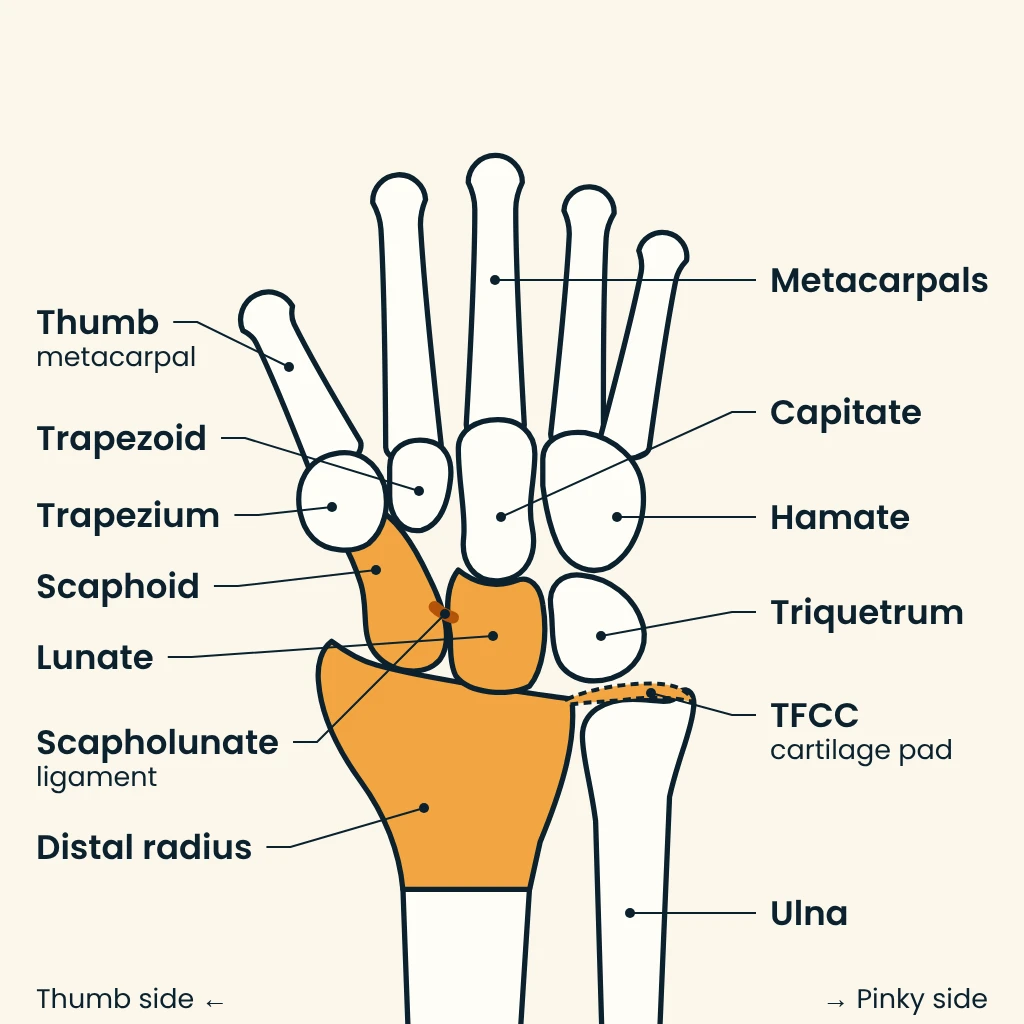
Bone, ligament, nerve, and tendon all sit within a few inches of each other, so car accident wrist injuries often involve more than one of them at once. A wrist that hurts after an accident is examined for each structure, not only for a broken bone.
Steering Wheel Grip at Impact
A driver usually has both hands on the wheel when a collision starts, and the arms lock as the body is thrown forward. Force travels through the palms into wrists that are already bent back. A passenger who braces against the dashboard loads the wrists the same way from a different angle.
A fall on an outstretched hand, or FOOSH, loads the wrist in a similar way, and it is one of the most common ways people injure their hands and wrists. Gripping a steering wheel during a car accident is a recognized cause of scapholunate dissociation, and car accidents are among the most common causes of distal radius fractures in young adults.
Which structure gives way depends on how the hand was turned and how much force reached it. One impact can break the radius, tear a ligament between the carpal bones, and bruise the median nerve together.
Distal Radius Fractures
The distal radius is the end of the larger forearm bone, on the thumb side of the wrist. About 1 out of every 6 broken bones treated in a U.S. emergency room is a distal radius fracture, and more than 640,000 cases were reported in the United States in 2001 alone.
In young people, these fractures typically come from high-energy events such as a motor vehicle collision, while in older people with osteoporosis a simple fall onto the wrist can cause one. The break usually causes immediate pain, swelling, bruising, and tenderness, and the wrist may look bent or out of place.
An imaging report names the break with one of the terms below, and each pattern carries its own definition in orthopaedic practice.
| Term | What It Describes |
|---|---|
| Colles fracture | The broken piece of the radius tilts backward toward the back of the wrist |
| Intra-articular fracture | The break extends into the wrist joint |
| Extra-articular fracture | The break stops short of the wrist joint |
| Open fracture | The broken bone breaks through the skin |
| Comminuted fracture | The bone is broken into many pieces |
Treatment can mean gently pulling and moving the wrist to set the broken bone back in position, then a splint or cast while it heals. When surgery is needed, surgeons may use metal plates, screws, pins, or a support frame outside the body.
Scapholunate Ligament Injury
The scapholunate ligament ties together two carpal bones, the scaphoid and the lunate. When it tears, the two bones can separate, an injury called scapholunate dissociation. A fall on an outstretched hand is the most common cause, and gripping a steering wheel during a car accident is another.
Symptoms include pain at the back of the wrist with a strong grip, reduced grip strength, swelling, and pain when the wrist bends back. On X-rays, a gap of 5 millimeters or more between the two bones points to the injury, where a normal gap is 2 millimeters or less, and MRI or arthroscopy confirms the tear.
Timing shapes the outcome. Many patients need hand surgery within six weeks of the injury, and a tear left untreated can lead to scapholunate advanced collapse, a pattern of degenerative arthritis in the wrist.
Triangular Fibrocartilage Complex Tears
The triangular fibrocartilage complex, or TFCC, is the group of ligaments, tendons, and cartilage on the pinky side of the wrist that steadies the joint as the forearm turns. The force of falling on the hand or wrist can tear it, and so can a sudden twist.
A TFCC tear causes pain on the pinky side of the wrist, clicks or pops when the forearm rotates, and a weaker grip. Because the TFCC is soft tissue, providers may order MRI along with X-rays to look for a tear. Minor tears often heal without treatment, while tears that keep causing symptoms may need a brace, therapy, injections, or arthroscopic surgery.
Carpal Tunnel Syndrome After Trauma
The median nerve supplies feeling to the thumb, the index and middle fingers, and the thumb side of the ring finger. Swelling inside the carpal tunnel puts pressure on the nerve, and a blow to the wrist can bring that swelling on quickly.
Symptoms of carpal tunnel syndrome developed in 96 patients within two months of an automobile accident, and 44 of them, or 46 percent, underwent carpal tunnel release. Blunt trauma from the steering wheel or dashboard was the proposed mechanism.
Nerve conduction studies and electromyography measure how well the nerve and the muscles it serves are working, which puts the injury into numbers. In very severe wrist fractures, the nerves in the hand can be injured or compressed, and numb fingers after a wrist injury call for an emergency room visit right away.
Symptoms Needing Prompt Attention
- Numb fingers after a wrist injury
- A wrist that looks bent or out of place
- A finger that will not bend at one or more joints
- Severe pain that does not get better
- Skin on the hand that changes color, temperature, or texture
Why Kentucky Hires
Sam Aguiar Injury Lawyers
Flexor Tendon Injuries
Flexor tendons let the fingers and thumb bend to grasp an object or make a fist, running from the forearm through the wrist and palm into the fingers. They are usually injured by a cut on the palm side of the fingers, hand, wrist, or forearm, and broken glass in a collision may leave that kind of wound.
The main sign is being unable to bend one or more joints of a finger. A cut tendon cannot heal on its own because the ends pull apart, so repair surgery is usually done within 7 to 10 days of the injury, followed by a protective splint for about 6 to 8 weeks and hand therapy.
A standard X-ray does not show a tendon. For a hand fracture with suspected tendon or ligament damage, ultrasound and MRI without contrast are usually appropriate.
Broken Hand Bones
A hand fracture is a break in one of the long bones of the palm, the metacarpals, or in the small bones of the fingers, the phalanges. A crushing or twisting force on the steering wheel can break either group, and a motor vehicle accident can cause a boxer’s fracture.
Signs include swelling, bruising, deformity, a shortened finger, and a finger that crosses over its neighbor when making a fist. A cast, splint, or brace may hold the bones in alignment while they heal, and some fractures need surgery with wires, screws, pins, or plates.
Long periods in a cast or splint can leave the hand and fingers stiff, and some patients develop a loss of motion that needs further surgery.
Imaging After a Normal X-Ray
X-rays are almost always the first imaging test after a hand or wrist injury. They show bone well and soft tissue poorly, and a scaphoid fracture can hide on the first film.
When the first X-ray is normal and an injury is still suspected, the usual next step is a repeat X-ray in about 14 days, or CT or MRI. When a wrist fracture comes with suspected tendon or ligament damage, MRI, ultrasound, or arthrography are usually appropriate.
Each later study either confirms the first reading or replaces it, and CT and MRI findings often become the clearest record of what the accident did to the wrist.
Recovery Timeline
Most distal radius fractures take about 3 months to heal enough for the wrist to be used for all activities, and full recovery can take up to 1 year. Wrist stiffness keeps improving for at least 2 years, and some people are left with permanent limitations in how the wrist works.
Soft tissue runs on its own schedule. A repaired flexor tendon takes about 3 to 4 months to heal before the hand can be used without restrictions, and most people return to normal activities within a few months of scapholunate repair. Hand therapy notes measure grip strength and range of motion along the way, so the chart shows how much function came back and how much did not.
Complex Regional Pain Syndrome
The most common injury associated with complex regional pain syndrome is a bone fracture, especially a wrist fracture. Severe, ongoing pain that does not get better after a distal radius fracture may be a sign of the condition.
Its symptoms include burning or stinging pain, swelling and stiffness, and changes in skin temperature, color, and texture compared with the other limb. Pain that outlasts the fracture is easy to dismiss, which is why CRPS after a car accident is documented through symptoms charted visit by visit.
Hand Surgery Training
The American Board of Orthopaedic Surgery issues a Subspecialty Certificate in Surgery of the Hand to board-certified orthopaedic surgeons. Applicants complete a one-year accredited fellowship in hand surgery and pass a separate examination.
A hand surgeon’s examination covers the bone, the ligaments, the median nerve, and the tendons in one visit, and it can be the visit that orders the MRI or nerve study an emergency department did not. That note can carry more detail than an emergency discharge summary.
Records for Car Accident Wrist Injuries
A wrist injury is documented in layers. The emergency note records how the injury happened and the first findings, including any numbness. Imaging reports name the fracture pattern and any gap between the carpal bones. The hand surgeon’s examination, the operative report, and the therapy notes follow the recovery, with grip and motion measured at each visit.
Disputes tend to start in the spaces between those records. A wrist first charted as a sprain and found months later to have a torn ligament leaves a stretch of time an insurer can point to, and a gap in treatment after a car accident is one of the first things an adjuster looks for.
Photos of the swollen or bruised wrist in the first days, the splint and brace receipts, and a short weekly note on what the hand could not do, such as buttons, jar lids, or a steering wheel, fill the space between medical visits. Those everyday details fade first.
Grip Still Weak Months After the Accident?
Car accident wrist injuries can start as a sprain on the first chart and turn into a torn ligament, a plate and screws, or months of hand therapy, and an insurer may still value it by that first note. Sam Aguiar Injury Lawyers gathers the emergency, imaging, surgical, and therapy records so the full course of your injury is documented. Under our Bigger Share Guarantee®, you always walk away with more than the firm after bills, liens, and case costs. Start with a free case review.