

Evidence Under Federal Motor Carrier Safety Regulations After a Truck Accident

Commercial trucks and other large commercial vehicles operate under a detailed set of federal safety rules known as the Federal Motor Carrier Safety Regulations. These rules govern how long a driver can be behind the wheel, what a motor carrier has to keep in a driver’s personnel file, how often a truck has to be inspected, how long each of those records has to be kept, and what a company has to do after a crash. The Federal Motor Carrier Safety Administration (FMCSA) administers them, and they sit in Title 49 of the Code of Federal Regulations.
Federal Trucking Rules After a Truck Accident
The Federal Motor Carrier Safety Regulations create documents, and those documents are evidence for an injured person. A crash on I-64 or the Watterson Expressway looks like a two-vehicle collision from the roadside, but behind the tractor there is usually an electronic log, a dispatch record, a maintenance file, a daily inspection report, and an annual inspection certificate. Each of those documents exists because a federal regulation required it. Each one has a retention clock attached to it. Almost all of them are in the possession of the trucking company, and the person who was hurt has none of them.
Sam Aguiar Injury Lawyers works the regulatory paper trail behind a commercial vehicle crash: duty status logs, driver qualification files, inspection and repair records, post-crash testing records, and the motor carrier’s own accident register. These records are frequently the only independent account of what the driver and the company were doing in the hours and months before impact.
Vehicles Covered by the Record Rules
Federal record requirements attach to commercial motor vehicles as 49 CFR 390.5 defines them. For an interstate truck, coverage starts at 10,001 pounds, and the definition also reaches certain passenger vans and placarded hazardous material loads. A box truck that needs no commercial driver’s license (CDL) can still carry a full set of logs, qualification files, and inspection reports. The weight, passenger, and hazmat thresholds, and the point where a CDL is required, are laid out in the firm’s breakdown of federal commercial vehicle definitions and CDL thresholds.
Duty Status Logs and Supporting Documents
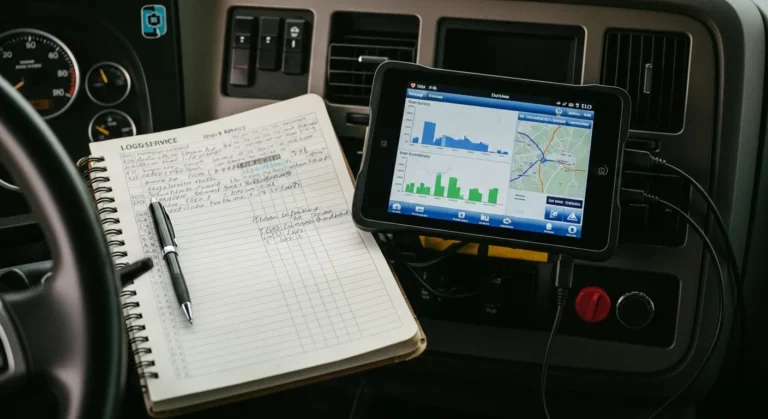
The driving and on-duty limits themselves, and how a violation is proven, are covered on the firm’s page on hours-of-service violations. The record that proves them comes from 49 CFR 395.8. Since December 18, 2017, a motor carrier operating commercial motor vehicles has generally been required to install and use an electronic logging device to record each driver’s duty status. A narrow set of operations may still record duty status manually, including drivers who complete a record of duty status on not more than 8 days within any 30-day period, driveaway-towaway operations, and vehicles manufactured before model year 2000 as reflected in the vehicle identification number.
Duty status is recorded in four categories: off duty, sleeper berth, driving, and on-duty not driving. A driver must submit the record of duty status to the motor carrier within 13 days of the 24-hour period it covers, and must keep a copy of the record for the previous 7 consecutive days in the driver’s possession and available for inspection while on duty.
The retention rule creates urgency after a crash. Under 395.8(k)(1), a motor carrier must retain records of duty status and supporting documents for each of its drivers for a period of not less than 6 months from the date of receipt. Supporting documents are the fuel receipts, bills of lading, dispatch records, and toll records that either corroborate a log or contradict it. Six months is a minimum, and a trucking company that receives no preservation demand may treat it as an expiry date.
Electronic logs carry a second copy. Under 49 CFR 395.22(i)(1), the motor carrier must keep a back-up copy of its electronic logging device records for 6 months on a device separate from the one holding the original data. When a trucking company says the original was lost or edited, the back-up is the first place to look.
Driver Qualification Files
Under 49 CFR 391.51, every motor carrier must maintain a driver qualification file for each driver it employs, and that file may be combined with the driver’s personnel file. The regulation lists what has to be in the file, so a gap in the file carries meaning.
The file must include the driver’s application for employment completed in accordance with 391.21, a copy of the motor vehicle record received from each licensing authority under 391.23(a)(1), and the certificate of the driver’s road test issued under 391.31(e) or an accepted equivalent under 391.33. It must also include the motor vehicle record returned in response to the annual driver record inquiry required by 391.25(a) and a note relating to the annual review of the driver’s driving record required by 391.25(c)(2).
Medical qualification is documented in the same file. The motor carrier must hold the medical examiner’s certificate required by 391.43(g) or a legible copy, and for commercial driver’s license holders whose state record carries medical certification status information, the motor carrier must obtain the Commercial Driver’s License Information System motor vehicle record from the current licensing state and place it in the qualification file. If the driver holds a medical variance, a Skill Performance Evaluation certificate issued under 391.49, or a federal medical exemption, that documentation belongs in the file as well.
The road test certificate is the piece of the file most often missing or mismatched. Under 49 CFR 391.31, the test must be given in the type of commercial vehicle the motor carrier intends to assign, and it covers eight operations, from the pre-trip inspection through coupling, braking, turning, and backing and parking. A motor carrier can accept a substitute under 49 CFR 391.33: a valid CDL earned on a road test in the same type of vehicle, or a road test certificate issued within the preceding 3 years. A tractor-trailer driver whose file holds only a straight-truck test has a gap the trucking company has to explain.
Driver Road-Test and Equipment Qualification Explorer
Choose the equipment and the claimed basis to see the operations and the documents to review.

Operations and Routes
The grouped operations follow 49 CFR § 391.31(c). Coupling and uncoupling apply when combination equipment is included.
Pre-trip inspection
The referenced pre-trip inspection.
Coupling and uncoupling
Included only when combination equipment is part of the intended operation.
Placing the vehicle in operation
Starting the combination or straight vehicle the carrier intends to assign.
Controls and emergency equipment
Using the vehicle’s controls and emergency equipment.
Traffic and passing
Operating in traffic and passing.
Turning
Turning the vehicle.
Braking and slowing
Braking, and slowing by means other than the brakes.
Backing and parking
Both backing and parking.
A certificate older than three years does not satisfy the three-year certificate branch. Holding a tank endorsement does not invalidate the CDL. A missing road-test document is not a finding the driver was unable to operate the truck.
Read together, those requirements mean a motor carrier is supposed to know its driver’s history before dispatch and to re-check it every year. A qualification file with no annual review note, no current medical certificate, or no motor vehicle record can indicate that the company never ran the checks the regulation requires.
The file has its own retention rule. Under 49 CFR 391.51(c), the motor carrier keeps it for as long as the driver works there and for three years after. The annual driving record checks, the annual review note, and the medical certificates can be removed three years after they were made, so older versions of those documents may already be gone.
A trucking company that skipped those checks, or kept a driver whose record showed the risk, is exposed on its own conduct. That file supports a negligent hiring or retention claim against the trucking company, separate from the driver’s fault in the crash itself.
Post-Accident Drug and Alcohol Testing
Post-crash testing is governed by 49 CFR 382.303, and the triggers are specific. As soon as practicable after a crash involving a commercial motor vehicle on a public road in commerce, the employer must test a surviving driver for alcohol if the driver was performing safety-sensitive functions and the crash involved the loss of human life. The employer must also test if the driver receives a citation within 8 hours under state or local law for a moving traffic violation arising from the crash, and the crash involved either bodily injury to a person who immediately received medical treatment away from the scene, or disabling damage to one or more vehicles requiring a tow away.
Controlled substance testing follows the same structure with a longer citation window. A test is required where the crash involved a fatality, or where the driver receives a citation within 32 hours for a moving traffic violation arising from a crash involving injury with immediate treatment away from the scene or disabling damage requiring a tow.
The timing rules generate their own records. If an alcohol test is not administered within 2 hours after the crash, the employer must prepare and maintain on file a record stating why the test was not promptly administered, and if it is not administered within 8 hours the employer must stop trying and prepare the same record. For controlled substances the employer must cease attempts after 32 hours and prepare a comparable record. Those explanatory memos are discoverable, and their absence can be as informative as their contents.
The test records themselves run on separate clocks under 49 CFR 382.401(b). Alcohol results of 0.02 or greater, verified positive drug results, and refusals to test are kept at least five years. Negative and canceled drug results and alcohol results under 0.02 are kept at least one year. Collection-process records, including documents generated in connection with decisions on post-accident tests, are kept at least two years.
Vehicle Inspection and Maintenance Records
Federal rules require three layers of vehicle records: ongoing maintenance files, daily driver inspection reports, and annual inspection reports. Each layer has its own content and retention rules, and the comparator below separates the daily report from the annual inspection.
Daily DVIR vs. Annual Inspection Comparator
Pick a dimension to compare the two records, then walk the repair chain. The 12-month inspection interval and the 14-month report retention stay separate.

Comparison
Purpose
Purpose · Driver report: Identify applicable discovered or reported defects and document corrective action. 49 CFR § 396.11.
Purpose · Periodic inspection: Inspect the required components under the periodic inspection standard. 49 CFR § 396.17.
Purpose · Ongoing maintenance: Keep systematic inspection, repair, and maintenance in place for the carrier’s vehicles. 49 CFR § 396.3.
Timing
Timing · Driver report: Reporting relates to completion of the day’s work, with the cited no-defect exception and the rule’s other exceptions. 49 CFR § 396.11.
Timing · Periodic inspection: Covered components must have passed an inspection within the preceding 12 months, subject to the rule’s terms. 49 CFR § 396.17. This interval is separate from how long the report is retained.
Timing · Ongoing maintenance: Ongoing. It is not the daily report and it is not the periodic inspection interval.
Documents
Documents · Driver report: Driver report, the repair certification when a defect is in play, and the next-driver review when that review applies. 49 CFR § 396.11 and § 396.13.
Documents · Periodic inspection: Inspection report and the on-vehicle documentation. 49 CFR § 396.17 and § 396.21.
Documents · Ongoing maintenance: The carrier’s maintenance records for the systematic program. They are not the driver report and not the periodic inspection report.
Retention
Retention · Driver report: Three months from preparation for the motor-carrier report and certifications. 49 CFR § 396.11(a)(4).
Retention · Periodic inspection: Fourteen months from the inspection report date. 49 CFR § 396.21(b). This retention period is separate from the inspection interval.
Retention · Ongoing maintenance: Maintenance-record retention follows its own rule. It is not copied from the driver report or from the periodic inspection report.
Interpretation
Interpretation · Driver report: The report may document notice, correction, and review. Existence or absence still needs context. A property-carrier no-defect example is not a missing mandatory daily report.
Interpretation · Periodic inspection: The report documents a periodic inspection. It does not describe every later operating condition, and it is not a continuing safety guarantee.
Interpretation · Ongoing maintenance: Ongoing maintenance is a third obligation. A current periodic report does not stand in for it.
A defect report leads to repair or to a certification that repair is unnecessary, then to applicable next-driver review. Review is conditional. The chain does not say three different people must sign. A property-carrier no-defect example is not a missing mandatory daily report.
Maintenance and Repair Records
49 CFR 396.3 requires every motor carrier to systematically inspect, repair, and maintain, or cause to be inspected, repaired, and maintained, all vehicles subject to its control, and it requires parts and accessories to be in safe and proper operating condition at all times. The regulation specifically names frames and frame assemblies, suspension systems, axles and attaching parts, wheels and rims, and steering systems alongside the equipment standards in Part 393.
The recordkeeping side is equally concrete. A motor carrier must maintain records for each vehicle it controls for 30 consecutive days, and those records must identify the vehicle by company number, make, serial number, and year, name the person furnishing the vehicle if the motor carrier does not own it, indicate the nature and due date of each inspection and maintenance operation to be performed, and record inspections, repairs, and maintenance with their date and nature.
Retention is set by 396.3(c): the records must be kept where the vehicle is either housed or maintained for a period of 1 year, and for 6 months after the vehicle leaves the motor carrier’s control. The second clause often decides whether records survive. A tractor involved in a crash is frequently sold, returned to a lessor, or scrapped, and once it leaves the fleet the retention obligation begins running out.
Read across several months, the maintenance file shows how the fleet was run. The same defect written up again and again, or scheduled service pushed past its due date, points to a fleet-wide practice rather than a one-time lapse.
Driver Vehicle Inspection Reports
The daily inspection paperwork is governed by 49 CFR 396.11. Every motor carrier must require its drivers to report, and every driver must prepare, a written report at the completion of each day’s work on each vehicle operated. The report has to cover at least service brakes including trailer brake connections, the parking brake, the steering mechanism, lighting devices and reflectors, tires, the horn, windshield wipers, rear vision mirrors, coupling devices, wheels and rims, and emergency equipment.
The report must identify the vehicle and list any defect or deficiency discovered by or reported to the driver that would affect safe operation or result in a mechanical breakdown, and the driver must sign it. A driver who finds no defect is not required to prepare a report at all, so the absence of a report is not automatically a violation. If a driver operates more than one vehicle in a day, a separate report is required for each.
The repair duty creates liability exposure. Before requiring or permitting a driver to operate the vehicle, the motor carrier or its agent must repair any listed defect or deficiency likely to affect safe operation, and must certify on the report that the defect has been repaired or that repair is unnecessary. The motor carrier must keep the driver vehicle inspection report, the certification of repairs, and the certification of the driver’s review for three months from the date the written report was prepared. Three months is the shortest retention window in this area, and it is frequently gone before a case is filed.
When a driver’s report lists a brake or tire defect and the truck went back out with no repair certification, the record shows the trucking company knew about the hazard before the crash and dispatched the truck anyway. That is direct evidence against the trucking company, not only against the driver.
Annual Inspection Records
On top of daily reports, 49 CFR 396.17 requires a periodic inspection of every commercial motor vehicle covering, at a minimum, the components listed in appendix A to Part 396. Each unit in a combination counts separately: for a tractor, semitrailer, and full trailer combination, the tractor, the semitrailer, and the full trailer including any converter dolly must each be inspected.
A motor carrier must not use a commercial motor vehicle unless each component identified in appendix A has passed an inspection at least once during the preceding 12 months and documentation of that inspection is on the vehicle. The documentation may be the inspection report itself or a sticker or decal based on it, provided it carries the inspection date, the name and address of the entity holding the report, information uniquely identifying the vehicle, and a certification that the vehicle passed.
49 CFR 396.21 then sets out what the inspector’s report must contain and how long it lives. The report identifies the inspector, the motor carrier, the date, and the vehicle, describes the components inspected and the results including any component that did not meet the appendix A standards, and certifies the accuracy and completeness of the inspection. The responsible party must retain the original or a copy for fourteen months from the date of the report, keep it where the vehicle is housed or maintained, and make it available on demand to an authorized federal, state, or local official.
Roadside Inspection Reports
A truck stopped for a roadside inspection leaves another record. Under 49 CFR 396.9(d), the driver delivers the inspection report to the motor carrier, the motor carrier must certify within 15 days that every listed violation was corrected, and the motor carrier keeps a copy for 12 months from the date of the inspection. A roadside report that found the same brake or light problem weeks before a crash, with a signed correction certificate, puts the motor carrier’s certification at issue.
Accident Registers and Reporting
Motor carriers keep a record of their own crash history. 49 CFR 390.15 requires each motor carrier to make all records and information pertaining to an accident available to an authorized FMCSA representative, an authorized state or local enforcement representative, or an authorized third-party representative within the time the request or investigation specifies, and to cooperate in the investigation, including a full, true, and correct response to any question.
The same section requires motor carriers to maintain an accident register for 3 years after the date of each accident. The register must list, for each accident, the date, the city or town where it occurred or the nearest one and the state, the driver’s name, the number of injuries, the number of fatalities, and whether hazardous materials other than fuel spilled from the fuel tanks of a vehicle involved were released. It must also include copies of all accident reports required by states, other governmental entities, or insurers.
For an injured person, the register is useful in two directions. It confirms what the trucking company itself recorded about the crash in question, and it shows what else the same trucking company has been involved in over the preceding three years.
Record Retention Periods
Each category of trucking record has its own federal minimum retention period, and those deadlines decide whether a document still exists when someone asks for it.
Inspection Reports Expire First Among Federal Trucking Records
Minimum federal retention periods for motor carrier records, shortest first
Driver vehicle inspection reports: three months from the date the written report was prepared, together with the certification of repairs and the certification of the driver’s review, under 49 CFR 396.11(a)(4).
Duty status logs and supporting documents: not less than 6 months from the date of receipt, under 49 CFR 395.8(k)(1). The electronic logging device back-up copy is kept 6 months under 49 CFR 395.22(i)(1), and the driver carries the previous 7 consecutive days.
Negative and canceled drug test results and alcohol results under 0.02: at least one year, under 49 CFR 382.401(b)(3).
Roadside inspection reports: 12 months from the date of the inspection, under 49 CFR 396.9(d)(3).
Maintenance and repair records: 1 year, and 6 months after the vehicle leaves the motor carrier’s control, kept where the vehicle is housed or maintained, under 49 CFR 396.3(c).
Annual inspection reports: fourteen months from the date of the inspection report, retained where the vehicle is housed or maintained, under 49 CFR 396.21(b)(1).
Drug and alcohol collection-process records, including documents on decisions about post-accident tests: at least two years, under 49 CFR 382.401(b)(2).
Accident register: 3 years after the date of each accident, including copies of accident reports required by states, other governmental entities, or insurers, under 49 CFR 390.15(b).
Driver qualification file: for the length of employment and three years after, with annual record checks and medical certificates removable three years after they were made, under 49 CFR 391.51(c) and (d).
Positive drug results, alcohol results of 0.02 or greater, and refusals to test: at least five years, under 49 CFR 382.401(b)(1).
Motor Carrier Records After an Accident
No single document decides a truck case. A driver who was past the 11-hour driving limit, a qualification file with no annual review note, a daily inspection report listing a brake defect with no certification of repair, and an annual inspection that was never performed each describe a different failure. Together they describe how a company was operating.
Custody is the practical problem. The logs sit on the trucking company’s electronic logging device platform or its vendor’s servers. The maintenance file sits at the terminal where the tractor is housed. Dispatch records and supporting documents stay in the trucking company’s back office. Telematics and in-cab camera footage often sit with a third-party technology provider under a contract the injured person has never seen. The person who was hurt has none of it, and the shortest federal retention period in the set is three months.
Telematics fills in what the paper records leave out. Global positioning system (GPS) units, in-cab cameras, and the engine control module record speed, hard braking, and fault codes for brake or tire problems, sometimes weeks before a part fails. A run of speeding alerts the trucking company never acted on, or a fault code logged and ignored for a month, moves the case from a careless driver to a careless company. Where the indifference is flagrant, it supports punitive damages, which Kentucky juries assess by weighing the trucking company’s awareness of the risk, how long the misconduct lasted, and any concealment of it under KRS 411.186.
The trucking company’s public FMCSA safety record adds outside context: its safety rating, inspection history, and out-of-service rates. Those numbers show how the company operated before this crash and what regulators had already seen.
The records also decide which claims reach the trucking company. The trucking company answers for its driver’s negligence on the job, and it answers separately for its own failures in hiring, training, supervision, and maintenance. That second claim rests almost entirely on the qualification file, the maintenance file, and the inspection reports.
A written preservation demand, sent early and addressed to the trucking company, its insurance company, and any equipment or telematics provider, does more work than any other early step in a truck case. It converts a routine document-destruction schedule into a known obligation to hold specific categories of records. Once the retention window closes and the records are gone in the ordinary course, no amount of later effort brings them back. Sam Aguiar Injury Lawyers handles Kentucky truck crash cases, and the firm’s overview of how violations of the Federal Motor Carrier Safety Regulations cause truck crashes covers the violations these records expose.
How Long Will the Trucking Company Keep Its Records?
Some trucking records can be destroyed in the ordinary course within months, which leaves a short window after a crash to demand that they be kept. Logs, qualification files, inspection records, and drug and alcohol tests are the records a dedicated trucking team at Sam Aguiar Injury Lawyers looks for in a truck case. Under our Bigger Share Guarantee®, you always take home more than the firm. Request a free case review while those records still exist.
Frequently Asked Questions
1What records does a trucking company have to keep about each driver?+
2How long does a trucking company have to keep its records?+
3How long does a trucking company have to keep electronic logging device data?+
4When is a truck driver tested for drugs or alcohol after an accident?+
5Does a missing driver inspection report prove a violation?+
6How quickly should federally required trucking records be requested after a truck accident?+
Latest Articles

Kentucky Diminished Value Claims
Kentucky drivers may pursue a repaired vehicle’s leftover market loss from the at-fault driver as part of a.
FMCSA Revoked ELDs: Fleet Compliance and Enforcement Deadlines
FMCSA removed five electronic logging devices from the registered list on August 6, 2026, and set an October.

FMCSA English Proficiency Rule and OOS Enforcement
FMCSA English Proficiency Rule Sam Aguiar Injury Lawyers August 11, 2026 7 minute read On This Page.