

Hours of Service Violation Consequences
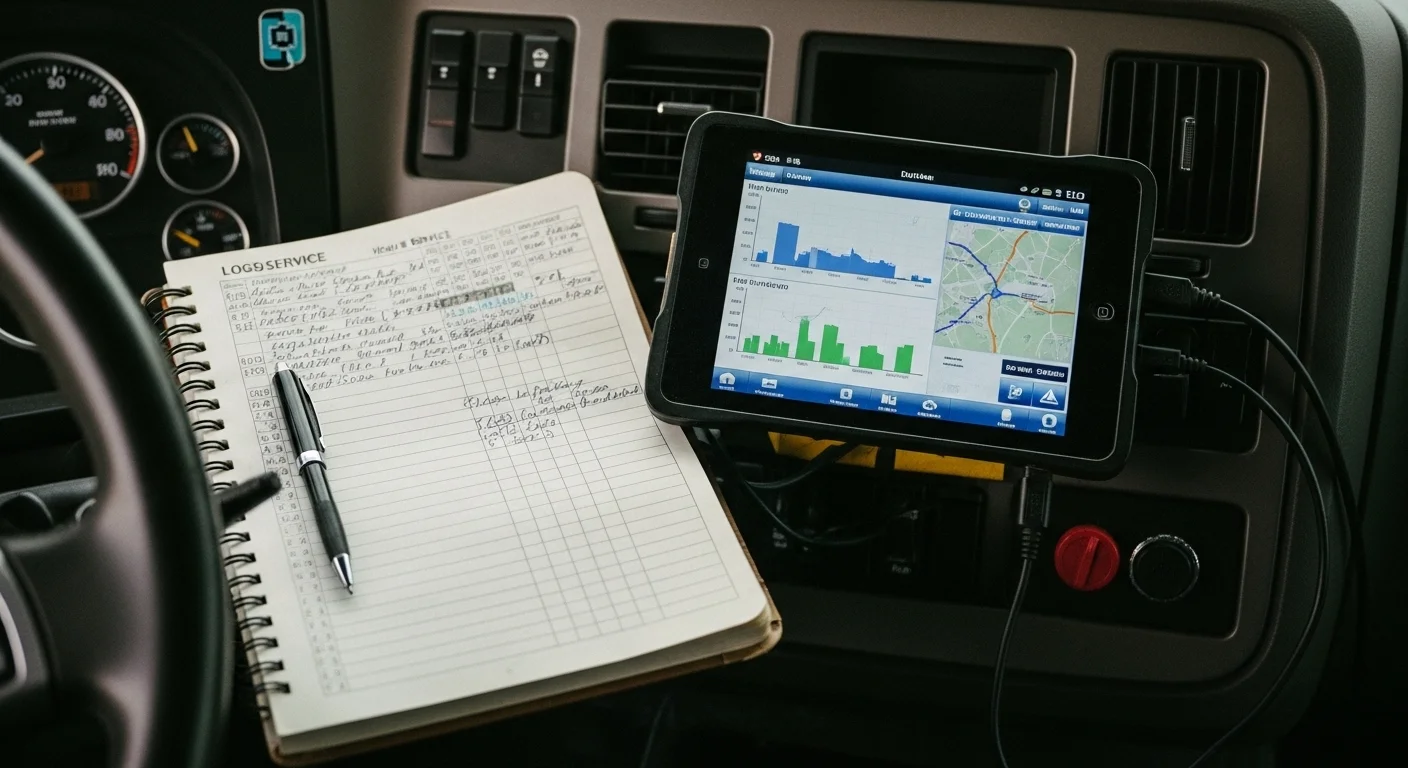
An hours of service (HOS) violation is a break of the federal limits on how long a truck driver may drive and work, or a false or missing record of that time. One violation can carry three consequences: an out-of-service order at the roadside, a civil penalty of up to $4,812 for a driver or $19,246 for a motor carrier for each violation of a driving-time limit under Appendix B to 49 CFR Part 386, and a mark on the carrier’s safety record at the Federal Motor Carrier Safety Administration (FMCSA). After a truck accident, each of those leaves records that can show whether the driver and the carrier were past the limits.
Types of Hours of Service Violations
Every hours of service violation traces to a rule in 49 CFR Part 395. The driving-time limits for property-carrying trucks are in 49 CFR 395.3, and the record rules are in 49 CFR 395.8. Each limit binds two parties: the driver may not drive past it, and the motor carrier may not permit or require the driver to. No driver or carrier may make a false report about duty status.
| Violation | Regulation |
|---|---|
| Violation11-Hour Driving LimitDriving more than 11 hours after 10 consecutive hours off duty | Regulation49 CFR 395.3(a)(1), (a)(3)(i) |
| Violation14-Hour WindowDriving after the 14th consecutive hour since coming on duty | Regulation49 CFR 395.3(a)(2) |
| Violation30-Minute InterruptionDriving after more than 8 hours of driving time without a 30-minute interruption | Regulation49 CFR 395.3(a)(3)(ii) |
| Violation60-Hour and 70-Hour LimitsDriving after 60 hours on duty in 7 days, or 70 hours in 8 days for a carrier that operates every day | Regulation49 CFR 395.3(b) |
| ViolationFalse Record of Duty StatusA false report about duty status, or an ELD tampered with so that it does not accurately record data | Regulation49 CFR 395.8(e) |
| ViolationMissing Record of Duty StatusNo record of duty status current for the day of the inspection and the prior seven consecutive days | Regulation49 CFR 395.13(b)(2) |
Source: 49 CFR Part 395
The audit lab below applies the baseline limits to sample records, so a reader can see where a log entry and a source record disagree.
Hours-of-Service Rulebook and Driver-Day Audit Lab
Use Rulebook for the baseline meters, Compare Records for mismatches, or Reconstruct the Day to place source events.

Baseline Concepts
- Ten consecutive hours off duty before driving under the baseline rule, 49 CFR § 395.3(a)(1).
- No driving after the 14-consecutive-hour window following the qualifying rest. Ordinary off-duty time does not automatically pause that window. Other work after 14 hours is not labeled universally forbidden.
- Eleven hours of driving within the window.
- After eight hours of driving, further driving needs at least 30 consecutive minutes interrupted from driving. Off duty, sleeper berth, on duty not driving, or a combination can satisfy it. Twenty-nine minutes does not. Driving breaks the continuous interruption.
- Sixty on-duty hours in seven days or seventy in eight, when the carrier’s cycle is known. Without prior-period data the cumulative meter stays unknown.
- A qualifying 34-hour off-duty period can restart the 7- or 8-day count under the cited rule.
Compare Records
Apparent overlap
Off duty, 13:10–13:40, as entered. A toll record shows 13:22. Possible inconsistency. The toll time may be a different clock or a different vehicle. Correcting the example timezone lines the toll up outside the off-duty interval. The correction removes the apparent inconsistency. It is not a finding of falsification.
Receipt mismatch
On duty not driving, 18:00–18:20. A fuel receipt posts at 21:05. The transaction time prints as 18:12. Possible inconsistency. Posting time and transaction time are different facts. Questions to resolve: which clock the receipt used, and whether the transaction time belongs to this driver and vehicle.
Edited record
Original driving entry 14:00–16:00. Edited entry 14:20–16:00. The file shows both the original and the edited lines. Possible inconsistency. An edit is a fact to read, not proof of falsification. Questions to resolve: who made the edit, when, and which source events agree with either line.
Dispatch conflict
A baseline driving schedule that cannot meet a requested 11-hour arrival. A dispatch message asks for that arrival. Possible inconsistency. A request is not evidence of actual driving. Questions to resolve: what movement, if any, the vehicle records show after the request.
Reconstruct the Day
Place events, accept or reject a proposed match, or leave an interval unresolved. Gaps are not filled with driving.
Out-of-Service Orders
An inspector can place a driver out of service for two hours of service conditions under 49 CFR 395.13(b): driving after being on duty longer than Part 395 allows, and having no record of duty status current for the day of the inspection and the prior seven consecutive days. A driver who has completed records for the previous six days and is missing only the current and prior day is given the chance to bring the record current.
The driver may not operate a commercial motor vehicle until the driver may lawfully do so under Part 395, and a driver ordered out of service for a missing record must first be off duty for the consecutive hours Part 395 requires. The carrier may not require or permit the driver to drive in the meantime, and it must complete the “Motor Carrier Certification of Action Taken” portion of the inspection report and deliver it to FMCSA within 15 days.
Driving during the order is its own violation. A commercial driver’s license holder convicted of violating an out-of-service order faces a civil penalty of not less than $3,961 for a first conviction and not less than $7,924 for a second or later one, and an employer that knowingly allows a driver to operate during the order faces a penalty of not less than $7,155 and not more than $39,615 under paragraph (b) of Appendix B. The full list of driver and vehicle out-of-service conditions is in the guide to DOT out-of-service violations.
Maximum Civil Penalties
Civil penalty ceilings rise with inflation under section 701 of Public Law 114-74, and Appendix B to 49 CFR Part 386 publishes the current amounts. The table lists the figures that apply to hours of service violations.
| Violation Type | Maximum Civil Penalty |
|---|---|
| Violation TypeNon-recordkeeping violationMotor carrier or other person, such as permitting a driver to exceed a driving-time limit | Maximum Civil Penalty$19,246 per violation |
| Violation TypeNon-recordkeeping violationDriver | Maximum Civil Penalty$4,812 per violation |
| Violation TypeRecordkeeping violationRecord that is missing, incomplete, inaccurate, or false | Maximum Civil Penalty$1,584 per day the violation continues, up to $15,846 |
| Violation TypeKnowing falsification of recordsFalsification that misrepresents a fact constituting a violation other than a recordkeeping violation | Maximum Civil Penalty$15,846 |
| Violation TypeEgregious driving-time violationDriving more than 3 hours past the limit in 49 CFR 395.3(a), or a carrier that requires or permits it | Maximum Civil PenaltyUp to the maximum permitted by law |
The category follows the kind of violation. Driving past a limit in Section 395.3 is a non-recordkeeping violation, so the ceilings are $19,246 for the carrier and $4,812 for the driver. A log that is missing, incomplete, or inaccurate is a recordkeeping violation, and a log knowingly falsified to hide another violation falls under the $15,846 falsification ceiling in paragraph (a)(2). The non-recordkeeping ceiling applies to each violation and the recordkeeping ceiling accrues for each day the violation continues, so one inspection or audit that finds multiple violations can produce multiple penalties.
These figures are ceilings. By statute, FMCSA sets the amount after weighing the nature, circumstances, extent, and gravity of the violation and, for the violator, the degree of culpability, the history of prior offenses, and the effect on the ability to continue to do business, under 49 U.S.C. 521(b)(2)(D).
Carrier Safety Records
A roadside violation does not stay at the roadside. FMCSA’s Safety Measurement System (SMS) scores each carrier in seven Behavior Analysis and Safety Improvement Categories (BASICs), and the Hours-of-Service Compliance BASIC is built from the violations inspectors record. Under the SMS Methodology (version 3.21, June 2026), an hours of service violation found in a Level 1, 2, 3, or 6 driver inspection counts for 24 months.
Newer violations weigh more. A violation recorded in the past six months receives a time weight of 3, one recorded between six and twelve months ago receives a 2, and an older one within the 24 months receives a 1. Each violation also has a severity weight from 1 to 10 that reflects its relationship to accident risk, and a violation that resulted in an out-of-service order receives an additional 2.
A general carrier at or above the 65th percentile in the Hours-of-Service Compliance BASIC has crossed FMCSA’s intervention threshold. The threshold is 60 percent for a carrier that hauls hazardous materials and 50 percent for a passenger carrier. FMCSA’s intervention tools run from a warning letter to an onsite investigation and, for a carrier that does not improve, civil penalties.
Property carriers’ SMS percentiles are no longer shown on FMCSA’s public website under the Fixing America’s Surface Transportation Act of 2015, and a property carrier logs in to see its own results. The inspections behind them are a separate record. The SAFER Company Snapshot reports a carrier’s roadside out-of-service inspection summary and safety rating, and reading an FMCSA SMS report explains how the scores are laid out.
Shared Responsibility
The regulations bind the driver and the carrier separately. Under 49 CFR 395.3(a), a driver may not drive past the limits and a motor carrier may not permit or require it. Under 49 CFR 390.11, whenever a regulation prescribes a duty for a driver, the carrier must require the driver to observe it. Under 49 CFR 395.8(e), neither a driver nor a carrier may make a false report about duty status, and neither may permit or require another person to tamper with an electronic logging device (ELD). Because each has its own duty, a violation can be cited against the driver, the carrier, or both.
Carrier Duties Under Part 395
A carrier must keep each driver’s records of duty status and supporting documents for at least six months from receipt under 49 CFR 395.8(k). Supporting documents include bills of lading, dispatch records, expense receipts, electronic mobile communication records, and payroll records, and the carrier need not keep more than eight for a driver’s 24-hour period under 49 CFR 395.11. For driving recorded under the ELD’s “Unidentified Driver” account, the carrier must annotate the record or assign it to the correct driver under 49 CFR 395.32(c). How edits and tampering show up in those records is covered in ELD falsification in truck accident cases, and the limits themselves are explained in hours-of-service rules and ELD evidence.
Hours of Service Violations as Accident Evidence
Fatigue is a documented factor in truck accidents. In FMCSA’s Large Truck Crash Causation Study, fatigue was coded for an estimated 13% of the large trucks studied, as an associated factor and not a finding of cause. The National Highway Traffic Safety Administration (NHTSA) estimates that 91,000 police-reported accidents in 2017 involved drowsy drivers of all vehicle types, with an estimated 50,000 people injured and nearly 800 deaths.
Supporting Records
The ELD shows how long a driver had been driving, and the supporting documents test whether it tells the whole story. A dispatch record can show whether a delivery schedule could be met inside the limits, and expense receipts and electronic messages can place the truck at a time and location. The regulation requires a carrier to keep these for six months, so a preservation demand should name them and not only the log file. Discovery in a Kentucky truck accident case explains how requests and subpoenas reach those records.
Prior Violation History
A carrier’s earlier violations can show what it knew before an accident. A pattern of hours of service violations in roadside inspections, or an Hours-of-Service Compliance percentile at or above the intervention threshold, is a record of notice that can be offered as evidence of a recurring problem the carrier did not correct. One 2026 truck driver fatigue verdict describes jurors hearing testimony about the carrier’s own rest policy.
Was the Truck Driver Over the Hours Limit?
Electronic logs, dispatch records, and inspection history can show whether a driver and a carrier broke the hours of service rules before your accident. Sam Aguiar Injury Lawyers handles truck accident cases through a dedicated trucking team that requests those records, and you pay $0 Out-Of-Pocket Forever. Call today for a free case review.
Frequently Asked Questions
1What Does an Hours of Service Violation Mean?+
2How Much Is an Hours of Service Violation?+
3What Happens if a Driver Breaks the 14-Hour Rule?+
4Do Hours of Service Violations Go on a Carrier’s Record?+
5How Common Are Hours of Service Violations?+
6Who Is Responsible for an Hours of Service Violation?+
7Can a Carrier’s Past Hours of Service Violations Be Used in a Truck Accident Case?+
Latest Articles

Kentucky Diminished Value Claims
Kentucky drivers may pursue a repaired vehicle’s leftover market loss from the at-fault driver as part of a.
FMCSA Revoked ELDs: Fleet Compliance and Enforcement Deadlines
FMCSA removed five electronic logging devices from the registered list on August 6, 2026, and set an October.

FMCSA English Proficiency Rule and OOS Enforcement
FMCSA English Proficiency Rule Sam Aguiar Injury Lawyers August 11, 2026 7 minute read On This Page.